
Bachelor in Biomedical Sciences
-
Schedule
regular course
- ECTS Credits 180
Overview
During your bachelor’s program, you will learn to master the fundamentals of physics, chemistry, and biology, which form the foundation of biomedical science education.
Through a morphological approach (cytology, histology, anatomy, and embryology), you will learn to identify and describe the main structures and functions of intracellular organelles, various cell types, as well as the tissues and anatomical structures that make up the human body.
You will study the normal functioning of the human body as well as the pathophysiology of major human diseases (biochemistry, genetics, microbiology, physiology, neuroscience, psychology, immunopathology, pathology, etc.).
At the same time, you will receive training in cutting-edge technologies in the field of biomedical research (courses in methodology, instrumental analysis and radiation protection, genomics, etc.), therapeutic approaches (innovative therapies, pharmacology, clinical development, etc.), as well as ethics.

You're off to a good start
- you are interested in scientific topics;
- you are thorough and precise;
- you have the ability to synthesize information;
- you are able to break down disciplinary barriers to establish connections between their content.
Teaching Methods
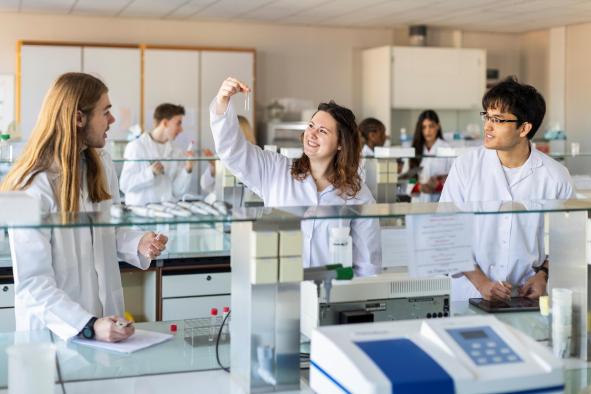
Lectures, seminars, practical sessions, exercise sessions, and labs—we do everything we can to ensure you master the theoretical concepts.
Organized in small groups, practical work and exercise sessions introduce you to the techniques specific to each discipline.
You will learn to use the equipment, take measurements, and interpret them. In this way, you will experimentally observe certain laws or phenomena covered in the theoretical lectures. You will learn to identify and depict the cells or organisms observed under an optical microscope, as well as to reconstruct them in three dimensions.
Significant resources are dedicated to your introduction to microscopy: a collection of microscopic sections of human specimens, binocular microscopes, electron micrographs, a multimedia learning system…
In addition to the numerous practical sessions in microscopy, biochemistry, microbiology, genetics, and more, you can apply to become a “student-researcher” during your bachelor’s program. This status allows you to join a Faculty laboratory and learn the craft of research by working side-by-side with professionals in the field of biomedical sciences. You’ll work on a research project, discover cutting-edge technologies, and develop your scientific approach.
Support for Success
Succeeding in a year of university studies involves many challenges.
To help you overcome them, we support you in developing your academic, methodological, and interpersonal skills—with the help of many professionals.
Preparatory courses, personalized assistance…
An education with an international focus
As part of the bachelor’s program, you have the opportunity to study abroad for a semester. A second opportunity for international mobility is available as part of the master’s internship.
Destinations are varied, both within Europe (France, Spain, Italy, etc.) and outside Europe (Canada, the United States, etc.).
During this semester, you’ll have the chance to continue your studies while exploring a new region, culture, or country. This enriching experience will help you become more independent, develop your employability skills, and potentially learn a foreign language.
After high school
As graduates with a bachelor’s degree in biomedical sciences, you are eligible for the following programs:
- Master 120 in Biomedical Sciences
- Master 60 in Biomedical Sciences
- International Master's in Translational Cosmetic and Dermatological Sciences (EMOTION)
- Master's (60 credits) in Biological Sciences
- Master's in Molecular Microbiology
offered at UNamur.
Contacts
School of Medicine
Place du Palais de Justice • B-5000 Namur
Administrative Office
Tel.: +32 (0) 81 72 43 47
administration-medecine@unamur.be
-
Basic sciences
Code Name Staff Th.+Ex. Credits/Block 1 2 3 SMATB111 Mathematics Lucas Maxime 30h th. + 15h ex. 3 SPHYB168 Louette Pierre 48h th. + 30h ex. 8 SPHYB169 Louette Pierre 24h th. + 16h ex. 4 SCHIB121 Wouters Johan 60h th. + 40h ex. 9 MCHIB107 Organic Chemistry Lanners Steve Lanners Steve 48h th. + 35h ex. 9 MMEDB283 Introduction to medical statistics Bihin Benoît Bihin Benoît 24h th. + 15h ex. 4 -
Biomedical sciences
Code Name Staff Th.+Ex. Credits/Block 1 2 3 Sustainable developmentImage English Friendly CoursesImage
MBIMB304 Introduction to bibliographic research and the critical presentation of its results Canon Caroline Hennequart Marc 5 -
Morphological approach
Code Name Staff Th.+Ex. Credits/Block 1 2 3 SVETB112 Cytology Boonen Marielle 20h th. 2 MMEDB253 Embryology Maystadt Isabelle 26h th. 3 MMEDB113 Histology II Nicaise Charles Balligand Thomas Canon Caroline 39h th. + 20h ex. 5 MMEDB214 Biomedical Anatomy I and II Garin Pierre 45h th. 6 MMEDB226 Histology I Nicaise Charles Canon Caroline 25h th. + 20h ex. 4 -
Functional approach
-
Therapeutic perspectives
Code Name Staff Th.+Ex. Credits/Block 1 2 3 Sustainable developmentImage
English Friendly CoursesImage
MBIMB305 Introduction to clinical development Beaudart Charlotte 15h th. 2 English Friendly CoursesImage
MMEDB334 Elements of general pharmacology Gillet Jean-Pierre 24h th. + 8h ex. 4 -
Technological approach
Code Name Staff Th.+Ex. Credits/Block 1 2 3 MMEDB211 Introduction to analytic equipment methodology in biomedical sciences Nisolle Jean-François HEUSKIN Anne-Catherine Arnould Thierry 24h th. 4 MMEDB220_I2 Partim Medical epidemiology Roberfroid Dominique 18h th. + 10h ex. 2 MMEDB344 Hot topics in preclinical and clinical research Hennequart Marc Beaudart Charlotte Boonen Marielle Gillet Jean-Pierre 22h th. 2 MBIMB311 Lambert De Rouvroit Catherine Boonen Marielle 35h th. + 50h ex. 6 MBIMB310 Locquet Médéa 18h th. 3
-
-
Humanities
Code Name Staff Th.+Ex. Credits/Block 1 2 3 MSPSB142 Philosophy of biomedicine Pontarotti Gaëlle Pontarotti Gaëlle HALFLANTS Louis DUBOIS Eve-Aline 24h th. + 15h ex. 3 Sustainable developmentImage
Soft skillsImage English Friendly CoursesImage
MMEDB272_I2 General psychology Givron Hélène Fryns Delphine Bayot Marie Desseilles Martin 26h th. 3 MBIMB303 Bioethics Ravez Laurent 30h th. 2 -
Language
Code Name Staff Th.+Ex. Credits/Block 1 2 3 MCDLB104 Introduction to scientific English (level B1 and above) Hansel Aude 24h th. 2 MCDLB204 English for biomedical students (level B1+ and above) Zimmer Carole 30h th. 2 Soft skillsImage
MCDLB300 English communication skills for biomedical students (level B2 and above) Zimmer Carole 30h th. 2 -
-
Code Name Staff Th.+Ex. Credits/Block 1 2 3 UNAM0059 Religions, Society, and Politics Lefebvre Perrin 24h th. 3 UNAM0060 The philosophical question of God Malvaux Paul 24h th. 3 UNAM0061 Comparative religions Malvaux Paul 24h th. 3 UNAM0062 Science and religion: a history of controversies Malvaux Paul 24h th. 3 UNAM0063 Cazalis Roland 30h th. 3 -
Code Name Staff Th.+Ex. Credits/Block 1 2 3 UNAM0057 Taking action for the planet Henry Sabine 8h th. + 30h ex. 3
-
-
Code Name Staff Th.+Ex. Credits/Block 1 2 3 Sustainable developmentImage
MMEDB360 One Health Wieërs Grégoire Lachapelle Amélie Canon Caroline 15h th. 3 Soft skillsImage
UNAM0049 Science for all : Introduction to popular science Schutz Natassia Hansel Aude 24h th. 3 UNAM0048 Artificial intelligence: challenges and opportunities Frenay Benoît 24h th. 3 UNAM0054 DigiComp 2.2 - Getting to grips with the digital world in my studies and beyond Depommier Clara 16h th. 3
-
Basic sciences
Code Name Staff Credits Hours/Quarter 1 2 SMATB111 Mathematics Lucas Maxime 3 30h th. + 15h ex. SPHYB168 Louette Pierre 8 48h th. + 30h ex. SPHYB169 Louette Pierre 4 24h th. + 16h ex. SCHIB121 Wouters Johan 9 60h th. + 24h ex. 16h ex. MCHIB107 Organic Chemistry Lanners Steve Lanners Steve 9 48h th. + 35h ex. -
Biomedical sciences
-
Morphological approach
Code Name Staff Credits Hours/Quarter 1 2 SVETB112 Cytology Boonen Marielle 2 20h th. -
Functional approach
Code Name Staff Credits Hours/Quarter 1 2 MBIMB109 Genetics Maystadt Isabelle De Backer Olivier 6 52h th. + 17h ex. SBIOB155 Renard Henri-François Hubin Marie-Laurence 7 36h th. + 22h ex. MBIMB151 General biology Gillet Jean-Pierre 7 36h th. + 22h ex.
-
-
Humanities
Code Name Staff Credits Hours/Quarter 1 2 MSPSB142 Philosophy of biomedicine Pontarotti Gaëlle Pontarotti Gaëlle HALFLANTS Louis DUBOIS Eve-Aline 3 24h th. + 15h ex. -
Language
Code Name Staff Credits Hours/Quarter 1 2 MCDLB104 Introduction to scientific English (level B1 and above) Hansel Aude 2 12h th. 12h th.
-
Basic sciences
Code Name Staff Credits Hours/Quarter 1 2 MMEDB283 Introduction to medical statistics Bihin Benoît Bihin Benoît 4 24h th. + 15h ex. -
Biomedical sciences
-
Morphological approach
Code Name Staff Credits Hours/Quarter 1 2 MMEDB253 Embryology Maystadt Isabelle 3 26h th. MMEDB113 Histology II Nicaise Charles Balligand Thomas Canon Caroline 5 39h th. + 20h ex. MMEDB214 Biomedical Anatomy I and II Garin Pierre 6 45h th. MMEDB226 Histology I Nicaise Charles Canon Caroline 4 25h th. + 20h ex. -
Functional approach
Code Name Staff Credits Hours/Quarter 1 2 MBIMB201 Molecular genetics and genomics De Backer Olivier 5 30h th. + 30h ex. MPHAB202 General biochemistry Masereel Bernard 5 45h th. Soft skillsImage
MPHAB203 Experimental biochemistry Masereel Bernard MALRÉCHAUFFÉ Yveline 3 25h ex. Sustainable developmentImage
English Friendly CoursesImage
MMEDB222 General physiology Kirschvink Nathalie 6 41h th. + 15h ex. MMEDB205 General Immunology Graux Carlos 3 26h th. MBIMB214 General microbiology Lambert De Rouvroit Catherine 2 15h th. -
Technological approach
Code Name Staff Credits Hours/Quarter 1 2 MMEDB211 Introduction to analytic equipment methodology in biomedical sciences Nisolle Jean-François HEUSKIN Anne-Catherine Arnould Thierry 4 24h th. MMEDB220_I2 Partim Medical epidemiology Roberfroid Dominique 2 18h th. + 10h ex.
-
-
Humanities
Code Name Staff Credits Hours/Quarter 1 2 Sustainable developmentImage
Soft skillsImage
English Friendly CoursesImage
MMEDB272_I2 General psychology Givron Hélène Fryns Delphine Bayot Marie Desseilles Martin 3 26h th. -
Language
Code Name Staff Credits Hours/Quarter 1 2 MCDLB204 English for biomedical students (level B1+ and above) Zimmer Carole 2 15h th. 15h th. -
-
Code Name Staff Credits Hours/Quarter 1 2 UNAM0059 Religions, Society, and Politics Lefebvre Perrin 3 24h th. UNAM0060 The philosophical question of God Malvaux Paul 3 24h th. UNAM0061 Comparative religions Malvaux Paul 3 24h th. UNAM0062 Science and religion: a history of controversies Malvaux Paul 3 24h th. UNAM0063 Cazalis Roland 3 30h th. -
Code Name Staff Credits Hours/Quarter 1 2 UNAM0057 Taking action for the planet Henry Sabine 3 4h th. + 15h ex. 4h th. + 15h ex.
-
-
Biomedical sciences
Code Name Staff Credits Hours/Quarter 1 2 Sustainable developmentImage
English Friendly CoursesImage
MBIMB304 Introduction to bibliographic research and the critical presentation of its results Canon Caroline Hennequart Marc 5 -
Functional approach
Code Name Staff Credits Hours/Quarter 1 2 MBIMB307 Cellular pathobiology Hamer Isabelle 2 20h th. MMEDB308 Immunopathology Graux Carlos 2 13h th. MPHAB306 Human biochemistry SIRIEZ Romain DECARPENTRIE Jonathan VASSART Julie Douxfils Jonathan Dogne Jean-Michel 6 60h th. MMEDB356 General pathology Gourdin Maximilien Canon Caroline 4 30h th. + 15h ex. MBIMB313 Medical microbiology Tré-Hardy Marie 4 30h th. + 12h ex. Sustainable developmentImage
English Friendly CoursesImage
MMEDB331 Human Physiology Kirschvink Nathalie 6 60h th. + 20h ex. MBIMB302 Cell growth, differentiation and death Balligand Thomas Balligand Thomas 3 30h th. Sustainable developmentImage
English Friendly CoursesImage
MBIMB300 Neuroscience Desseilles Martin De Backer Olivier 4 45h th. -
Therapeutic perspectives
Code Name Staff Credits Hours/Quarter 1 2 Sustainable developmentImage
English Friendly CoursesImage
MBIMB305 Introduction to clinical development Beaudart Charlotte 2 15h th. English Friendly CoursesImage
MMEDB334 Elements of general pharmacology Gillet Jean-Pierre 4 24h th. + 8h ex. -
Technological approach
Code Name Staff Credits Hours/Quarter 1 2 MMEDB344 Hot topics in preclinical and clinical research Hennequart Marc Beaudart Charlotte Boonen Marielle Gillet Jean-Pierre 2 22h th. MBIMB311 Lambert De Rouvroit Catherine Boonen Marielle 6 20h th. + 45h ex. 15h th. + 5h ex. MBIMB310 Locquet Médéa 3 18h th.
-
-
Humanities
Code Name Staff Credits Hours/Quarter 1 2 MBIMB303 Bioethics Ravez Laurent 2 30h th. -
Language
Code Name Staff Credits Hours/Quarter 1 2 Soft skillsImage
MCDLB300 English communication skills for biomedical students (level B2 and above) Zimmer Carole 2 15h th. 15h th. -
Code Name Staff Credits Hours/Quarter 1 2 Sustainable developmentImage
MMEDB360 One Health Wieërs Grégoire Lachapelle Amélie Canon Caroline 3 15h th. Soft skillsImage
UNAM0049 Science for all : Introduction to popular science Schutz Natassia Hansel Aude 3 12h th. 12h th. UNAM0048 Artificial intelligence: challenges and opportunities Frenay Benoît 3 24h th. UNAM0054 DigiComp 2.2 - Getting to grips with the digital world in my studies and beyond Depommier Clara 3 16h th.
Careers in the biomedical sciences
Careers in biomedical sciences
Advancing research in the field of human health
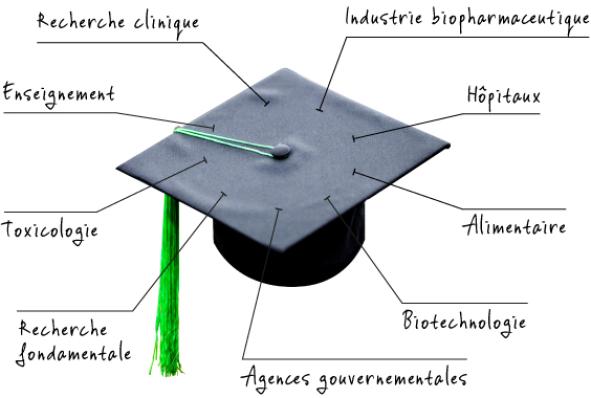
Biomedical sciences open the door to numerous career opportunities, primarily in the field of research—whether basic or applied—at universities, in industry, in teaching hospitals, or in government agencies.
Basic biomedical research aims to understand, through an experimental approach, how the human body functions at all levels. The insights it provides may one day find clinical applications.
Applied biomedical research puts the findings of basic research into practice. Its goal is to improve diagnostic and therapeutic methods. It may, for example, focus on the development of new vaccines, new diagnostic tests, new drugs…
Clinical research is a branch of applied research that focuses on improving diagnostic and therapeutic methods based on data from patients’ medical records.
In addition to research, the clinical field offers numerous career paths: toxicology, nutrition, clinical biology, bioengineering, medical imaging…
I am working on a doctoral thesis in toxicology. I am trying to understand esophageal cancer and identify new targets for a therapy against this disease. I recently presented the status of my research at a conference in California.
Céline, PhD student in toxicology
The pharmaceutical and biotechnology industry
The world of industry isn’t limited to research: some biomedical scientists build careers in drug manufacturing, gene or cell therapy development, quality control, medical affairs, and regulatory affairs.
Graduates in biomedical sciences can specialize in biostatistics. This equips them with a profile sought after by companies in the life sciences sector that require the analysis of quantitative data (for example, in genomics, epidemiology, or clinical trials).
As a clinical research assistant, I manage the administrative aspects and coordinate clinical trials—such as those for cancer treatments—conducted by pharmaceutical companies, international organizations, or medical groups. I ensure that protocols are followed in strict compliance with patient rights, procedures, and the study’s established objectives. My colleagues and I evaluate the efficacy and tolerability of the various treatments. In addition to these tasks, we occasionally attend research meetings abroad to prepare for a new study at our center.
Anne-Laure, Clinical Research Assistant
Sharing and disseminating scientific progress
Thanks to training that emphasizes the human applications of research, biomedical scientists can promote science as a discipline connected to the real world, for example in the education sector (graduates have access to a master’s degree in education). They can also advise government or quasi-governmental organizations, particularly in the field of public health.
If they are aware of development-related issues, they are also qualified to manage biomedical projects in the Global South.
I visit university centers to inform Key Opinion Leaders about our products in cardiology and gynecology. I also negotiate contracts to ensure our products are listed on hospital formularies and regularly organize scientific meetings.
Christian, Product Specialist in the pharmaceutical industry