Image

CdL
The Language Center is intended for members of the university community. Its mission is to provide foreign language instruction in partnership with each faculty, offering accessible, high-quality instruction that meets the academic and professional needs of our students.
Providing active and ambitious teaching methods is a priority for teachers. With our extensive experience in various fields related to education, we design innovative teaching projects through stimulating and meaningful activities.

The Language Center aims to position its professional practice at a high level of quality and conducts research in language teaching for specific purposes in order to foster innovative teaching that meets the needs of the academic community and society.

As part of or in addition to their classes, teachers organize various extracurricular activities with the aim of offering students additional opportunities to practice, as well as promoting the languages taught and their cultures.

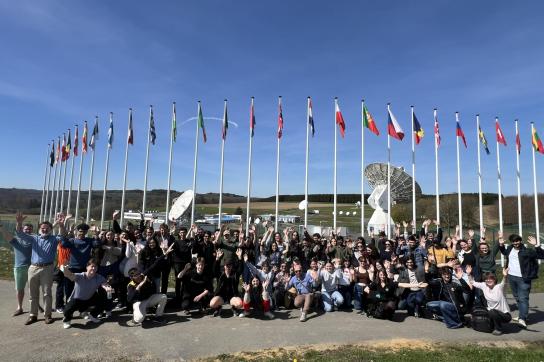
In April 2026, UNamur hosted two events as part of the UNIVERSEH alliance, bringing together more than a hundred students from across Europe.
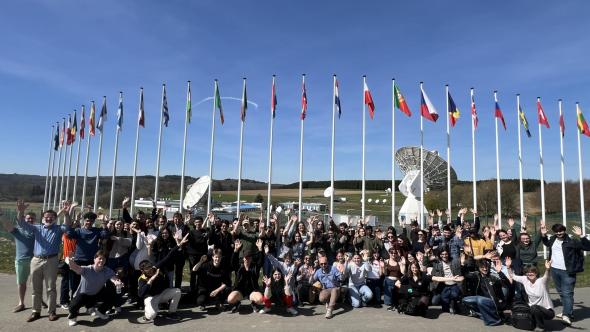
The Spring School, a short-term exchange program (BIP), aims to raise awareness among students from the Alliance’s seven universities about the diverse challenges and societal impacts of the space sector. Through a program combining lectures, visits, and group projects, as well as stargazing and exercises inspired by astronaut training, participants explored space in all its facets: from cybersecurity and nuclear energy in space to satellite services, space environment monitoring, launch vehicles, and astrodynamics.
Inspiration from UNamur experts and partners
Informative and insightful lectures were delivered by a panel of high-level experts from various disciplines. Speakers included André Füzfa (UNamur), Marc Toussaint (ESA/EPFL), Stijn Ilsen (Redwire), Christine Leurquin (Aldoria), Boris Hespeels (UNamur), Magdalena Teissandier (TBS-Toulouse), Fabienne Delhaise (ESA), Bartosz Sawik (AGH), Alain De Neve (Royal Higher Institute of Defense), Brieux Spindler (TRACTEBEL), Liina Vaabel (ESA), Alexandre de Geradon and Matteo Manieri (Telespazio), Jean-Luc Trullemans (ESA-ESEC), Natacha Callens (ESA Academy), and Cindy Léonard (ESA).
The topics covered a wide range of subjects, including the ground segment, astrodynamics, biological experiments, space defense, satellite operations, Space Situational Awareness, New Space, and many others.
Exclusive access to ESA facilities
Throughout the week, the students enjoyed unique and exclusive access to two major ESA sites. The first was the ESA Academy Training and Learning Centre, where they learned how the agency collaborates with universities to pass on its expertise, technical skills, and best practices to the next generation of European space professionals. The second was a visit to ESA’s ESEC-Redu facility, the European Space Safety and Education Center, which provided them with a hands-on look at satellite operations, space safety initiatives, and the management of Smallsat and Cubesat missions. These visits allowed participants to immerse themselves in the infrastructure that supports Europe’s space ambitions.

Among the lessons learned at the Spring School, the most striking is undoubtedly that the space sector is not limited to complex calculations. On the contrary, it brings together people from diverse backgrounds, united by a shared passion.


Designed to bridge the gap between academia and society, this short-term mobility program (BIP) aimed to equip students with the skills needed to communicate their expertise clearly and accessibly beyond specialized circles. The goal was to produce a science communication video that was both engaging and understandable, while encouraging students to adapt their use of English to reach a non-specialist audience.
Throughout the program, students acquired a wide range of key skills. They strengthened their language skills, particularly in the field of science communication in English, while gaining fluency through regular exchanges in an international environment. Critical thinking was also central to the learning process, through structured peer-review sessions that encouraged reflection and constructive feedback. At the same time, participants developed their digital skills, learning to identify reliable online sources and master video recording and editing techniques.
A high degree of autonomy was required throughout the program. Students had an entire day to organize and carry out the filming of their projects on their own, while being able to count on guidance and technical support from instructors as needed.
They were also encouraged to think deeply about their themes in order to identify angles likely to capture the interest of a broad audience. Creativity and originality played a central role, particularly in the visual storytelling that brought their projects to life.

What really struck us was how quickly the groups bonded. From the very first day, a genuine spirit of collaboration, curiosity, and openness took hold.


UNIVERSEH is an alliance of seven universities from seven European countries. It was established in November 2020 as part of the "European Universities" initiative promoted and funded by the European Commission.

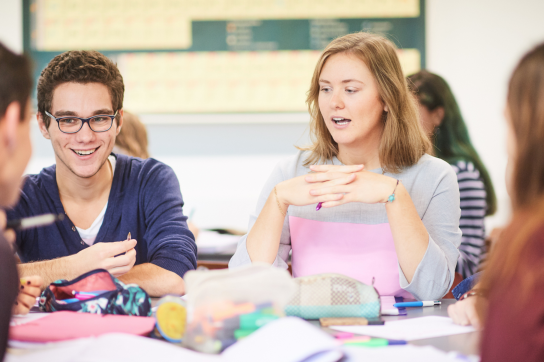
Why take English classes when you want to become a veterinarian? How can you teach Spanish to future management engineers? Far from vocabulary lists or lab classes with headphones, these languages are taught as genuine cross-disciplinary skills that are essential for the jobs of tomorrow.

In recent years, language teaching has continued to evolve, adapting to new societal challenges. Students no longer work solely on grammar or vocabulary, but carry out practical tasks directly related to their discipline. "The professional world is changing rapidly, and we must prepare them for that," emphasizes Natassia Schutz, director of the UNamur Language Center. "International mobility and the internationalization of careers also require adaptation to multilingual and multicultural environments." Cultural diversity and inclusion are further requirements. "Ludwig Wittgenstein said, 'The limits of one's language are the limits of one's world.' Knowing several languages allows you to see your environment differently," she points out. Finally, the digital transition is profoundly transforming teaching practices, with the integration of technological tools that multiply the possibilities for training and interaction.
To respond to these changes, the Language Center places students at the heart of its approach. "We start with their needs, their context, and their goals. Everything must be meaningful and authentic," explains Natassia Schutz. In concrete terms, this translates into courses tailored to the academic and professional realities of each discipline. In the Faculty of Science, students are introduced to reading articles, writing and scientific presentation in English from their first year. In the Faculty of Economics, Management and Communication Sciences (EMCP), they learn how to write a CV in Dutch and practice in mock job interviews. "We go far beyond vocabulary lists and grammar and use the foreign language as a tool to achieve a specific goal."
"We often describe ourselves as Swiss Army knives: depending on the context, the course, or the students, we pull out the right tool," explains the director. The team collectively reflects on its strategic priorities, but above all, it works closely with professors in each field. This co-construction allows language courses to be anchored in concrete and relevant situations. "Interdisciplinary collaboration is essential. To design our courses, we are in regular contact with faculty professors, which allows us to provide tailor-made learning that combines language learning with direct application in the field being studied," adds Natassia Schutz.
In the Department of Veterinary Medicine, English is no longer taught as a separate subject, but is directly integrated into a specialized course through the CLIL (Content and Language Integrated Learning) program. The principle is simple: "We use English to teach a subject, combining learning the subject matter with developing language skills in a concrete and motivating context for the learner," explains Hélène Bouchat, a language teacher. "This program is based on three principles: motivating students by giving meaning to language learning, promoting intensive exposure to English, and bringing together a subject specialist and a language specialist to integrate content and language in a balanced way," she adds.
As a result, the animal ethnography course has been merged with the English course to form a single course. In practical terms, Benoît Muylkens and Marlies Dauwen, professors of animal ethnography, teach the subject, while Hélène Bouchat regularly intervenes to draw attention to specific linguistic points, such as technical vocabulary, false friends, and useful grammatical structures. "I want to make sure that students understand, because their success in the course also depends on their mastery of English." For those who encounter more difficulties, remedial sessions are organized.
"The results are very positive. Students are more motivated and better understand the usefulness of English in their future careers, which gives meaning to their learning," says Hélène Bouchat. "We also know that veterinarians will need to read scientific literature in English. It is therefore essential to prepare them from the very beginning."

At the EMCP Faculty, languages are also integrated into interdisciplinary projects called "integrated teaching units." "These projects allow us to link several courses around a concrete achievement. In the entrepreneurship project, for example, students design a business plan and we help them write their executive summary in English, which is intended to convince a potential investor," explains Jérémie Dupal, who is in charge of the English part of the project.
This approach requires good coordination between teachers. "We need to know what our colleagues have already covered with the students, because the executive summary can only be written once the financial, marketing, and other aspects are in place. This multidisciplinary approach also shows students that the disciplines are complementary, as they are in professional life. These projects make learning more concrete and develop cross-disciplinary skills such as creativity, collaboration, and the ability to make connections between their different courses. Even students who sometimes see languages as a constraint understand, in this context, how essential they are in their future profession," concludes Jérémie Dupal.
The UNamur School of Modern Languages is becoming the Language Center. Created in the 1970s, the School has evolved over time: from an audio-oral approach, it has moved to an action-oriented and communicative approach, in line with the academic and professional needs of learners. "The term 'school' and the distinction between modern and dead languages no longer corresponded to our reality," explains Natassia Schutz. "With this new name, we are affirming our identity as a university entity and strengthening the sense of belonging within the institution."

This article is taken from the "Tomorrow Learn" section of Omalius magazine #38 (September 2025).

As part of the English course given in the first year of science-medicine, students are introduced to the popularization of scientific concepts in the form of videos. This is the "It's not Rocket Science" project, proposed by Natassia Schutz and Aude Hansel, professors at UNamur's School of Modern Languages (ELV). This year's competition prize-giving event featured a highlight: a live audio connection with Donald Pettit, American astronaut, currently aboard the International Space Station.
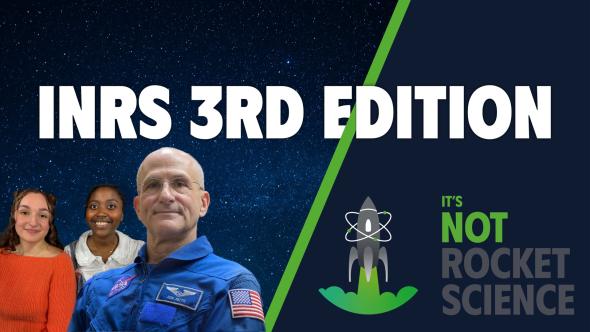
The project's ambition is to make science accessible to as many people as possible, especially high school students. The aim is clear: to demystify complex scientific concepts while offering young people a fascinating gateway to the world of research.
The idea behind "It's not Rocket Science" is simple but ambitious: each student duo must design a 2-minute popular science video that explains a space-related scientific concept or phenomenon. From a pool of 300 videos, the most convincing are selected to take part in a competition organized during Printemps des Sciences. High school students are invited to vote for the best video.
The objectives of this project are multiple: (1) to practice English in a concrete way , (2) to offer secondary school students a glimpse of what is achieved at university , (3) to discover interdisciplinarity and (4) to inspire young people to study science - why not at UNamur?
To meet this challenge, the finalist students are supported in the production of their videos by the team of English and subject teachers, by Confluent des Savoirs - UNamur's science popularization service - and by the Audio-Visual Service.
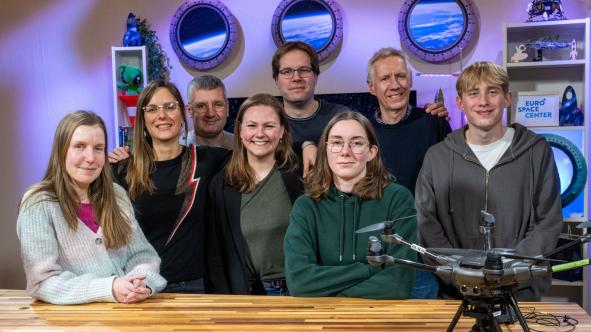
The videos produced by the students cover concepts related to space, a theme that captures the imagination and arouses the curiosity and interest of young people. From the effects of cosmic radiation on the human body, to the quest for new energy sources in space or the study of volcanoes on other planets, each video becomes a fascinating exploration of a complex subject, presented in a clear and engaging way.

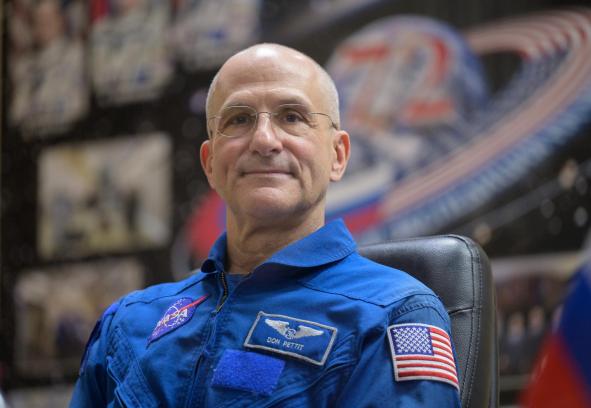
The competition's prize-giving event was marked by a highlight: a live audio connection with Donald Pettit, American astronaut, currently aboard the International Space Station. This privileged moment of exchange enabled the students and secondary school pupils in attendance to ask questions of the astronaut orbiting the Earth and learn more about life on board, the astronauts' journey and the challenges they face on a daily basis.
Following this exchange, the winners of the 2025 edition were presented with prizes donated by project partner EuroSpace Centre. Among the 7 finalist videos, the one made by Ella Cishahayo and Angelina Severino, students in biomedical sciences, won the competition.
The evening closed with a talk by Julie Henry, STEAM Project Manager at UNamur, on the challenge of attracting girls to scientific fields.
Funded by the European Union. Views and opinions expressed are however those of the author(s) only and do not necessarily reflect those of the European Union or European Education and Culture Executive Agency (EACEA). Neither the European Union nor the granting authority can be held responsible for them.