
Bachelor in Physics
-
Schedule
regular course
- ECTS Credits 180
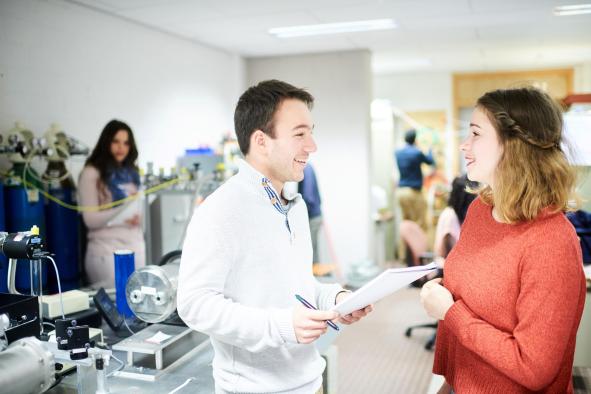
Your bachelor starts with a solid grounding in general physics.
He then gradually moves on to more advanced subjects whose teaching is largely based on recent advances in research: astrophysics, quantum mechanics, electrodynamics, solid state physics, nuclear physics...
From the first year, you learn to develop experimental skills that quickly lead you to participate in the activities of the physics department's research laboratories.
In addition to physics courses, you receive rigorous training in mathematics, chemistry and computer science. You will also develop your command of English to read and write scientific articles.
A human dimension completes your bachelor's degree with a historical and philosophical approach to science.
Your bachelor's training is both wide-ranging and high-level. It provides ideal preparation for master's studies in physics in Namur or elsewhere in Europe.
You're off to a good start
- you're curious and enthusiastic about the phenomena that surround you;
- you're at ease with mathematics and science;
- you're rigorous and precise;
- you're good at synthesizing.
Teaching methods
Courses, exercise sessions, practical work, individual and group projects, innovative pedagogies, everything is done to ensure that you master the concepts.
Lectures are illustrated by experiments, multimedia animations, videos... and supported by course materials (books, syllabuses...).
Organized in small groups, practical work and exercise sessions introduce you to the rigor and techniques specific to each discipline under the supervision of an assistant.
To make and interpret measurements, you'll learn to work in a laboratory environment, using precision equipment and specific high-performance teaching aids. In this way, you observe, experimentally, certain laws or phenomena exposed in the more theoretical lessons.
Many teachers have set up "flipped classes". You learn theory at home, and active, interactive teaching is provided in the auditorium!
In your first bachelor's block, you take part in a general physics research "mini-project" in which you intervene as young researchers to find a creative answer to a challenge in which technology plays an important role.
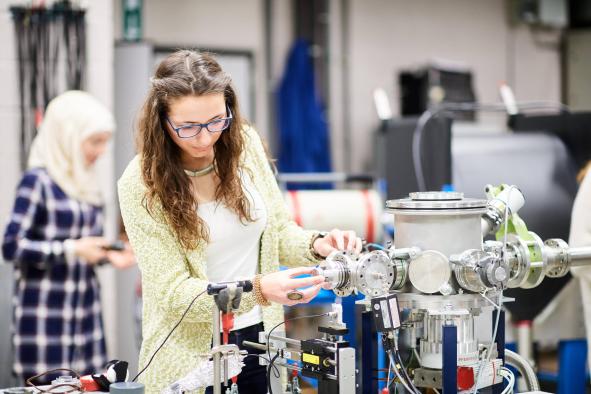
Finally, the teachers are keen to remain available to answer your questions and help you improve.
Success aids
Succeeding in a year of study at university involves many challenges.
To help you meet them, we support you in developing your disciplinary, methodological and human skills... with the support of numerous professionals.
Preparatory courses, individualized help... Find out more about the schemes set up for your training.
After the baccalauréat: the master's degree
The University of Namur offers:
- the 120-credit Master's program in Physical Sciences
- the 60-credit Master's in Physical Sciences
directly accessible after obtaining your bachelor's degree in physical sciences.
-
<unknown>
-
<unknown>
Code Name Staff Th.+Ex. Credits/Block 1 2 3 SPHYB210 Mathematical physics I Olivier Yoann 40h th. + 25h ex. 5 SPHYB211 Analytical mechanics Caudano Yves 45h th. + 45h ex. 7 SPHYB301 Quantum Mechanics II Caudano Yves Fuzfa André Olivier Yoann HERMAN Nicolas 45h th. + 30h ex. 6 SPHYB306 Course of Special and General Relativity MAYER Alexandre MAYER Alexandre 30h th. 3 SPHYB311 Analytical methods for solving problems in physics Deparis Olivier 22h th. + 15h ex. 3 SPHYB319 Quantum mechanics and statistical physics of many-body systems Houssiau Laurent Houssiau Laurent 22.5h th. + 15h ex. 3 SPHYB206_P36750 <unknown> Henrard Luc 30h th. + 15h ex. 5 -
<unknown>
Code Name Staff Th.+Ex. Credits/Block 1 2 3 SMATB108 Ordinary differential equations Carletti Timoteo 15h th. + 7.5h ex. 2 SMATB102_P35428 Real analysis II Winkin Joseph 30h th. + 30h ex. 5 SMATB103_P35430 Actual analysis Winkin Joseph 30h th. + 30h ex. 5 SMATB101_P35432 Linear algebra I Mauroy Alexandre 30h th. + 30h ex. 4 SMATB107_P35434 Algebra and analytical geometry Fuzfa André 30h th. + 30h ex. 4 SMATB203 Calcul différentiel et intégral II Carletti Timoteo 22.5h th. + 30h ex. 5 SMATB312 Statistics Van Bever Germain Franco Nicolas 30h th. + 15h ex. 3 SMATB335_P36751 <unknown> Fuzfa André 15h th. + 15h ex. 3 -
<unknown>
Code Name Staff Th.+Ex. Credits/Block 1 2 3 English Friendly CoursesImage
SPHYB208 Programmation Henrard Luc Guillaume Emerick 15h th. + 45h ex. 4 SPHYB127 Méthodes de calcul Louette Pierre 15h th. + 15h ex. 2 SPHYB128 Introduction to scientific computing Debarsy Paul-Louis 15h th. + 30h ex. 3 -
<unknown>
Code Name Staff Th.+Ex. Credits/Block 1 2 3 SCHIB111_P35312 General chemistry Wouters Johan 30h th. + 15h ex. 3 SCHIB207_P35447 Introduction to radiocristallography, mineralogy and petrology Yans Johan Wouters Johan 15h th. + 15h ex. 2 SCHIB210 Introduction to organic materials Berionni Guillaume Collin Stéphane 15h th. 2 SCHIB112_P36776 General chemistry of solutions Dehon Jérémy 25h th. + 10h ex. 3 SCHIB220 Physical chemistry Liégeois Vincent 30h th. 3 -
<unknown>
Code Name Staff Th.+Ex. Credits/Block 1 2 3 SPHYB333 Introduction to didactics 30h th. 3 SBIOB219 Biology Messiaen Johan 30h th. 3 Sustainable developmentImage
SGOLB313_P33839 Geophysics Louette Pierre Collinet Max 15h th. + 15h ex. 3 SGOGB314_P36479 Physical Partim : Climatology Houssiau Laurent 30h th. 3
-
-
<unknown>
Code Name Staff Th.+Ex. Credits/Block 1 2 3 SSPSB101 Philosophical questions Sartenaer Olivier Modera Astrid 22.5h th. + 7.5h ex. 2 Service learningImage
SSPSB102 Religious Studies: Anthropology, Metaphysics and Science Leyens Stéphane Cazalis Roland 30h th. 2 -
<unknown>
Code Name Staff Th.+Ex. Credits/Block 1 2 3 SSPSB204 Logic and argumentation Sartenaer Olivier Sartenaer Olivier 22.5h th. 2 SSPSB202 History of science Sartenaer Olivier 22.5h th. 2 SSPSB203 Psychology Ravez Laurent 22.5h th. 2 SSPSB308 Philosophy of science Sartenaer Olivier 15h th. 2 SSPSB309 Ethical Leyens Stéphane LAURENT Nathanaël 15h th. 2 SSPSB307 Formal logic Sartenaer Olivier 15h th. 2
-
-
<unknown>
Code Name Staff Th.+Ex. Credits/Block 1 2 3 Soft skillsImage
SELVB105 Introduction to Scientific English (level B1 and above) Dupal Jérémie 30h th. 3 Soft skillsImage
SELVB205 English II (level B1 and above) Dupal Jérémie 30h th. 3 Soft skillsImage
SELVB305 English III (level B2 minimum) Dupal Jérémie 30h th. 3 -
<unknown>
Code Name Staff Th.+Ex. Credits/Block 1 2 3 SMATB243 Introduction to Space Sciences Dupal Jérémie Zimmer Carole Fuzfa André 3
-
-
<unknown>
Code Name Staff Th.+Ex. Credits/Block 1 2 3 SBIOB003 Pluridisciplinary scientific field trip Yans Johan Silvestre Frédéric Yans Johan Silvestre Frédéric 48h th. + 48h ex. 3 3
-
<unknown>
Code Name Staff Credits Hours/Quarter 1 2 SPHYB124 General physics: Mechanics HEUSKIN Anne-Catherine 8 55h th. + 30h ex. SPHYB126 General physics: Electricity Sporken Robert 8 52h th. + 36h ex. Sustainable developmentImage
SPHYB125 General physics: Optics Lepere Muriel Dhyne Miguël 3 22h th. + 14h ex. SPHYB122 Great concerns in Physics Dias De Carvalho Junior Gabriel Houssiau Laurent Colaux Julien Henrard Luc 3 15h th. 15h th. -
<unknown>
Code Name Staff Credits Hours/Quarter 1 2 SMATB108 Ordinary differential equations Carletti Timoteo 2 15h th. + 7.5h ex. SMATB102_P35428 Real analysis II Winkin Joseph 5 30h th. + 30h ex. SMATB103_P35430 Actual analysis Winkin Joseph 5 30h th. + 30h ex. SMATB101_P35432 Linear algebra I Mauroy Alexandre 4 30h th. + 30h ex. SMATB107_P35434 Algebra and analytical geometry Fuzfa André 4 30h th. + 30h ex. -
<unknown>
Code Name Staff Credits Hours/Quarter 1 2 SPHYB127 Méthodes de calcul Louette Pierre 2 15h th. + 15h ex. SPHYB128 Introduction to scientific computing Debarsy Paul-Louis 3 7.5h th. + 15h ex. 7.5h th. + 15h ex. -
<unknown>
Code Name Staff Credits Hours/Quarter 1 2 SCHIB111_P35312 General chemistry Wouters Johan 3 30h th. + 15h ex. SCHIB112_P36776 General chemistry of solutions Dehon Jérémy 3 25h th. + 10h ex. -
<unknown>
Code Name Staff Credits Hours/Quarter 1 2 SSPSB101 Philosophical questions Sartenaer Olivier Modera Astrid 2 22.5h th. + 7.5h ex. Service learningImage
SSPSB102 Religious Studies: Anthropology, Metaphysics and Science Leyens Stéphane Cazalis Roland 2 30h th. -
<unknown>
Code Name Staff Credits Hours/Quarter 1 2 Soft skillsImage
SELVB105 Introduction to Scientific English (level B1 and above) Dupal Jérémie 3 15h th. 15h th.
-
<unknown>
Code Name Staff Credits Hours/Quarter 1 2 SPHYB205 Thermodynamique (thermodynamics) Houssiau Laurent 3 30h th. SPHYB207 Practical work in general physics Zanotto Laurent 3 45h ex. SPHYB209 Electrodynamics I Deparis Olivier Deparis Olivier 4 30h th. + 15h ex. Soft skillsImage
English Friendly CoursesImage
SMATB213 Astronomie Fuzfa André DUBOIS Eve-Aline 2 7.5h th. 7.5h th. SPHYB229 Wave optics and introduction to photonics Lepere Muriel Leonis Sylvain 2 15h th. SPHYB230 Electronics Sporken Robert 5 30h th. + 45h ex. Course not organized this yearImage
SPHYB221 Physics: personal project Dias De Carvalho Junior Gabriel Dias De Carvalho Junior Gabriel 3 15h th. + 15h ex. -
<unknown>
Code Name Staff Credits Hours/Quarter 1 2 SPHYB210 Mathematical physics I Olivier Yoann 5 40h th. + 25h ex. SPHYB211 Analytical mechanics Caudano Yves 7 30h th. + 15h ex. 15h th. + 30h ex. SPHYB206_P36750 <unknown> Henrard Luc 5 30h th. + 15h ex. -
<unknown>
Code Name Staff Credits Hours/Quarter 1 2 SMATB203 Calcul différentiel et intégral II Carletti Timoteo 5 22.5h th. + 30h ex. -
<unknown>
Code Name Staff Credits Hours/Quarter 1 2 English Friendly CoursesImage
SPHYB208 Programmation Henrard Luc Guillaume Emerick 4 15h th. + 15h ex. 30h ex. -
<unknown>
Code Name Staff Credits Hours/Quarter 1 2 SCHIB207_P35447 Introduction to radiocristallography, mineralogy and petrology Yans Johan Wouters Johan 2 15h th. + 15h ex. SCHIB210 Introduction to organic materials Berionni Guillaume Collin Stéphane 2 15h th. SCHIB220 Physical chemistry Liégeois Vincent 3 30h th. -
<unknown>
-
<unknown>
Code Name Staff Credits Hours/Quarter 1 2 SSPSB204 Logic and argumentation Sartenaer Olivier Sartenaer Olivier 2 22.5h th. SSPSB202 History of science Sartenaer Olivier 2 22.5h th. SSPSB203 Psychology Ravez Laurent 2 22.5h th.
-
-
<unknown>
Code Name Staff Credits Hours/Quarter 1 2 Soft skillsImage
SELVB205 English II (level B1 and above) Dupal Jérémie 3 15h th. 15h th. -
<unknown>
Code Name Staff Credits Hours/Quarter 1 2 SMATB243 Introduction to Space Sciences Dupal Jérémie Zimmer Carole Fuzfa André 3
-
-
<unknown>
Code Name Staff Credits Hours/Quarter 1 2 SBIOB003 Pluridisciplinary scientific field trip Yans Johan Silvestre Frédéric Yans Johan Silvestre Frédéric 3 48h th. + 48h ex.
-
<unknown>
Code Name Staff Credits Hours/Quarter 1 2 SPHYB303 Electrodynamics II Deparis Olivier 5 30h th. + 15h ex. SPHYB302 Atomic and Molecular Physics Lepere Muriel Dhyne Miguël 4 30h th. + 15h ex. SPHYB305 Nuclear physics Colaux Julien 4 30h th. + 15h ex. SPHYB307 Mechanics of continuous media Deparis Olivier 3 30h th. English Friendly CoursesImage
SPHYB309 Solid state physics Henrard Luc Guillaume Emerick 4 30h th. + 30h ex. SPHYB315 Advanced physics laboratory Frising Fernande 7 60h ex. SPHYB317 Introduction to the scientific research Louette Pierre 4 96h ex. -
<unknown>
Code Name Staff Credits Hours/Quarter 1 2 SPHYB301 Quantum Mechanics II Caudano Yves Fuzfa André Olivier Yoann HERMAN Nicolas 6 45h th. + 30h ex. SPHYB306 Course of Special and General Relativity MAYER Alexandre MAYER Alexandre 3 30h th. SPHYB311 Analytical methods for solving problems in physics Deparis Olivier 3 22h th. + 15h ex. SPHYB319 Quantum mechanics and statistical physics of many-body systems Houssiau Laurent Houssiau Laurent 3 22.5h th. + 15h ex. -
<unknown>
Code Name Staff Credits Hours/Quarter 1 2 SMATB312 Statistics Van Bever Germain Franco Nicolas 3 30h th. + 15h ex. SMATB335_P36751 <unknown> Fuzfa André 3 15h th. + 15h ex. -
<unknown>
-
<unknown>
Code Name Staff Credits Hours/Quarter 1 2 SPHYB333 Introduction to didactics 3 30h th. SBIOB219 Biology Messiaen Johan 3 30h th. Sustainable developmentImage
SGOLB313_P33839 Geophysics Louette Pierre Collinet Max 3 15h th. + 15h ex. SGOGB314_P36479 Physical Partim : Climatology Houssiau Laurent 3 30h th.
-
-
<unknown>
-
<unknown>
Code Name Staff Credits Hours/Quarter 1 2 SSPSB308 Philosophy of science Sartenaer Olivier 2 15h th. SSPSB309 Ethical Leyens Stéphane LAURENT Nathanaël 2 15h th. SSPSB307 Formal logic Sartenaer Olivier 2 15h th.
-
-
<unknown>
Code Name Staff Credits Hours/Quarter 1 2 Soft skillsImage
SELVB305 English III (level B2 minimum) Dupal Jérémie 3 15h th. 15h th. -
<unknown>
Code Name Staff Credits Hours/Quarter 1 2 SBIOB003 Pluridisciplinary scientific field trip Yans Johan Silvestre Frédéric Yans Johan Silvestre Frédéric 3 48h th. + 48h ex.
Jury
Les métiers des physiciens
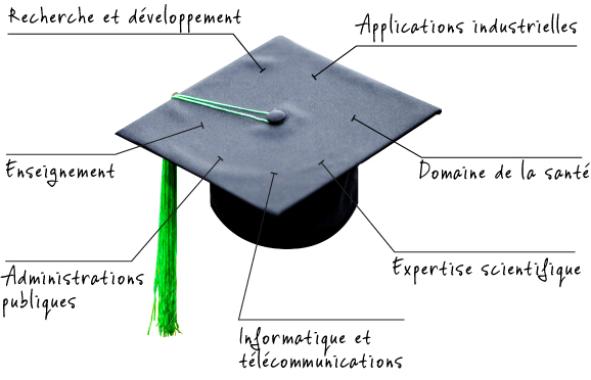
Physicists' professions
A wide range of skills
Thanks to their multidisciplinary training—physics, mathematics, computer science, materials science, physical chemistry, modeling, and data analysis—physicists possess a versatile and highly sought-after skill set. They have access to a wide range of careers, spanning scientific, technological, and cross-functional fields:
- Industry and R&D: development of innovative materials, quality control, instrumentation, industrial processes, and the energy sector.
- Hospital and biomedical sectors: medical radiophysics, imaging, biophysics, development of devices and sensors.
- Digital and data: data analysis, modeling, AI, scientific programming, technology consulting.
- Finance and insurance: risk management, quantitative modeling, predictive analytics.
- Environment and energy: air quality, energy transition, renewable energy, environmental monitoring and modeling.
- Nanotechnology and high technology: quantum devices, advanced optics, micro- and nanofabrication.
- Research and education: university research, public or private research centers, secondary and higher education.
- Public sector and institutions: scientific analysis, technical expertise, innovation, energy or environmental policies.
Rigorous, with strong analytical skills, excellent mathematical modeling abilities, and a broad scientific background, physicists contribute to the advancement of knowledge and the development of applications that benefit humanity.
All these high-value-added skills make physicists highly sought-after professionals in the job market.
Developing industrial applications
In industry, physicists participate in the development of high-tech or highly specialized products (such as energy-saving treated glass, safer sheet metal for the automotive industry, cyclotrons for nuclear medicine, etc.). They also hold key leadership roles downstream from research and development, particularly in production departments.
Computer Science and Telecommunications
A solid background in computer science enables physicists to work in IT services companies (consulting) or in any type of user organization (banks, insurance companies,
etc.). The telecommunications sector, in particular, relies on physicists’ expertise in optics, electronics, and information processing.
Sharing a Passion for the Real World
Among the career paths open to physicists, teaching and the education sector in general remain highly promising. More than 15% of our professionally active graduates share their passion for the real world by teaching physics, as well as science and mathematics, at universities or in upper secondary schools.
Physics and Medicine
In hospital settings, physicists work alongside physicians: they help develop treatment plans for patients receiving nuclear medicine care; they ensure quality control of various medical imaging devices; and they also contribute to the development of new analytical technologies.
Expert Physicists
Government agencies rely on the expertise of physicists. They help shape policies in energy, the environment, space, and other fields, for example by providing advice on research priorities.
Pushing the boundaries of our knowledge
According to a survey of our alumni, about half of recent graduates begin their professional careers with experience in scientific research, primarily in academic settings, in Belgium or abroad.
Other physicists continue their research work at cutting-edge research institutes in highly specialized fields (such as CENAERO, a center of excellence in aeronautics in Gosselies; CERN, the particle physics laboratory in Geneva; SCK-CEN, the nuclear energy research center in Mol; or the Royal Meteorological Institute).
Testimonials from former students
The research institute where I work focuses on the composition of our atmosphere and air quality. We develop analytical techniques to continuously
measure the concentration of a series of key atmospheric gases using both satellite and ground-based instruments. These activities are conducted in an international context in collaboration with major European agencies such as the ESA and EUMETSAT.Christophe — Institute of Space Aeronomy
Thanks to the work I completed during my PhD at UNamur and the connections I made, I am now a postdoctoral researcher at Lawrence Berkeley National Lab in California. My time is divided between lab work, analyzing results, and writing scientific papers or proposals. In the lab, the tasks are varied and include both highly technical and highly specialized aspects, such as laser alignment, sample preparation, and data acquisition. Analyzing results involves, in particular, developing code.
Frédéric — Lawrence Berkeley National Lab
At UNamur, I gained a solid background in physics as well as a passion for optical phenomena in living organisms, such as their coloration. I am currently conducting
research on the fluorescence of beetles and butterflies. This research is interdisciplinary and allows me to work not only with physicists, but also with biologists, chemists, and engineers. The goal is to understand the influence of color on the behavior of living organisms in order to develop new technological applications inspired by nature.Sébastien — University of Exeter in the United Kingdom
After completing my PhD at UNamur, where I gained solid multidisciplinary knowledge, I spent two years doing postdoctoral research at a marine biology institute in San Diego. Now, I work as a business consultant across all areas: market research, sales and procurement reorganization, and support for tenders.
Annick — H & Z