
Bachelor in Pharmacy
-
Schedule
regular course
- ECTS Credits 180
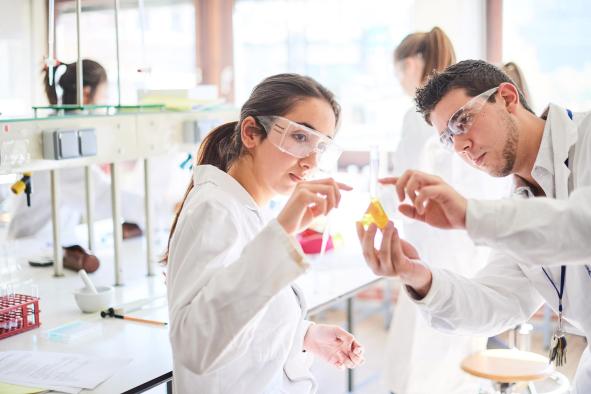
To gain a perfect understanding of drugs and their effects on living organisms, and particularly on humans, you will learn to master the physical, chemical and biological processes essential to the pharmaceutical approach.
Pharmaceutical specificity (pharmaceutical chemistry, studies of active substances derived from plants, study of the interaction of therapeutic substances with the human organism...) quickly takes a predominant place in your training, as does the handling of laboratory and analysis equipment.
Throughout your course, you acquire in-depth knowledge of diseases and therapeutic strategies, and learn to manage the human dimension of the pharmacist-patient relationship.
Scientific training takes ethical aspects into account, enabling you to play a major role as public health advisors to help improve our health and quality of life.

You're off to a good start
- you are able to demonstrate rigor, order and precision;
- you are observant;
- you have real people skills;
- you have a good scientific grounding (mathematics, physics, chemistry, biology).
Teaching methods
Scientific concepts are taken from their starting point, but the presentation is fairly quick on concepts that are part of the secondary school curriculum.
Theory, seminars, laboratories and exercise sessions, everything is done to ensure that you master
the concepts.
Organized in small groups, laboratories and exercise sessions introduce you to techniques specific to each discipline. Interactive boards, forums, online questionnaires... are available to make it as easy as possible for you to keep in touch with your teachers.
The pharmaceutical sciences sector allows you to combine the scientific and human aspects. By becoming specialists in medicines, we ensure their proper use and the safety of patients.
Behind every drug lies a complex development process and a perpetual questioning process offering young graduates numerous career prospects.
In addition, the campus of the University of Namur is very pleasant and the reputation of the teaching conditions reinforced my choice. The professors are approachable and the training lives up to my expectations."
Laure, assistant
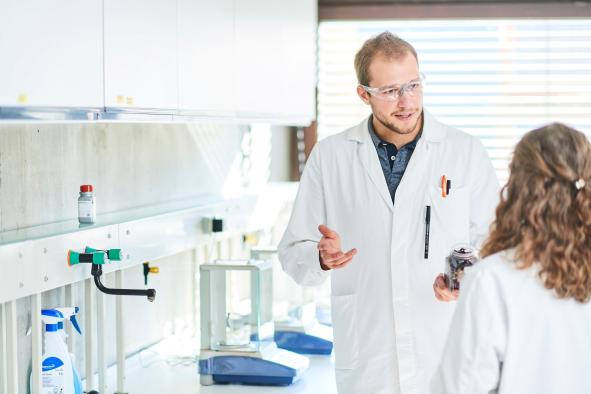
Success aids
Succeeding in a year of study at university involves many challenges.
To help you meet them, UNamur supports you in developing your disciplinary, methodological and human skills... with the support of numerous professionals.
Preparatory courses, individualized help...
After the baccalauréat: the master's degree

The University of Namur is organizing:
- Master 120 in Pharmaceutical Sciences
- Master 120 in Biomedical Sciences
- Master 60 in Biomedical Sciences
directly accessible after obtaining your bachelor's degree in pharmaceutical sciences.
-
Scientific training
-
Humanities and public health
Code Name Staff Th.+Ex. Credits/Block 1 2 3 MSPSB142 Philosophy of biomedicine HALFLANTS Louis Pontarotti Gaëlle 20h th. + 15h ex. 3 MSPSB140 Religious Studies Malvaux Paul 30h th. 3 Sustainable developmentImage Soft skillsImage
 English Friendly CoursesImage
MMEDB272_I2 General psychology Desseilles Martin 26h th. 3 MMEDB220_I2 Partim Medical epidemiology Roberfroid Dominique 18h th. + 10h ex. 2 MSPSB328 Medical Bioethics Ravez Laurent 22.5h th. 2 Sustainable developmentImage
Soft skillsImage
MPHAB397 Pharmacist-patient relationship Desseilles Martin 10h ex. 2 -
Personal work
Code Name Staff Th.+Ex. Credits/Block 1 2 3 MPHAB315 End of cycle work in Pharmaceutical Sciences and observation period in a pharmacy Masereel Bernard SIRIEZ Romain 30h ex. 6 -
Pharmaceutical sciences
-
Language
Code Name Staff Th.+Ex. Credits/Block 1 2 3 MCDLB103 Introduction to scientific English (level B1 and above) Bar Vanina 30h th. 3 MCDLB203 English : communicating science effectively (level B1+ or higher) Bouchat Hélène 30h th. 3 -
Optional internship
Code Name Staff Th.+Ex. Credits/Block 1 2 3 SBIOB003 Pluridisciplinary scientific field trip Yans Johan Silvestre Frédéric Silvestre Frédéric Yans Johan 48h th. + 48h ex. 3 3 -
Biomedical sciences
-
Morphological approach
Code Name Staff Th.+Ex. Credits/Block 1 2 3 MMEDB212 Anatomy applied to pharmaceutical sciences, including an introduction to medical imaging Garin Pierre Nisolle Jean-François 35h th. + 2h ex. 4 MMEDB216 Cytology and human histology Balligand Thomas Canon Caroline 45h th. + 15h ex. 5 -
Functional approach
Code Name Staff Th.+Ex. Credits/Block 1 2 3 MPHAB202 General biochemistry Masereel Bernard 45h th. 5 Soft skillsImage
MPHAB203 Experimental biochemistry MALRÉCHAUFFÉ Yveline RASKIN Lucie Masereel Bernard 25h ex. 3 MBIOB215 Génie génétique et éléments de génomique Maystadt Isabelle 22.5h th. 3 Sustainable developmentImage
English Friendly CoursesImage
MMEDB222 General physiology Kirschvink Nathalie 41h th. + 15h ex. 6 MMEDB205 General Immunology Graux Carlos Graux Carlos 26h th. 3 MBIOB262 General microbiology Lambert De Rouvroit Catherine 15h th. 2 MPHAB306 Human biochemistry Dogne Jean-Michel 60h th. 6 Sustainable developmentImage
English Friendly CoursesImage
MMEDB331 Human Physiology Kirschvink Nathalie 60h th. + 20h ex. 6
-
-
Scientific training
Code Name Staff Credits Hours/Quarter 1 2 SPHYB161 Life Science Physics I: Mechanics Louette Pierre 6 45h th. + 22.5h ex. SPHYB162 Life Science Physics II: Electricity, Magnetism and Nuclear Louette Pierre 5 40h th. + 12.5h ex. SPHYB163 Life science physics III: waves, sound, optics Louette Pierre 3 20h th. + 10h ex. SBIOB153 Biology of organisms Renard Henri-François Hubin Marie-Laurence 4 35h th. SBIOB154_Pharma <unknown> Hubin Marie-Laurence Renard Henri-François 2 16h ex. SBIOB157 General biology Messiaen Johan 6 35h th. + 22h ex. SCHIB111 General chemistry Wouters Johan 7 50h th. + 24h ex. SCHIB112 General solution chemistry Dehon Jérémy 4 25h th. + 16h ex. MCHIB107 Organic Chemistry Lanners Steve 8 45h th. + 35h ex. -
Humanities and public health
Code Name Staff Credits Hours/Quarter 1 2 MSPSB142 Philosophy of biomedicine HALFLANTS Louis Pontarotti Gaëlle 3 20h th. + 15h ex. MSPSB140 Religious Studies Malvaux Paul 3 30h th. -
Pharmaceutical sciences
Code Name Staff Credits Hours/Quarter 1 2 MPHAB100 Introduction to pharmaceutical sciences Masereel Bernard 6 30h th. + 10h ex. -
Language
Code Name Staff Credits Hours/Quarter 1 2 MCDLB103 Introduction to scientific English (level B1 and above) Bar Vanina 3 15h th. 15h th.
-
Scientific training
Code Name Staff Credits Hours/Quarter 1 2 MBIOB200 Botanical introduction to pharmacognosy and mycology Messiaen Johan 4 30h th. + 15h ex. MPHAB287 Computational methods applied to pharmaceutical sciences BORETTI Emma Douxfils Jonathan 2 10h ex. MMEDB283 Introduction to medical statistics Bihin Benoît Bihin Benoît 4 24h th. + 15h ex. -
Humanities and public health
Code Name Staff Credits Hours/Quarter 1 2 Sustainable developmentImage
Soft skillsImage
English Friendly CoursesImage
MMEDB272_I2 General psychology Desseilles Martin 3 26h th. -
Pharmaceutical sciences
Code Name Staff Credits Hours/Quarter 1 2 MPHAB286 Molecular structure and properties Pochet Lionel 4 25h th. + 10h ex. MPHAB288 Pharmacology - pharmacodynamic and pharmacokinetic approach, including alternative methods to animal testing Douxfils Jonathan Douxfils Jonathan 5 40h th. MPHAB284 Introduction to pharmaceutical analysis MALRÉCHAUFFÉ Yveline Pochet Lionel 4 25h th. + 30h ex. MPHAB285 Medicinal Chemistry: introduction Dogne Jean-Michel 5 20h th. -
Language
Code Name Staff Credits Hours/Quarter 1 2 MCDLB203 English : communicating science effectively (level B1+ or higher) Bouchat Hélène 3 15h th. 15h th. -
Optional internship
Code Name Staff Credits Hours/Quarter 1 2 SBIOB003 Pluridisciplinary scientific field trip Yans Johan Silvestre Frédéric Silvestre Frédéric Yans Johan 3 48h th. + 48h ex. -
Biomedical sciences
-
Morphological approach
Code Name Staff Credits Hours/Quarter 1 2 MMEDB212 Anatomy applied to pharmaceutical sciences, including an introduction to medical imaging Garin Pierre Nisolle Jean-François 4 35h th. + 2h ex. MMEDB216 Cytology and human histology Balligand Thomas Canon Caroline 5 45h th. + 15h ex. -
Functional approach
Code Name Staff Credits Hours/Quarter 1 2 MPHAB202 General biochemistry Masereel Bernard 5 45h th. Soft skillsImage
MPHAB203 Experimental biochemistry MALRÉCHAUFFÉ Yveline RASKIN Lucie Masereel Bernard 3 25h ex. MBIOB215 Génie génétique et éléments de génomique Maystadt Isabelle 3 22.5h th. Sustainable developmentImage
English Friendly CoursesImage
MMEDB222 General physiology Kirschvink Nathalie 6 41h th. + 15h ex.
-
-
Humanities and public health
Code Name Staff Credits Hours/Quarter 1 2 MMEDB220_I2 Partim Medical epidemiology Roberfroid Dominique 2 18h th. + 10h ex. MSPSB328 Medical Bioethics Ravez Laurent 2 22.5h th. Sustainable developmentImage
Soft skillsImage
MPHAB397 Pharmacist-patient relationship Desseilles Martin 2 10h ex. -
Personal work
Code Name Staff Credits Hours/Quarter 1 2 MPHAB315 End of cycle work in Pharmaceutical Sciences and observation period in a pharmacy Masereel Bernard SIRIEZ Romain 6 30h ex. -
Pharmaceutical sciences
Code Name Staff Credits Hours/Quarter 1 2 MPHAB312 Pharmacognosy - Part II: Therapeutic activity of plants BORETTI Emma Douxfils Jonathan RASKIN Lucie 4 30h th. + 20h ex. MPHAB314 Pharmaceutical chemistry - Part II Dogne Jean-Michel 4 30h th. MPHAB316 Integrated practical work in Pharmaceutical Sciences BORETTI Emma 6 60h ex. MPHAB313 Pharmaceutical chemistry - Part I Dogne Jean-Michel 2 20h th. MPHAB309 Pharmaceutical analysis - Part II Pochet Lionel 4 25h th. + 20h ex. MPHAB310 Pharmacognosy - Part I: Phytochemistry Douxfils Jonathan 3 20h th. MPHAB311 Introduction to galenics Douxfils Jonathan 3 20h th. MPHAB333 Pharmacology - pathophysiological and systematic approach Douxfils Jonathan Musuamba Tshinanu Flora DJOKOTO Happy 5 55h th. + 10h ex. -
Optional internship
Code Name Staff Credits Hours/Quarter 1 2 SBIOB003 Pluridisciplinary scientific field trip Yans Johan Silvestre Frédéric Silvestre Frédéric Yans Johan 3 48h th. + 48h ex. -
Biomedical sciences
-
Functional approach
Code Name Staff Credits Hours/Quarter 1 2 MMEDB205 General Immunology Graux Carlos Graux Carlos 3 26h th. MBIOB262 General microbiology Lambert De Rouvroit Catherine 2 15h th. MPHAB306 Human biochemistry Dogne Jean-Michel 6 60h th. Sustainable developmentImage
English Friendly CoursesImage
MMEDB331 Human Physiology Kirschvink Nathalie 6 60h th. + 20h ex.
-
Jury
Les métiers des pharmaciens
Pharmacy Careers
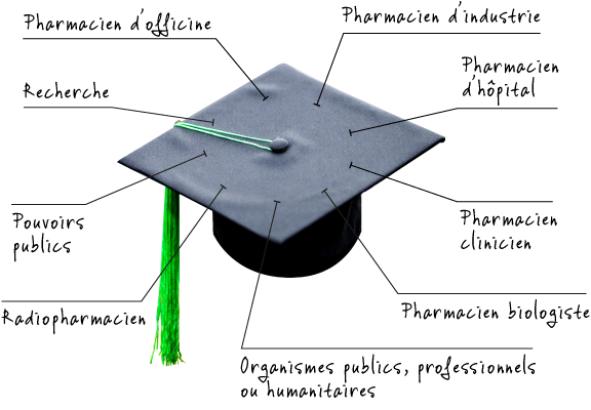
The dispensary is the historic and traditional domain of pharmacists. For a long time, all of a pharmacist’s duties were concentrated there. As medication preparers, following the doctor’s prescription, they would prepare “compounded medications,” tablets, pills, syrups from substances of biological or mineral origin, most of which were themselves prepared and analyzed in the dispensary. They then dispensed these medications to patients, assuming full responsibility for them.
Scientific and social developments, particularly the emergence of pharmaceutical specialties, have shifted the balance of these roles. Adapting to this new situation means that, faced with an increasingly complex and diverse therapeutic arsenal, the primary role of pharmacists today is to have a thorough understanding of the medications they dispense and their effects. More than ever, they are the last line of defense between the medication and the patients, whom they must be able to guide and advise on its use.
Approximately 70% of graduates pursue careers as community pharmacists. Consulted twice as often as doctors and enjoying a high level of trust among the public, community pharmacists are frontline public health professionals. Their role as advisors in dispensing medications, providing pharmaceutical follow-up, and supporting patients is essential.
Fulfilling this mission requires solid knowledge of pharmacology and medical conditions, as well as strong listening, communication, and teaching skills.
Pharmacists can also play an important role in a wide variety of other fields that are difficult to categorize. For example, pharmacists apply their expertise in toxicology, hygiene and environmental protection, food analysis, cosmetology, dietetics, and herbal medicine, as well as in the fields of research and higher education.
In the pharmaceutical industry, industrial pharmacists play a key role in research and development (drug development, formulation, analysis, etc.), contribute to clinical trials, are involved in regulatory affairs concerning, among other things, drug registration, and are responsible for drug production, quality control (QC), and quality assurance (QA). Finally, certain key positions must be held by industrial pharmacists.
In a hospital setting, hospital pharmacists manage and oversee the pharmacy department. They are responsible for the manufacturing, control, analysis, sterilization, and dispensing of medications, as well as the management of the hospital pharmacy. As specialists in medications and medical equipment (prosthetics, surgical equipment, etc.), they are in constant contact with healthcare staff (doctors, nurses, etc.).
In hospitals, clinical pharmacists are part of the healthcare team. They also interact with patients, and their goal is to optimize medication use (rational selection, adverse effects, cost, etc.).
Clinical laboratory scientists manage private or hospital-affiliated clinical laboratory (or medical testing) facilities. They are responsible for the quality of the tests as well as their interpretation. Through the information they provide, they contribute, in collaboration with physicians, to establishing a diagnosis of the disease. Clinical biology comprises three main fields: medical chemistry (analysis of chemical and biochemical components, toxicology, etc.), hematology (analysis of blood cells and proteins, immunology, etc.), and microbiology (analysis of bacteria, viruses, parasites, etc.).
Radiopharmacists, for their part, are responsible for the production and control of radioisotopes for diagnostic (medical imaging) and therapeutic (radiotherapy) use.
A number of government agencies and organizations rely on the expertise of pharmacists. These include public authorities (e.g., the Federal Agency for Medicines and Health Products, which oversees the Pharmacy Inspectorate), the military (Health Service), public agencies (INAMI, mutual insurance companies), professional organizations (Belgian Pharmaceutical Association, Medicines Control Service, etc.), and humanitarian organizations (Pharmacists Without Borders).