Portrait

Juliette Crespin-Boucaud, a microeconomist, works at the intersection of development economics, household economics, and economic history. In 2021, she earned her Ph.D. from the Paris School of Economics. She then pursued several multidisciplinary research projects, first at the London School of Economics and later at the Barcelona Institute of International Studies. This background has shaped her current approach, which emphasizes dialogue with other social sciences, particularly political science, sociology, and demography.


The TransmId Project: Intergenerational Transmission of Identity in Sub-Saharan Africa

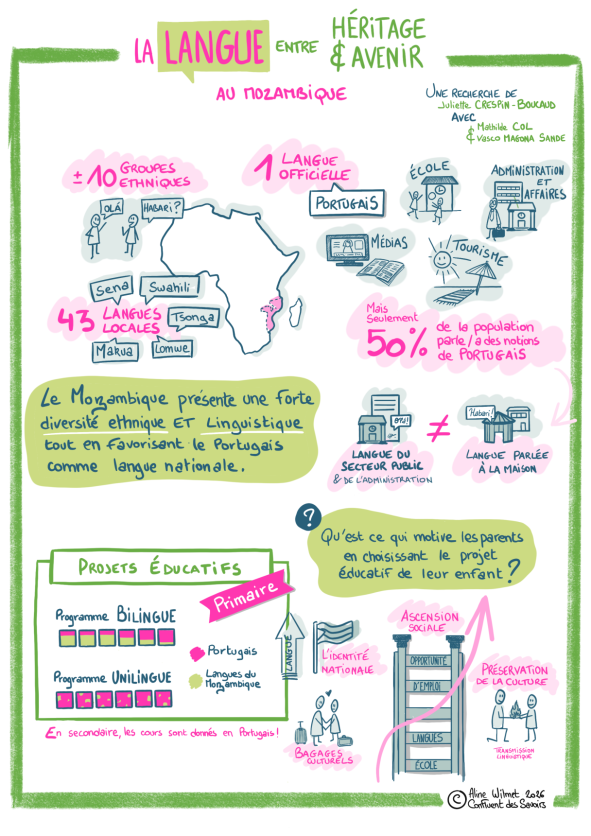
In TranmId, Juliette seeks to understand how social identities (ethnic, national, religious, or linguistic) are formed, acquired, and passed down from one generation to the next. In other words: How do parents’ choices shape their children’s social identities?
The project focuses primarily on marriages, since the choice of a partner influences the possible identities of the children born of that union. Parents’ affiliations, languages, or religions can open up different paths of transmission: a single heritage, multiple combined heritages, or identities that are reshaped over generations.
But transmission does not stop at birth. It continues through very concrete decisions: Which language to speak at home? Which school should you enroll your children in? What priority should be given to a national language, a mother tongue or a language spoken within the family circle, religion, or educational opportunities? Development economics helps connect these individual decisions to broader contexts: available resources, public policies, history, social norms, and family aspirations.

One component of the project, funded by the International Growth Centre, focuses specifically on Mozambique, where parents’ language and educational choices provide a concrete example of this transmission. Indeed, in this country marked by significant linguistic diversity, the choice of an educational program, a language of instruction, or the language spoken at home contributes to the formation of children’s sense of identity. These decisions depend on practical constraints such as available financial resources, the languages known or spoken by parents, and accessible schools, but they are also directly linked to the aspirations parents have for their children: giving them the best opportunities for the future, preserving a family language, or maintaining a cultural identity.

TransmId

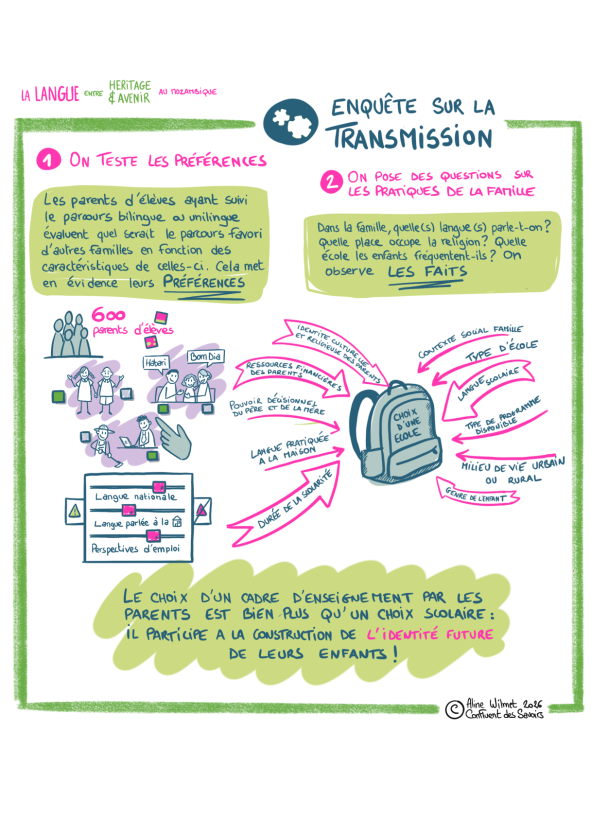
To understand these choices, Juliette observes families’ behaviors as clues. What language do they speak at home? What program (bilingual or not) do they prefer for their children? 
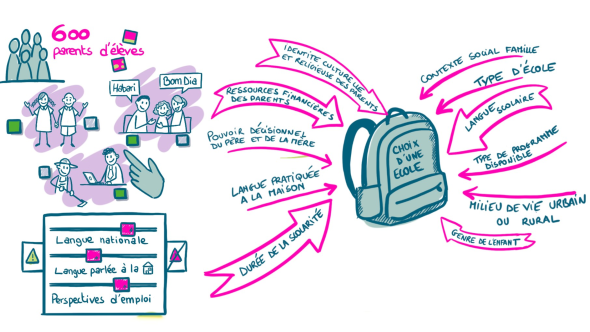
To study how parents shape their children’s “identity background,” the survey focuses on both parents’ practices and their expectations and preferences. To measure the latter, the survey asks parents
to estimate the benefits of both types of programs. For example: Out of 10 children in the bilingual/unilingual program, how many will speak Portuguese by the end of elementary school?
— to consider hypothetical scenarios in which the language spoken at home, the parents’ occupation, and the child’s gender vary. For example: Which program will parents who are farmers and do not speak Portuguese at home prefer for their daughter?
This information is then compared with families’ actual practices: languages spoken at home, programs attended, etc.
 

TransmId

Moving Beyond a Rigid View of Identities

Ethnic, national, or linguistic identities are not merely categories inherited once and for all. They are also shaped by everyday choices: getting married, speaking a language at home, enrolling a child in school, or choosing one form of learning over another.

Through this research, Juliette Crespin-Boucaud shows that education is not merely a place for acquiring knowledge. It is also a space for transmission, negotiation, and planning for the future. Amid family heritage, national identity, and social opportunities, language thus becomes a common thread for understanding how families shape the identities of future generations.

The Marie Skłodowska-Curie Fellowship (MSCA-PF)

The Marie Skłodowska-Curie Fellowship (MSCA-PF) is a selective European grant that enables a postdoctoral researcher to carry out an ambitious project at a new institution, often abroad. It supports the excellence of the project, the researcher’s mobility, and the development of their scientific career.

This project has received funding from the European Union under the Marie Skłodowska-Curie Actions (MSCA) Postdoctoral Fellowships program, grant agreement No. 101151041 

EU

Outreach and Accessibility: Aline Wilmet - Confluent des Savoirs

European Researchers' Night

To mark European Researchers’ Night, UNamur is highlighting several research projects conducted as part of the Marie Skłodowska-Curie Actions (MSCA). To make this research and its implications accessible to as many people as possible, Confluent des Savoirs, UNamur’s research outreach and dissemination service, has created a visual summary of each project. These visualizations aim to organize scientific information into an illustrated, accessible summary that combines keywords, diagrams, and graphics to help readers quickly grasp the mechanisms being studied and the key research questions.