

DeFIPP
DeFiPP consolidates the research work carried out in three pre-existing centers, CRED, CEREFIM and CERPE, each of which represents one of the three main areas of research: development economics, public policy and regional economics and finance, and monetary economics. DeFiPP's main objective is to promote excellent research in economics and finance, with a high international profile, using economic methodology, both in theory and empirical research, which is the common link between the clusters. Cross-fertilization will take place through the joint sharing of new methods or approaches.
DeFiPP's main objective is to promote research excellence in economics and finance through leading theoretical and empirical scientific publications. To achieve this, the institute relies heavily on interactions between members of its three research centers and encourages the sharing of methods and approaches. DeFiPP also aims to develop national and international visibility by collaborating with researchers from numerous universities and countries. In this respect, the institute, along with several other Belgian universities (KULeuven, UCLouvain and Universiteit Antwerpen), is currently involved in the Excellence of Science (EOS) project, which focuses on developing knowledge on the consequences of globalization and market integration in developed and developing countries.
.


Spotlight
News

News
-
Faculty Economics Management Communication Politics (EMCP)
Namur School of Economics (NSE) DeFIPP Institute
Catherine Guirkinger will present her research at KU Leuven as part of a Francqui Chair
Gender and diversity
Economy
News
-
Faculty Economics Management Communication Politics (EMCP)
Namur School of Economics (NSE)
DeFIPP Institute
Catherine Guirkinger will present her research at KU Leuven as part of a Francqui Chair
Gender and diversity
Economy
Catherine Guirkinger, a professor of economics at UNamur, has been invited by KU Leuven to hold a Francqui Chair. This distinction will give her the opportunity to present her research on gender relations and decision-making within households, as well as to strengthen ties between the two universities.

Established in 1933, the Francqui Chairs aim to promote exchanges between universities and highlight academic excellence. Each year, Belgian universities invite professors from other institutions to deliver a series of approximately ten hours of lectures, preceded by an inaugural lecture open to a wider audience.
This year, KU Leuven has chosen to invite Catherine Guirkinger, a professor of economics at the University of Namur. “What interests me is how arrangements within couples and families are reshaped when the world around them changes, and how these changes affect each of their members.” “Her research, conducted primarily in sub-Saharan Africa but also in Europe, combines field surveys, experiments, and historical data.”
An introductory lecture and three advanced courses
The Francqui Chair will begin with an inaugural lecture titled “Economic Change and the Family: Adjustment and Resistance,” followed by three more technical courses designed for master’s and doctoral students. Catherine Guirkinger will demonstrate how economic changes, laws, or social norms can influence decisions made within households. “We cannot ignore what happens within the family: all policy is, in a way, filtered through it,” she emphasizes.
She will draw in particular on her research on divorce, domestic violence, decision-making within couples, and the influence of the economic environment on families. These courses will also provide an opportunity to engage with students already involved in research. “You can go deeper with an audience like this,” Catherine Guirkinger notes. “It’s always very stimulating.”
Another opportunity to bring UNamur and KU Leuven closer together
This Francqui Chair also builds on an existing relationship between UNamur and KU Leuven. Economists from both universities have collaborated, in particular, on an EOS (Excellence of Science) project, the joint research program of the FNRS and the FWO. Catherine Guirkinger has very fond memories of that experience: “This program led to very fruitful scientific exchanges. This chair is a wonderful opportunity to build on them.”
Her presence in Leuven will thus provide a new opportunity to exchange ideas, share research conducted in Namur, and further the collaboration between the two institutions. Congratulations to Catherine Guirkinger on this prestigious honor!
Article
-
Faculty Economics Management Communication Politics (EMCP)
DeFIPP Institute
Inheriting, Choosing, Passing On: How Are Identities Formed?
Outreach
Inheriting, Choosing, Passing On: How Are Identities Formed?
Outreach
How are our social identities formed? Are they simply inherited, like a last name or a family history passed down at birth? Or are they built gradually, at the intersection of family legacies, educational choices, and the social contexts in which children grow up? These questions lie at the heart of the work of Juliette Crespin-Boucaud, a postdoctoral researcher and Marie Skłodowska-Curie fellow at the Center for Research in Development Economics (CRED) at the University of Namur. To mark European Researchers’ Night, UNamur is highlighting several research projects conducted under the Marie Skłodowska-Curie Actions (MSCA).
Portrait
Juliette Crespin-Boucaud, a microeconomist, works at the intersection of development economics, household economics, and economic history. In 2021, she earned her Ph.D. from the Paris School of Economics. She then pursued several multidisciplinary research projects, first at the London School of Economics and later at the Barcelona Institute of International Studies. This background has shaped her current approach, which emphasizes dialogue with other social sciences, particularly political science, sociology, and demography.
The TransmId Project: Intergenerational Transmission of Identity in Sub-Saharan Africa
In TranmId, Juliette seeks to understand how social identities (ethnic, national, religious, or linguistic) are formed, acquired, and passed down from one generation to the next. In other words: How do parents’ choices shape their children’s social identities?
The project focuses primarily on marriages, since the choice of a partner influences the possible identities of the children born of that union. Parents’ affiliations, languages, or religions can open up different paths of transmission: a single heritage, multiple combined heritages, or identities that are reshaped over generations.
But transmission does not stop at birth. It continues through very concrete decisions: Which language to speak at home? Which school should you enroll your children in? What priority should be given to a national language, a mother tongue or a language spoken within the family circle, religion, or educational opportunities? Development economics helps connect these individual decisions to broader contexts: available resources, public policies, history, social norms, and family aspirations.
One component of the project, funded by the International Growth Centre, focuses specifically on Mozambique, where parents’ language and educational choices provide a concrete example of this transmission. Indeed, in this country marked by significant linguistic diversity, the choice of an educational program, a language of instruction, or the language spoken at home contributes to the formation of children’s sense of identity. These decisions depend on practical constraints such as available financial resources, the languages known or spoken by parents, and accessible schools, but they are also directly linked to the aspirations parents have for their children: giving them the best opportunities for the future, preserving a family language, or maintaining a cultural identity.
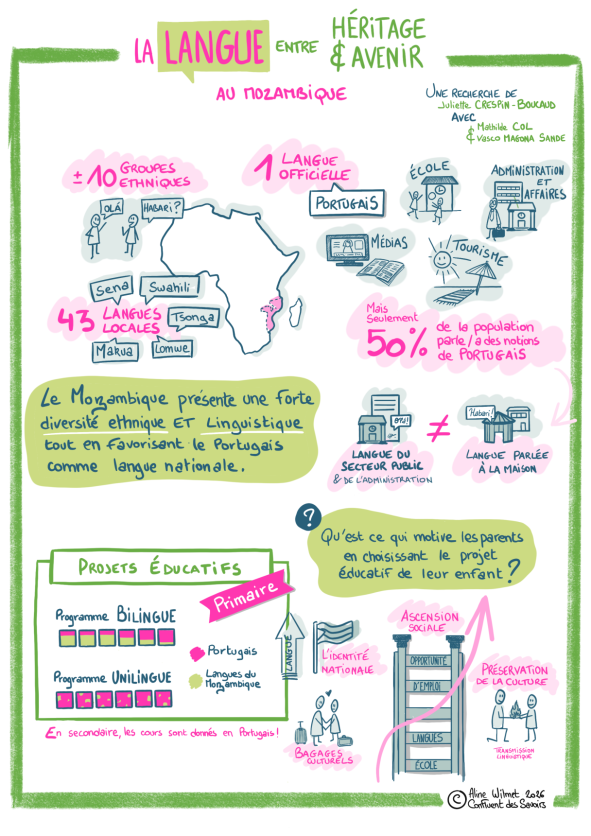
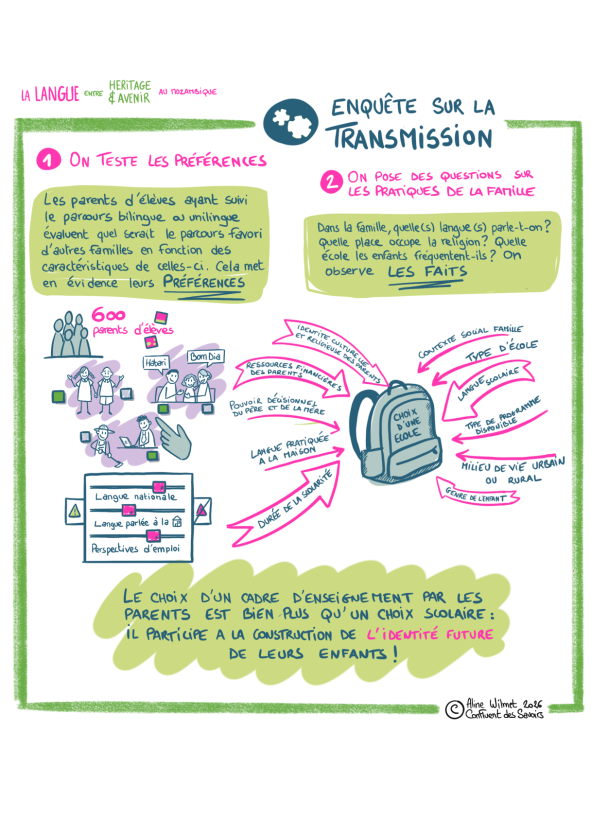
To understand these choices, Juliette observes families’ behaviors as clues. What language do they speak at home? What program (bilingual or not) do they prefer for their children?
To study how parents shape their children’s “identity background,” the survey focuses on both parents’ practices and their expectations and preferences. To measure the latter, the survey asks parents
to estimate the benefits of both types of programs. For example: Out of 10 children in the bilingual/unilingual program, how many will speak Portuguese by the end of elementary school?
— to consider hypothetical scenarios in which the language spoken at home, the parents’ occupation, and the child’s gender vary. For example: Which program will parents who are farmers and do not speak Portuguese at home prefer for their daughter?
This information is then compared with families’ actual practices: languages spoken at home, programs attended, etc.
Moving Beyond a Rigid View of Identities
Ethnic, national, or linguistic identities are not merely categories inherited once and for all. They are also shaped by everyday choices: getting married, speaking a language at home, enrolling a child in school, or choosing one form of learning over another.
Through this research, Juliette Crespin-Boucaud shows that education is not merely a place for acquiring knowledge. It is also a space for transmission, negotiation, and planning for the future. Amid family heritage, national identity, and social opportunities, language thus becomes a common thread for understanding how families shape the identities of future generations.
The Marie Skłodowska-Curie Fellowship (MSCA-PF)
The Marie Skłodowska-Curie Fellowship (MSCA-PF) is a selective European grant that enables a postdoctoral researcher to carry out an ambitious project at a new institution, often abroad. It supports the excellence of the project, the researcher’s mobility, and the development of their scientific career.
This project has received funding from the European Union under the Marie Skłodowska-Curie Actions (MSCA) Postdoctoral Fellowships program, grant agreement No. 101151041

Outreach and Accessibility: Aline Wilmet - Confluent des Savoirs
European Researchers' Night
To mark European Researchers’ Night, UNamur is highlighting several research projects conducted as part of the Marie Skłodowska-Curie Actions (MSCA). To make this research and its implications accessible to as many people as possible, Confluent des Savoirs, UNamur’s research outreach and dissemination service, has created a visual summary of each project. These visualizations aim to organize scientific information into an illustrated, accessible summary that combines keywords, diagrams, and graphics to help readers quickly grasp the mechanisms being studied and the key research questions.

Article
-
Faculty Economics Management Communication Politics (EMCP)
DeFIPP Institute
“Economics Starts with People” — A Nobel Laureate at the ERINN 2026 Conference
Economy
“Economics Starts with People” — A Nobel Laureate at the ERINN 2026 Conference
Economy
The ERINN 2026 annual conference, organized by the CRED Research Center at the DeFiPP Institute, took place on June 15 and 16, 2026, at the EMCP Faculty. Funded by the Wallonia-Brussels Federation’s ARC IDnomics project, the conference explored the interaction between rapidly evolving social identities and public policy, as well as the impact of these factors on societal behaviors and economic choices.
It also welcomed a distinguished guest: Professor George Arthur Akerlof, a 2001 recipient of the Alfred Nobel Prize in Economic Science. In the interview Professor Akerlof granted us, he reflects on the origins of his career but does not discuss equations or economic models. He talks about people.

George Akerlof was educated at Yale and the Massachusetts Institute of Technology, where he received his PhD in 1966, the same year he became an assistant professor at Berkeley. He became a full professor in 1978. Professor Akerlof is a 2001 recipient of the Alfred E. Nobel Prize in Economic Science; he was honoured for his theory of asymmetric information and its effect on economic behaviour. He is also the 2006 President of the American Economic Association. He served earlier as vice president and member of the executive committee. He is also on the North American Council of the Econometric Association.
A young boy encounters unemployment
"When I was 11 years old, my father lost his job. My 11-year-old boy reasoning was that if my father spent less, somebody else would get less income, and then they would spend less, and the consequences would spread throughout society."
George Akerlof

He also remembers growing up in a country marked by racial discrimination and deep inequalities. These early experiences shaped a question that would remain at the centre of his work for decades: why do economies generate persistent unemployment and exclusion when the standard economic theory predicts that markets should clear?
Learning How to Think
George Akerlof grew up in an unusually academic family and frequently felt that he was not the most naturally gifted person in the room. That belief forced him to work harder. It also encouraged a kind of intellectual humility that still remains. Before arriving at MIT, Akerlof spent an entire summer teaching himself advanced topology. And the professor who taught the course would leave a lasting impression. Before solving a puzzle, identify the larger question that makes the puzzle important. This became a lifelong research philosophy.
"You have to look at the big picture: first understand the structure of the problem, then work on the details."
George Akerlof
Justice, Inequality, and Moral Purpose
"I was concerned about unemployment, but I was also concerned about segregation. Those problems seemed very important to me. I thought economics was one way of understanding them.”
George Akerlof
This concern for real-world problems rather than purely theoretical puzzles resonates strongly with the mission of the Center for Research in Development Economics (CRED), one of the three research centers that make up the Institute for Development Finance & Public Policies (DeFiPP) at the University of Namur.

DeFiPP brings together expertise in development economics, finance, and public policy, while encouraging dialogue across disciplines and methodological approaches. Within this framework, CRED has established itself as one of Europe's leading centres in development economics. Founded by scholars including Jean-Marie Baland and Jean-Philippe Platteau and now directed by Catherine Guirkinger, CRED has built an international reputation through research that combines theoretical rigor with extensive fieldwork. Its researchers study how institutions, social norms, collective action, market development, and political processes shape economic outcomes in developing countries. Much of the work relies on original data collected directly in Africa, Asia, and Latin America, allowing researchers to confront economic theory with realities observed on the ground.
These questions are at the heart of CRED’s research program. The centre’s researchers study the role of institutions and social norms in shaping development trajectories, analysing how informal rules, collective beliefs, and governance structures influence economic opportunities and well-being. Their work contributes to international research networks such as “Economic Development and Institutions” (EDI), a major initiative dedicated to understanding the links between the quality of institutions and economic development.


India Changes Everything
This approach echoes one of George Akerlof's central convictions: economics cannot be understood solely through mathematical models. During his studies and later through a formative year in India where he too observed realities on the ground, he became increasingly convinced that economics is not just about facts and figures.
"I learned that understanding an economy means understanding the people who live in it. You have to understand institutions, customs, and beliefs."
George Akerlof
Development, he argues, cannot be explained by markets alone. To understand why some societies prosper while others remain trapped in poverty, we must understand how people behave within specific social and institutional environments.
The market for Lemons
George Akerlof's work on information asymmetries provides another point of connection. His landmark article The Market for Lemons demonstrated that markets can fail when buyers and sellers possess different information.
"People make decisions without knowing what other people know."
George Akerlof
The insight transformed economics by showing that imperfect information is not an exception but a fundamental feature of many markets.
At CRED, researchers similarly examine the frictions that prevent markets from functioning efficiently. Their work explores access to credit, agricultural productivity, market integration, taxation, and development finance, seeking to understand why some individuals and communities remain excluded from economic opportunities. Recent projects have investigated issues ranging from tax compliance in Sub-Saharan Africa to the long-term effects of colonial institutions and the digital transformation of agricultural value chains in West Africa.
Multiple Equilibria
Another important theme linking George Akerlof's work and CRED's research concerns the role of social norms and multiple equilibria.
He challenged the idea that economies naturally converge toward a single optimal outcome. Drawing partly on observations made in India, he argued that societies can become trapped in persistent patterns of behaviour sustained by shared beliefs and institutions. Poverty, discrimination, or unemployment may therefore persist not because individuals make irrational choices, but because entire systems of expectations reinforce existing outcomes.
"One of the things I got from India was that one should take into account what people were thinking when thinking about equilibrium. There may be more than one equilibrium."
George Akerlof
This perspective has become increasingly influential in development economics. Researchers at CRED investigate how social norms affect household decisions, gender relations, collective action, and access to economic resources. Particular attention has been devoted to understanding discrimination, bargaining power within households, and the economic constraints faced by women. Research led by Catherine Guirkinger, for example, examines the mechanisms behind gender inequalities in Sub-Saharan Africa and the factors that limit women's economic opportunities.
Beyond its research output, CRED also serves as a vibrant international hub for scholarly exchange. The centre regularly hosts conferences, workshops, doctoral training activities, and collaborations with researchers from around the world. Through these initiatives, it contributes to the development of new generations of economists committed to addressing some of the most pressing challenges facing developing societies.
The Identity and the Future of Economics
The collaboration with Rachel Kranton represented, in many ways, the culmination of George Akerlof’s intellectual trajectory. Identity economics brought together themes that had been present for decades. Social expectations. Collective beliefs. Norms. Institutions. The boundaries between economics, sociology, psychology, and political science are often less rigid than academic institutions suggest. Human behaviour does not respect disciplinary boundaries.
"What people think they should do affects what they actually do."
George Akerlof
What ultimately emerges from George Akerlof's reflections is a simple but powerful idea: economics is a science of people before it is a science of markets. Markets matter, institutions matter, and policies matter—but understanding human behaviour remains essential.
This principle lies at the core of CRED's identity. Whether studying poverty, gender inequality, market development, public institutions, or collective action, the centre seeks to understand how economic outcomes are shaped by the interactions between individuals, communities, and institutions. In doing so, it continues a tradition of research that combines analytical rigor with a deep concern for real-world problems.
For George Akerlof, the purpose of economics has always been to better understand society and improve human well-being. For CRED, that ambition remains as relevant today as ever.
Useful References
- George Akerlof
- DeFiPP Institute, Center for Research in Development Economics (CRED), University of Namur
- University of Namur Research Portal (CRED)
The ARC IDnomics Project
The IDnomics project (Identities, Norms, and Narratives) is an inter-university Concerted Research Action (ARC) funded by the Wallonia-Brussels Federation (FWB). It explores the interaction between rapidly evolving social identities and public policies, and how these factors impact societal behaviours and economic choices.
The research is a collaborative effort between the Université de Namur (UNamur) and UCLouvain. Key features and goals of the initiative include:
- An Interdisciplinary Approach: The project bridges economics, political science, and data science to understand how changing societal demographics and group identities influence public policy adoption.
- Academic research: It serves as a fundamental research hub, aiming to develop centres of excellence in economic and social sciences.
- Research Conferences: The project frequently sponsors academic gatherings, such as the ERINN (Economic Research on Identity, Norms, and Narratives) conference series hosted in Namur.
Article
-
Faculty Economics Management Communication Politics (EMCP)
Namur School of Economics (NSE) DeFIPP Institute
Economy: Why Are More African Women Converting to New Christian Churches?
Economy
Article
-
Faculty Economics Management Communication Politics (EMCP)
Namur School of Economics (NSE)
DeFIPP Institute
Economy: Why Are More African Women Converting to New Christian Churches?
Economy
New Christian churches are experiencing spectacular growth, particularly in Africa. While they are attracting a growing number of followers, it is notable that women are joining them far more often than men. Catherine Guirkinger, a professor and researcher in development economics, examines this gendered phenomenon of religious conversion and the economic mechanisms underlying it. This original research has just received prestigious WelCHANGE funding through the 2025 call for proposals from the F.R.S-FNRS.
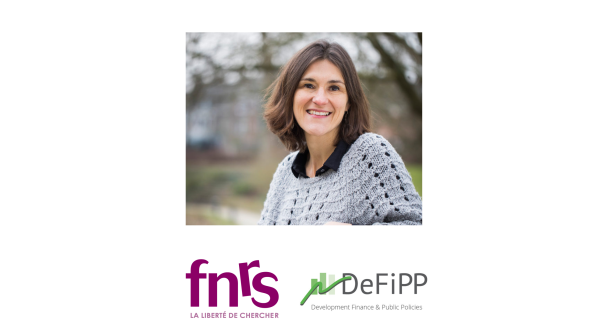
A phenomenon that has received little attention in the scientific literature has caught the attention of Catherine Guirkinger, an economist and professor at Sciences Po’s Faculty of Economics, Management, and Communication (EMCP), and her colleagues, Pablo Alvarez-Aragon, a postdoctoral researcher at the University of Bologna, and Jean-Philippe Platteau, professor emeritus at UNamur: the conversion of African women to “new Christian churches.” This term encompasses new Christian-inspired religious movements such as evangelical or Pentecostal churches, which are growing rapidly on the African continent and in other regions of the world.
“Statistical analyses show that women are much more likely to be members of these new churches than men. This imbalance is unique to these new churches and is not observed in Catholic churches or other traditional religions,” explains Catherine Guirkinger.
Economic Growth and Religious Conversion
To explain this trend of female conversion, Catherine Guirkinger puts forward a hypothesis centered on the support services offered by these churches, which encourage women in their economic empowerment. “In a previous research study conducted in Benin, we observed that when women gain access to new sources of income, they are more likely to convert,” explains Catherine Guirkinger. “When interviewed, they frequently mention these support services, which help them overcome the obstacles they face in accessing new economic opportunities. These services are not solely financial in nature but also include ‘spiritual protection,’ in a context where ‘successful’ women are often accused of or fall victim to witchcraft.”
Thus, initial analyses suggest that religious conversion is correlated with the economic cycle: it is more frequent when incomes rise. “This is a rather unexpected finding,” the researcher notes. “Religious conversion is generally interpreted as a response to difficulties, particularly financial ones. Yet it would seem that economic growth, on the contrary, encourages membership in these new churches.”
Economic tools for understanding individual behavior
One of the gray areas Catherine Guirkinger hopes to shed light on is identifying the roles these churches play in the empowerment of these women in the face of rather conservative and patriarchal gender norms. To understand this, Catherine Guirkinger will employ a combination of methods: statistical data, qualitative surveys, econometric analyses, as well as “economic games”—role-playing exercises designed to understand individual behaviors through simulated scenarios.
Image

The analysis of individual decisions always takes place within an economic conceptual framework, in which individuals make trade-offs based on the constraints they face and the negotiation processes at work. In this project, particular attention is paid to negotiation within the couple, where the husband plays a central role in upholding gender norms. Economic concepts thus shed light on religious decisions by situating them within economic and social dynamics.
The project will run for four years, from 2026 to 2030. The project team includes a doctoral student (currently being recruited), Jean-Philippe Platteau, professor emeritus at the Defipp Institute, and Pablo Alvarez of the University of Bologna (Italy).
Quick Bio
Catherine Guirkinger specializes in development economics. At the Center for Economic Development Research (CRED) of the DeFIPP Institute (Development Finance & Public Policies), she conducts research on changes in family structures during development processes. Her work also focuses on the respective roles of women and men in society and on the role of public institutions in the broader sense. Catherine Guirkinger explores these issues particularly in the colonial context, drawing on archival data and historical surveys. In 2017, she received European ERC funding for this research program, and in 2024, she secured funding from the F.R.S-FNRS for a collaborative project with Bruno Schoumaker, professor of demography at UCLouvain, aimed at digitizing census data. As a professor, Catherine Guirkinger teaches courses in microeconomics and development economics.
Discover the Defipp Institute
DeFIPP brings together the research conducted at the CRED, CEREFIM, and CERPE research centers, which focus on the following major research areas: development economics (CRED), finance and macroeconomics (CEREFIM), and regional economics and economic policy (CERPE). DeFIPP’s primary objective is to promote excellence in economic and financial research with strong international visibility, while applying economic methodology in both theoretical and empirical research.
DeFiPP's strengths
- The integration of different but related areas of research and approaches in both economics and finance.
- The importance of the institute's three research centers. In particular, the CRED is considered a leading center in development economics in Europe, and is notably supported by the European Union through the European Research Council (ERC) Starting Grant. The CERPE is known for its advisory role in Belgian public policy. As for the CeReFiM, it has recently collaborated with private sector organizations as part of the Ageas and BNP Paribas Fortis research chairs devoted to systemic and asset risk management.
- The organization of various research activities that bring together members of the various research centers. These activities fall into two categories: DeFiPP activities, (e.g. DeFiPP's weekly economics seminars and workshops) and activities co-organized with other universities (e.g. the doctoral workshop co-organized twice a year with UCLouvain and Université Saint-Louis).
- The participation of DeFiPP's three research centers in a joint doctoral school with other Belgian universities, enabling DeFiPP members to follow high-quality doctoral courses.