
Bachelor in Economics and Management
-
Schedule
regular course
- ECTS Credits 180

Overview
Your bachelor's degree is built on five pillars
- Economics and Management: From your very first year, you’ll dive right into the heart of these subjects. You’ll learn to apply the major theories in these fields. As you progress, you’ll explore the subfields of economics and management, such as marketing, finance, accounting, monetary economics, international economics, and business strategy…
- the humanities (history, sociology, psychology, philosophy): to help you better understand the environment in which you’ll operate and make decisions. Indeed, managers must be able to understand the motivations of their clients or employees, as well as the unique dynamics of the groups of people they will lead. If economists want to understand the debt crisis, they must know what happened previously. That is why a solid foundation in the humanities is a “must” for economists and managers.
- Law: to understand the legal framework within which economists and managers make decisions;
- Quantitative methods (e.g., mathematics, statistics) and computer science: to diagnose economic and managerial issues and make better decisions based on a critical analysis of data;
- Languages: English and Dutch, or German, or Spanish.
Early on, you’ll have the opportunity to choose some of your courses. This allows you to specialize in the areas that interest you most.
You're off to a good start
- You are interested in the economy, business, and issues related to the appropriate use of resources;
- you want to analyze the causes and consequences of decisions;
- you feel comfortable with math;
- you are creative, solution-oriented, and enjoy working in a team;
- you’re willing to use multiple languages;
- you want to gain international experience.
Teaching Methods
Lectures, exercises, integrated projects, company visits, business games… every effort is made to ensure a thorough understanding of the concepts and the development of practical skills.

In small groups, exercise sessions and hands-on activities help you absorb the material through case studies and real-world experiences of business managers.
Your interactions with professionals expose you to current events and real-world business practices. You’ll develop your understanding and critical thinking skills, as well as your creativity.
By stepping into the shoes of business managers during business games, you’ll develop decision-making skills in a computer-simulated competitive environment.
Last but not least… you’ll enjoy close interaction with professors and teaching assistants!
Développez vos compétences linguistiques ! |
| En plus de l’anglais, vous apprenez une seconde langue (allemand, espagnol ou néerlandais) dans une perspective concrète et directement intégrée dans vos projets. Quel que soit votre niveau, vous progressez grâce à des activités immersives : excursions, tables de conversation, tandems… |
Learning by Doing
Project managers and change agents—starting as early as the bachelor’s degree!

Project-based learning integrates and applies your knowledge from multiple disciplines through real-world case studies.
Just like real project managers, you’ll learn to work collaboratively and demonstrate a range of skills:
- from observation, literature review, source critique, data collection, and analysis;
- to producing a high-quality report—in some cases including an executive summary written in English—which you and your team present to a panel.
A team of experts will coach you on:
- managing your projects,
- your oral and written communication,
- your work in English,
- the theoretical and practical foundations of your proposed actions.
The "Learning by Doing" Approach |
In BLOCK 1Market Analysis Project
|
MODULE 2Entrepreneurship Project
OR Globalization and Economic Interdependence
|
BLOCK 3Innovation Project
AND Strategy Project
What if you changed the rules of the game? |
International experience
Discover the international and multicultural context, learn how to manage a project and communicate in another language!
Your studies in economics and management offer you the opportunity to participate in two international study abroad programs: one during your bachelor’s degree and one during your master’s degree, in Flanders, elsewhere in Europe, or outside Europe. It’s also possible to complete your master’s internship abroad.
Barcelona, Madrid, Milan, Rome, Galway, Tampere, Maastricht, Debrecen—as well as the United States, Canada, Brazil, Japan, and many other destinations—are waiting for you!
Support for Success
Succeeding in a year of college involves many challenges.
To help you overcome them, UNamur supports you in developing your academic, methodological, and interpersonal skills—with the help of many professionals.
Preparatory courses, individualized assistance…
After the bachelor's degree: the master's degree

After the baccalauréat: the master's degree
The University of Namur offers master’s degrees in economics and master’s degrees in management. These programs, offered as full-time or part-time courses, are directly accessible after you earn your bachelor’s degree in economics and management.
Master’s Programs in Economics
Daytime Schedule
- The 120-credit Master’s in Economics
- The 60-credit Master’s in Economics
Evening classes
Master’s Programs in Management Sciences
Daytime Schedule
- The 120-credit Master’s in Management
- The 60-credit Master’s in Management Sciences
Evening classes
Master's Degrees in Education
Empowering young people to learn and collaborate, guiding them, and helping them become agents of change… Being a teacher is exciting!
Find out how to become a high school teacher (grades 4 through 6) after earning your bachelor’s degree in economics and management.
More information on master’s degrees in education.
Contacts
Faculty of Economics, Management, and Communication, Sciences Po
Rempart de la Vierge, 8 • B-5000 Namur
Office of the Bachelor’s Program in Economics and Management
Tel.: +32 (0) 81 72 48 53
secretariat.ecogestion@unamur.be
-
Economy
Code Name Staff Th.+Ex. Credits/Block 1 2 3 Sustainable developmentImage
ECGEB170 Economic facts and decisions De Crombrugghe De Picquendaele Alain 45h th. + 15h ex. 5 ECGEB261 Microeconomics Guirkinger Catherine 45h th. + 15h ex. 5 ECGEB270 Macroeconomics Kiedaisch Christian De Callatay Etienne 45h th. + 15h ex. 5 ECGEB366 Project: economic strategies and decisions Toulemonde Éric RICHARD Quentin Decerf Benoît 90h th. + 30h ex. 10 ECGEB371 Money and the Financial System Rychalovska Yuliya 45h th. + 10h ex. 5 -
Management
Code Name Staff Th.+Ex. Credits/Block 1 2 3 ECGEB180 Fundamentals of management Zidda Pietro 45h th. + 15h ex. 5 ECGEB281 Financial and cost accounting Bernal Diaz Oscar 45h th. + 15h ex. 5 ECGEB284 Marketing Management Decrop Alain 30h th. + 30h ex. 5 Sustainable developmentImage
Soft skillsImage
ECGEB367 Projet : innovation Latiers Mélanie Hammedi Wafa De Bruyne Marie-Julie 90h th. + 30h ex. 10 ECGEB383 Finance Gnabo Jean-Yves 45h th. + 15h ex. 5 -
Quantitative methods
Code Name Staff Th.+Ex. Credits/Block 1 2 3 ECGEB150 Mathematics for economics and management 1 DEHAYE Jérémy 37.5h th. + 22.5h ex. 5 ECGEB151 Mathematics for Economic Analysis I Libert Anne-Sophie 30h th. + 22.5h ex. 5 ECGEB152 Statistics for the Humanities I Bugli Céline 30h th. + 15h ex. 5 ECGEB252 Probability and Mathematical Statistics Soetewey Antoine 45h th. + 22.5h ex. 5 ECGEB251 Mathematics for economics and management 3 Van Bever Germain 37.5h th. + 22.5h ex. 5 ECGEB352 Econometrics Do Nascimento Miguel Jeremy 45h th. + 22.5h ex. 6 -
Law
Code Name Staff Th.+Ex. Credits/Block 1 2 3 ECGEB130 Foundations of law De Streel Alexandre 45h th. + 15h ex. 5 Sustainable developmentImage
ECGEB232_gestion Economic Law Lachapelle Amélie 45h th. 4 -
Humanities
Code Name Staff Th.+Ex. Credits/Block 1 2 3 ECGEB120 Philosophy De Briey Laurent 45h th. + 15h ex. 5 ECGEB121 Economic and social history Roekens Anne 45h th. + 7.5h ex. 5 ECGEB140 Sociology Djelloul Ghaliya 45h th. + 15h ex. 5 ECGEB221 Psychology Buxant Coralie 30h th. 3 -
IT
Code Name Staff Th.+Ex. Credits/Block 1 2 3 ECGEB110 Data Organization and Processing Burnay Corentin Verlaine Bertrand 30h th. + 15h ex. 4 ECGEB210 Digitalization of Organizations Simonofski Anthony 30h th. + 15h ex. 4 -
Project
Code Name Staff Th.+Ex. Credits/Block 1 2 3 Sustainable developmentImage
Soft skillsImage
ECGEB163 Project: economic and sectoral diagnosis Verlaine Bertrand Zidda Pietro De Crombrugghe De Picquendaele Alain Barakat Tarek 30h th. + 30h ex. 5 -
<unknown>
Code Name Staff Th.+Ex. Credits/Block 1 2 3 ECGEB265 Project: Globalisation and economic interdependencies Cassan Guilhem Trimarchi Lorenzo 90h th. + 30h ex. 10 -
Management
Code Name Staff Th.+Ex. Credits/Block 1 2 3 Sustainable developmentImage
Soft skillsImage
ECGEB264 Project: entrepreneurship Londono van Rutten Rodrigo Bernal Diaz Oscar Béreau Sophie Bernal Diaz Oscar Decrop Alain Bernal Diaz Oscar 90h th. + 30h ex. 10
-
-
Channel
-
Economy
Code Name Staff Th.+Ex. Credits/Block 1 2 3 Sustainable developmentImage
ECONB311 Environmental economics Do Nascimento Miguel Jeremy 30h th. + 15h ex. 5 Sustainable developmentImage
Soft skillsImage
English Friendly CoursesImage
ECONB312 Growth and development Houssa Romain Guirkinger Catherine 45h th. + 15h ex. 5 ECONB313 Economy and AI: Transformations and challenges Hungerbuhler Mathias 45h th. 5 ECONB907 History of Economic Thought Lefebvre Perrin 30h th. 5 -
Management
Code Name Staff Th.+Ex. Credits/Block 1 2 3 Sustainable developmentImage
EGESB313 Theory and diagnosis of organisations Ajzen Michel 30h th. + 30h ex. 5 EGESB311 Organization and strategy Castiaux Annick 30h th. + 15h ex. 5 EFASM056 Management simulation : business game Burnay Corentin 30h th. + 30h ex. 5 EGESB332_ECGE Operations Management and Business Logistics De Wolf Daniel 30h th. + 15h ex. 5
-
-
Languages
Code Name Staff Th.+Ex. Credits/Block 1 2 3 Soft skillsImage
ECDLB190 Anglais 1 (niveau B1+) Bulon Amélie Dupal Jérémie 30h th. 3 ECDLB290 English 2 (level B1+ or higher) Hoorelbeke Christelle 30h th. 3 ECDLB390 English 3 (level B2) Hoorelbeke Christelle Foissac Patrick 30h th. 3 -
Spanish
Code Name Staff Th.+Ex. Credits/Block 1 2 3 ECDLB196 Spanish 1 (minimum level A2) Marsily Aurélie Perez Fernandez Sofia 30h th. 3 ECDLB296 Español 2 (nivel B1 o superior) Marsily Aurélie Perez Fernandez Sofia 30h th. 3 ECDLB396 Español 3 (nivel B1+ o superior) Marsily Aurélie Mil-Homens Cavaco Noémie 30h th. 3 -
German
Code Name Staff Th.+Ex. Credits/Block 1 2 3 ECDLB192 German 1 (minimum level A2) Palm Christian 60h th. 3 ECDLB193 German 1 (A1+) Palm Christian 30h th. 3 ECDLB292 Deutsch 2 (Level B1) Palm Christian 30h th. 3 ECDLB392 Deutsch 3 (mindestens level B1+) Palm Christian 30h th. 3 -
Dutch
-
Course 2 - advanced level
Code Name Staff Th.+Ex. Credits/Block 1 2 3 ECDLB181 Kritische benadering van socio-economische onderwerpen Naveau Sophie 30h th. 3 ECDLB281 De Vlaamse/Nederlandse bedrijfswereld - interculturaliteit Miceli Marc 30h th. 3 ECDLB381 Bedrijfscommunicatie en sollicitatiegesprekken – B2 Hoorelbeke Christelle 30h th. 3 -
Course 1 - intermediate level
Code Name Staff Th.+Ex. Credits/Block 1 2 3 ECDLB191 Elementair Nederlands: basisgrammatica, -woordenschat en dagelijkse situaties Miceli Marc 30h th. 3 ECDLB291 Mondelinge en schriftelijke communicatie in het alledaagse Nederlands Naveau Sophie 30h th. 3 ECDLB391 Mondelinge en schriftelijke communicatie op de werkvloer -B1 Hoorelbeke Christelle Miceli Marc 30h th. 3
-
-
-
-
Code Name Staff Th.+Ex. Credits/Block 1 2 3 UNAM0059 Religions, Society, and Politics Lefebvre Perrin 24h th. 3 UNAM0060 The philosophical question of God Malvaux Paul 24h th. 3 UNAM0061 Comparative religions Malvaux Paul 24h th. 3 UNAM0062 Science and religion: a history of controversies Malvaux Paul 24h th. 3 UNAM0063 Cazalis Roland 30h th. 3 -
Code Name Staff Th.+Ex. Credits/Block 1 2 3 UNAM0057 Taking action for the planet Henry Sabine 8h th. + 30h ex. 3
-
-
-
Code Name Staff Th.+Ex. Credits/Block 1 2 3 Sustainable developmentImage
MMEDB360 One Health Wieërs Grégoire Lachapelle Amélie Canon Caroline 15h th. 3 Course not organized this yearImage
UNAM0064 Environmental philosophy 20h th. 3 UNAM0065 Thinking in systems Béreau Sophie 26h th. 3 Sustainable developmentImage
UNAM0043 Global change and the Anthropocene Yans Johan Dendoncker Nicolas Yans Johan Linard Catherine Houssiau Laurent Henry Sabine 24h th. 3 Sustainable developmentImage
Soft skillsImage
UNAM0047 Law, sustainable development and transition Lachapelle Amélie 24h th. 3 Sustainable developmentImage
Soft skillsImage
UNAM0055 JEDDT Lachapelle Amélie 30h th. 3 Sustainable developmentImage
Soft skillsImage
UNAM0055_Part 1 JEDDT Lachapelle Amélie 10h th. 1 -
Code Name Staff Th.+Ex. Credits/Block 1 2 3 UNAM0066-50 History of astronomy Libert Anne-Sophie 30h th. 3 UNAM0066-51 Medical engineering for Space and Earth Libert Anne-Sophie 30h th. 3 UNAM0066-52 Space Innovation, Business & Law Libert Anne-Sophie 30h th. 3 UNAM0066-53 English C1: Terms and Concepts of Space (Winter) Libert Anne-Sophie 30h th. 3 UNAM0066-54 English C1: Terms and Concepts of Space (Summer) Libert Anne-Sophie 30h th. 3 UNAM0066-55 Let's talk über l´espace - Trilingual Online Course: French, English and German (Winter) Libert Anne-Sophie 30h th. 3 UNAM0066-56 Let's talk über l´espace - Trilingual Online Course: French, English and German (Summer) Libert Anne-Sophie 30h th. 3 UNAM0066-01 Page & Screen : exploring narratives of space Malcolm Ophélie Bar Vanina 3 Soft skillsImage
UNAM0049 Science for all : Introduction to popular science Schutz Natassia Hansel Aude 24h th. 3 UNAM0066-02 Introduction to Space Sciences Fuzfa André Zimmer Carole 3 -
Code Name Staff Th.+Ex. Credits/Block 1 2 3 UNAM0048 Artificial intelligence: challenges and opportunities Frenay Benoît 24h th. 3 Soft skillsImage
UNAM0049 Science for all : Introduction to popular science Schutz Natassia Hansel Aude 24h th. 3 UNAM0054 DigiComp 2.2 - Getting to grips with the digital world in my studies and beyond Depommier Clara 16h th. 3 -
Code Name Staff Th.+Ex. Credits/Block 1 2 3 UNAM0067 Critical thinking and intellectual self-defense Sartenaer Olivier 30h th. 3 UNAM0068 Gender and racial bias. How to identify, reflect on, and avoid it? Ravez Laurent 30h th. 3 -
Code Name Staff Th.+Ex. Credits/Block 1 2 3 UNAM0069 Ethics in human-animal relations Pontarotti Gaëlle 30h th. + 20h ex. 3 -
Code Name Staff Th.+Ex. Credits/Block 1 2 3 UNAM0052 MOOC “Aim for success – become a super student” Wathelet Valérie 2h th. 3 UNAM0041 MOOC "Aim for success - become a super student". Wathelet Valérie 2h th. 3 UNAM0056 Biémar Sandrine 12h th. + 5h ex. 3 UNAM0034 Public risk management and emergency management Mathen Denis 20h th. 3
-
-
Economy
Code Name Staff Credits Hours/Quarter 1 2 Sustainable developmentImage
ECGEB170 Economic facts and decisions De Crombrugghe De Picquendaele Alain 5 45h th. + 15h ex. -
Management
Code Name Staff Credits Hours/Quarter 1 2 ECGEB180 Fundamentals of management Zidda Pietro 5 45h th. + 15h ex. -
Quantitative methods
Code Name Staff Credits Hours/Quarter 1 2 ECGEB150 Mathematics for economics and management 1 DEHAYE Jérémy 5 37.5h th. + 22.5h ex. ECGEB151 Mathematics for Economic Analysis I Libert Anne-Sophie 5 30h th. + 22.5h ex. ECGEB152 Statistics for the Humanities I Bugli Céline 5 30h th. + 15h ex. -
Law
Code Name Staff Credits Hours/Quarter 1 2 ECGEB130 Foundations of law De Streel Alexandre 5 45h th. + 15h ex. -
Humanities
Code Name Staff Credits Hours/Quarter 1 2 ECGEB120 Philosophy De Briey Laurent 5 45h th. + 15h ex. ECGEB121 Economic and social history Roekens Anne 5 45h th. + 7.5h ex. ECGEB140 Sociology Djelloul Ghaliya 5 45h th. + 15h ex. -
IT
Code Name Staff Credits Hours/Quarter 1 2 ECGEB110 Data Organization and Processing Burnay Corentin Verlaine Bertrand 4 30h th. + 15h ex. -
Project
Code Name Staff Credits Hours/Quarter 1 2 Sustainable developmentImage
Soft skillsImage
ECGEB163 Project: economic and sectoral diagnosis Verlaine Bertrand Zidda Pietro De Crombrugghe De Picquendaele Alain Barakat Tarek 5 30h th. + 30h ex. -
Languages
Code Name Staff Credits Hours/Quarter 1 2 Soft skillsImage
ECDLB190 Anglais 1 (niveau B1+) Bulon Amélie Dupal Jérémie 3 10h th. 20h th. -
Spanish
Code Name Staff Credits Hours/Quarter 1 2 ECDLB196 Spanish 1 (minimum level A2) Marsily Aurélie Perez Fernandez Sofia 3 15h th. 15h th. -
German
Code Name Staff Credits Hours/Quarter 1 2 ECDLB192 German 1 (minimum level A2) Palm Christian 3 30h th. 30h th. ECDLB193 German 1 (A1+) Palm Christian 3 15h th. 15h th. -
Dutch
-
Course 2 - advanced level
Code Name Staff Credits Hours/Quarter 1 2 ECDLB181 Kritische benadering van socio-economische onderwerpen Naveau Sophie 3 15h th. 15h th. -
Course 1 - intermediate level
Code Name Staff Credits Hours/Quarter 1 2 ECDLB191 Elementair Nederlands: basisgrammatica, -woordenschat en dagelijkse situaties Miceli Marc 3 15h th. 15h th.
-
-
-
Economy
Code Name Staff Credits Hours/Quarter 1 2 ECGEB261 Microeconomics Guirkinger Catherine 5 45h th. + 15h ex. ECGEB270 Macroeconomics Kiedaisch Christian De Callatay Etienne 5 45h th. + 15h ex. -
Management
Code Name Staff Credits Hours/Quarter 1 2 ECGEB281 Financial and cost accounting Bernal Diaz Oscar 5 45h th. + 15h ex. ECGEB284 Marketing Management Decrop Alain 5 30h th. + 30h ex. -
Quantitative methods
Code Name Staff Credits Hours/Quarter 1 2 ECGEB252 Probability and Mathematical Statistics Soetewey Antoine 5 45h th. + 22.5h ex. ECGEB251 Mathematics for economics and management 3 Van Bever Germain 5 37.5h th. + 22.5h ex. -
Law
Code Name Staff Credits Hours/Quarter 1 2 Sustainable developmentImage
ECGEB232_gestion Economic Law Lachapelle Amélie 4 45h th. -
Humanities
Code Name Staff Credits Hours/Quarter 1 2 ECGEB221 Psychology Buxant Coralie 3 30h th. -
IT
Code Name Staff Credits Hours/Quarter 1 2 ECGEB210 Digitalization of Organizations Simonofski Anthony 4 30h th. + 15h ex. -
Project
-
<unknown>
Code Name Staff Credits Hours/Quarter 1 2 ECGEB265 Project: Globalisation and economic interdependencies Cassan Guilhem Trimarchi Lorenzo 10 90h th. + 30h ex. -
Management
Code Name Staff Credits Hours/Quarter 1 2 Sustainable developmentImage
Soft skillsImage
ECGEB264 Project: entrepreneurship Londono van Rutten Rodrigo Bernal Diaz Oscar Béreau Sophie Bernal Diaz Oscar Decrop Alain Bernal Diaz Oscar 10 90h th. + 30h ex.
-
-
Languages
Code Name Staff Credits Hours/Quarter 1 2 ECDLB290 English 2 (level B1+ or higher) Hoorelbeke Christelle 3 30h th. -
Spanish
Code Name Staff Credits Hours/Quarter 1 2 ECDLB296 Español 2 (nivel B1 o superior) Marsily Aurélie Perez Fernandez Sofia 3 15h th. 15h th. -
German
Code Name Staff Credits Hours/Quarter 1 2 ECDLB292 Deutsch 2 (Level B1) Palm Christian 3 15h th. 15h th. -
Dutch
-
Course 2 - advanced level
Code Name Staff Credits Hours/Quarter 1 2 ECDLB281 De Vlaamse/Nederlandse bedrijfswereld - interculturaliteit Miceli Marc 3 15h th. 15h th. -
Course 1 - intermediate level
Code Name Staff Credits Hours/Quarter 1 2 ECDLB291 Mondelinge en schriftelijke communicatie in het alledaagse Nederlands Naveau Sophie 3 15h th. 15h th.
-
-
-
-
Code Name Staff Credits Hours/Quarter 1 2 Sustainable developmentImage
MMEDB360 One Health Wieërs Grégoire Lachapelle Amélie Canon Caroline 3 15h th. Course not organized this yearImage
UNAM0064 Environmental philosophy 3 20h th. UNAM0065 Thinking in systems Béreau Sophie 3 26h th. Sustainable developmentImage
UNAM0043 Global change and the Anthropocene Yans Johan Dendoncker Nicolas Yans Johan Linard Catherine Houssiau Laurent Henry Sabine 3 24h th. Sustainable developmentImage
Soft skillsImage
UNAM0047 Law, sustainable development and transition Lachapelle Amélie 3 24h th. Sustainable developmentImage
Soft skillsImage
UNAM0055 JEDDT Lachapelle Amélie 3 30h th. Sustainable developmentImage
Soft skillsImage
UNAM0055_Part 1 JEDDT Lachapelle Amélie 1 10h th. -
Code Name Staff Credits Hours/Quarter 1 2 UNAM0066-50 History of astronomy Libert Anne-Sophie 3 30h th. UNAM0066-51 Medical engineering for Space and Earth Libert Anne-Sophie 3 15h th. 15h th. UNAM0066-52 Space Innovation, Business & Law Libert Anne-Sophie 3 15h th. 15h th. UNAM0066-53 English C1: Terms and Concepts of Space (Winter) Libert Anne-Sophie 3 30h th. UNAM0066-54 English C1: Terms and Concepts of Space (Summer) Libert Anne-Sophie 3 30h th. UNAM0066-55 Let's talk über l´espace - Trilingual Online Course: French, English and German (Winter) Libert Anne-Sophie 3 30h th. UNAM0066-56 Let's talk über l´espace - Trilingual Online Course: French, English and German (Summer) Libert Anne-Sophie 3 30h th. UNAM0066-01 Page & Screen : exploring narratives of space Malcolm Ophélie Bar Vanina 3 Soft skillsImage
UNAM0049 Science for all : Introduction to popular science Schutz Natassia Hansel Aude 3 12h th. 12h th. UNAM0066-02 Introduction to Space Sciences Fuzfa André Zimmer Carole 3 -
Code Name Staff Credits Hours/Quarter 1 2 UNAM0048 Artificial intelligence: challenges and opportunities Frenay Benoît 3 24h th. Soft skillsImage
UNAM0049 Science for all : Introduction to popular science Schutz Natassia Hansel Aude 3 12h th. 12h th. UNAM0054 DigiComp 2.2 - Getting to grips with the digital world in my studies and beyond Depommier Clara 3 16h th. -
Code Name Staff Credits Hours/Quarter 1 2 UNAM0067 Critical thinking and intellectual self-defense Sartenaer Olivier 3 30h th. UNAM0068 Gender and racial bias. How to identify, reflect on, and avoid it? Ravez Laurent 3 30h th. -
Code Name Staff Credits Hours/Quarter 1 2 UNAM0069 Ethics in human-animal relations Pontarotti Gaëlle 3 30h th. + 20h ex. -
Code Name Staff Credits Hours/Quarter 1 2 UNAM0052 MOOC “Aim for success – become a super student” Wathelet Valérie 3 2h th. UNAM0041 MOOC "Aim for success - become a super student". Wathelet Valérie 3 2h th. UNAM0056 Biémar Sandrine 3 12h th. + 5h ex. UNAM0034 Public risk management and emergency management Mathen Denis 3 20h th.
-
-
Economy
Code Name Staff Credits Hours/Quarter 1 2 ECGEB366 Project: economic strategies and decisions Toulemonde Éric RICHARD Quentin Decerf Benoît 10 90h th. + 30h ex. ECGEB371 Money and the Financial System Rychalovska Yuliya 5 45h th. + 10h ex. -
Management
Code Name Staff Credits Hours/Quarter 1 2 Sustainable developmentImage
Soft skillsImage
ECGEB367 Projet : innovation Latiers Mélanie Hammedi Wafa De Bruyne Marie-Julie 10 90h th. + 30h ex. ECGEB383 Finance Gnabo Jean-Yves 5 45h th. + 15h ex. -
Quantitative methods
Code Name Staff Credits Hours/Quarter 1 2 ECGEB352 Econometrics Do Nascimento Miguel Jeremy 6 45h th. + 22.5h ex. -
Channel
-
Economy
Code Name Staff Credits Hours/Quarter 1 2 Sustainable developmentImage
ECONB311 Environmental economics Do Nascimento Miguel Jeremy 5 30h th. + 15h ex. Sustainable developmentImage
Soft skillsImage
English Friendly CoursesImage
ECONB312 Growth and development Houssa Romain Guirkinger Catherine 5 45h th. + 15h ex. ECONB313 Economy and AI: Transformations and challenges Hungerbuhler Mathias 5 45h th. ECONB907 History of Economic Thought Lefebvre Perrin 5 30h th. -
Management
Code Name Staff Credits Hours/Quarter 1 2 Sustainable developmentImage
EGESB313 Theory and diagnosis of organisations Ajzen Michel 5 30h th. + 30h ex. EGESB311 Organization and strategy Castiaux Annick 5 30h th. + 15h ex. EFASM056 Management simulation : business game Burnay Corentin 5 30h th. + 30h ex. EGESB332_ECGE Operations Management and Business Logistics De Wolf Daniel 5 30h th. + 15h ex.
-
-
Languages
Code Name Staff Credits Hours/Quarter 1 2 ECDLB390 English 3 (level B2) Hoorelbeke Christelle Foissac Patrick 3 30h th. -
Spanish
Code Name Staff Credits Hours/Quarter 1 2 ECDLB396 Español 3 (nivel B1+ o superior) Marsily Aurélie Mil-Homens Cavaco Noémie 3 15h th. 15h th. -
German
Code Name Staff Credits Hours/Quarter 1 2 ECDLB392 Deutsch 3 (mindestens level B1+) Palm Christian 3 15h th. 15h th. -
Dutch
-
Course 2 - advanced level
Code Name Staff Credits Hours/Quarter 1 2 ECDLB381 Bedrijfscommunicatie en sollicitatiegesprekken – B2 Hoorelbeke Christelle 3 15h th. 15h th. -
Course 1 - intermediate level
Code Name Staff Credits Hours/Quarter 1 2 ECDLB391 Mondelinge en schriftelijke communicatie op de werkvloer -B1 Hoorelbeke Christelle Miceli Marc 3 15h th. 15h th.
-
-
-
-
Code Name Staff Credits Hours/Quarter 1 2 UNAM0059 Religions, Society, and Politics Lefebvre Perrin 3 24h th. UNAM0060 The philosophical question of God Malvaux Paul 3 24h th. UNAM0061 Comparative religions Malvaux Paul 3 24h th. UNAM0062 Science and religion: a history of controversies Malvaux Paul 3 24h th. UNAM0063 Cazalis Roland 3 30h th. -
Code Name Staff Credits Hours/Quarter 1 2 UNAM0057 Taking action for the planet Henry Sabine 3 4h th. + 15h ex. 4h th. + 15h ex.
-
Jury
Careers in Economics and Management
Between Strategy, Consulting, and Decision-Making
As managers, you make strategic decisions and provide innovative solutions to business problems.
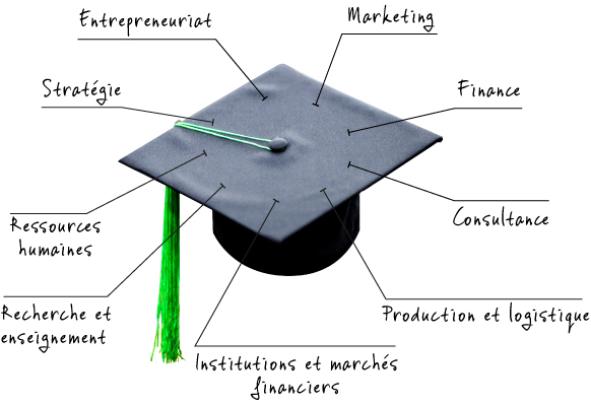
Constantly engaged with the company’s core business, you are proficient in the methods and tools of various management disciplines: finance, marketing, human resources, strategy, organization, operations management, management information systems, business law…
You don’t hesitate to put your multilingual communication skills to good use on the international stage or with the various teams with whom you manage projects.
You put your socially responsible management practices into action and ensure that your activities address social, environmental, and economic concerns.
As economists, you take a nuanced approach to the complex realities of businesses, institutions, and society, and you propose economic models tailored to their new organizational structures.
You collaborate with specialists from other disciplines and are skilled in multilingual communication and managing the international aspects of your projects.
Attentive to the human and ethical dimensions of economic and social issues, you assess the interdependencies among the decisions of multiple stakeholders and develop opportunities for cooperation.
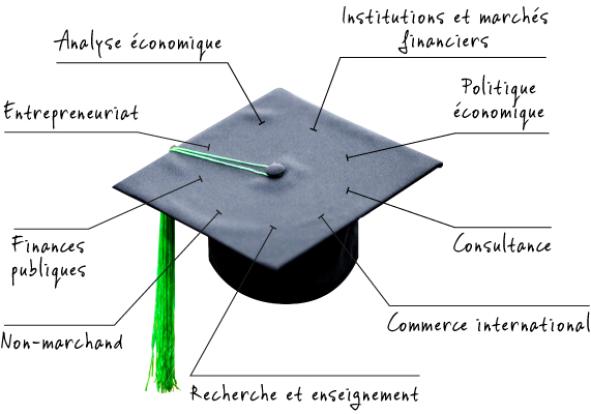
Some examples of job roles
As recent graduates, you’re often involved in project management. Whether working alone or as part of a team, you provide analyses or propose actions to achieve a given objective within a set timeframe, using available resources or those you organize and mobilize. Your excellent analytical skills, communication skills, knowledge of foreign languages, international outlook, and—above all—your eagerness to learn are also important assets for many careers.
Finance
The financial sector (banking, insurance, government, etc.) is the leading employer for our graduates. Every company—from family-owned small and medium-sized businesses to multinational corporations—needs reliable financial metrics to develop realistic budgets and plans. The range of careers open to those passionate about numbers is broad:
- financial analysis: dissecting balance sheets, evaluating loans, advising investors;
- customer advisory services at a credit institution;
- internal audit: verifying internal procedures for good governance and the preparation of reliable financial statements;
- external auditing: verifying the quality and accuracy of the financial information provided;
- risk management: assessing and modeling all risks that could impact an organization;
- fund accounting: daily calculation of the net asset value of various investment funds;
- etc.
Retail and Distribution
Negotiating, securing the best prices, sourcing new suppliers, monitoring the development of new packaging, optimizing product delivery to customers… these are just some of the high-responsibility roles related to sales and distribution. In addition to strictly commercial enterprises such as mass retailers, manufacturing industries and certain service companies also offer numerous career opportunities in the fields of procurement, marketing, and logistics.
Negotiating, securing the best prices, sourcing new suppliers, overseeing the development of new packaging, and optimizing product delivery to customers… these are all high-responsibility roles related to sales and distribution. In addition to strictly commercial enterprises such as mass-market retailers, manufacturing companies and certain service firms also offer numerous career opportunities in the fields of purchasing, marketing, and logistics.
Business Management
In the industrial sector, our graduates are involved in every stage of the supply chain: they plan production, mediate disputes between sales representatives and manufacturers, manage inventory, organize the transport of goods, and more.
Others apply their skills in the IT department, for example, by implementing integrated enterprise management software.
Some join human resources departments, where they handle recruitment, calculate payroll costs, implement skills management tools or training policies, and so on.
After a few years in operational roles, the careers of business graduates often progress to management positions where they participate in the company’s strategic decisions.
Consulting firms, which specialize in advising businesses, put their expertise and technical and human resources at the service of their clients, for example in the areas of strategy or the evaluation of internal processes. Many recent graduates begin their professional careers there.
Finally, entrepreneurship allows the most daring individuals to draw on the solid, multidisciplinary foundation of their education to launch their own companies.
Socioeconomic Analysis and Policy Making
In public administrations, the nonprofit sector, health insurance funds, political parties, labor unions, development aid organizations, business federations, and other such settings, economics graduates observe and analyze the socioeconomic situation. By providing opinions and advice, they contribute to the development and implementation of policies and legislation.
Research and Teaching
Some graduates pursue research careers in Belgium or abroad. They pursue a Ph.D. or participate in a research program. Many alumni share their knowledge through teaching in secondary schools, higher education, and continuing education.
Job Search Assistance
The Career Services Office supports final-year master’s students and recent graduates in their career paths through several services: posting job and internship openings, career counseling interviews, workshops on topics related to entering the workforce, and information and resources on the job market.