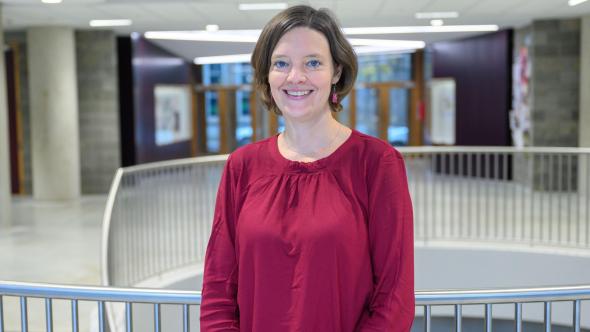
Why do certain infectious diseases pose a greater risk in some regions than in others? What role do urbanization, climate change, and population movements play in their spread? These are the kinds of questions that interest Catherine Linard, a researcher in the Department of Geography at UNamur

A geographer by training, she works in the field of health geography, which studies the relationship between health and place. “I study health, but through the eyes of a geographer. I’m primarily interested in the landscape, and I try to understand the natural and social processes that shape health in a given place.”

Understanding Diseases Across the Region

Her research focuses specifically on vector-borne diseases—that is, diseases transmitted by organisms such as mosquitoes. These include, in particular, malaria and dengue fever. To better understand their geographic distribution, the researcher analyzes various factors that may influence their transmission. The environment obviously plays a role, since it determines, in particular, where mosquitoes can breed, but it is not enough on its own to explain the spread of a disease. 

 “I take a fairly systemic approach. We’ll look at the environment, but also at human behavior, mobility, and so on.” Part of her research thus focuses on the impact of rapid changes in our environments—such as the rapid urbanization of the African continent—on mosquito-borne diseases. 

 This work has now received significant recognition. Starting in September, Catherine Linard will hold a three-year grant from the Francqui Foundation. Her proposal was first selected by the UNamur Research Council before being approved by the Foundation. 

Three years to take a step back 

This appointment will allow the researcher to be relieved of most of her teaching duties so she can devote more time to her research. This is a particularly valuable opportunity given that her daily academic life is divided between teaching, supervising researchers and doctoral students, conducting research, and handling administrative tasks. 

However, there are no plans yet to establish a specific schedule for the next three years. Catherine Linard first wants to take advantage of this newfound availability to devote more time to her ongoing projects and to mentor several doctoral students who are nearing the completion of their dissertations.

Image
Catherine Linard

“In recent years, I’ve felt that my work had become quite fragmented. I no longer necessarily had the time to explore certain aspects on my own that I would have liked to delve into more deeply. This appointment will give me valuable time to devote myself fully to research activities that are close to my heart.”

Catherine Linard Researcher in the Department of Geography at UNamur

The appointment should also enable her to strengthen her international collaborations. In particular, the researcher works with Cheick Anta Diop University in Dakar, Senegal, and plans to use these three years to deepen these exchanges and organize new fieldwork trips. In the longer term, she hopes above all to find time to explore new avenues and determine the future direction of her research. “Research is advancing at a breakneck pace. To stay abreast of everything happening in our field, we need to keep reading and following the work of other teams.” 

Collective Recognition 

Catherine Linard also sees the Francqui Prize as recognition of the work she has carried out with her team and her many collaborators. She also sees it as recognition for the field of health geography, a discipline long overlooked by the general public, but whose importance was particularly highlighted during the COVID-19 pandemic, when understanding the geographic spread of an epidemic became a particularly critical issue. “I believe it is also recognition of the relevance of this research to society, of its ability to shed light on major and highly topical societal issues, as well as of the value of a resolutely interdisciplinary project.” 

Catherine Linard – Short Biography

After defending her dissertation titled "Spatial and Integrated Modeling of Complex Disease Systems" in the Department of Geography at UCL in January 2009, she spent four months at the Department of Zoology at the University of Oxford (TALA Research Group) as a visiting researcher. She then began a two-year postdoc (2009–2011) at the University of Oxford on the WorldPop project, funded by the Wiener-Anspach Foundation, followed by six years (2011–2017) of postdoctoral research at the Spatial Epidemiology Laboratory (SpELL) at ULB (with funding from FNRS and BELSPO). She has been a professor in the Department of Geography at UNamur since 2015.

Catherine Linard