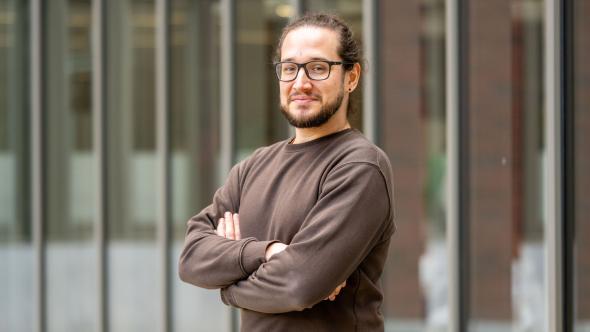
Pressure to publish, short-term funding, competition, and the precarious nature of early-career stages: Can these constraints push young researchers to prioritize “safer” projects at the expense of more original ideas? This is the central question of an international publication to which Eli Thoré, an assistant professor at the University of Namur, contributed.

Having been interested for several years in “metascience”—that is, the study of how science itself works—he participated in the discussions, the development of ideas, and the drafting and revision of the manuscript. The project, launched at the initiative of Phillip Haubrock in late 2025, led to numerous exchanges among the authors before it was finally published in *Nature Human Behaviour*. “The exchanges were very fruitful and, at first, quite chaotic!” says Eli Thoré.

Constraints that stifle creativity

To conduct their analysis, the authors compiled numerous studies on the workings of the academic world. Their conclusion is clear: scientific creativity is not merely an individual trait; it also depends on the conditions under which researchers work. 

Short-term funding, pressure to publish, emphasis on the number of articles or the prestige of journals, fierce competition for positions or funding… All these constraints can push researchers to prioritize projects whose results are easier to predict, at the expense of more original or risky ideas. 

This situation particularly affects early-career researchers. They often have less autonomy, and their future depends more heavily on upcoming publications, grant applications, or job opportunities. Taking a risk in one’s research can thus also become a risk to one’s career. 

Image
Eli Thoré

“The problem isn’t that young researchers lack creativity, but that the system doesn’t always provide them with the conditions they need to express it.”

Eli Thoré Teaching Assistant at UNamur

The consequences can be significant. For example, a study cited in the publication shows that narrowly failing to secure key funding early in one’s career increases the risk of leaving academia by more than 10 percent. 

Eli Thoré himself acknowledges having felt this tension between creativity and the need to demonstrate in advance that a project will succeed. During his Ph.D., he became interested in the daily rhythms of animal behavior—similar to our sleep-wake cycle—and how they might modify the effects of environmental pollution. At the time, this line of inquiry was quite removed from his main research project.  Yet he decided to pursue it. Over time, this idea became a central focus of his research. “If I had limited myself to questions I already knew were safe and easy to justify, I might never have gotten here,” he explains.

More time, stability, and autonomy

The authors propose several approaches to create an environment more conducive to this kind of scientific risk-taking. These include: providing funding over longer periods, offering greater stability to early-career researchers, reducing certain administrative burdens, and revising the criteria used to evaluate a scientific career. 

The idea, in particular, is to no longer measure success solely through easily quantifiable indicators, such as the number of publications or the prestige of journals, but to give greater weight to originality, collaboration, perseverance, and scientific independence. The publication also emphasizes three essential conditions for creativity: time, autonomy, and the freedom to fail.

Image
Eli Thoré

“Some of the most interesting discoveries probably begin with an idea that at first seems strange, uncertain, or even a little crazy.”

Eli Thoré Teaching Assistant at UNamur

The paper therefore puts forward an idea that seems fairly simple on the surface: if we want researchers to be creative, we must give them the freedom to be so. This is a particularly important issue for young scientists, who will shape the future directions of research. Congratulations to Eli Thoré and all the researchers involved in this work on their publication in *Nature Human Behaviour*!