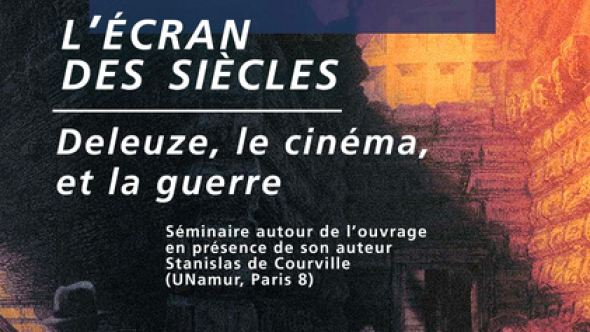
As part of its seminar series, the Arcadie Center at the ESPHIN Institute is hosting a session with Stanislas de Courville focused on his book *L'Écran des siècles: Deleuze, Cinema, and War* (Mimesis, 2025).
Stanislas de Courville is currently a postdoctoral researcher at the Arcadie Center (ESPHIN Institute). He is a lecturer in the film studies departments at Paris 8 and Aix-Marseille Universities. He also teaches in the Film Analysis and Culture department at La Fémis. He is an associate member of the ESTCA (Paris 8) and IRPhiL (Lyon 3) research laboratories. A specialist in film aesthetics, theory, and history, his work focuses in particular on Deleuzian thought on cinema, the relationship between cinema and history, and Soviet and post-Soviet cinema.
Following a presentation of the book, Stanislas de Courville will be interviewed by Déborah V. Brosteaux, Dagmara Osmayeva, Vivien Giet, and Sébastien Laoureux.
Book Presentation
While Gilles Deleuze opens his two-volume work on cinema—comprising *The Movement-Image* and *The Time-Image*—by emphasizing that he is not writing a “history” of the seventh art but rather “a taxonomy, an attempt to classify images and signs,” it has often been pointed out that it is a historical event that appears to serve as the link between the two volumes and their corresponding regimes of images. It is the Second World War, in fact, that seems to mark the transition from the “image-movement” to the “image-time,” despite the philosopher’s stated intentions. The tension that can be discerned between taxonomy and history in the diptych is far from trivial, as it profoundly disrupts its overall structure. Returning to the theoretical and cinematic sources of Deleuze’s thought, this book seeks to examine the claim that a rupture in the “history” of cinema occurred with World War II, and to determine the nature of the history at stake here. At its core lies the idea of the seventh art’s complicity in propaganda, particularly that of the Nazi regime, whose fusion with its own staging—according to Hans-Jürgen Syberberg and Deleuze after him—leaves us grappling with Hitler as a “filmmaker.” A “negative myth” of the dictator, whose shadow would fall over all cinematic images in the postwar period—a shadow that would ultimately prove to be that of so-called “modern” cinema as well.
Free admission. Everyone is welcome!