

ESPHIN
A transdisciplinary space open to the outside world and designed to stimulate original research, ESPHIN addresses themes developed in its two founding departments: that of Philosophy in the Faculty of Philosophy and Letters and that of Sciences-Philosophies-Society in the Faculty of Science.
In synergy with other entities, researchers also aim for the emergence of new themes in the major fields of philosophy, such as anthropology, ethics, aesthetics, epistemology, logic and metaphysics.
The ESPHIN Institute intends to promote and support philosophical research, both fundamental and applied.


Spotlight
News

Article
-
ESPHIN Institute
Post-truth: What if the truth were no longer the issue?
Democracy
Law
Political science
Post-truth: What if the truth were no longer the issue?
Democracy
Law
Political science
The measles vaccine supposedly causes autism. Global warming is supposedly just a natural phenomenon. Immigrants supposedly eat the neighborhood’s cats. These claims all have one thing in common: they have been disproved by the facts. Yet they continue to circulate, to be shared, and sometimes to influence elections. Even more surprising, some are repeated by figures in the highest political offices. What becomes of our relationship with the truth when opinion is presented as fact, when humor obscures intentions, and when information spreads without going through traditional intermediaries? To understand these changes, four researchers from UNamur share their perspectives. Behind the debates on fake news, they see a deeper shift taking shape: the truth still matters, but it is no longer always enough to convince people.

“There is no established, consensus-based definition of ‘post-truth,’” warns Olivier Sartenaer, director of the Department of Sciences, Philosophy, and Society and a member of the ESPHIN Institute (Namur Philosophical Forum). He prefers to describe four trends that, together, shape the phenomenon.
First observation: our relationship with established consensus is becoming more fragile. Ideas that were once marginal now enjoy unprecedented visibility thanks to social media. Second transformation: the line between opinion and knowledge is blurring. “Everyone’s opinion is considered knowledge.” ” Third change: lying has lost some of its symbolic cost. “Until recently, when a political figure was caught lying shamelessly, they had to pay a price—whether electoral or symbolic. Today, lying can even become a sort of badge of honor.”
The fourth transformation, the most subtle, concerns what philosophers call “rhetoric.” “While a liar knows the truth and conceals it, a rhetorician produces discourse to seduce, frighten, or convince, regardless of whether it is true. ” Thus, when Donald Trump claims that one should drink bleach to treat COVID, the most important thing may not be the content of the statement. “Saying that positions him against the elites and gets people talking about him. Is it true? He doesn’t even ask himself that question.”
Olivier Sartenaer explains the emergence of post-truth through the “epistemic deluge”—this overabundance of information driven in particular by digital technologies. Our critical faculties have not necessarily weakened, but the environment in which they operate has become infinitely more complex. This complexity also poses challenges for the law.

Olivier Sartenaer
The Law in the Face of Information Chaos
While “post-truth” is not a legal category in and of itself, Alejandra Michel, a researcher at CRIDS (Center for Research on Information, Law, and Society) within the NaDI Institute (Namur Digital Institute), approaches the phenomenon through what are known as “information disorders.” A key distinction sheds light on the mechanisms at work: “misinformation” refers to incorrect information disseminated without the intent to deceive; “disinformation,” by contrast, implies an intent to manipulate; and “malinformation” is based on true information that has been taken out of context or used to cause harm. In practice, however, these categories remain difficult to distinguish. Intentionally produced false information can be shared in good faith by thousands of people who believe it to be authentic, and its status then changes as it circulates.
From a legal perspective, the issue is all the more delicate because freedom of expression protects both the speaker and the recipient of the information. Should the authors of false information be punished? It’s not that simple: criminalization could backfire on journalists, whistleblowers, or those who disseminate information that is inconvenient for those in power.
Alejandra Michel is therefore more interested in the right to receive high-quality information—not with an absolute obligation to truth, but with a requirement to strive for accuracy and to comply with the rules governing the collection and dissemination of information.
On the European front, the Digital Services Act addresses the information environment itself, notably by requiring large digital platforms to implement measures related to moderation, transparency, and the adaptation of recommendation systems.

Alejandra Michel
The fight against disinformation cannot, therefore, be solely a legal one. It also requires media literacy, support for quality journalism, and the protection of pluralism. One question remains that the law cannot resolve: when no one seems to regard the truth as a common reference point anymore, what still underpins a person’s credibility?
Authenticity: The New Currency of Credibility
Part of the answer lies in humor, which has become a dominant form of communication on the web. According to Fanny Barnabé, a lecturer at CRIDS/NaDI, memes, parodies, trolling, and shitposting play such a significant role in digital cultures that they, too, blur our relationship with the truth.
In classical irony, the speaker says the opposite of what they mean while leaving their listener enough clues to grasp the message’s true meaning. Irony has now lost its transgressive nature because it has become ubiquitous. To continue to surprise, internet users have therefore developed new levels of ambiguity. Today, the lines are blurred: “We no longer know whether a statement is ironic, sincere, or partly both.” This is what is known as post-irony.
A content creator’s credibility therefore no longer rests on their relationship to the truth, but on their authenticity. Fanny Barnabé observes this shift on the streaming platform Twitch, where the relationship between streamers and their community hinges on a sense of direct and sincere connection: awkward moments, spontaneous reactions, and an unfiltered personality are valued more highly than accuracy.
For Fanny Barnabé, the real question, then, may be whether it’s still possible to be serious on the Internet. On Twitch, the reversal has become so complete that “users sometimes explicitly state that they’re being serious. People no longer indicate that a message is ironic. It’s the literal meaning that now needs to be made clear.”

Fanny Barnabé
When Authenticity Becomes a Political Issue
We see exactly this same mechanism at work in politics. Figures like Donald Trump and Elon Musk now use memes, provocation, trolling, and references to gaming culture to speak directly to their audience. Post-irony offers them powerful rhetorical protection. Serious statements can be made in a joking manner, and if the reaction is negative, all one has to do is say, “I was just kidding.”
For Arthur Borriello, a professor of political science at UNamur and a researcher at the Transitions Institute, credibility in politics is measured the same way as it is on Twitch: by perceived authenticity rather than truthfulness. “Trump can afford to come across as a liar or a crackpot. What matters is that he appears authentic,” explains the political scientist. Insults, extravagance, and the transgression of linguistic norms thus become markers of closeness to ordinary people, as opposed to the polished discourse of the elites.

Arthur Boriello
Authenticity doesn’t promise virtue; it promises closeness. It means standing with ordinary people, with all their flaws, their anger, and sometimes even their transgressions. Facing off against Hillary Clinton, Trump essentially declared: Yes, the Wall Street system is corrupt—since I make use of it myself. He didn’t promise to put an end to it; he promised to be authentic.
The political scientist goes further. He questions the very idea that politics is a matter of truth. “Political discourse is not a discourse of truth. That is not its aim.” Its strength lies rather in its internal coherence and its ability to give meaning to lived experience. Trumpism, for example, links economic decline, unemployment, immigration, and a sense of American decline into a single narrative. “Do immigrants eat pets? It doesn’t matter whether that statement is true or false. What matters is that it fits with the other elements in this coherent narrative,” summarizes the political scientist.
The Cost of Distorting the Truth
For Olivier Sartenaer, the consequences of this new relationship with the truth are not merely rhetorical. “If, for example, one claims that the recommendations of the IPCC (Intergovernmental Panel on Climate Change) are merely the ‘religion’ of bourgeois-bohemian environmentalists and that one prefers the popular common sense that favors coal-fired power plants, one creates a climate that becomes uninhabitable. ” The problem here isn’t just being mistaken about a scientific phenomenon; it’s choosing to ignore available knowledge even when the consequences are predictable.
The same mechanism is at work in debates about vaccination. When scientific knowledge gives way to “common sense” or political convictions, collective decisions can have dramatic consequences. “The resurgence of measles in the United States is directly linked to the spread of doubts about vaccines. Today, children are dying from a disease that had been eradicated long ago,” laments the philosopher.
Beyond poor decision-making, it is the very possibility of living together as a society that is at stake. “To discuss and reach agreement, we need a shared world. If we polarize to the extreme, we lose that shared world. We can no longer understand one another or act together.”
Respond Differently
Beyond fake news and conspiracy theories, the “post-truth” and “post-irony” eras thus reveal a profound transformation in our relationship with the shared world. Authenticity versus expert opinion, humor that obscures intentions: the issue is becoming less one of truth and more one of trust. Hence the importance, for researchers, of rebuilding shared spaces through quality information, media literacy, a vibrant civil society, forums for debate, and collective narratives. For without a shared world, it becomes difficult not only to agree on the facts, but also to form a society. One final, distinctly political question remains: can we even combat this obfuscation with “truth” alone? Arthur Borriello believes not, and explains why in the sidebar.
Arthur Borriello: “You have to fight ideology with ideology.”
According to political scientist Arthur Borriello, we must first distance ourselves from two concepts that have become ubiquitous. “The concepts of ‘post-truth’ and ‘populism’ play the same role in public debate today: they serve as catch-all terms that allow us to broadly describe political developments without always analyzing them with the precision they deserve.”
The dominant definition of populism is based on a contrast between a “virtuous people” and “corrupt elites,” which leads to very different movements—including those on the far right—being labeled as populist. In his book *Populism: The Misnamed Phenomenon*, the political scientist defends a view—which he acknowledges is in the minority—that populism is above all a democratic moment, driven by a desire to deepen democracy and return more power to the people. “This definition effectively excludes the far right, which does not seek to deepen democracy but rather to restrict the circle of those who benefit from it.”
But why is this promise to return power to the people used by so many political movements, including the far right? It responds to a very real experience. Many citizens feel they have lost some of their ability to influence political decisions. Arthur Borriello attributes this to the disintermediation observed since the 1970s: political parties, unions, and associations—which traditionally served to transform individual concerns into collective demands—have lost their significance.
The power of political discourse therefore rests more on its ability to give meaning to lived experience and on its internal coherence. This perspective leads him to question the effectiveness of a strategy that consists solely of “fact-checking” the rhetoric of the far right. He illustrates this with a deliberately radical example: “Faced with Hitler, who claimed that Jews were the cause of all evil, would fact-checking have weakened that discourse? Certainly not. The only way to combat this type of rhetoric is to offer an alternative narrative that is sufficiently convincing and resonates with people’s lived experiences. Ideology must be countered with ideology.”
In practical terms, Arthur Borriello advocates for the rebuilding of spaces for mediation: associations, collective organizations, and forums for debate and mobilization that enable citizens to regain their capacity for action and representation. French-speaking Belgium offers an interesting point for reflection in this regard. While the far right is making significant gains in several European countries, it has so far remained relatively marginal there. He attributes this resilience in particular to the persistence of a dense network of associations and to the local roots of certain political groups, such as the PTB through its youth organizations, community health centers, and so on.
The response to the far right, therefore, is not solely a matter of the accuracy of information. It also hinges on a society’s ability to forge connections and offer collective narratives in which everyone can see themselves reflected.
Further Reading
The Truth in Crisis: Disinformation, Critical Thinking, and the Right to Information
A collective work to be published in the fall of 2026 by Larcier Intersentia. This book brings together several contributions, including texts by Alejandra Michel and Fanny Barnabé.
Arthur Borriello, Populism: The Misnamed
University of Brussels Press, “Débats” series.
In this essay, the political scientist examines contemporary uses of the notion of populism and offers a critical analysis of a concept that has become ubiquitous in public debate.
Denis Saint-Amand, Countering Fascist Laughter: Trolling and Resistance
Éditions Rue de l’Échiquier, “Les Incisives” series.
An analysis of the political uses of humor, trolling, and digital cultures, as well as the forms of resistance they can inspire.
Denis Saint-Amand is a qualified researcher at the FNRS at UNamur and president of the Namur Institute of Language, Text, and Transmediality (NALTT)
“The measles vaccine causes autism”: The topic of fake news in the field of health—and specifically regarding vaccination—was one of the subjects discussed during UNamur’s official 2026 academic year opening ceremony. Watch the video of this presentation.
This article is taken from the "Issues" section of Omalius magazine, Issue #42 (September 2026).

News
-
Faculty of Sciences
Science, Philosophy and Society Department ESPHIN Institute
Science & Philosophy in Namur
"Beyond genes": what if we rethought the notion of heredity?
Science, philosophy and society
Philosophy
News
-
Faculty of Sciences
Science, Philosophy and Society Department
ESPHIN Institute
Science & Philosophy in Namur
"Beyond genes": what if we rethought the notion of heredity?
Science, philosophy and society
Philosophy
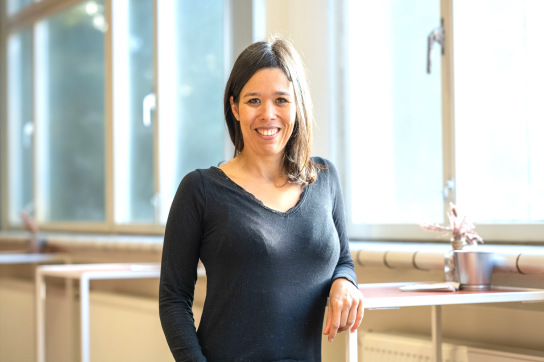
Are we prisoners of our genetic heritage? Can filiation be reduced to genes alone? Can we escape our destiny? Existential questions we all ask ourselves, and to which Gaëlle Pontarotti, lecturer and researcher in the Department of Sciences, Philosophies and Societies at UNamur, sheds new light in her book Par-delà les gènes. Une autre histoire de l'hérédité, published last October by Gallimard.
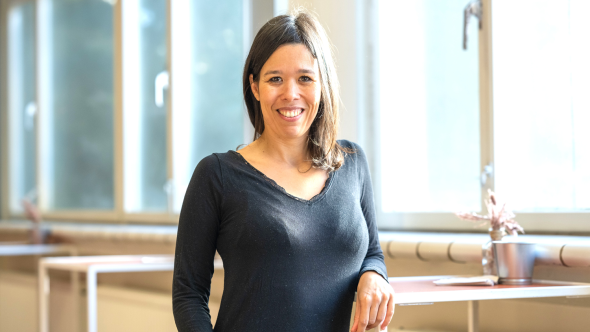
Until the end of the 20th century, heredity was seen by scientists as a matter of genes and DNA transmission. But in recent decades, research has revealed non-genetic transmissions, helping to explain why children on average resemble their parents more than other individuals in a population. These include epigenetic (changes in gene activity without changing the DNA sequence), microbial, hormonal and behavioral transmissions. Some biologists and philosophers now speak of "extended heredity".
Between fatalism and freedom
"The challenge is to redraw the concept of heredity, going beyond the strictly genetic vision that has prevailed until now", explains Gaëlle Pontarotti. "The aim of my book and my research is to articulate different forms of transmission and to rethink the compatibility between heredity and transgenerational freedom."
For since Greek antiquity, everything suggests that we are locked into a family destiny. But if heredity goes beyond genes, what room for manoeuvre do we have? "The challenge is to find a happy medium between hereditary fatalism and the illusion of omnipotence in the face of our heritage", sums up the researcher.
A paradigm shift with multiple consequences
This new concept overturns our vision of filiation and the status of the individual. We are no longer simply objects determined by causes beyond our control: we are once again actors in what we receive and transmit. It also invites us to reconsider the place of genes in filiation: is the parent fundamentally the one who transmits his or her genetic heritage?
And what if, ultimately, our heritage was also what we chose to make of it?
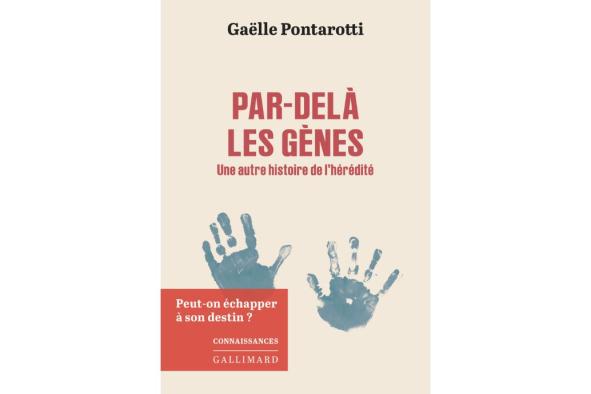
Cover credit: Éditions Gallimard, book visual Par-delà les gènes.
Discover the book
Par-delà les gènes. Une autre histoire de l'hérédité, by Gaëlle Pontarotti - Gallimard (collection Connaissances)
News
-
Faculty of Sciences
Science, Philosophy and Society Department ESPHIN Institute
Science & Philosophy in Namur
SPiN: a new research center for a new way of thinking about science
Science, philosophy and society
News
-
Faculty of Sciences
Faculty of Philosophy and Letters
Faculty of Computer Science
Science, Philosophy and Society Department
ESPHIN Institute
Science & Philosophy in Namur
SPiN: a new research center for a new way of thinking about science
Science, philosophy and society
At a time when misinformation, post-truths and conspiracies are undermining confidence in science, UNamur welcomes SPiN (Science & Philosophy in Namur), a new interdisciplinary research center that questions the place of science in society. Founded last September by Olivier Sartenaer, Professor of Philosophy of Science at UNamur, SPiN brings together philosophers and scientists around a common vision: to develop a critical and accessible reflection on science in all its diversity.
.
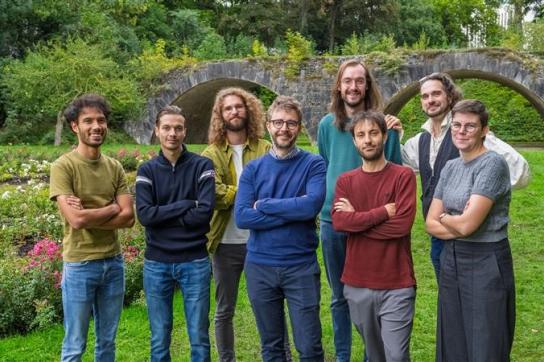
Olivier Sartenaer's team: Doan Vu Duc, Maxime Hilbert, Charly Mobers, Olivier Sartenaer, Louis Halflants, Andrea Roselli, Gauvain Leconte-Chevillard, Eve-Aline Dubois.
While UNamur is distinguished by the presence of a Philosophy of Science department within its Faculty of Science, until now there has been no research center specifically dedicated to the epistemological, ethical, political and metaphysical challenges of science. SPiN fills this gap.

"Several contingent factors enabled the creation of SPiN: the absence of a research structure specifically dedicated to these themes and the almost simultaneous arrival of four young philosophers of science. It's a bit like an alignment of the planets", explains Olivier Sartenaer.
At his side are Juliette Ferry-Danini (Faculty of Computer Science), Thibaut De Meyer (Faculty of Philosophy and Letters) and Gaëlle Pontarotti (Faculty of Science), who form the core of SPiN.
Responding to strong societal demand
SPiN is part of a research dynamic committed to the heart of contemporary debates.
Image

There is a real need for citizens to be enlightened on these issues. It was important for us that a research structure reflect this growing societal demand and host research on these themes.
SPiN researchers explore a wide range of themes, against a backdrop of questioning our relationship to scientific knowledge. These include:
- the relationship between science and pseudoscience;
- reductionism in science;
- genetic determinism and heredity;
- medical ethics and public health (vaccinations, pandemics);
- ethology,
- perspectivism.
This research is carried out by an interdisciplinary team of teacher-researchers, doctoral students and post-docs from the various faculties of UNamur.
An academic meeting place...but also a civic meeting place
SPiN organizes weekly seminars devoted to current research in philosophy of science, as well as seminars linked to more specific themes: health, life sciences, cosmology and theories of emergence and reductionism in the natural sciences.
But SPiN is not limited to the academic sphere: the center intends to take these issues outside the university walls, through events and activities accessible to all. An inaugural event is already planned for next spring on a topical theme: mistrust in science. More info to come!
Find out more about the SPiN research center

Article
-
Faculty of Education and Training Sciences
UNamur School of Social Sciences, Politics and Communication Institute
University and democracy: a living, sometimes threatened, link
What the experts have to say
Democracy
Article
-
Faculty of Education and Training Sciences
Faculty Economics Management Communication Politics (EMCP)
Faculty of Philosophy and Letters
Faculty of Law
UNamur School of Social Sciences, Politics and Communication
Philosophy Department
Institute
ESPHIN Institute
IRDENa Institute
University and democracy: a living, sometimes threatened, link
What the experts have to say
Democracy
Trust of traditional political institutions and elected representatives, rise of authoritarian logics, definition of public services... Democracy today seems to be going through a turbulent zone. What role does the university play in this context? To shed light on this question, we interviewed four researchers from different disciplines: educationalist Sephora Boucenna, philosopher Louis Carré, political scientist Vincent Jacquet and legal scholar Aline Nardi. Their contrasting views sketch out the contours of an issue that is more topical than ever: thinking about and defending the link between university and democracy.

Democracy is by no means a fixed concept. It is the subject of debate, especially today. Louis Carré, Director of the Department of Philosophy and member of the Espace philosophique de Namur (Institut ESPHIN), proposes a three-dimensional definition: a political regime, a state of law and a way of forming society.
.The concept of democracy: between people power and centralization
"Etymologically, democracy is a political regime that consists in giving power to the people," he reminds us. "Our Western democracies today are based on the idea that the people are sovereign, without governing directly. From this arises a tension between ideal democracy and real democracy."Vincent Jacquet, professor in the Department of Social, Political and Communication Sciences and president of the Transitions Institute supports the point: "Democracy is an ideal of citizen self-government, but it is in tension with more centralizing, authoritarian logics. [...] Our political systems are crisscrossed by these different tensions, with both authoritarian logics increasingly present, including in our own country, and logics of participation that are sometimes accompanied by a great deal of hope and disappointment too."
The second pillar according to Louis Carré: the rule of law. Democracy guarantees the fundamental rights of all citizens through the constitution. But here again, beware of paradoxes: "One could indeed imagine laws passed by a majority of representatives or by a referendum, but which contravene fundamental rights" the philosopher stresses. Democracy cannot therefore be summed up by the majority principle alone.
Finally, democracy is also a way of forming society. It is based on real pluralism: diversity of opinions, beliefs and values. "This presupposes the existence of a relatively autonomous public space in the face of the power in place, which at times challenges the decisions taken by the governments that have been elected,"insists Louis Carré.
As such, citizens' distrust of politics is not necessarily a symptom of democratic crisis. It may even be a sign of its vitality, as Vincent Jacquet explains:"The fact that citizens are critical of their government is not necessarily negative because, in a democracy, citizens must be able to control the actions of those in power."

Vincent Jacquet
Training the governors... and the governed
In this context, what is the university's responsibility? Louis Carré begins by reminding us of a simple fact: a large proportion of our elected representatives have passed through university benches. But its teaching mission doesn't stop there. "It's about training enlightened citizens, not just rulers. Universities must offer quality higher education, open to as many people as possible", he asserts.
"Democracy does indeed presuppose citizens capable of debating, reflecting, problematizing issues", adds Sephora Boucenna, Dean of the Faculty of Education and Training Sciences and member of UNamur's Institut de Recherches en Didactiques et Éducation (IRDENA). It's all about training reflective minds, capable of questioning their times.
Training reflective teachers for critical citizens
Universities also train those who, tomorrow, will educate future generations: teachers. And here again, democracy is at stake.
"Our mission is to train reflective teachers who, in turn, will teach their students to think critically"insists Sephora Boucenna. This requires in-depth work on analyzing practices, collective construction and learning to debate, from initial teacher training through to in-service training.

Sephora Boucenna
Producing and disseminating knowledge... in complete independence
In addition to teaching, universities also have a research and social service mission. It produces knowledge that can enlighten public policy, but also question it. This critical function presupposes real independence from politics. "To analyze democratic mechanisms with lucidity, including those that governments put in place, the university must retain its freedom of research and speech," insists Vincent Jacquet.
Louis Carré goes further: "Like the press, the university is a form of counter-power in the public space". He also points out that "there is a confusion between freedom of opinion and academic freedom. Academic knowledge goes through a series of verification, experimentation and discussion procedures within the scientific community. This gives it a robustness that is not that of an opinion, a value, a belief."

Louis Carré
This critical function of the university presupposes strong independence. In Belgium, however, university funding is largely a matter for the political authorities. "Celane must not mean being placed under tutelage", warns Louis Carré. "Conducting critical research that doesn't satisfy short-term sponsors requires independence, including in terms of resources. We need a large number of researchers who can analyze different types of dynamics. The more we cut research funding, as is the case today, the fewer researchers we'll have and therefore the less capacity for independent analysis and diversity of perspectives, insists Vincent Jacquet.
The "Université en colère" movement, recently launched within the universities of the Wallonia-Brussels Federation, intends to denounce the effects of definancement. Its representatives are calling for "guarantee the conditions for the development of an open, independent, quality university accessible to the greatest number. Faced with the social, economic and political challenges of our time, and because other choices for society, and therefore budgets, are possible, it is more essential than ever to strengthen the institutions and players at the heart of knowledge production."
Between vigilance and commitment: a link to be reinvented
Democracy is therefore not limited to elections or institutions. It is based on collective vigilance, carried by citizens, knowledge... and the places where this knowledge is built. In this respect, universities are an essential link in the chain of democratic vitality. Provided it remains independent, accessible and open to society.
"Democracy is not just a matter of institutions. It's about citizens who bring it to life and organize themselves to assert their perspectives at different times", insists Vincent Jacquet. A clear invitation not to remain a spectator, but to participate, with lucidity and exigency, in the construction of a common democratic future.
On the same subject
- Artificial intelligence, a danger for democracy?
An academic year focused on democracy
Find the speech given by Rectrice Annick Castiaux at the 2025-2026 Academic Back-to-School Ceremony.

Cet article est tiré de la rubrique "Le jour où" du magazine Omalius #38 (Septembre 2025).

Agenda
Deleuze, Cinema, and War
Philosophy
13
2026
14:00
-
17:00
UNamur, Faculté de Philosophie et Lettres, Salle Académique - Rue Grafé 1 - 5000 Namur
Contact person
:
Laoureux Sébastien
Arcadie Center Seminar with Stanislas de Courville
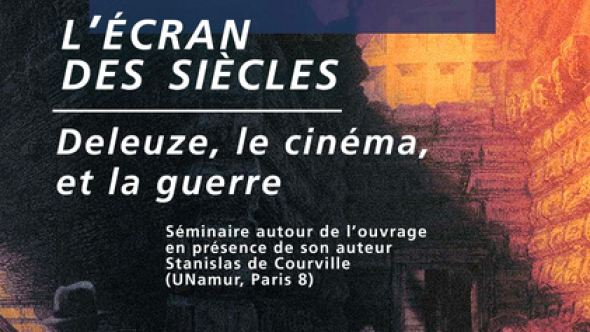
As part of its seminar series, the Arcadie Center at the ESPHIN Institute is hosting a session with Stanislas de Courville focused on his book *L'Écran des siècles: Deleuze, Cinema, and War* (Mimesis, 2025).
Stanislas de Courville is currently a postdoctoral researcher at the Arcadie Center (ESPHIN Institute). He is a lecturer in the film studies departments at Paris 8 and Aix-Marseille Universities. He also teaches in the Film Analysis and Culture department at La Fémis. He is an associate member of the ESTCA (Paris 8) and IRPhiL (Lyon 3) research laboratories. A specialist in film aesthetics, theory, and history, his work focuses in particular on Deleuzian thought on cinema, the relationship between cinema and history, and Soviet and post-Soviet cinema.
Following a presentation of the book, Stanislas de Courville will be interviewed by Déborah V. Brosteaux, Dagmara Osmayeva, Vivien Giet, and Sébastien Laoureux.
Book Presentation
While Gilles Deleuze opens his two-volume work on cinema—comprising *The Movement-Image* and *The Time-Image*—by emphasizing that he is not writing a “history” of the seventh art but rather “a taxonomy, an attempt to classify images and signs,” it has often been pointed out that it is a historical event that appears to serve as the link between the two volumes and their corresponding regimes of images. It is the Second World War, in fact, that seems to mark the transition from the “image-movement” to the “image-time,” despite the philosopher’s stated intentions. The tension that can be discerned between taxonomy and history in the diptych is far from trivial, as it profoundly disrupts its overall structure. Returning to the theoretical and cinematic sources of Deleuze’s thought, this book seeks to examine the claim that a rupture in the “history” of cinema occurred with World War II, and to determine the nature of the history at stake here. At its core lies the idea of the seventh art’s complicity in propaganda, particularly that of the Nazi regime, whose fusion with its own staging—according to Hans-Jürgen Syberberg and Deleuze after him—leaves us grappling with Hitler as a “filmmaker.” A “negative myth” of the dictator, whose shadow would fall over all cinematic images in the postwar period—a shadow that would ultimately prove to be that of so-called “modern” cinema as well.
Free admission. Everyone is welcome!
ESPHIN is also...
Reflect
Philosophical research aims both to study, in an interdisciplinary way, issues arising from the formal sciences (logic, mathematics), the humanities and nature, and to construct properly philosophical issues in a transdisciplinary space where the contributions of the various human sciences (political, sociological, clinical, etc.) are mobilized.
Debate
ESPHIN also defines itself as a place for debate, sparking encounters (seminars, colloquia, conferences,...) between practitioners and technicians of the above-mentioned sciences and philosophers in order to implement an effective inter- and transdisciplinarity, based on the conjunction of in-depth study of scientific content and high-level philosophical investigation.
Teaching
Parting from the principle that, within a University, teaching and research must be intimately linked, the Institute also makes it its mission to share the fruits of its research activities with Baccalaureate students (from the Faculty of Philosophy and Letters, the Faculty of Science and other Faculties wishing to join ESPHIN) or Master's students (from the Faculty of Science), and to open up some of their activities to them.
While the Institute aims to be in touch with "field" issues, it intends to strongly preserve the specificity of fundamental philosophical approaches integrating rigorous and demanding approaches to the history of philosophy.