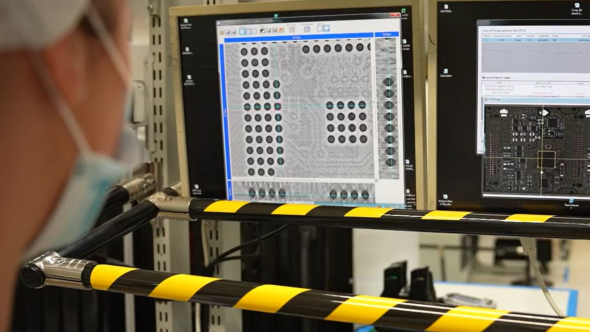
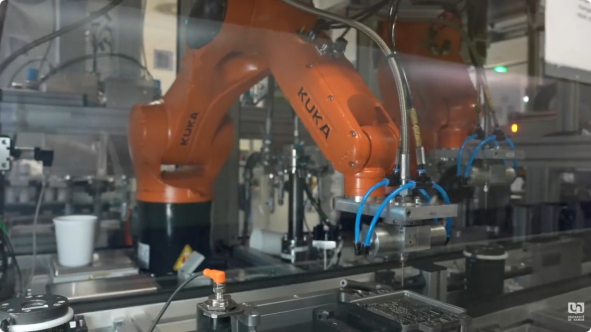
Missing components, fragile solder joints, reversed polarity, scratches, or foreign objects such as a screw that falls onto the product: on a production line for automotive electronic components, such as the one at AISIN Europe, defects—even if they are rare—must be detected immediately and accurately. “My goal was to teach a computer to distinguish between what is normal and what is abnormal in images,” explains Arnaud Bougaham, a data scientist at AISIN Europe and an associate researcher at the Faculty of Computer Science at UNamur. 

On a production line, images are captured by cameras positioned above a conveyor belt, and a computer system is then tasked with verifying, at a high rate, that each part meets specifications. “However, while the traditional inspection system does its job well, it also generates a lot of false positives—false alerts. This has a significant impact on the work of the people responsible for confirming or dismissing the alerts: they are constantly called upon, at the risk of wasting time and energy.” It is this process that Arnaud Bougaham decided to improve for his company by beginning a doctoral thesis in 2020 at the HuMaLearn laboratory in the School of Computer Science—a lab recognized for its expertise in machine learning—under the supervision of Professors Benoit Frenay and Isabelle Linden.

Today, the results of his dissertation were just presented, and they look promising. “I have developed a model that, using artificial intelligence, very accurately and reliably distinguishes a normal image from one that is not, thereby reducing the false alarms of the past.” 

Arnaud Bougaham

In addition, when a defect is suspected, the model can precisely pinpoint the affected area: the operator can view the indication, manipulate the part if necessary, and then make a decision. 

Another benefit of the tool? The system doesn’t just display a verdict; it also indicates the level of confidence the system has in its prediction. “The goal is to filter out simple cases and draw attention to more complex ones, so that experts are no longer overwhelmed by incorrect diagnoses and can focus on what really matters, emphasizes Arnaud Bougaham.

Potential Beyond the Automotive Industry

While the tool was primarily designed to meet the needs of the automotive manufacturing industry, its underlying logic is generic. “It could be adapted for use in factories that manufacture hardwood flooring, wood, or fabric. But also in the medical sector,” says Arnaud Bougaham enthusiastically. “A disease is, ultimately, an anomaly in an image. The challenges are similar: when there’s a defect, it’s essential to detect it while minimizing false positives as much as possible. In the medical sector, having a similar tool that streamlines the analysis while leaving the final decision to the doctor can make a real difference.”

In this approach, AI is not an autopilot, but a decision-making tool that serves humans. “The goal is for the person to make the final decision, not for it to happen automatically,” adds Arnaud Bougaham. It is an assistant that “filters, explains, and provides all the information so that, ultimately, a person can make the decision.” 

Scan

When Research Meets “Real-World Truth”

Arnaud Bougaham’s dissertation grew out of a dual role: as a doctoral student at UNamur and, at the same time, as an engineer at AISIN Europe. This position gave him access to what he calls “the reality on the ground.” “In the lab, you can get very good results, but in production, there’s a reality with a specific environment.” Noisy data, variable conditions, cost constraints, and above all, production pace: “Our system has to operate at the same pace as the production line.” By dividing his time between AISIN Europe and UNamur, Arnaud Bougaham demonstrates how a dissertation can have a tangible impact on real-world needs—all while balancing the operations and obligations of both organizations. 

Image
Arnaud Bougaham

On the academic side, we tend to focus more on in-depth analysis to find long-term solutions, whereas on the industrial side, we’re more concerned with finding a reliable solution right here and now. This is where, when working simultaneously for both sectors, we must demonstrate a willingness to compromise, engage in dialogue, and build trust. But this synergy between academic research and industrial reality allows us to achieve very fruitful results.

Arnaud Bougaham Data scientist at AISIN EUROPE and research associate at the Faculty of Computer Science at UNamur

Roll out, expand, strengthen

Beyond the promises, this research is already being applied to real-world use cases. At AISIN Europe, the framework developed is currently being integrated into an active production line to detect unexpected components (such as a screw) on printed circuit boards. In the medical field, the approach is geared toward analyzing responsiveness in comatose patients through medical imaging that allows for the observation of organ and tissue function. Certain techniques are also being adapted for applications involving the segmentation of ovarian cancer or lymphoma.

These results also demonstrate how artificial intelligence can be reliable and human-centered in high-risk environments.

The Project in Pictures: AI Serving People in the Industrial Sector—Myth or Reality? :

IA

This article is from the "Impact" section of Omalius magazine, Issue #41 (June 2026).

Omalius 41