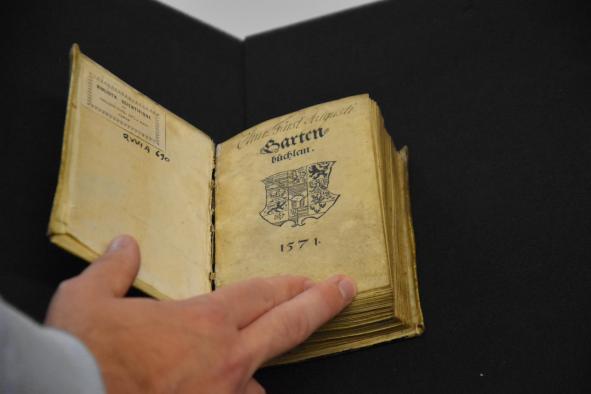
At first glance, the volume might almost go unnoticed. Its binding is relatively traditional, and its contents—written in German—consist mainly of texts devoted to horticultural practices. Yet today, it may well be among the most valuable works preserved at the Moretus Plantin University Library (BUMP, UNamur). 

Titled *Garten Büchlein*, or “little book of gardening,” the work is attributed to Prince-Elector Augustus of Saxony, a great lover of horticulture. The text focuses in particular on the cultivation of fruit trees and reflects a period when the development of gardens also contributed to the management and prosperity of princely estates. The work is dated 1571. It is written in German, even though Latin was more common at the time. “At the time, Latin was still often the language of scholarship. This shows that it was a work geared more toward practical application,” explains Olivier Latteur, who holds a Ph.D. in History and serves as the heritage collections outreach coordinator at the BUMP (Heritage Division).  

An Unexpected Discovery in the UNamur Collections

The story of its rediscovery began almost by chance. The book had already been in the UNamur collection for a long time, and the fact that it was printed on parchment had drawn attention. However, its true rarity had not yet been established. 

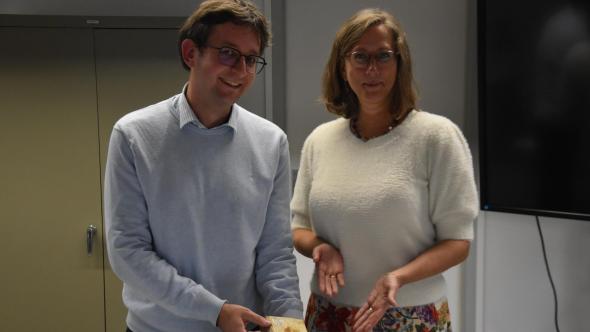
In February, Sandrine Paternotte, a librarian with the BUMP Heritage Division, added the work to the library’s computerized catalog. A month later, Dr. Dominik Fugger, a researcher at the University of Frankfurt specializing in this type of text, spotted it online. He quickly contacted UNamur and traveled there a few days later to examine the volume in person. After several months of research, he confirmed during the summer that it was exceptional: it is now believed to be the only copy in the world. “Until then, the existence of this edition was known only through texts and reprints produced several decades later,” explains Olivier Latteur. “But no copy of this first version had been identified at that time. Even more surprising, certain sections found in the volume preserved in Namur have never been found in later editions. Part of its content is therefore, to this day, accessible only through this copy.”  

A book printed entirely on parchment

Its content is a rarity in itself. Its production is another: the entire book is printed on parchment, a particularly unusual choice in the 16th century. “At that time, parchment was more expensive than paper and required more work during the printing process, particularly because ink does not adhere to it as easily. On the other hand, it is much more durable. This material was therefore typically reserved for prestigious documents or works intended to be handled regularly,” explains Olivier. 

Le Garten Büchlein
Le Garten Büchlein

An exceptional play that deserves to be shared

How did such a book end up in Namur? Certain clues suggest that it has been part of the collections for several decades. In particular, an old bookplate links the volume to the former scientific library of the Namur University Faculties, likely as early as the late 19th or early 20th century. Its earlier history, however, remains unknown: there are no marks today that clearly identify its previous owners or indicate whether it arrived through a donation, a purchase, or some other means. “Even the number of copies originally printed remains impossible to determine,” continues Sandrine Paternotte. “Experts believe it was a small print run, but other copies may very well have existed before being lost, destroyed, or damaged over the centuries. The Namur copy is simply, to date, the only known one.” 

For the library, this identification also highlights the importance of cataloging its historical collections. Just a few weeks after it was entered into the online catalog, the book was discovered by a specialist several hundred kilometers away from Namur. The goal now is to raise awareness of the work and make it accessible to researchers who might be interested in it, particularly in the fields of book history and botany. No specific research project has been finalized yet, but its rediscovery could spark new research. “It’s always special to make this kind of discovery. It shows that our precious collections can still hold surprises for us,” concludes Sandrine Paternotte.