
-
2025-2026
Master in Physics, Research focus
-
Schedule
regular course
- ECTS Credits 120
Matter, energy and the environment
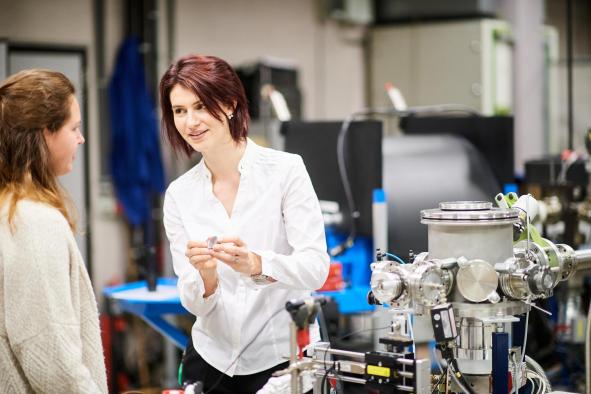
A great many discoveries made by physicists have profoundly changed our modern daily lives: semiconductors, lasers, plasma or QLED screens, hard disks... There is no shortage of challenges: use of renewable energies, energy storage, waste treatment... To meet them, society needs physicists who are experts in the properties of matter and its interaction with radiation.
Your objectives
- Understanding natural phenomena in all their complexity.
Examples: How does electromagnetic radiation propagate in complex media and how does it interact with matter? How do the quantum properties of nanoscopic materials lead to technological revolutions (electronics, photonics...)? - Create innovative physical models inspired by nature.
Examples: biomimicry is a new approach that aims to draw inspiration from the complex organic structures of numerous animal or plant species. In optics, natural photonics is a new discipline born of this approach. - Act on your environment and develop applications that help build a more sustainable world.
Examples: improving the performance of photovoltaic cells, developing hybrid materials for fuel cells, reducing atmospheric pollution...
The benefits of training
- A choice between specialization and broader training through elective courses, dissertation, personal work and internship.
- An opening up to society thanks to an internship - in Belgium or abroad - which enables you to fine-tune your training as a physicist and offers you the opportunity for numerous scientific and human encounters and experiences. Erasmus stays and visits to internationally renowned laboratories are also strongly encouraged.
- A broad training in the different fields of physics with specializations (lasers, new materials, environmental physics, life physics, data science and didactics) that offer a wealth of job opportunities directly after the master's degree.
- An ethical awareness: physicists' responsibility in building a fairer, more sustainable world.
Research and dissertation
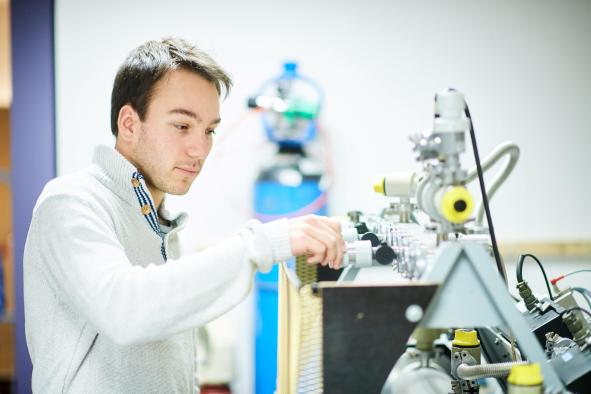
Research can be both experimental (studying material surfaces by scanning tunneling microscopy, measuring optical properties...) theoretical and numerical (modeling the physical properties of natural or artificial structures, quantum optics...). These different approaches are essential and complementary.
As an example, here's a thesis topic: interaction of electromagnetic waves, in particular microwaves, with graphene, a crystal whose thickness is a single atom. The aim is to theoretically design a shield against stray waves for sensitive electrical circuits.
Other master's degrees in physics
The University of Namur offers:
- the 120-credit Master's program in Physical Sciences
- the 60-credit Master's in Physical Sciences
-
<unknown>
Code Name Staff Th.+Ex. Credits/Block 1 2 SPHYM136 Data acquisition and digital processing Deparis Olivier 30h th. + 15h ex. 4 English Friendly CoursesImage
SPHYM138 Scientific communication Lobet Michaël 15h th. 2 Sustainable developmentImage
SSPSM101 Science, ethics and development Leyens Stéphane Tilman Valérie 18h th. + 6h ex. 3 SPHYM101 Radiation-matter interaction Colaux Julien Lucas Stéphane Stasser Coraline 30h th. + 30h ex. 6 English Friendly CoursesImage
SPHYM106 Nanomaterials ans applications of solid state physics Henrard Luc Sporken Robert 45h th. + 15h ex. 6 SPHYM109 Laser physics, non-linear and quantum optics Lepere Muriel Caudano Yves Leonis Sylvain 45h th. + 15h ex. 6 SPHYM231 Fundamental interactions Daubie Evelyne 30h th. 3 Sustainable developmentImage
English Friendly CoursesImage
SCHIM223 Science and Energy Su Bao Lian Olivier Yoann 24h th. 3 SSPSM202 Philosophy of material sciences Sartenaer Olivier 12h th. 3 -
<unknown>
Code Name Staff Th.+Ex. Credits/Block 1 2 SPHYM133 Theoretical and digital photonics Lobet Michaël 30h th. + 15h ex. 3 SPHYM216 Molecular physics and the environment Lepere Muriel Leonis Sylvain 30h th. 3 SPHYM222 Synthesis of materials Sporken Robert Haye Emile 30h th. 3 SPHYM226 Surface and interface characterisation techniques Colaux Julien Houssiau Laurent 30h th. 3 English Friendly CoursesImage
SPHYM134 Plasmonics and applications Henrard Luc 15h th. + 15h ex. 3 SPHYM233 Internship Haye Emile 15 -
<unknown>
Code Name Staff Th.+Ex. Credits/Block 1 2 English Friendly CoursesImage
SPHYM122 Research project Louette Pierre 9 -
<unknown>
Code Name Staff Th.+Ex. Credits/Block 1 2 English Friendly CoursesImage
Cyclic course not organized this yearImage
SPHYM230 Biological physics HEUSKIN Anne-Catherine 30h th. 3 3 English Friendly CoursesImage
Course not organized this yearImage
SMATM121_P33811 Part 1 : Relativistic gravitation and cosmology Fuzfa André 15h th. + 15h ex. 3 3 English Friendly CoursesImage
Course not organized this yearImage
SMATM121_P33812 Part 2 : Relativistic gravitation and cosmology Fuzfa André 15h th. + 15h ex. 3 3 SDASM101 Graph mining Daquin Jérôme Salnikov Vsevolod 20h th. + 20h ex. 5 5 SCHIM109 Scientific Programming for Chemists Liégeois Vincent 12h th. 4 4 English Friendly CoursesImage
Cyclic course not organized this yearImage
SPHYM228 simulations in material physics Henrard Luc 15h th. + 15h ex. 3 3 Sustainable developmentImage
SGOLB313_P33839 Geophysics Louette Pierre Collinet Max 15h th. + 15h ex. 3 3 Cyclic course organized this yearImage
SPHYM111 Natural photonics and biomimicry Deparis Olivier Mouchet Sébastien 22h th. + 8h ex. 3 3 Cyclic course organized this yearImage
SPHYM112 Electron microscopy Colomer Jean-François 22h th. + 8h ex. 3 3 Cyclic course organized this yearImage
SPHYM119 Nuclear Astrophysics Terwagne Guy 15h th. + 15h ex. 3 3 Cyclic course not organized this yearImage
SPHYM117 Project Management 22h th. + 8h ex. 3 3 Cyclic course organized this yearImage
SPHYM123 Course of Computational Physics I MAYER Alexandre 15h th. + 15h ex. 3 3 Cyclic course organized this yearImage
SPHYM124 Experimental optics of surfaces and nanostructures Cecchet Francesca 22h th. 3 3 Cyclic course organized this yearImage
SPHYM126 Programming Methods for High-Performance Computing MAYER Alexandre 15h th. + 15h ex. 3 3 Cyclic course not organized this yearImage
SPHYM127 Sounding and physics of the atmosphere Lepere Muriel 22h th. + 8h ex. 3 3 Cyclic course not organized this yearImage
SPHYM128 Introduction to medical imaging 22h th. + 8h ex. 3 3 Cyclic course organized this yearImage
SPHYM135 Quantum theory of information and measurement Caudano Yves 22h th. 3 3 English Friendly CoursesImage
Cyclic course organized this yearImage
SPHYM137 Simulation of dose deposition on biological targets HEUSKIN Anne-Catherine 15h th. + 15h ex. 3 3 Cyclic course organized this yearImage
SPHYM215 Spectral profiles Lepere Muriel 22h th. + 8h ex. 3 3 Cyclic course organized this yearImage
SPHYM225 Radiation detection and radioprotection Colaux Julien 15h th. + 15h ex. 3 3 SBIOM122 Cancer Michiels Carine 22h th. 3 3 SBIOB232_P33829 System Histology Renard Patricia 15h th. 2 2 SBIOM134 Protein Structure and Function Wouters Johan De Bolle Xavier 22h th. 3 3 SCHIM102 Advanced Theoretical Chemistry Champagne Benoît Olivier Yoann Nascimento Ramos Tárcius Champagne Benoît 36h th. + 24h ex. 6 6 English Friendly CoursesImage
Cyclic course not organized this yearImage
SCHIM218 Further information on quantum chemistry Champagne Benoît 12h th. 2 2 English Friendly CoursesImage
SMATB304 Optimization Sartenaer Annick 30h th. + 22.5h ex. 5 5 English Friendly CoursesImage
SMATM103 Numerical linear algebra: direct and iterative methods Sartenaer Annick Berger Guillaume 30h th. + 30h ex. 5 5 English Friendly CoursesImage
SMATM225 Chaos and determinism Libert Anne-Sophie Daquin Jérôme 30h th. + 30h ex. 5 5 SGOGB314_P36479 Physical Partim : Climatology Houssiau Laurent 30h th. 3 3 Service learningImage Cyclic course organized this yearImage
SPHYM150 Physics practice and commitment Lobet Michaël Dias De Carvalho Junior Gabriel Houssiau Laurent 12h th. 3 3 -
<unknown>
Code Name Staff Th.+Ex. Credits/Block 1 2 SELVM202_P33857 Refresher course in Dutch (level B1) Vanparys Johan Dobbelaere Katia 30h th. 3 Soft skillsImage
SELVM201_P33760 Further training in English (level B2+) Zimmer Carole 30h th. 3 -
<unknown>
Code Name Staff Th.+Ex. Credits/Block 1 2 SPHYM205 Master thesis Louette Pierre 21
-
<unknown>
Code Name Staff Credits Hours/Quarter 1 2 SPHYM136 Data acquisition and digital processing Deparis Olivier 4 30h th. + 15h ex. English Friendly CoursesImage
SPHYM138 Scientific communication Lobet Michaël 2 15h th. Sustainable developmentImage
SSPSM101 Science, ethics and development Leyens Stéphane Tilman Valérie 3 18h th. + 6h ex. SPHYM101 Radiation-matter interaction Colaux Julien Lucas Stéphane Stasser Coraline 6 30h th. + 30h ex. English Friendly CoursesImage
SPHYM106 Nanomaterials ans applications of solid state physics Henrard Luc Sporken Robert 6 45h th. + 15h ex. SPHYM109 Laser physics, non-linear and quantum optics Lepere Muriel Caudano Yves Leonis Sylvain 6 45h th. + 15h ex. -
<unknown>
Code Name Staff Credits Hours/Quarter 1 2 SPHYM133 Theoretical and digital photonics Lobet Michaël 3 30h th. + 15h ex. SPHYM216 Molecular physics and the environment Lepere Muriel Leonis Sylvain 3 30h th. SPHYM222 Synthesis of materials Sporken Robert Haye Emile 3 30h th. SPHYM226 Surface and interface characterisation techniques Colaux Julien Houssiau Laurent 3 30h th. English Friendly CoursesImage
SPHYM134 Plasmonics and applications Henrard Luc 3 15h th. + 15h ex. -
<unknown>
Code Name Staff Credits Hours/Quarter 1 2 English Friendly CoursesImage
SPHYM122 Research project Louette Pierre 9 -
<unknown>
Code Name Staff Credits Hours/Quarter 1 2 English Friendly CoursesImage
Cyclic course not organized this yearImage
SPHYM230 Biological physics HEUSKIN Anne-Catherine 3 30h th. English Friendly CoursesImage
Course not organized this yearImage
SMATM121_P33811 Part 1 : Relativistic gravitation and cosmology Fuzfa André 3 15h th. + 15h ex. English Friendly CoursesImage
Course not organized this yearImage
SMATM121_P33812 Part 2 : Relativistic gravitation and cosmology Fuzfa André 3 15h th. + 15h ex. SDASM101 Graph mining Daquin Jérôme Salnikov Vsevolod 5 20h th. + 20h ex. SCHIM109 Scientific Programming for Chemists Liégeois Vincent 4 12h th. English Friendly CoursesImage
Cyclic course not organized this yearImage
SPHYM228 simulations in material physics Henrard Luc 3 15h th. + 15h ex. Sustainable developmentImage
SGOLB313_P33839 Geophysics Louette Pierre Collinet Max 3 15h th. + 15h ex. Cyclic course organized this yearImage
SPHYM111 Natural photonics and biomimicry Deparis Olivier Mouchet Sébastien 3 22h th. + 8h ex. Cyclic course organized this yearImage
SPHYM112 Electron microscopy Colomer Jean-François 3 22h th. + 8h ex. Cyclic course organized this yearImage
SPHYM119 Nuclear Astrophysics Terwagne Guy 3 15h th. + 15h ex. Cyclic course not organized this yearImage
SPHYM117 Project Management 3 22h th. + 8h ex. Cyclic course organized this yearImage
SPHYM123 Course of Computational Physics I MAYER Alexandre 3 15h th. + 15h ex. Cyclic course organized this yearImage
SPHYM124 Experimental optics of surfaces and nanostructures Cecchet Francesca 3 22h th. Cyclic course organized this yearImage
SPHYM126 Programming Methods for High-Performance Computing MAYER Alexandre 3 15h th. + 15h ex. Cyclic course not organized this yearImage
SPHYM127 Sounding and physics of the atmosphere Lepere Muriel 3 22h th. + 8h ex. Cyclic course not organized this yearImage
SPHYM128 Introduction to medical imaging 3 22h th. + 8h ex. Cyclic course organized this yearImage
SPHYM135 Quantum theory of information and measurement Caudano Yves 3 22h th. English Friendly CoursesImage
Cyclic course organized this yearImage
SPHYM137 Simulation of dose deposition on biological targets HEUSKIN Anne-Catherine 3 15h th. + 15h ex. Cyclic course organized this yearImage
SPHYM215 Spectral profiles Lepere Muriel 3 22h th. + 8h ex. Cyclic course organized this yearImage
SPHYM225 Radiation detection and radioprotection Colaux Julien 3 15h th. + 15h ex. SBIOM122 Cancer Michiels Carine 3 22h th. SBIOB232_P33829 System Histology Renard Patricia 2 15h th. SBIOM134 Protein Structure and Function Wouters Johan De Bolle Xavier 3 22h th. SCHIM102 Advanced Theoretical Chemistry Champagne Benoît Olivier Yoann Nascimento Ramos Tárcius Champagne Benoît 6 36h th. + 24h ex. English Friendly CoursesImage
Cyclic course not organized this yearImage
SCHIM218 Further information on quantum chemistry Champagne Benoît 2 12h th. English Friendly CoursesImage
SMATB304 Optimization Sartenaer Annick 5 30h th. + 22.5h ex. English Friendly CoursesImage
SMATM103 Numerical linear algebra: direct and iterative methods Sartenaer Annick Berger Guillaume 5 30h th. + 30h ex. English Friendly CoursesImage
SMATM225 Chaos and determinism Libert Anne-Sophie Daquin Jérôme 5 30h th. + 30h ex. SGOGB314_P36479 Physical Partim : Climatology Houssiau Laurent 3 30h th. Service learningImage
Cyclic course organized this yearImage
SPHYM150 Physics practice and commitment Lobet Michaël Dias De Carvalho Junior Gabriel Houssiau Laurent 3 12h th.
-
<unknown>
Code Name Staff Credits Hours/Quarter 1 2 SPHYM231 Fundamental interactions Daubie Evelyne 3 30h th. Sustainable developmentImage
English Friendly CoursesImage
SCHIM223 Science and Energy Su Bao Lian Olivier Yoann 3 24h th. SSPSM202 Philosophy of material sciences Sartenaer Olivier 3 12h th. -
<unknown>
Code Name Staff Credits Hours/Quarter 1 2 SPHYM233 Internship Haye Emile 15 -
<unknown>
Code Name Staff Credits Hours/Quarter 1 2 English Friendly CoursesImage
Cyclic course not organized this yearImage
SPHYM230 Biological physics HEUSKIN Anne-Catherine 3 30h th. English Friendly CoursesImage
Course not organized this yearImage
SMATM121_P33811 Part 1 : Relativistic gravitation and cosmology Fuzfa André 3 15h th. + 15h ex. English Friendly CoursesImage
Course not organized this yearImage
SMATM121_P33812 Part 2 : Relativistic gravitation and cosmology Fuzfa André 3 15h th. + 15h ex. SBIOM122 Cancer Michiels Carine 3 22h th. SBIOB232_P33829 System Histology Renard Patricia 2 15h th. SBIOM134 Protein Structure and Function Wouters Johan De Bolle Xavier 3 22h th. SCHIM102 Advanced Theoretical Chemistry Champagne Benoît Olivier Yoann Nascimento Ramos Tárcius Champagne Benoît 6 36h th. + 24h ex. English Friendly CoursesImage
Cyclic course not organized this yearImage
SCHIM218 Further information on quantum chemistry Champagne Benoît 2 12h th. English Friendly CoursesImage
SMATB304 Optimization Sartenaer Annick 5 30h th. + 22.5h ex. English Friendly CoursesImage
SMATM103 Numerical linear algebra: direct and iterative methods Sartenaer Annick Berger Guillaume 5 30h th. + 30h ex. English Friendly CoursesImage
SMATM225 Chaos and determinism Libert Anne-Sophie Daquin Jérôme 5 30h th. + 30h ex. SDASM101 Graph mining Daquin Jérôme Salnikov Vsevolod 5 20h th. + 20h ex. SCHIM109 Scientific Programming for Chemists Liégeois Vincent 4 12h th. Cyclic course organized this yearImage
SPHYM112 Electron microscopy Colomer Jean-François 3 22h th. + 8h ex. Sustainable developmentImage
SGOLB313_P33839 Geophysics Louette Pierre Collinet Max 3 15h th. + 15h ex. Cyclic course organized this yearImage
SPHYM111 Natural photonics and biomimicry Deparis Olivier Mouchet Sébastien 3 22h th. + 8h ex. Cyclic course not organized this yearImage
SPHYM117 Project Management 3 22h th. + 8h ex. Cyclic course organized this yearImage
SPHYM124 Experimental optics of surfaces and nanostructures Cecchet Francesca 3 22h th. Cyclic course organized this yearImage
SPHYM119 Nuclear Astrophysics Terwagne Guy 3 15h th. + 15h ex. Cyclic course organized this yearImage
SPHYM225 Radiation detection and radioprotection Colaux Julien 3 15h th. + 15h ex. Cyclic course not organized this yearImage
SPHYM127 Sounding and physics of the atmosphere Lepere Muriel 3 22h th. + 8h ex. Cyclic course not organized this yearImage
SPHYM128 Introduction to medical imaging 3 22h th. + 8h ex. Cyclic course organized this yearImage
SPHYM126 Programming Methods for High-Performance Computing MAYER Alexandre 3 15h th. + 15h ex. Cyclic course organized this yearImage
SPHYM123 Course of Computational Physics I MAYER Alexandre 3 15h th. + 15h ex. Cyclic course organized this yearImage
SPHYM135 Quantum theory of information and measurement Caudano Yves 3 22h th. English Friendly CoursesImage
Cyclic course organized this yearImage
SPHYM137 Simulation of dose deposition on biological targets HEUSKIN Anne-Catherine 3 15h th. + 15h ex. Cyclic course organized this yearImage
SPHYM215 Spectral profiles Lepere Muriel 3 22h th. + 8h ex. English Friendly CoursesImage
Cyclic course not organized this yearImage
SPHYM228 simulations in material physics Henrard Luc 3 15h th. + 15h ex. SGOGB314_P36479 Physical Partim : Climatology Houssiau Laurent 3 30h th. Service learningImage
Cyclic course organized this yearImage
SPHYM150 Physics practice and commitment Lobet Michaël Dias De Carvalho Junior Gabriel Houssiau Laurent 3 12h th. -
<unknown>
Code Name Staff Credits Hours/Quarter 1 2 SELVM202_P33857 Refresher course in Dutch (level B1) Vanparys Johan Dobbelaere Katia 3 30h th. Soft skillsImage
SELVM201_P33760 Further training in English (level B2+) Zimmer Carole 3 30h th. -
<unknown>
Code Name Staff Credits Hours/Quarter 1 2 SPHYM205 Master thesis Louette Pierre 21
Jury
Teaching profile
The Master’s degree in Physical Sciences that Unamur offers aims at furthering the training that students have received while completing their bachelor’s degree. Students make a choice among three focuses (in-depth focus, focus on specialisation, focus on teaching) in the first year of the Master’s training, which allows them to perfect their knowledge in Physics within a more specific domain. Besides broadening the general knowledge of modern Physics that every physicist is expected to have acquired, this training is clearly oriented towards research. Students will benefit from the members of staff’s expertise in research, specifically in the areas of Matter and Radiance and in the exploitation of the interactions between this duality. They receive constant guidance from renowned researchers and from professors who have developed teaching strategies whose effectiveness and reliability have been highly rated over the years.
The general subject-linked training is supplemented by a more interdisciplinary approach, including courses such as philosophy, ethics, languages and communication in the field of science, aiming at developing openmindedness and critical thinking.
Aims and objectives
Aims and objectives are established as follows :
- Understanding natural phenomena in their complexity : how electromagnetic radiation propagates in various environments and interacts with matter, how the quantum properties of nanoscopic materials lead to technological revolutions (nano-electronics, nanophotonics…) how cellular tissue responds to radiation from photons or particles (particularly in cancer treatment),
- Modelling of innovative physical systems, following nature’s patterns ;
- Biomimetism is a new approach which seeks to follow and copy the patterns of complex organic structures in various animal or plant species which have been perfected over millions of years of evolution (within the field of optics, natural photonics is a new field, inspired by this approach) ;
- Addressing Environmental issues and developing applications that can contribute to Sustainable Energy (improving the performance of photovoltaic cells, developing hybrid materials for fuel-producing batteries, reducing pollution of the atmosphere, etc.)
Description
The research focus of the master 120 physical addresses current problems of the society such as new materials, energy and the environment.
In addition to the core courses designed to improve the general education of the physicist, the research focus is characterized by 5 courses, which are specific to research topics in the physics department: synthesis and characterization of materials, optical properties and methods simulation in physics and optics. The student can also choose courses for specialization in a non-exhaustive list. It may also choose courses from another department, another faculty or another university. A research project organized in the second semester of the 1st year of Master is to perfect the research training that will culminate in the realization of a final dissertation during the second year of master. An 8-week internship in Belgium or abroad is also organized in the second semester of the last year of master.
Teaching methods
The Master’s degree in Physical Sciences is offered at Unamur under three different focuses. Regardless of the orientation, the programme includes a common core as well as courses that students can choose from a wide range of options. The compulsory courses ensure that students acquire throrough knowledge in crucial domains of modern Physics. The courses chosen from options cover more specialised fields linked with Physics of Matter, Radiation and Wave-Matter Interaction.
Alongside this traditional course-oriented training, students receive initiation to research, which will include the acquisition of teaching skills for those choosing the teaching focus. This training towards research will add to a good number of credits, as it associates two types of activities. In the first stage of the initation to research, students will undertake a project on a well-defined subject during the first year, involving bibliographical research, a personal experimental or theoretical development, and a presentation of the obtained results. The second stage constitutes the actual research project and dissertation, which is to be completed throughout the second year. It must be an innovative project, carried out under the guidance of a member of the academic staff or a member of the department. A dissertation and an oral presentation will allow a jury to assess its value.
The training as described above is completed through a work placement / internship in accordance with the chosen focus. It can take place in industry (specialised focus), within the University department or at an external research centre (in-depth focus), or within the Belgian Secondary system (focus on teaching). The choice of focus has to be made at the beginning of the second year, and leads to thirty specific credits.
Assessment
Depending on the activities, the assessment of the acquired knowledge is done following three main methods :
- an oral exam with the lecturer or lecturers having given the specific course
- the elaboration of a report which is then assessed by a member of the academic staff
- a presentation of a seminar summarising the pursued goals, the methodology that was used and the work accomplished.
The assessments take place during the specific periods of the academic year that have been assigned for this purpose.
For a certain number of activities, ongoing assessment is carried out as the activity develops. This approach is certainly the one used in the framework of internships and projects and their dissertation.
International mobility and openness
Students have the opportunity to study abroad within the Erasmus scheme for Europe, they can also do an internship in a research centre in Belgium or abroad, and a department theme trip to a renowned international laboratory (USA, Switzerland, France, etc. ).
Les métiers des physiciens
Physicists' professions
A wide range of skills
Thanks to their multidisciplinary training—physics, mathematics, computer science, materials science, physical chemistry, modeling, and data analysis—physicists possess a versatile and highly sought-after skill set. They have access to a wide range of careers, spanning scientific, technological, and cross-functional fields:
- Industry and R&D: development of innovative materials, quality control, instrumentation, industrial processes, and the energy sector.
- Hospital and biomedical sectors: medical radiophysics, imaging, biophysics, development of devices and sensors.
- Digital and data: data analysis, modeling, AI, scientific programming, technology consulting.
- Finance and insurance: risk management, quantitative modeling, predictive analytics.
- Environment and energy: air quality, energy transition, renewable energy, environmental monitoring and modeling.
- Nanotechnology and high technology: quantum devices, advanced optics, micro- and nanofabrication.
- Research and education: university research, public or private research centers, secondary and higher education.
- Public sector and institutions: scientific analysis, technical expertise, innovation, energy or environmental policies.
Rigorous, with strong analytical skills, excellent mathematical modeling abilities, and a broad scientific background, physicists contribute to the advancement of knowledge and the development of applications that benefit humanity.
All these high-value-added skills make physicists highly sought-after professionals in the job market.
Developing industrial applications
In industry, physicists participate in the development of high-tech or highly specialized products (such as energy-saving treated glass, safer sheet metal for the automotive industry, cyclotrons for nuclear medicine, etc.). They also hold key leadership roles downstream from research and development, particularly in production departments.
Computer Science and Telecommunications
A solid background in computer science enables physicists to work in IT services companies (consulting) or in any type of user organization (banks, insurance companies,
etc.). The telecommunications sector, in particular, relies on physicists’ expertise in optics, electronics, and information processing.
Sharing a Passion for the Real World
Among the career paths open to physicists, teaching and the education sector in general remain highly promising. More than 15% of our professionally active graduates share their passion for the real world by teaching physics, as well as science and mathematics, at universities or in upper secondary schools.
Physics and Medicine
In hospital settings, physicists work alongside physicians: they help develop treatment plans for patients receiving nuclear medicine care; they ensure quality control of various medical imaging devices; and they also contribute to the development of new analytical technologies.
Expert Physicists
Government agencies rely on the expertise of physicists. They help shape policies in energy, the environment, space, and other fields, for example by providing advice on research priorities.
Pushing the boundaries of our knowledge
According to a survey of our alumni, about half of recent graduates begin their professional careers with experience in scientific research, primarily in academic settings, in Belgium or abroad.
Other physicists continue their research work at cutting-edge research institutes in highly specialized fields (such as CENAERO, a center of excellence in aeronautics in Gosselies; CERN, the particle physics laboratory in Geneva; SCK-CEN, the nuclear energy research center in Mol; or the Royal Meteorological Institute).
Testimonials from former students
The research institute where I work focuses on the composition of our atmosphere and air quality. We develop analytical techniques to continuously
measure the concentration of a series of key atmospheric gases using both satellite and ground-based instruments. These activities are conducted in an international context in collaboration with major European agencies such as the ESA and EUMETSAT.Christophe — Institute of Space Aeronomy
Thanks to the work I completed during my PhD at UNamur and the connections I made, I am now a postdoctoral researcher at Lawrence Berkeley National Lab in California. My time is divided between lab work, analyzing results, and writing scientific papers or proposals. In the lab, the tasks are varied and include both highly technical and highly specialized aspects, such as laser alignment, sample preparation, and data acquisition. Analyzing results involves, in particular, developing code.
Frédéric — Lawrence Berkeley National Lab
At UNamur, I gained a solid background in physics as well as a passion for optical phenomena in living organisms, such as their coloration. I am currently conducting
research on the fluorescence of beetles and butterflies. This research is interdisciplinary and allows me to work not only with physicists, but also with biologists, chemists, and engineers. The goal is to understand the influence of color on the behavior of living organisms in order to develop new technological applications inspired by nature.Sébastien — University of Exeter in the United Kingdom
After completing my PhD at UNamur, where I gained solid multidisciplinary knowledge, I spent two years doing postdoctoral research at a marine biology institute in San Diego. Now, I work as a business consultant across all areas: market research, sales and procurement reorganization, and support for tenders.
Annick — H & Z