In early May 1940, many Belgians still hoped that their country, protected by its neutrality, might escape the conflict that had broken out a few months earlier. At the Facultés universitaires Notre-Dame de la Paix—now the University of Namur—registration for the upcoming first exam session was proceeding as usual. But the situation changed dramatically on May 10 when German forces invaded Belgium. Two days later, Namur was bombed, and on the 15th, the city fell to the Wehrmacht. This marked the beginning of four years under an increasingly authoritarian occupation regime.


The Faculties During the Occupation

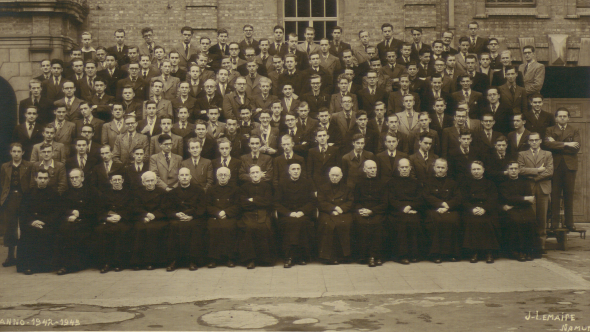
Despite the curfew and numerous hardships, life is gradually returning to some semblance of normalcy. At the universities, classes and exams are resuming. Determined not to leave the “intellectual guidance of students” in the hands of the occupying forces, the rectors of Belgian universities all championed the idea of continuing educational and scientific activities. In Namur, the classes of 1941, 1942, and 1943 were even photographed alongside their professors. 

However, the situation changed drastically during the spring and summer of 1943. The Third Reich was facing a severe labor shortage, and it was decided to impose a form of compulsory labor on young Belgians. Students were conscripted: a series of laws first barred them from registering for university exams, then denied them all access to higher education unless they had completed several months of labor in the service of the occupying forces. Universities were also ordered to hand over the names and addresses of their students. The rector of the Namur Faculties, Father Eugène Thibaut (1887–1972), opposed this. Fearing a roundup, he suspended classes in May 1943.

However, although the university’s doors remained officially closed, the Namur professors joined the resistance and secretly organized classes during the 1943–1944 academic year. Syllabi were secretly sent to some 120 students enrolled in Philosophy and Humanities, and “tutors”—trusted former students—were appointed to mentor the new enrollees. Unfortunately, this approach could not be applied to science programs, as it was impossible to organize laboratory practicals. Some young faculty members traveled to teach classes to small groups of students gathered in secret. Thus, Father Walthère Derouau (1904–2000), a professor of classical languages, and Father Camille Joset (1912–1992), a professor of medieval and modern history, traveled throughout Belgium to meet with their students. 

Camille Joset: A Jesuit Resistance Fighter

Alongside his teaching activities, Camille Joset was also a key figure in the Belgian Resistance. As early as January 1941, he had joined the ranks of the Belgian National Movement (MNB), which his father had led. The network gathered intelligence and published an underground newspaper, *La Voix des Belges*, in which Camille Joset wrote articles under the pseudonyms Pierre and later André. Following his father’s arrest in May 1942, he took over as editor-in-chief of the publication. He also played an important role within the MNB, establishing intelligence networks and escape routes for Jews and those evading forced labor. His historical and archaeological work constitutes

Camille Joset

In 1943, while teaching in Namur, Camille Joset devoted his energy to helping his students. But in June 1944, the Jesuit learned that his name had been turned over to the Gestapo. To evade capture, he staged a ruse with the complicity of the university rector: ostensibly leaving the university buildings with a suitcase in hand, he pretended to head toward the Namur train station, before discreetly turning back and hiding in a small room located within the “quadrilateral” (the main building of the Faculties, at the rear of 61 Rue de Bruxelles). He stayed there for two months, supplied with provisions by the rector and Father André Schortgen (1902–1955). Faced with the threat of searches, Father Joset was eventually

La Voix des Belges

On September 5, 1944, the city of Namur was liberated by American forces. The universities quickly reopened their doors, and life returned to normal. The Liberation also marked the end of Camille Joset’s involvement in the Resistance: his efforts would be recognized by Belgian and foreign authorities after the war. A builder and visionary, he became managing director of the Facultés Notre-Dame de la Paix, secured better public funding for them, significantly expanded the campus, and played a fundamental role in the founding of the Faculty of Economic and Social Sciences, of which he would become the first dean (1961–1968), as well as the Institute of Computer Science (1970). 

This article is taken from the "The Day When" section of Omalius magazine, Issue #41 (June 2026).

Omalius 41