Research is hope

While scientific research has significantly improved the cure rates for certain cancers over the past few decades, others remain incurable or recur quickly. In this regard, advances in scientific research offer real hope to all patients who are looking forward to increasingly targeted and innovative treatments. A closer look at the Télévie projects currently underway at UNamur.  

Les chercheurs Télévie à l’UNamur et leurs promoteurs académiques
Télévie researchers at UNamur and their academic advisors

Researchers on Anne-Catherine Heuskin’s team

Jade Nichols, Thierry Arnould, Giacomo Lopopolo, Anne-Catherine Heuskin, Keïla Openge-Navenge, and Shalini Iyer, a former Télévie PhD student who is now a postdoctoral researcher on the Walloon Region’s ProtherWal project in the field of proton therapy. 

Jade Nichols, Thierry Arnould, Giacomo Lopopolo, Anne-Catherine Heuskin, Keïla Openge-Navenge et Shalini Iyer, ancienne doctorante Télévie aujourd’hui chercheuse postdoctorante sur le projet ProtherWal de la Région wallonne en matière de protonthérapie.

Enhancing the effects of radiation therapy and proton therapy

Radiation therapy is a treatment currently used for 50% of cancer patients. Several projects are underway under the direction of Professor Anne-Catherine Heuskin, aimed at optimizing its effectiveness while reducing harmful side effects for patients. 

Giacomo Lopopolo is studying the consequences of oxidative stress generated by radiation therapy and the damage it causes to cellular mitochondria, particularly in the treatment of lung cancer. Objective: to determine the necessary doses in treatment plans for conventional radiotherapy or proton therapy to ensure effective treatment while improving the patient’s quality of life. This interdisciplinary project also benefits from the expertise of Professor Thierry Arnould, co-supervisor (URBC). 

For her part, Keïla Openge-Navenge is attempting to decipher the mechanisms of radiation resistance at work in breast, lung, and colorectal cancers, and in particular the role of lipid metabolism, ferroptosis, and mitochondria within cancer cells. 

Jade Nichols, who has just joined UNamur, is launching a Télévie project to understand the response of macrophages—which play an essential role in shaping the tumor microenvironment—to ultra-high-dose-rate (UHDR) radiation, a phenomenon that has not yet been explored and whose results could eventually help optimize treatment strategies that leverage both radiation and the patient’s own immune responses.

The researchers on Carine Michiels' team

Shalini Iyer, Eloïse Rapport, Inès Bouriez, Manon Van Den Abbeel, Carine Michiels, Anne-Catherine Heuskin, and Emma Lambert. 

Shalini Iyer, Eloïse Rapport, Inès Bouriez, Manon Van Den Abbeel, Carine Michiels, Anne-Catherine Heuskin et Emma Lambert.

Understanding tumors to better fight them

Within the URBC, under the direction of Professor Carine Michiels, several projects aim to better understand the factors contributing to the development of different types of tumors and the mechanisms that arise in response to treatment. Inès Bourriez focuses her research on skin cancers, which account for 40% of cancers diagnosed today. She is interested in the impact of skin aging and the accumulation of so-called senescent cells on tumor development and progression. 

Understanding how cells react to radiation is also the focus of projects led by Emma Lambert, on the one hand, and Manon Van Den Abbeel, on the other, through a collaboration with Anne-Catherine Heuskin at LARN. Manon Van Den Abbeel is studying the irradiation conditions that induce the strongest possible immune response to circumvent the various immunosuppressive mechanisms developed within tumors, thereby enhancing the immunogenicity of tumors and thus their recognition and destruction by the immune system. 

Emma Lambert, meanwhile, is launching a project on glioblastoma, an aggressive and currently incurable brain tumor, to better understand the resistance mechanisms that develop during combination treatments using chemotherapy, radiation therapy, or proton therapy. 

As for Eloïse Rapport, she is interested in a third form of radiation therapy, using alpha particles—that is, ionized helium atoms—to increase the death of cancer cells within tumors. In particular, she is studying the different forms of induced cell death and their potential immunogenicity. 

Improving the diagnosis of pancreatic cancer

Pancreatic cancer, particularly pancreatic ductal adenocarcinoma (PDAC), remains one of the deadliest cancers, with a five-year survival rate of only 13%. Because the disease is often asymptomatic in its early stages, it is frequently diagnosed at an advanced stage. This situation, coupled with the lack of effective treatments and the immunosuppressive tumor microenvironment that limits the efficacy of immunotherapies, explains the poor prognosis of PDAC. Early detection of this type of cancer is therefore crucial, but current diagnostic tools have limited sensitivity and specificity. 

Emma Thompson has dedicated herself to this project, having joined Professor Marc Hennequart’s team at URPhyM. This research explores the metabolic changes associated with the early progression of PDAC with the aim of identifying new biomarkers that enable earlier detection and intervention, thereby improving patients’ chances of recovery. 

Marc Hennequart et Emma Thompson
Marc Hennequart and Emma Thompson

The UNamur community rallies to support Télévie and the fight against cancer

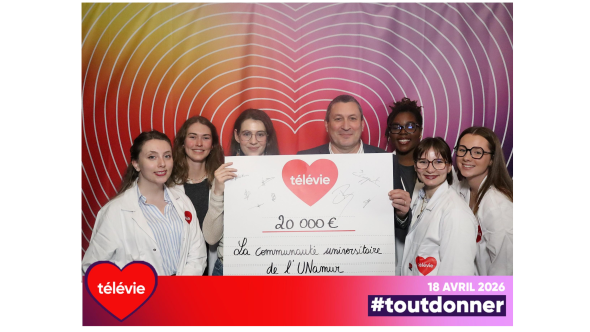
As it has done every year for the past 23 years, the UNamur community is organizing a series of events to raise funds for the Télévie campaign. In 2026, students have been particularly active through three initiatives.

On February 18, the ImproNam project team came together once again to face off against the Namur-based troupe Oh My God in a lively improv match, which raised a generous total of 1,058.02 euros. 

“It’s always a pleasure to contribute, in our own small way, to a project like Télévie. It’s an event that brings all generations together”—Calixte Henin Groves, student and president of ImproNam. 

Le match ImproNam au profit du Télévie 2026
Photo credit: Marie Michel Photographer.

On March 12, the Student General Assembly brought the house down at the Arsenal during the second edition of the Grand Blind Test at UNamur. It was a fun-filled evening that brought together some thirty teams of staff and students to compete on the biggest hits of the past 30 years, and, thanks to the support of sponsors, raised €6,338.91. 

Finally, the Namur Computer Club dedicated its 24-hour charity livestream on the Twitch platform. Over the course of the hours, and thanks to the generosity, activities, and challenges taken on by the Club’s members, a generous sum of €1,831.91 was donated to Télévie. 

Well done everyone! 

UNamur thanks all the students and staff members who rallied to support the Télévie campaign on campus. 

UNamur also thanks all the suppliers and sponsors who have partnered with these initiatives and helped boost the Télévie total. 

Les sponsors du Télévie

For many years, the university community, its alumni, and its partners have been rallying to support cancer research through the Télévie campaign. All donations collected are donated to the FNRS.

Logo du Télévie