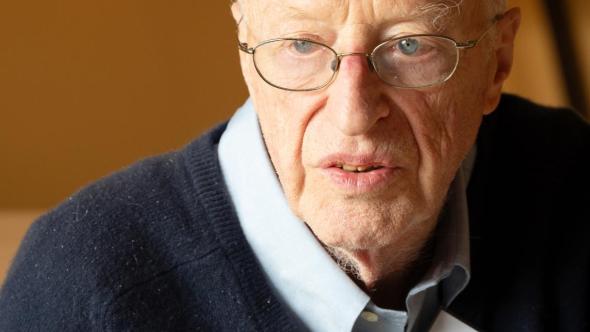
What first inspired you to become an economist?

The decisive event was probably my father's loss of employment when I was eleven years old. I began thinking about the consequences of unemployment: when a family loses income, it spends less, which in turn affects other families and businesses. Very early on, I found myself asking why unemployment exists when economic models seem to predict that markets should naturally move toward equilibrium.

Was economics primarily an intellectual discipline for you?

Not really. My interest came first and foremost from human problems. I was concerned about unemployment, but also about social and racial inequality. I wanted to understand these issues and, in my own way, contribute to addressing them. For me, economics was never simply about numbers or equations; it was a way of understanding the challenges people face in their everyday lives.

Did mathematics influence the way you approached research?

Very much so. During my studies, I took a topology course that left a lasting impression on me. The professor emphasized a simple idea: before focusing on details, you must understand the overall structure of a problem. That lesson stayed with me throughout my career. I always tried to begin with the big questions and only then look for the tools needed to answer them.

You have often argued that economics should engage with the other social sciences. Why?

Because economic behaviour is shaped by beliefs, institutions, social norms, and the way people see themselves. Economic models are useful, but they do not explain everything. To understand how people make decisions, we often need insights from psychology, sociology, history, and other disciplines.

Did your time in India play an important role in that realization?

Absolutely. My year in India was probably the most important intellectual experience of my life. It taught me that economic development cannot be reduced to capital and labor alone. Beliefs, institutions, traditions, and social interactions matter enormously. I came away convinced that an economy cannot be understood without understanding the people who live within it.

Your paper The Market for Lemons changed the way economists think about markets. What was the central idea?

The core insight was that information is not distributed equally among market participants. Sellers often know more than buyers. This asymmetry of information can create significant distortions and prevent markets from functioning as classical economic models predict.

I never expected the idea to have such a broad impact. Yet it turned out to apply to countless areas, from finance and insurance to credit markets and labour economics.

You later became interested in social norms and multiple equilibria. What led you in that direction?

Some situations persist simply because everyone expects them to persist. Collective beliefs influence behaviour, and behaviour reinforces those beliefs. As a result, societies can remain trapped in inefficient outcomes.

My experience in India, particularly my observations of the caste system, led me to think that there is often more than one possible equilibrium. Expectations and social norms can lock societies into patterns that endure for generations.

Your collaboration with Rachel Kranton led to the development of Identity Economics. What does this approach add?

It reminds us that people are motivated by more than money and material incentives. They also act according to their identity, their sense of belonging, and the social roles with which they identify.

Together, Rachel Kranton and I sought to show that economic behaviour is influenced by how individuals see themselves and by what they believe they ought to be. This perspective helps explain phenomena ranging from workplace motivation and educational achievement to discrimination and collective behaviour.

After a lifetime of research, what is the most important lesson you have learned?

That economics is fundamentally about people. Markets matter, but they cannot be understood without considering the human beings who make them work.

In the end, all my research—on unemployment, information, social norms, and identity—grew out of the same conviction: to understand economics, we must understand what people think, believe, and experience.

7 Key Quotes by George Akerlof

"When I was eleven, my father lost his job."

"First understand the structure of the problem. Then work on the details."

"India changed the way I thought about economics."

"One of the things I got from India was that one should take into account what people were thinking when thinking about equilibrium."

"The seller knows something the buyer does not know."

"Identity affects behaviour."

"Economics begins with people."

George Akerlof's career can be seen as a continuous effort to bring economics closer to reality. From the unemployment that marked his childhood to the development of identity economics later in life, he consistently challenged economists to look beyond abstract models and pay closer attention to human behaviour. By reintroducing beliefs, social norms, and identity into economic analysis, he helped transform the discipline—and reminded us that economics are ultimately created by people, not by equations.

George Akerlof was interviewed during his participation in the ERINN 2026 conference, organized by Professors Guilhem Cassan and Catherine Guirkinger of the DeFiPP Research Institute and the CRED Research Center as part of the IDnomics project, an interuniversity Concerted Research Initiative (ARC) funded by the Wallonia-Brussels Federation (FWB). 

Catherine Guirkinger, George Arthur Akerlof, Guilhem Cassan
From left to right: Catherine Guirkinger, George Arthur Akerlof, and Guilhem Cassan at the ERINN 2026 conference at UNamur

This article is taken from the "Guest" section of Omalius magazine, Issue #42 (September 2026).

Omalius-Septembre-2026