
Bachelor in Ancient and Modern Languages and Literatures
-
Schedule
regular course
- ECTS Credits 180
Overview
Latin…
There are no prerequisites for the Latin program, although some prior basic knowledge is strongly recommended. If you did not study Latin in high school, an introductory course is available specifically for you. If you are already at an advanced level, you can directly enroll in the “Reading Latin Texts” or “Analysis of Latin Authors” courses; the latter focuses as much on literary and historical analysis as on the study of the language itself.
Starting in the first year, you will specialize in Latin. The curriculum includes theoretical courses, translation and essay exercises, linguistic analysis, the study of Latin literature, and an introduction to research methods.
To understand the historical and cultural context of Latin literature, a knowledge of Antiquity is necessary. You will therefore receive training in the history, archaeology, and art history of Greco-Roman Antiquity.
Since Latin literature developed along the lines of Greek literature, your program also includes instruction in the fundamentals of the Greek language. A gradual introduction is provided if you did not take Greek courses in high school.
… to French
In linguistics, you will learn to analyze and describe the French language in its various aspects (phonology, morphosyntax, semantics) and to understand how it has evolved over the course of history to reach its current form. Courses in written and spoken French will help you develop the excellent command of the French language that is essential for these studies.
In literature, you’ll be introduced to reading and analyzing texts, the history of literary themes and genres, and the study of French and Francophone authors, from the Middle Ages to the contemporary era.
Several courses draw connections between Latin and French, particularly through the study of the evolution of Latin into the Romance languages and the earlier forms of the French language.
You're off to a good start
- You have an excellent command of French, particularly in spelling;
- You have a genuine “knack for writing” and enjoy reading carefully;
- You are capable of rigor and precision in analyzing a text;
- You enjoy researching information and developing complex arguments.
Teaching Methods
Lectures, practical exercises, individual assignments… every effort is made to ensure that you master Latin and French, their history, and the cultures they represent.
To learn Latin, you’ll take lectures in a large auditorium and specialized courses in small groups. These courses are supplemented by regular practice sessions that gradually train you in translation and essay writing. All exercises are reviewed and corrected by the instructor during a dedicated session.
Practical courses in written and spoken French include regular exercise sessions. Completing the assigned exercises is essential to ensuring your learning.
The history of Latin and French literature is covered in theoretical courses, which are supplemented by readings (Latin works in translation, novels, plays, short stories, etc.) and personal analyses.
In the third year, you will complete a final-year project under the direct supervision of a faculty member from the Classics Department, who will guide you in choosing a topic, conducting research, and writing the paper. This project prepares you to independently conduct scientific research.
At the end of your bachelor’s degree, you have the opportunity to experience a different approach to university education and enjoy a cultural—and even linguistic—experience through the “Erasmus” program.

Support for Success
Succeeding in a year of university studies involves many challenges.
To help you overcome them, UNamur supports you in developing your academic, methodological, and interpersonal skills—with the help of many professionals.
Preparatory courses, individualized assistance… Discover the resources available to support your education.

After the bachelor's degree: the master's degree
A bachelor’s degree in ancient and modern languages and literature automatically grants you admission to the master’s program in ancient and modern languages and literature at universities in the Wallonia-Brussels Federation that offer it.
During this second cycle, you can choose a master’s program that prepares you more specifically for teaching (Master’s in Teaching), research (Advanced Track), or another professional specialization in fields such as publishing, editing, computer science, linguistics, journalism, and more.
Contacts
School of Philosophy and Letters
Office
1 Rue Grafé • B-5000 Namur
Tel.: +32 (0) 81 72 42 07
Ms. E. Debu and Ms. S. Favero: secretariat-etudiants.lettres@unamur.be
-
Latin language
Code Name Staff Th.+Ex. Credits/Block 1 2 3 LCLAB102 Latin Language I Kaisin Mathilde Fontaine Elise 30h th. + 75h ex. 12 LCLAB205 Latin Language II Kaisin Mathilde 30h th. + 90h ex. 12 LHISB202 Translation of medieval Latin texts I Hermand Xavier 30h th. 3 Cyclic course organized this yearImage
LCLAB003 Explanation of Latin authors A Assenmaker Pierre 30h th. 3 3 Cyclic course not organized this yearImage
LCLAB011 Explanation of Latin authors B Assenmaker Pierre 30h th. 3 3 Cyclic course not organized this yearImage
LCLAB012 Explanation of Latin authors C Assenmaker Pierre 30h th. 3 3 LCLAB306 Latin Language III Kaisin Mathilde Fontaine Elise 30h th. + 90h ex. 12 LHISB316 Translation of medieval Latin texts II Pignot Matthieu Nieus Jean-François 30h th. 3 -
Elective UE
Code Name Staff Th.+Ex. Credits/Block 1 2 3 LCLAB009 Introduction to the Latin language Assenmaker Pierre 60h th. 3 Cyclic course not organized this yearImage
LCLAB012_Bloc 1 Explanation of Latin authors C Assenmaker Pierre 30h th. 3 Cyclic course organized this yearImage
LCLAB003_Bloc 1 Explanation of Latin authors A Assenmaker Pierre 30h th. 3 Cyclic course not organized this yearImage
LCLAB011_Bloc 1 Explanation of Latin authors B Assenmaker Pierre 30h th. 3 LCLAB007 Reading of Latin texts Assenmaker Pierre 45h th. 3 3 Cyclic course organized this yearImage
LCLAB003 Explanation of Latin authors A Assenmaker Pierre 30h th. 3 3 Cyclic course not organized this yearImage
LCLAB011 Explanation of Latin authors B Assenmaker Pierre 30h th. 3 3 Cyclic course not organized this yearImage
LCLAB012 Explanation of Latin authors C Assenmaker Pierre 30h th. 3 3
-
-
Ancient Sciences
Code Name Staff Th.+Ex. Credits/Block 1 2 3 LCLAB101 History of Antiquity Liard Florence Flament Christophe 45h th. 4 LARTB111_Bloc 1 Archaeology and Art history : Greek and Roman Antiquity Richard Julian 30h th. 3 Soft skillsImage
LCLAB212_LLAM Heuristics of Antiquity Flament Christophe 30h th. 3 Cyclic course organized this yearImage
LCLAB006 Explanation of Greek authors A Fontaine Elise 45h th. 3 3 Cyclic course not organized this yearImage
LCLAB013 Explanation of Greek authors 45h th. 3 3 Cyclic course not organized this yearImage
LCLAB014 Explanation of Greek authors C 45h th. 3 3 LCLAB307 Tools and methods of Latin philology Kaisin Mathilde Fontaine Elise 30h th. 3 -
Elective UE
Code Name Staff Th.+Ex. Credits/Block 1 2 3 LCLAB004_Bloc 1 Introduction to the Greek language Obsomer Claude 60h th. 3 LCLAB005_Bloc 1 Reading of Greek texts Obsomer Claude 45h th. 3 Cyclic course organized this yearImage
LCLAB006_Bloc 1 Explanation of Greek authors A Fontaine Elise 45h th. 3 Cyclic course not organized this yearImage
LCLAB013_Bloc 1 Explanation of Greek authors 45h th. 3 Cyclic course not organized this yearImage
LCLAB014_Bloc 1 Explanation of Greek authors C 45h th. 3 LCLAB005 Reading of Greek texts Obsomer Claude 45h th. 3 Cyclic course organized this yearImage
LCLAB006 Explanation of Greek authors A Fontaine Elise 45h th. 3 3 Cyclic course not organized this yearImage
LCLAB013 Explanation of Greek authors 45h th. 3 3 Cyclic course not organized this yearImage
LCLAB014 Explanation of Greek authors C 45h th. 3 3
-
-
Philosophy
Code Name Staff Th.+Ex. Credits/Block 1 2 3 LHISB101 Religious Studies Hermans Michel 30h th. 3 LPHIB105 General introduction to philosophy De Meyer Thibault 45h th. 4 -
French language and linguistics
Code Name Staff Th.+Ex. Credits/Block 1 2 3 LROMB104 Synchronic Linguistics of Modern French I Vaxelaire Jean-Louis 30h th. + 30h ex. 5 LROMB117 Practice of written French I SINTE Aurélie SINTE Aurélie 30h th. 5 LROMB123_Bloc 1 History of the French language and its grammatical norms SINTE Aurélie Vaxelaire Jean-Louis 30h th. 4 -
Literature
Code Name Staff Th.+Ex. Credits/Block 1 2 3 Cyclic course not organized this yearImage
LROMB229 Explanation of French texts from the Middle Ages (Old French) Palumbo Giovanni Battista 30h th. 5 5 Cyclic course organized this yearImage
LROMB330 Explanation of French texts from the Middle Ages (Middle French) Palumbo Giovanni Battista 30h th. 5 5 Cyclic course organized this yearImage
LROMB327 Explanations by modern and contemporary French authors Vrydaghs David 30h th. 4 4 Cyclic course not organized this yearImage
LROMB228 Theory of literature Vrydaghs David 30h th. 4 4 LROMB339 Questions of literary history De Mulder Caroline 30h th. 4 -
Tools and methods for Romance studies
Code Name Staff Th.+Ex. Credits/Block 1 2 3 LROMB214 Philology: editing of texts Palumbo Giovanni Battista 15h th. 3 LROMB321_LLAM Methodology of literary and linguistic studies SINTE Aurélie 30h th. 4 -
History
Code Name Staff Th.+Ex. Credits/Block 1 2 3 LHISB001_15h <unknown> Hermand Xavier 15h th. 2 -
French language
Code Name Staff Th.+Ex. Credits/Block 1 2 3 Soft skillsImage
LROMB219 Written French Practices II SINTE Aurélie SINTE Aurélie 30h th. 4 LROMB231 Historical linguistics of French and Romance languages Vaxelaire Jean-Louis Palumbo Giovanni Battista 45h th. 5 -
Linguistics
Code Name Staff Th.+Ex. Credits/Block 1 2 3 LROMB218 General Linguistics I Vaxelaire Jean-Louis 30h th. + 15h ex. 5 -
Ancient and modern literature
Code Name Staff Th.+Ex. Credits/Block 1 2 3 LLETB002 History of ancient literature and its legacies Minet Mathieu 30h th. 4 LROMB109_Bloc 1 History of French Literature I Saint-Amand Denis Vrydaghs David HOUTART Manon 30h th. 5 LROMB124 History of French literature (19th-21st century) Vrydaghs David Saint-Amand Denis 30h th. 5 Cyclic course not organized this yearImage
LROMB228 Theory of literature Vrydaghs David 30h th. 4 4 Cyclic course organized this yearImage
LROMB327 Explanations by modern and contemporary French authors Vrydaghs David 30h th. 4 4 Cyclic course not organized this yearImage
LROMB229 Explanation of French texts from the Middle Ages (Old French) Palumbo Giovanni Battista 30h th. 5 5 Cyclic course organized this yearImage
LROMB330 Explanation of French texts from the Middle Ages (Middle French) Palumbo Giovanni Battista 30h th. 5 5 LCLAB209 History of Latin literature 45h th. 4 LROMB233_LLAM Literary analysis Vrydaghs David Saint-Amand Denis 30h th. 4 -
Modules
-
Literature, linguistics, media
-
History and archaeology
-
Modern languages
Code Name Staff Th.+Ex. Credits/Block 1 2 3 LROMB102 Spanish I François Jéromine Diaz y Ruiz Fernardo 15h th. + 60h ex. 8 LROMB103 Italian I Palumbo Giovanni Battista 15h th. + 60h ex. 8 LCDLB011 German as a Receptive Language: Reading and Listening (German I) Hansel Aude Drese Mathilde 30h th. 4 Soft skillsImage
LCDLB022 English 2 (level B1 or higher) Bar Vanina 60h th. 4
-
-
End-of-cycle work
Code Name Staff Th.+Ex. Credits/Block 1 2 3 LCLAB308 End of cycle work Assenmaker Pierre 7

-
Latin language
Code Name Staff Credits Hours/Quarter 1 2 LCLAB102 Latin Language I Kaisin Mathilde Fontaine Elise 12 30h ex. 30h th. + 45h ex. -
Elective UE
Code Name Staff Credits Hours/Quarter 1 2 LCLAB009 Introduction to the Latin language Assenmaker Pierre 3 30h th. 30h th. Cyclic course not organized this yearImage
LCLAB012_Bloc 1 Explanation of Latin authors C Assenmaker Pierre 3 30h th. Cyclic course organized this yearImage
LCLAB003_Bloc 1 Explanation of Latin authors A Assenmaker Pierre 3 30h th. Cyclic course not organized this yearImage
LCLAB011_Bloc 1 Explanation of Latin authors B Assenmaker Pierre 3 30h th. LCLAB007 Reading of Latin texts Assenmaker Pierre 3 30h th. 15h th.
-
-
Ancient Sciences
Code Name Staff Credits Hours/Quarter 1 2 LCLAB101 History of Antiquity Liard Florence Flament Christophe 4 45h th. LARTB111_Bloc 1 Archaeology and Art history : Greek and Roman Antiquity Richard Julian 3 30h th. -
Elective UE
Code Name Staff Credits Hours/Quarter 1 2 LCLAB004_Bloc 1 Introduction to the Greek language Obsomer Claude 3 30h th. 30h th. LCLAB005_Bloc 1 Reading of Greek texts Obsomer Claude 3 22.5h th. 22.5h th. Cyclic course organized this yearImage
LCLAB006_Bloc 1 Explanation of Greek authors A Fontaine Elise 3 30h th. 15h th. Cyclic course not organized this yearImage
LCLAB013_Bloc 1 Explanation of Greek authors 3 30h th. 15h th. Cyclic course not organized this yearImage
LCLAB014_Bloc 1 Explanation of Greek authors C 3 30h th. 15h th.
-
-
Philosophy
Code Name Staff Credits Hours/Quarter 1 2 LHISB101 Religious Studies Hermans Michel 3 30h th. LPHIB105 General introduction to philosophy De Meyer Thibault 4 22.5h th. 22.5h th. -
French language and linguistics
Code Name Staff Credits Hours/Quarter 1 2 LROMB104 Synchronic Linguistics of Modern French I Vaxelaire Jean-Louis 5 30h th. + 30h ex. LROMB117 Practice of written French I SINTE Aurélie SINTE Aurélie 5 30h th. LROMB123_Bloc 1 History of the French language and its grammatical norms SINTE Aurélie Vaxelaire Jean-Louis 4 30h th. -
Ancient and modern literature
Code Name Staff Credits Hours/Quarter 1 2 LLETB002 History of ancient literature and its legacies Minet Mathieu 4 30h th. LROMB109_Bloc 1 History of French Literature I Saint-Amand Denis Vrydaghs David HOUTART Manon 5 30h th. LROMB124 History of French literature (19th-21st century) Vrydaghs David Saint-Amand Denis 5 30h th.
-
Latin language
Code Name Staff Credits Hours/Quarter 1 2 LCLAB205 Latin Language II Kaisin Mathilde 12 15h th. + 45h ex. 15h th. + 45h ex. LHISB202 Translation of medieval Latin texts I Hermand Xavier 3 15h th. 15h th. -
Elective UE
Code Name Staff Credits Hours/Quarter 1 2 LCLAB007 Reading of Latin texts Assenmaker Pierre 3 30h th. 15h th. Cyclic course organized this yearImage
LCLAB003 Explanation of Latin authors A Assenmaker Pierre 3 30h th. Cyclic course not organized this yearImage
LCLAB011 Explanation of Latin authors B Assenmaker Pierre 3 30h th. Cyclic course not organized this yearImage
LCLAB012 Explanation of Latin authors C Assenmaker Pierre 3 30h th.
-
-
Ancient Sciences
Code Name Staff Credits Hours/Quarter 1 2 Soft skillsImage
LCLAB212_LLAM Heuristics of Antiquity Flament Christophe 3 30h th. -
Elective UE
Code Name Staff Credits Hours/Quarter 1 2 LCLAB005 Reading of Greek texts Obsomer Claude 3 22.5h th. 22.5h th. Cyclic course organized this yearImage
LCLAB006 Explanation of Greek authors A Fontaine Elise 3 30h th. 15h th. Cyclic course not organized this yearImage
LCLAB013 Explanation of Greek authors 3 30h th. 15h th. Cyclic course not organized this yearImage
LCLAB014 Explanation of Greek authors C 3 30h th. 15h th.
-
-
Tools and methods for Romance studies
Code Name Staff Credits Hours/Quarter 1 2 LROMB214 Philology: editing of texts Palumbo Giovanni Battista 3 15h th. -
History
Code Name Staff Credits Hours/Quarter 1 2 LHISB001_15h <unknown> Hermand Xavier 2 15h th. -
French language
Code Name Staff Credits Hours/Quarter 1 2 Soft skillsImage
LROMB219 Written French Practices II SINTE Aurélie SINTE Aurélie 4 30h th. LROMB231 Historical linguistics of French and Romance languages Vaxelaire Jean-Louis Palumbo Giovanni Battista 5 45h th. -
Linguistics
Code Name Staff Credits Hours/Quarter 1 2 LROMB218 General Linguistics I Vaxelaire Jean-Louis 5 30h th. + 15h ex. -
Ancient and modern literature
Code Name Staff Credits Hours/Quarter 1 2 Cyclic course not organized this yearImage
LROMB228 Theory of literature Vrydaghs David 4 30h th. Cyclic course organized this yearImage
LROMB327 Explanations by modern and contemporary French authors Vrydaghs David 4 30h th. Cyclic course not organized this yearImage
LROMB229 Explanation of French texts from the Middle Ages (Old French) Palumbo Giovanni Battista 5 30h th. Cyclic course organized this yearImage
LROMB330 Explanation of French texts from the Middle Ages (Middle French) Palumbo Giovanni Battista 5 30h th. LCLAB209 History of Latin literature 4 22.5h th. 22.5h th. LROMB233_LLAM Literary analysis Vrydaghs David Saint-Amand Denis 4 30h th.
-
Latin language
Code Name Staff Credits Hours/Quarter 1 2 LCLAB306 Latin Language III Kaisin Mathilde Fontaine Elise 12 15h th. + 45h ex. 15h th. + 45h ex. LHISB316 Translation of medieval Latin texts II Pignot Matthieu Nieus Jean-François 3 15h th. 15h th. Cyclic course organized this yearImage
LCLAB003 Explanation of Latin authors A Assenmaker Pierre 3 30h th. Cyclic course not organized this yearImage
LCLAB011 Explanation of Latin authors B Assenmaker Pierre 3 30h th. Cyclic course not organized this yearImage
LCLAB012 Explanation of Latin authors C Assenmaker Pierre 3 30h th. -
Ancient Sciences
Code Name Staff Credits Hours/Quarter 1 2 LCLAB307 Tools and methods of Latin philology Kaisin Mathilde Fontaine Elise 3 30h th. Cyclic course organized this yearImage
LCLAB006 Explanation of Greek authors A Fontaine Elise 3 30h th. 15h th. Cyclic course not organized this yearImage
LCLAB013 Explanation of Greek authors 3 30h th. 15h th. Cyclic course not organized this yearImage
LCLAB014 Explanation of Greek authors C 3 30h th. 15h th. -
Literature
Code Name Staff Credits Hours/Quarter 1 2 Cyclic course not organized this yearImage
LROMB229 Explanation of French texts from the Middle Ages (Old French) Palumbo Giovanni Battista 5 30h th. Cyclic course organized this yearImage
LROMB330 Explanation of French texts from the Middle Ages (Middle French) Palumbo Giovanni Battista 5 30h th. Cyclic course organized this yearImage
LROMB327 Explanations by modern and contemporary French authors Vrydaghs David 4 30h th. LROMB339 Questions of literary history De Mulder Caroline 4 30h th. Cyclic course not organized this yearImage
LROMB228 Theory of literature Vrydaghs David 4 30h th. -
Tools and methods for Romance studies
Code Name Staff Credits Hours/Quarter 1 2 LROMB321_LLAM Methodology of literary and linguistic studies SINTE Aurélie 4 30h th. -
Modules
-
Literature, linguistics, media
-
History and archaeology
-
Modern languages
Code Name Staff Credits Hours/Quarter 1 2 LROMB102 Spanish I François Jéromine Diaz y Ruiz Fernardo 8 7h th. + 30h ex. 8h th. + 30h ex. LROMB103 Italian I Palumbo Giovanni Battista 8 7h th. + 30h ex. 8h th. + 30h ex. LCDLB011 German as a Receptive Language: Reading and Listening (German I) Hansel Aude Drese Mathilde 4 30h th. Soft skillsImage
LCDLB022 English 2 (level B1 or higher) Bar Vanina 4 30h th. 30h th.
-
-
End-of-cycle work
Code Name Staff Credits Hours/Quarter 1 2 LCLAB308 End of cycle work Assenmaker Pierre 7
Careers for Latin-French Experts
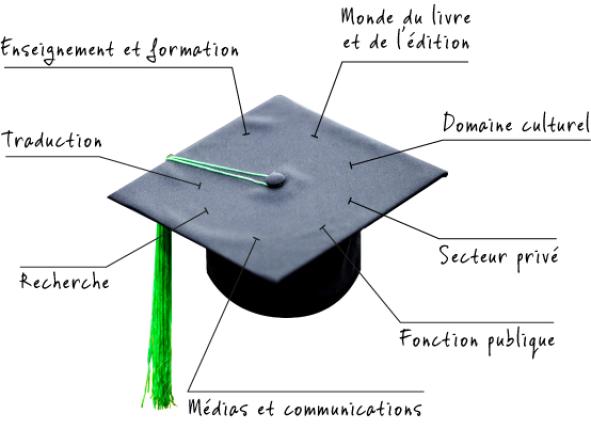
While a majority of graduates in ancient and modern languages and literature (Latin-French) go on to teach Latin and French, this program actually opens the door to a wide variety of career paths, some of which may be unexpected.
Teaching and Training
- Latin and/or French teacher at the upper secondary level
(the required certification is awarded through the Master’s in Education); - Instructor at a teacher training college, particularly in programs preparing future teachers of Latin and French for lower secondary education. A Master’s degree with a specialization in teacher education is required for appointment;
- Teacher of French as a Foreign Language (FLE). Recent graduates can gain initial professional experience abroad as French language assistants, selected by Wallonie-Bruxelles International (WBI). This is a unique opportunity to promote the French language and Belgium’s Francophone culture;
- Instructor at private language centers, continuing education organizations, or similar institutions.
Publishing and the Book Industry
- Preferred access, through the master’s program, to the specialized track in publishing and the book industry;
- A variety of roles within the publishing chain, in both the print and digital book sectors: managing book series, proofreading, and handling media relations for publications…
- Jobs in bookstores, libraries, and documentation centers, at various levels of responsibility.
Scientific Research
- Professor and/or researcher at universities or research institutions in Belgium and abroad (access to these positions requires a doctoral degree);
- A variety of research fields: linguistics (primarily historical), Latin, Neo-Latin, or French literature, and cultural history from antiquity to the present day. Graduates’ expertise is particularly recognized in the study of the Renaissance and the Modern Era, periods based on an abundance of Latin sources that remain largely untapped or untranslated.
Culture, Media, and Communication
- Management and coordination of cultural projects within institutions such as cultural centers, poetry centers, theaters, and festivals…
- Media professions: journalist, literary critic, or columnist in print, radio, or television media.
Other Career Opportunities
- Civil service, at all levels (federal, community, regional, provincial, or local), in fields such as administration, culture, or international relations;
- Private and nonprofit sectors: insurance, banking, consulting firms, nongovernmental organizations, etc.
Sought-After Transferable Skills
Some graduates now work in fields far removed from their initial training. Their academic background has, in fact, enabled them to develop transferable skills that are particularly valued in the job market, including:
- excellent command of the French language, both written and spoken;
- the ability to research, analyze, and synthesize high-quality information with rigor and a critical mindset;
- intellectual independence, creativity, and the ability to handle complex issues with ease.
By keeping their curiosity constantly engaged and building on the experiences and connections they have accumulated throughout their studies—and sometimes by supplementing their education with additional degrees—our graduates can shape their career paths in a personalized way and with a high degree of autonomy.