
Advanced Master in Computer Science and Innovation
-
Schedule
flexible schedule
- ECTS Credits 60

Overview
If IT is a major challenge or issue in your professional life, this program—which bridges the gap between computer science and management and can be completed in 1 year (or 2 years) at a rate of two days (or one day) per week, is the best way to equip you with the tools to understand, manage, and make the most of digital and information technologies within your company.
Whether you’re pursuing a career path toward a position as a Business Analyst, Business Intelligence Consultant, Digital Transformation Manager, Product Manager, Enterprise Architect, or Chief Information Officer, the Specialized Master’s in Computer Science and Innovation is THE program designed to support you every step of the way.
Your Goals
Develop an understanding of the strategic issues that precede functional analysis and software project management, as well as the means to address them.
The training is structured around three pillars to help you develop a set of essential skills to meet this challenge:

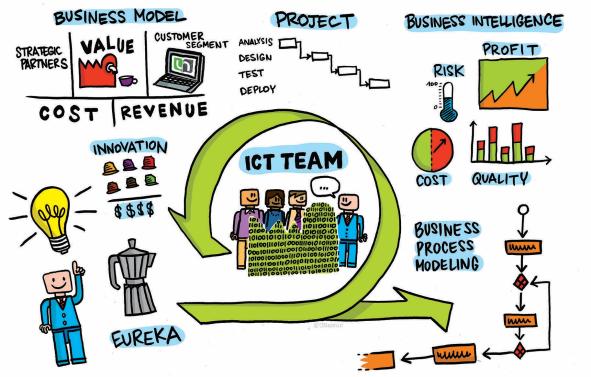
- IT-driven transformation, meaning the business analysis and modeling capabilities essential for developing innovative IT projects that align with the company’s strategy;
- Data and governance, namely the ability to define and implement an IT strategy in all its technological, organizational, commercial, and financial complexity, while taking into account the challenges and opportunities presented by AI and aspects of digital law;
- Leadership and innovation, namely the ability to manage digital and data to identify opportunities and mitigate risks related to the digital domain, new technologies, and methodological approaches, and to responsibly support the profound transformations these entail for the company’s operations.
The Benefits of Studying at UNamur
- An interdisciplinary approach that combines the fields of computer science and business administration;
- Academic expertise and guest speakers from the business world;
- An interactive “Business Model Design & Innovation” workshop held over two consecutive days;
- A response to an industry need supported by companies and associations representing the ICT sector;
- Access, even after the program ends, to a community of practice focused on innovation challenges.
The Program
The Specialized Master’s in Computer Science and Innovation—Business Analysis/IT Governance & Innovation—is designed for adults and university students who are already working in ICT-related fields.
It focuses on aspects of computer science and management relevant to the fields of business analysis, IT governance, and innovation management. It develops your skills in strategic analysis, organization, and ICT-specific governance.
The program enables you to master the basic technical skills in systems design to understand the underlying technological mechanisms and engage with designers.
The curriculum emphasizes real-world case studies, interaction between students and faculty, the application of theoretical principles through personal inquiry, and the discussion of articles and books. Some course components are also available online.
Class Schedule
Classes are held on Fridays and/or Saturdays from 9:00 a.m. to 12:00 p.m. and from 1:00 p.m. to 4:00 p.m.
If necessary, this approach allows students working “4/5” to complete the entire specialized master’s program by spreading the coursework over two years.
Specifically, under a system where all classes held on Fridays in year “t” are held on Saturdays in year “t+1”—and vice versa—you can complete the entire program by choosing a single
day of classes per week, either Friday or Saturday, over the course of two years.
Active participation in the business model course—a two-day workshop (Friday and Saturday)—is mandatory for all newly enrolled students, regardless of whether they are enrolled in the condensed schedule.
This program entitles workers who are regularly enrolled and who attend only the Saturday classes under the reduced-load option to paid educational leave.
Contact
School of Computer Science
Rue Grandgagnage, 21
5000 Namur
Tel.: +32 (0) 81 72 52 52
and +32 (0) 81 72 52 55
msbagi@unamur.be
-
Leadership and innovation
Code Name Staff Th.+Ex. Credits/Block 1 IBAGM311 Theories and Strategies of Innovation in ICT Thiran Philippe 30h th. 5 Soft skillsImage
IBAGM312 Organisation and change management Latiers Mélanie 30h th. 5 IBAGM310 Responsible digital and data management Bono Rossello Nicolas 30h th. 5 -
IT-driven transformation
Code Name Staff Th.+Ex. Credits/Block 1 IBAGM321 Requirements engineering Verlaine Bertrand Heymans Patrick 30h th. + 15h ex. 5 IBAGM322 Organisational and business modelling: languages and methods Englebert Vincent 30h th. + 15h ex. 5 IBAGM323 Project and risk management Kolp Manuel Vanderose Benoît 30h th. 5 -
Data and governance
Code Name Staff Th.+Ex. Credits/Block 1 Sustainable developmentImage
IBAGM331 IT strategies and service quality Wautelet Yves 30h th. 5 IBAGM332 Business Intelligence Linden Isabelle 30h th. 5 Soft skillsImage
IBAGM333 Digital Law Defreyne Élise 30h th. 5 UNAM0048 Artificial intelligence: challenges and opportunities Frenay Benoît 24h th. 5 -
Dissertation
Code Name Staff Th.+Ex. Credits/Block 1 IBAGM300 Master thesis: Digital innovation project Vanderose Benoît Sieberath Roald 60h th. + 45h ex. 15
-
Leadership and innovation
Code Name Staff Credits Hours/Quarter 1 2 IBAGM311 Theories and Strategies of Innovation in ICT Thiran Philippe 5 30h th. Soft skillsImage
IBAGM312 Organisation and change management Latiers Mélanie 5 30h th. IBAGM310 Responsible digital and data management Bono Rossello Nicolas 5 30h th. -
IT-driven transformation
Code Name Staff Credits Hours/Quarter 1 2 IBAGM321 Requirements engineering Verlaine Bertrand Heymans Patrick 5 30h th. + 15h ex. IBAGM322 Organisational and business modelling: languages and methods Englebert Vincent 5 30h th. + 15h ex. IBAGM323 Project and risk management Kolp Manuel Vanderose Benoît 5 30h th. -
Data and governance
Students choose 3 UE from the 4 listed below, for a total of 15 credits.Code Name Staff Credits Hours/Quarter 1 2 Sustainable developmentImage
IBAGM331 IT strategies and service quality Wautelet Yves 5 30h th. IBAGM332 Business Intelligence Linden Isabelle 5 30h th. Soft skillsImage
IBAGM333 Digital Law Defreyne Élise 5 30h th. UNAM0048 Artificial intelligence: challenges and opportunities Frenay Benoît 5 24h th. -
Dissertation
Code Name Staff Credits Hours/Quarter 1 2 IBAGM300 Master thesis: Digital innovation project Vanderose Benoît Sieberath Roald 15 30h th. + 22.5h ex. 30h th. + 22.5h ex.
Jury
Teaching profile
At the end of their training, students having completed an Advanced Master in Computer Science and Innovation will be capable of :
- Designing and elaborating models that meet the needs of industry, taking into account various judicial aspects, allowing for the introduction of TIC innovation into the market
- Establishing models for the various aspects of organisations (strategy, process, information...) and implementing Business Intelligence tools that are suitable to each particular organisation.
- Developing an IT strategy and ensuring the quality of the services made available.
- Implementing effective and suitable strategies regarding project management, change management and risk and conflict management.
- Communicating effectively, orally and in written form, adapting the language to the target audience.
Aims and objectives
Teaching profile of the Advanced Master’s in Computer Science and Innovation
Upon completion of the Advanced Master’s in Computer Science and Innovation, students will have developed competences in three key areas:
- IT-driven transformation, namely skills in business analysis and modelling that are essential for designing innovative IT projects aligned with an organisation’s strategy;
- Data and governance, namely the ability to define and implement an IT strategy in all its technological, organisational, commercial and financial complexity, while taking into account the challenges and opportunities offered by artificial intelligence and the legal framework of the digital domain;
- Leadership and innovation, namely capabilities in digital and data management enabling graduates to identify opportunities and mitigate risks related to the digital environment, emerging technologies and methodological approaches, and to support the profound transformations they bring about in the functioning of organisations in a responsible manner.
More specifically, by the end of the programme, students will be able to:
- Support IT-driven transformation in the marketplace and design business models aligned with organisational needs, while taking into account the relevant legal and ethical considerations;
- Model the various dimensions of organisations (strategy, processes, information, etc.) and implement Business Intelligence tools suited to the organisation concerned, while developing technical competences in artificial intelligence and data;
- Develop an IT strategy and ensure the quality of the services delivered;
- Implement effective and appropriate strategies in project management, change management and risk management;
- Develop communication and leadership skills in change processes, as well as adaptability in order to foster a culture of innovation and a spirit of collaboration across the different units and departments within organisations or across the market.
Graduates will be able to pursue a career as a Business Analyst. This role does not replace that of the project manager; rather, when combined with it, it enables the entire design and development chain to be effectively managed.
Description
Unique in French-speaking Belgium, this Advanced Master’s programme combines the fields of computer science and management.
It is designed for an adult audience of working professionals who already hold a university Master’s degree and are currently employed in a role related to ICT.
The curriculum is structured around an introductory module, from which some students may be exempted, and four specialised modules:
- Leadership and Innovation
- IT-Driven Transformation
- Data and Governance
- Digital Innovation Project
The programme’s alignment with the needs of businesses is ensured through the participation of companies and representative organisations from the ICT sector in the training, including AG Real Estate, Trasys Group, Microsoft, AXA, IBM, Agoria, HEC Lausanne and Sirris.
Terms and conditions of organisation
The courses are concentrated in a two day per week timetable, Fridays and Saturdays on a six-hour basis (from 9 am to 12 am and from 1 pm to 4 pm), but there is a possibility of spreading out the training to a two year programme and choosing to attend courses only one day per week, Friday or Saturday (all courses taught on Friday for the « t » year are given on Saturday for the year « t+1 » and vice versa.)
This programme gives the right to the « congé-education payé » congé-éducation payé (a paid leave for educational purposes), to workers who enrol on a basis of regular attendance and who follow the spread-out two year option for Saturdays. The conditions are established by the law of January 22 1985 and its implementations. Workers who meet the required conditions receive paid leave to follow this training…
Teaching methods
The Advanced Master’s in Computer Science and Innovation offers a teaching approach tailored to professionals who are actively engaged in the workforce:
- The teaching approach builds on students’ professional experience in order to enhance learning efficiency and ensure relevance;
- Courses emphasise case studies drawn from the professional world, interaction between students and lecturers, the validation of theoretical principles through personal reflection, and the discussion of articles or books;
- The Digital Innovation Project is structured around a cycle of conferences, masterclasses and seminars, enabling students to reflect on and analyse innovation through a broad range of theoretical and practical knowledge drawn directly from the business world;
- Certain parts of the course units are also available online.
Assessment
Assessments consist of written or oral examinations, the completion of projects (individual or group-based), as well as the writing and oral defence of a Digital Innovation Project structured around a cycle of conferences, masterclasses and seminars.
The specific assessment methods for each course unit can be consulted in the corresponding course information sheets.
The Business Analyst has a thorough command of the aspects that precede requirements analysis and the role of design project manager (typically those holding a master’s degree in computer science from UNamur).
Consequently, someone with a Master’s degree in Computer Science and a specialized Master’s degree in Computer Science and Innovation—Business Analysis / IT Governance & Innovation—will have a comprehensive understanding of the entire process.