
Bachelor in Information and Communication
-
Schedule
regular course
- ECTS Credits 180
Overview
The bachelor’s program begins with foundational courses that provide you with a theoretical foundation as well as a solid understanding of media, a nuanced understanding of how news is covered, and a critical approach to interactive and participatory media.
To understand the environment in which information and communication evolve, you will study subjects such as sociology, economics, political science, philosophy, law, and history.
In Block 2, you deepen your knowledge of the field of information and communication and explore the professional world. You choose a specialized track: “Journalism and News Media,” “Organizational Communication,” or “Cultural and Creative Industries.”
In Block 3, you’ll continue your studies in this specialization, broaden your skills in information and communication, and complete a professional internship.
New! |
Creative Industries and CulturesA brand-new program to develop creative and artistic uses of media Do you enjoy using media in creative or artistic ways? Do you dream of working in culture, audiovisual production, content creation, influencer marketing, digital arts, transmedia, or video games? Then this track is for you! With courses focused on audiovisual production, the creative uses of new technologies, cinematic language, and cultural mediation, this track will help you develop the essential skills needed to break into this rapidly growing professional sector. You’ll also discover Namur’s rich creative ecosystem through your internship. |
You're off to a good start
- You are passionate about current events, the media, culture, and digital technologies;
- you enjoy interacting with people, whether in the public eye or not;
- You express yourself fluently both verbally and in writing;
- You have a critical and analytical mind;
- you are creative and enjoy working as part of a team.
Teaching Methods
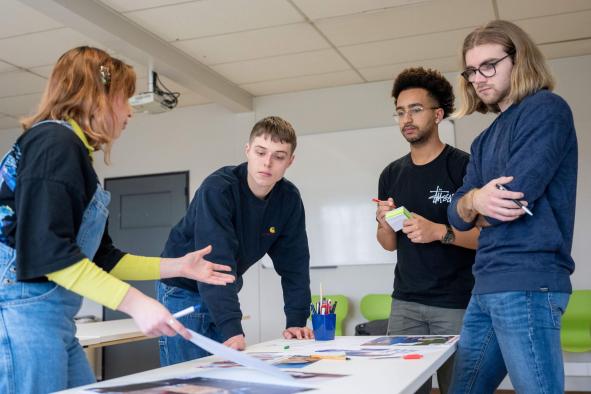
Classes, practice sessions, communication workshops, internships, collaborative projects… we do everything we can to ensure you gain a thorough understanding of the concepts and develop effective professional skills.
Practical sessions and assignments help you absorb and review the material with high-quality guidance.
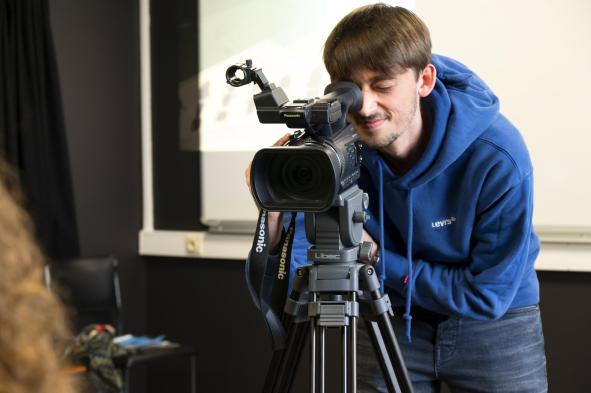
In the classes, presentations by experts and professionals introduce you to current issues and challenges in communication. Journalists, filmmakers, influencers, and webmasters also lead your hands-on workshops.
Starting in Block 2, you’ll participate in communication workshops. These workshops allow you to explore the subject matter through hands-on activities and the creation of communication materials such as:
- writing press articles and corporate documents,
- website design,
- audiovisual production (radio and television news programs, dramas, documentaries, etc.),
- facilitating debates,
- …
New! |
Take the quizzes with Act’UNamur!An educational innovation to help you understand current events As part of the practical work for the course “Fundamentals of Communication and News Analysis” (Block 1), you’ll work in teams to create current events quizzes for your classmates. These activities, which are both fun and creative, develop your skills in researching, processing, and synthesizing information, and familiarize you with the essential methods and tools for following Belgian and international news using a variety of media sources. |
Développez vos compétences linguistiques ! |
| En plus de l’anglais, vous apprenez une seconde langue (allemand, espagnol ou néerlandais) dans une perspective concrète et directement intégrée dans vos projets. Quel que soit votre niveau, vous progressez grâce à des activités immersives : excursions, tables de conversation, tandems… |
Learning by Doing
Communications Specialists or Journalists Starting Right After High School!

Communications managers and journalists from the baccalaureate level!
Project-based learning integrates and applies your knowledge from multiple disciplines to real-world scenarios.
Just like true communication experts, you’ll learn to work collaboratively and demonstrate a wide range of skills:
- from observation, literature review, source criticism, and data collection and analysis;
- to producing a high-quality report—in some cases, including an executive summary or a scientific poster written in English—which you and your team present to a panel of judges.
To boost your soft skills in foreign-language communication, your language instructors provide coaching.
At the end of the program, you have the opportunity to spend a four-month term studying at a Flemish university or abroad to deepen your knowledge of English, Dutch, or Spanish.
The “Learning by Doing” Approach |
| Projects play an increasingly important role throughout your bachelor’s program, through concrete and diverse case studies: |
IN BLOCK 1:
|
IN BLOCK 2:
|
IN BLOCK 3:
|

The Internship: A First Professional Experience
A full month of internship gives you the chance to experience the reality of the field. Whether in the media, at a company, in government, or at a cultural organization, you’ll have a unique and enriching experience, mentored by communications professionals. It’s your first opportunity to put the skills you’ve learned during your studies into practice, refine your career goals, and expand your network.
Support for Success
Succeeding in a year of college involves many challenges.
To help you overcome them, UNamur supports you in developing your academic, methodological, and interpersonal skills—with the help of many professionals.
Preparatory courses, individualized assistance…
After the bachelor's degree: the master's degree
UNamur does not offer a graduate program (master’s degree) in information and communication, but the bachelor’s degree provides access to all master’s programs in information and communication in the Wallonia-Brussels Federation, regardless of the track chosen.
Changing institutions between your bachelor’s and master’s programs allows you to build a broad network of contacts throughout your studies, across different geographic areas, which is a real advantage for future professionals in the field of communication.
New! |
Have you chosen the “Organizational Communication” track?By adding just 10 credits to your bachelor’s program, you can gain access to the master’s programs in management sciences at the UNamur School of Management! This is an opportunity to combine fundamental skills in communication and management that will set you apart in the job market. In practice: two courses are added to your bachelor’s program, and two courses are swapped out to allow you to strengthen the interdisciplinary aspect of your education. Are you interested in this track?At the start of Block 2, select the “Organizational Communication” option and contact Prof. Fanny Barnabé, the program director, to express your interest. |
Contacts
Faculty of Economics, Management, and Communication, Sciences Po
Rempart de la Vierge, 8 • B-5000 Namur
Department of Social, Political, and Communication Sciences Office
Tel.: +32 (0) 81/ 72 48 55
secretariat.infocom@unamur.be
-
Channel
-
Journalism and news media
Code Name Staff Th.+Ex. Credits/Block 1 2 3 EINCB215 Audiovisual Journalism Workshop Collin Pascal 20h th. + 45h ex. 5 LHISB204_Prêté Belgian political structures and institutions in contemporary times Dodeigne Jérémy Tixhon Axel Vertongen Youri Lou 45h th. 5 Sustainable developmentImage
EPOLB309 Ecological governance Jacquet Vincent 30h th. + 15h ex. 5 UNAM0048_Infor/commu Artificial intelligence: challenges and opportunities Frenay Benoît 24h th. 5 -
Organizational communication
Code Name Staff Th.+Ex. Credits/Block 1 2 3 Sustainable developmentImage
EPICB241 Organizational Theory Ajzen Michel 45h th. 5 EINCB216 Digital Communication Workshop Van Eetvelde Antoine 20h th. + 45h ex. 5 ELMSM412 Digital Marketing and Communication Decrop Alain De Bruyne Marie-Julie 30h th. 5 EINCB371 Strategies and communication plan Lahaye Anne-Catherine 30h th. + 15h ex. 5 -
Cultural and Creative Industries
Code Name Staff Th.+Ex. Credits/Block 1 2 3 LROMB002 Introduction to the language of film Gabriel Jean-Benoît 30h th. 3 Soft skillsImage
LHISB320 Critique of film sources Roekens Anne 15h th. 2 EINCB217 "Audiovisual creation" workshop Hallet Nicolas 20h th. + 45h ex. 5 LARTB302_Prêté Museology Lefftz Michel 30h th. 5 EITCB110 Creative Technologies Management Simonofski Anthony 30h th. 5
-
-
Communication Science
Code Name Staff Th.+Ex. Credits/Block 1 2 3 EPICB141 Communication fundamentals and news analysis Collard Anne-Sophie Haineaux Esther 30h th. + 30h ex. 5 EPICB143 Interactive and participatory media Barnabé Fanny 30h th. + 15h ex. 5 EINCB213 Actors, structures, and networks in the digital age Djelloul Ghaliya 30h th. + 15h ex. 5 EINCB214 Communication Writing Workshop Lahaye Anne-Catherine Vandenbroucke Catherine 20h th. + 45h ex. 5 Soft skillsImage
EINCB360 Semiotics Collard Anne-Sophie 30h th. + 15h ex. 5 EINCB365 Sociology and history of the media Barnabé Fanny Roekens Anne 60h th. 5 EINCB361 Media narratives and storytelling Barnabé Fanny 30h th. + 15h ex. 5 EINCB314 Digital platforms and influence Barnabé Fanny 30h th. + 15h ex. 5 -
Humanities
Code Name Staff Th.+Ex. Credits/Block 1 2 3 ECGEB140 Sociology Djelloul Ghaliya 45h th. + 15h ex. 5 ECGEB120 Philosophy De Briey Laurent 45h th. + 15h ex. 5 EPICB160 Political Science Dodeigne Jérémy 45h th. + 15h ex. 5 ECGEB121 Economic and social history Roekens Anne 45h th. + 7.5h ex. 5 ECGEB221 Psychology Buxant Coralie 30h th. 3 Service learningImage
EPICB322 Anthropology 30h th. + 22.5h ex. 4 -
Law
Code Name Staff Th.+Ex. Credits/Block 1 2 3 ECGEB130 Foundations of law De Streel Alexandre 45h th. + 15h ex. 5 EINCB363 Media law Mouffe Bernard 30h th. + 15h ex. 5 -
Economy
Code Name Staff Th.+Ex. Credits/Block 1 2 3 Sustainable developmentImage
ECGEB170 Economic facts and decisions De Crombrugghe De Picquendaele Alain 45h th. + 15h ex. 5 -
Management
Code Name Staff Th.+Ex. Credits/Block 1 2 3 ECGEB284 Marketing Management Decrop Alain 30h th. + 30h ex. 5 -
Methods
Code Name Staff Th.+Ex. Credits/Block 1 2 3 ECGEB110 Data Organization and Processing Burnay Corentin Verlaine Bertrand 30h th. + 15h ex. 4 ECGEB152 Statistics for the Humanities I Bugli Céline 30h th. + 15h ex. 5 EPICB225 Statistics for the social sciences De Bodt Cyril 15h th. + 30h ex. 4 EPOLB214 Criticism of information sources Haineaux Esther Collard Anne-Sophie 30h th. + 15h ex. 5 -
Project
Code Name Staff Th.+Ex. Credits/Block 1 2 3 Soft skillsImage
EPICB132 Project: Decoding political communication Borriello Arthur 37.5h th. + 30h ex. 5 EINCB218 Research Project : Digital Transition Burnay Nathalie Barnabé Fanny 75h th. + 15h ex. 10 EINCB344 Collard Anne-Sophie Haineaux Esther 30h th. + 225h ex. 16 -
Languages
Code Name Staff Th.+Ex. Credits/Block 1 2 3 Soft skillsImage
ECDLB190 Anglais 1 (niveau B1+) Bulon Amélie Dupal Jérémie 30h th. 3 ECDLB290 English 2 (level B1+ or higher) Hoorelbeke Christelle 30h th. 3 ECDLB390 English 3 (level B2) Hoorelbeke Christelle Foissac Patrick 30h th. 3 -
Spanish
Code Name Staff Th.+Ex. Credits/Block 1 2 3 ECDLB196 Spanish 1 (minimum level A2) Marsily Aurélie Perez Fernandez Sofia 30h th. 3 ECDLB296 Español 2 (nivel B1 o superior) Marsily Aurélie Perez Fernandez Sofia 30h th. 3 ECDLB396 Español 3 (nivel B1+ o superior) Marsily Aurélie Mil-Homens Cavaco Noémie 30h th. 3 -
German
Code Name Staff Th.+Ex. Credits/Block 1 2 3 ECDLB192 German 1 (minimum level A2) Palm Christian 60h th. 3 ECDLB193 German 1 (A1+) Palm Christian 30h th. 3 ECDLB292 Deutsch 2 (Level B1) Palm Christian 30h th. 3 ECDLB392 Deutsch 3 (mindestens level B1+) Palm Christian 30h th. 3 -
Dutch
-
Course 1 - intermediate level
Code Name Staff Th.+Ex. Credits/Block 1 2 3 ECDLB191 Elementair Nederlands: basisgrammatica, -woordenschat en dagelijkse situaties Miceli Marc 30h th. 3 ECDLB291 Mondelinge en schriftelijke communicatie in het alledaagse Nederlands Naveau Sophie 30h th. 3 ECDLB391 Mondelinge en schriftelijke communicatie op de werkvloer -B1 Hoorelbeke Christelle Miceli Marc 30h th. 3 -
Course 2 - advanced level
Code Name Staff Th.+Ex. Credits/Block 1 2 3 ECDLB181 Kritische benadering van socio-economische onderwerpen Naveau Sophie 30h th. 3 ECDLB281 De Vlaamse/Nederlandse bedrijfswereld - interculturaliteit Miceli Marc 30h th. 3 ECDLB381 Bedrijfscommunicatie en sollicitatiegesprekken – B2 Hoorelbeke Christelle 30h th. 3
-
-
-
-
Code Name Staff Th.+Ex. Credits/Block 1 2 3 UNAM0059 Religions, Society, and Politics Lefebvre Perrin 24h th. 3 UNAM0060 The philosophical question of God Malvaux Paul 24h th. 3 UNAM0061 Comparative religions Malvaux Paul 24h th. 3 UNAM0062 Science and religion: a history of controversies Malvaux Paul 24h th. 3 UNAM0063 Cazalis Roland 30h th. 3 -
Code Name Staff Th.+Ex. Credits/Block 1 2 3 UNAM0057 Taking action for the planet Henry Sabine 8h th. + 30h ex. 3
-
-
-
Code Name Staff Th.+Ex. Credits/Block 1 2 3 Sustainable developmentImage
MMEDB360 One Health Wieërs Grégoire Lachapelle Amélie Canon Caroline 15h th. 3 Course not organized this yearImage
UNAM0064 Environmental philosophy 20h th. 3 UNAM0065 Thinking in systems Béreau Sophie 26h th. 3 Sustainable developmentImage
UNAM0043 Global change and the Anthropocene Yans Johan Dendoncker Nicolas Yans Johan Linard Catherine Houssiau Laurent Henry Sabine 24h th. 3 Sustainable developmentImage
Soft skillsImage
UNAM0047 Law, sustainable development and transition Lachapelle Amélie 24h th. 3 Sustainable developmentImage
Soft skillsImage
UNAM0055 JEDDT Lachapelle Amélie 30h th. 3 Sustainable developmentImage
Soft skillsImage
UNAM0055_Part 1 JEDDT Lachapelle Amélie 10h th. 1 -
-
Code Name Staff Th.+Ex. Credits/Block 1 2 3 UNAM0048 Artificial intelligence: challenges and opportunities Frenay Benoît 24h th. 3 Soft skillsImage
UNAM0049 Science for all : Introduction to popular science Schutz Natassia Hansel Aude 24h th. 3 UNAM0054 DigiComp 2.2 - Getting to grips with the digital world in my studies and beyond Depommier Clara 16h th. 3 -
Code Name Staff Th.+Ex. Credits/Block 1 2 3 UNAM0067 Critical thinking and intellectual self-defense Sartenaer Olivier 30h th. 3 UNAM0068 Gender and racial bias. How to identify, reflect on, and avoid it? Ravez Laurent 30h th. 3 -
Code Name Staff Th.+Ex. Credits/Block 1 2 3 UNAM0069 Ethics in human-animal relations Pontarotti Gaëlle 30h th. + 20h ex. 3 -
Code Name Staff Th.+Ex. Credits/Block 1 2 3 UNAM0052 MOOC “Aim for success – become a super student” Wathelet Valérie 2h th. 3 UNAM0041 MOOC "Aim for success - become a super student". Wathelet Valérie 2h th. 3 UNAM0056 Biémar Sandrine 12h th. + 5h ex. 3 UNAM0034 Public risk management and emergency management Mathen Denis 20h th. 3
-
-
Communication Science
Code Name Staff Credits Hours/Quarter 1 2 EPICB141 Communication fundamentals and news analysis Collard Anne-Sophie Haineaux Esther 5 30h th. + 30h ex. EPICB143 Interactive and participatory media Barnabé Fanny 5 30h th. + 15h ex. -
Humanities
Code Name Staff Credits Hours/Quarter 1 2 ECGEB140 Sociology Djelloul Ghaliya 5 45h th. + 15h ex. ECGEB120 Philosophy De Briey Laurent 5 45h th. + 15h ex. EPICB160 Political Science Dodeigne Jérémy 5 45h th. + 15h ex. ECGEB121 Economic and social history Roekens Anne 5 45h th. + 7.5h ex. -
Law
Code Name Staff Credits Hours/Quarter 1 2 ECGEB130 Foundations of law De Streel Alexandre 5 45h th. + 15h ex. -
Economy
Code Name Staff Credits Hours/Quarter 1 2 Sustainable developmentImage
ECGEB170 Economic facts and decisions De Crombrugghe De Picquendaele Alain 5 45h th. + 15h ex. -
Methods
Code Name Staff Credits Hours/Quarter 1 2 ECGEB110 Data Organization and Processing Burnay Corentin Verlaine Bertrand 4 30h th. + 15h ex. ECGEB152 Statistics for the Humanities I Bugli Céline 5 30h th. + 15h ex. -
Project
Code Name Staff Credits Hours/Quarter 1 2 Soft skillsImage
EPICB132 Project: Decoding political communication Borriello Arthur 5 37.5h th. + 30h ex. -
Languages
Code Name Staff Credits Hours/Quarter 1 2 Soft skillsImage
ECDLB190 Anglais 1 (niveau B1+) Bulon Amélie Dupal Jérémie 3 10h th. 20h th. -
Spanish
Code Name Staff Credits Hours/Quarter 1 2 ECDLB196 Spanish 1 (minimum level A2) Marsily Aurélie Perez Fernandez Sofia 3 15h th. 15h th. -
German
Code Name Staff Credits Hours/Quarter 1 2 ECDLB192 German 1 (minimum level A2) Palm Christian 3 30h th. 30h th. ECDLB193 German 1 (A1+) Palm Christian 3 15h th. 15h th. -
Dutch
-
Course 1 - intermediate level
Code Name Staff Credits Hours/Quarter 1 2 ECDLB191 Elementair Nederlands: basisgrammatica, -woordenschat en dagelijkse situaties Miceli Marc 3 15h th. 15h th. -
Course 2 - advanced level
Code Name Staff Credits Hours/Quarter 1 2 ECDLB181 Kritische benadering van socio-economische onderwerpen Naveau Sophie 3 15h th. 15h th.
-
-
-
Channel
-
Journalism and news media
Code Name Staff Credits Hours/Quarter 1 2 EINCB215 Audiovisual Journalism Workshop Collin Pascal 5 20h th. + 45h ex. LHISB204_Prêté Belgian political structures and institutions in contemporary times Dodeigne Jérémy Tixhon Axel Vertongen Youri Lou 5 45h th. -
Organizational communication
Code Name Staff Credits Hours/Quarter 1 2 Sustainable developmentImage
EPICB241 Organizational Theory Ajzen Michel 5 45h th. EINCB216 Digital Communication Workshop Van Eetvelde Antoine 5 20h th. + 45h ex. -
Cultural and Creative Industries
Code Name Staff Credits Hours/Quarter 1 2 LROMB002 Introduction to the language of film Gabriel Jean-Benoît 3 30h th. Soft skillsImage
LHISB320 Critique of film sources Roekens Anne 2 15h th. EINCB217 "Audiovisual creation" workshop Hallet Nicolas 5 20h th. + 45h ex.
-
-
Communication Science
Code Name Staff Credits Hours/Quarter 1 2 EINCB213 Actors, structures, and networks in the digital age Djelloul Ghaliya 5 30h th. + 15h ex. EINCB214 Communication Writing Workshop Lahaye Anne-Catherine Vandenbroucke Catherine 5 20h th. + 45h ex. -
Humanities
Code Name Staff Credits Hours/Quarter 1 2 ECGEB221 Psychology Buxant Coralie 3 30h th. Service learningImage
EPICB322 Anthropology 4 30h th. + 22.5h ex. -
Management
Code Name Staff Credits Hours/Quarter 1 2 ECGEB284 Marketing Management Decrop Alain 5 30h th. + 30h ex. -
Methods
Code Name Staff Credits Hours/Quarter 1 2 EPICB225 Statistics for the social sciences De Bodt Cyril 4 15h th. + 30h ex. EPOLB214 Criticism of information sources Haineaux Esther Collard Anne-Sophie 5 30h th. + 15h ex. -
Project
Code Name Staff Credits Hours/Quarter 1 2 EINCB218 Research Project : Digital Transition Burnay Nathalie Barnabé Fanny 10 45h th. + 7h ex. 30h th. + 8h ex. -
Languages
Code Name Staff Credits Hours/Quarter 1 2 ECDLB290 English 2 (level B1+ or higher) Hoorelbeke Christelle 3 30h th. -
Spanish
Code Name Staff Credits Hours/Quarter 1 2 ECDLB296 Español 2 (nivel B1 o superior) Marsily Aurélie Perez Fernandez Sofia 3 15h th. 15h th. -
German
Code Name Staff Credits Hours/Quarter 1 2 ECDLB292 Deutsch 2 (Level B1) Palm Christian 3 15h th. 15h th. -
Dutch
-
Course 1 - intermediate level
Code Name Staff Credits Hours/Quarter 1 2 ECDLB291 Mondelinge en schriftelijke communicatie in het alledaagse Nederlands Naveau Sophie 3 15h th. 15h th. -
Course 2 - advanced level
Code Name Staff Credits Hours/Quarter 1 2 ECDLB281 De Vlaamse/Nederlandse bedrijfswereld - interculturaliteit Miceli Marc 3 15h th. 15h th.
-
-
-
-
Code Name Staff Credits Hours/Quarter 1 2 Sustainable developmentImage
MMEDB360 One Health Wieërs Grégoire Lachapelle Amélie Canon Caroline 3 15h th. Course not organized this yearImage
UNAM0064 Environmental philosophy 3 20h th. UNAM0065 Thinking in systems Béreau Sophie 3 26h th. Sustainable developmentImage
UNAM0043 Global change and the Anthropocene Yans Johan Dendoncker Nicolas Yans Johan Linard Catherine Houssiau Laurent Henry Sabine 3 24h th. Sustainable developmentImage
Soft skillsImage
UNAM0047 Law, sustainable development and transition Lachapelle Amélie 3 24h th. Sustainable developmentImage
Soft skillsImage
UNAM0055 JEDDT Lachapelle Amélie 3 30h th. Sustainable developmentImage
Soft skillsImage
UNAM0055_Part 1 JEDDT Lachapelle Amélie 1 10h th. -
-
Code Name Staff Credits Hours/Quarter 1 2 UNAM0048 Artificial intelligence: challenges and opportunities Frenay Benoît 3 24h th. Soft skillsImage
UNAM0049 Science for all : Introduction to popular science Schutz Natassia Hansel Aude 3 12h th. 12h th. UNAM0054 DigiComp 2.2 - Getting to grips with the digital world in my studies and beyond Depommier Clara 3 16h th. -
Code Name Staff Credits Hours/Quarter 1 2 UNAM0067 Critical thinking and intellectual self-defense Sartenaer Olivier 3 30h th. UNAM0068 Gender and racial bias. How to identify, reflect on, and avoid it? Ravez Laurent 3 30h th. -
Code Name Staff Credits Hours/Quarter 1 2 UNAM0069 Ethics in human-animal relations Pontarotti Gaëlle 3 30h th. + 20h ex. -
Code Name Staff Credits Hours/Quarter 1 2 UNAM0052 MOOC “Aim for success – become a super student” Wathelet Valérie 3 2h th. UNAM0041 MOOC "Aim for success - become a super student". Wathelet Valérie 3 2h th. UNAM0056 Biémar Sandrine 3 12h th. + 5h ex. UNAM0034 Public risk management and emergency management Mathen Denis 3 20h th.
-
-
Channel
-
Journalism and news media
Code Name Staff Credits Hours/Quarter 1 2 Sustainable developmentImage
EPOLB309 Ecological governance Jacquet Vincent 5 30h th. + 15h ex. UNAM0048_Infor/commu Artificial intelligence: challenges and opportunities Frenay Benoît 5 24h th. -
Organizational communication
Code Name Staff Credits Hours/Quarter 1 2 ELMSM412 Digital Marketing and Communication Decrop Alain De Bruyne Marie-Julie 5 30h th. EINCB371 Strategies and communication plan Lahaye Anne-Catherine 5 30h th. + 15h ex. -
Cultural and Creative Industries
Code Name Staff Credits Hours/Quarter 1 2 LARTB302_Prêté Museology Lefftz Michel 5 15h th. 15h th. EITCB110 Creative Technologies Management Simonofski Anthony 5 30h th.
-
-
Communication Science
Code Name Staff Credits Hours/Quarter 1 2 Soft skillsImage
EINCB360 Semiotics Collard Anne-Sophie 5 30h th. + 15h ex. EINCB365 Sociology and history of the media Barnabé Fanny Roekens Anne 5 60h th. EINCB361 Media narratives and storytelling Barnabé Fanny 5 30h th. + 15h ex. EINCB314 Digital platforms and influence Barnabé Fanny 5 30h th. + 15h ex. -
Law
Code Name Staff Credits Hours/Quarter 1 2 EINCB363 Media law Mouffe Bernard 5 30h th. + 15h ex. -
Project
Code Name Staff Credits Hours/Quarter 1 2 EINCB344 Collard Anne-Sophie Haineaux Esther 16 30h th. + 225h ex. -
Languages
Code Name Staff Credits Hours/Quarter 1 2 ECDLB390 English 3 (level B2) Hoorelbeke Christelle Foissac Patrick 3 30h th. -
Spanish
Code Name Staff Credits Hours/Quarter 1 2 ECDLB396 Español 3 (nivel B1+ o superior) Marsily Aurélie Mil-Homens Cavaco Noémie 3 15h th. 15h th. -
German
Code Name Staff Credits Hours/Quarter 1 2 ECDLB392 Deutsch 3 (mindestens level B1+) Palm Christian 3 15h th. 15h th. -
Dutch
-
Course 1 - intermediate level
Code Name Staff Credits Hours/Quarter 1 2 ECDLB391 Mondelinge en schriftelijke communicatie op de werkvloer -B1 Hoorelbeke Christelle Miceli Marc 3 15h th. 15h th. -
Course 2 - advanced level
Code Name Staff Credits Hours/Quarter 1 2 ECDLB381 Bedrijfscommunicatie en sollicitatiegesprekken – B2 Hoorelbeke Christelle 3 15h th. 15h th.
-
-
-
-
Code Name Staff Credits Hours/Quarter 1 2 UNAM0059 Religions, Society, and Politics Lefebvre Perrin 3 24h th. UNAM0060 The philosophical question of God Malvaux Paul 3 24h th. UNAM0061 Comparative religions Malvaux Paul 3 24h th. UNAM0062 Science and religion: a history of controversies Malvaux Paul 3 24h th. UNAM0063 Cazalis Roland 3 30h th. -
Code Name Staff Credits Hours/Quarter 1 2 UNAM0057 Taking action for the planet Henry Sabine 3 4h th. + 15h ex. 4h th. + 15h ex.
-
International mobility and openness
Mobilité et ouverture internationale
Communication Careers
Communication professions
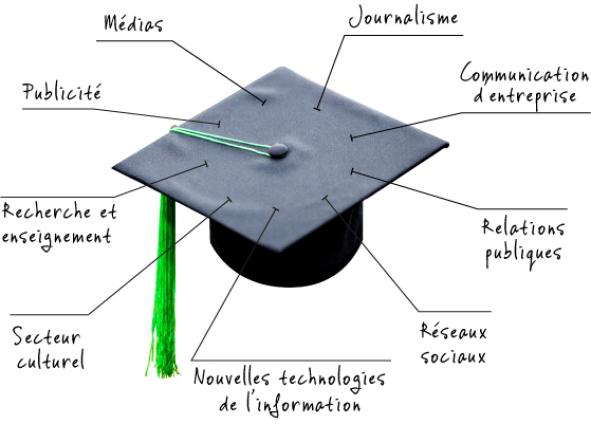
The skills acquired through training in information and communication enable individuals to pursue careers in fields such as:
- journalism (print media, radio, television news, general or specialized journalism, etc.)
- media (television production, film, video games, etc.)
- information technology (digital platforms, social media, online streaming, etc.)
- advertising
- event management (festivals, trade shows, corporate events, etc.)
- public relations and corporate communications (managing internal and external communications within a company, community management, crisis management, managing an organization’s image, etc.)
- the sociocultural sector (museums, theaters, concert halls, nonprofit organizations, continuing education, etc.).
Furthermore, the world of communication is constantly evolving and redefining itself: new professions therefore emerge regularly, while others transform in response to technological innovations and societal changes. Today, for example, we must devise new ways of producing television in response to the growth of digital platforms and streaming.
Managing social media—whether internally or externally—has become a role handled by the organization’s community manager. When designing a media project, it is increasingly common to integrate different media channels, following the transmedia model, and to consider how to structure content through storytelling. Online “influencers” are also inventing new ways to communicate by innovatively leveraging the unique features of digital platforms. Curiosity and adaptability are therefore two essential personal qualities for thriving in communication careers.