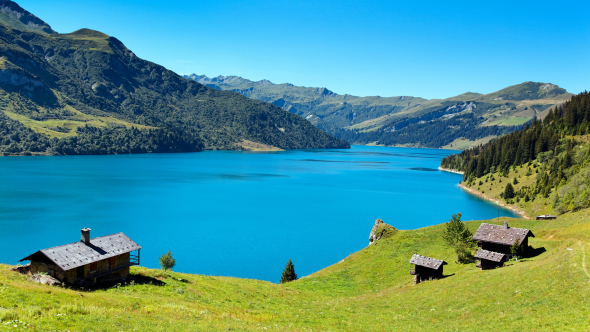
But what drives so many people to spend several days in the mountains? That’s the question researchers set out to answer. “The popularity of multi-day hiking in the mountains continues to grow, and it’s certainly intriguing, begins Alain Decrop. “Today, some destinations are even facing overtourism. We thought it would be interesting to understand what people are really looking for in this type of experience.” The researchers conducted a field study at a dozen mountain huts in the French Alps. This choice was no accident: mountain huts are an ideal place to meet hikers and gather their accounts after several hours of walking. For nearly a year, the team conducted in-depth interviews and ethnographic observations to understand what really happens during these trips. 

Although Alain Decrop did not participate in the field data collection, his role was crucial in analyzing the results. “The data was collected by our colleagues in Savoie, who were closest to the field. My role was to provide an outside perspective to analyze and interpret this data, linking it to theoretical concepts, he explains. “When you’re less involved in the data collection, you can sometimes spot things that people immersed in the field no longer see as easily.” This complementary approach among researchers has led to a better understanding of what happens during a stay at a mountain hut. 

Disconnect to Reconnect Better

The study shows that backpacking in the mountains creates conditions conducive to letting go. Walking, the natural environment, and the simplicity of life in a mountain hut foster what researchers call “resonant availability”—a state that allows people to break away from the demands of daily life. 

This renewed openness allows people to take a step back from their lives, live more fully in the present moment, and view their surroundings with fresh eyes. “This disconnection then allows them to reconnect with themselves, with others, and with their environment, summarizes Alain Decrop. “They regain a mental openness that offers them genuine space for reflection and peace of mind.” 

This research, conducted over nearly a year, led to a publication in *Recherche et Applications en Marketing* (RAM), one of the most prestigious scientific journals in the field. “The review process is particularly selective: only one in five or six articles is accepted, notes Alain Decrop. “It’s a highly ranked journal, which attests to the scientific quality of our work.” Congratulations to Alain Decrop and all of his colleagues on this outstanding scientific recognition. 

About Alain Decrop

Alain Decrop is a full professor of marketing at the University of Namur in Belgium. A founding member and former director of NADI-CeRCLe (Namur Digital Institute - Center for Research on Consumption and Leisure) and the CCMS (Center for Research on Consumers and Marketing Strategy), he also served as president of the French Marketing Association (AFM). He holds a master’s degree in modern history and economics, and a Ph.D. in business administration. 

Alain Decrop has taught a number of courses related to marketing management, consumer behavior, digital marketing communications, research methods, service management, and collaborative business models.

Alain Decrop