UNamur’s membership in the European alliance UNIVERSEH (European Space University for Earth and Humanity) is the result of a long process that began in 2017 and was formalized in the Univers2025 strategic plan. 

Following an in-depth analysis of existing European alliances and various integration initiatives, UNamur had the opportunity to join UNIVERSEH, a thematic alliance dedicated to space sciences, Earth sciences, and the humanities, for the alliance’s second phase, which officially began on November 1, 2023. In addition to UNamur, the member universities of UNIVERSEH are the Community of Universities and Higher Education Institutions of Toulouse (France), AGH University of Krakow (Poland), the University of Luxembourg (Luxembourg), Luleå University of Technology (Sweden), Heinrich Heine University Düsseldorf (Germany), and Tor Vergata University of Rome (Italy). 

This affiliation marks a strategic turning point: until now, UNamur was the only French-speaking university in Belgium not to belong to a European alliance, which limited its visibility and influence at the national and international levels. Joining UNIVERSEH has helped bridge this gap and strengthen UNamur’s position within the European Higher Education Area.

This integration offers a multitude of opportunities to UNamur and its entire community:

  • Enhanced regional and international visibility,
  • Development of common curricula and joint degrees,
  • Establishment of new scientific collaborations and increased mobility,
  • Increased appeal to students and researchers,
  • Strengthening ties with the economic, political, and cultural ecosystem.
  • Alignment with other Belgian universities that are members of alliances,
  • Participation in strategic working groups at the national and European levels,
  • Promotion during state visits and economic missions.

A space where space sciences and the humanities come together

Within the UNIVERSEH alliance, the humanities and social sciences (HSS) play a vital role alongside space sciences and STEM disciplines (Science, Technology, Engineering, and Mathematics). Indeed, understanding, supporting, and guiding the transformations in the space sector cannot be limited to technological progress: the exploration and exploitation of space also raise major ethical, legal, economic, cultural, and societal issues.

By integrating these different perspectives, UNIVERSEH adopts a truly interdisciplinary approach to the space sector. This approach enriches the overall understanding of future challenges and trains citizens capable of addressing them through diverse and complementary skills.

At the heart of this dynamic, the “Humanities” working group plays a key role. This group of experts from the seven partner universities opens the alliance to a wide range of disciplines beyond STEM and promotes the integration of expertise in the social sciences and humanities, as well as students from these fields, into UNIVERSEH initiatives.

Several concrete activities already illustrate this openness. Among them is the Winter School held in Rome in December 2025 on the theme “Space through Literature, Theater, Cinema, and Other Arts,” which explored space-related issues from artistic, cultural, and societal perspectives.

Furthermore, UNamur, through its Language Center and in collaboration with two other Alliance universities, is offering a new course whose first in-person student exchange will take place in April 2026: “Science for All: An Introduction to Popular Science.” Participants will learn to create original, authentic, and innovative popular science content, particularly through two-minute videos designed for social media.

These initiatives underscore that the skills needed to address future challenges in the space sector are not limited to technical expertise: they also include understanding social contexts, anticipating impacts, and contributing to responsible governance.


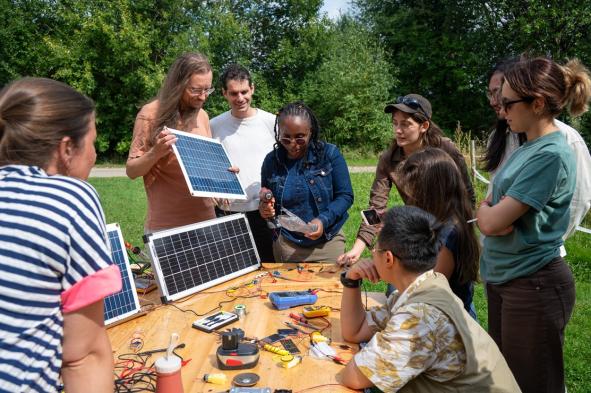
Doctorants lors d'un atelier UNIVERSEH

A driving force for change at UNamur

UNamur’s participation in UNIVERSEH serves as a powerful catalyst for growth, both for the institution and for its staff and students. It enables us to develop new course content, expand our course offerings, and strengthen our teaching practices, while showcasing UNamur’s expertise to our European partners.

These first two years within UNIVERSEH have already brought significant progress for UNamur. Strengthened collaboration between departments, the launch of joint international activities, and the gradual alignment of administrative practices all point to a profound transformation. We are also seeing a shift from isolated, one-off initiatives toward a more systemic approach where internationalization and cooperation are fully integrated. 

At UNamur, this evolution is particularly visible. The strategic involvement of the new Faculty of Education and Training Sciences (FaSEF) is a prime example. Its commitment, supported by the hiring of a techno-pedagogue specializing in international educational innovation, will enable the design of innovative teaching methods, the integration of multilingual and multicultural approaches into programs, and the building of bridges between academic teams, administrative services, and the UNIVERSEH unit. This cross-disciplinary expertise directly contributes to the internationalization of teaching practices across UNamur.

Staff weeks—training sessions for staff members at UNIVERSEH universities, organized within the framework of the Alliance—also play a central role. In particular, UNamur organized a staff week in April 2025 titled “Building a Joint Program: Challenges and Opportunities.” These meetings provide a structured framework for exchanging best practices, allowing academic and administrative staff to compare their approaches, identify potential common ground, and collaboratively develop shared solutions. 

Photo de groupe à l'occasion d'une staff week

All of these achievements demonstrate UNIVERSEH’s tangible contribution to the goals of transforming European higher education:

  • Improving educational quality through the development of joint courses and programs and pedagogical innovation;
  • Strengthening institutional cooperation in line with the European Higher Education Area;
  • Increased mobility and intercultural openness;
  • The emergence of a cohesive and committed UNIVERSEH community.

Through this integrated approach (governance, pedagogical innovation, staff skills development, administrative convergence, and student engagement), the Alliance produces immediate results while paving the way for sustainable structural transformation that benefits the entire university community: students, faculty, researchers, and other staff members.

UNIVERSEH: A Strategic Tool for Strengthening Collaborations

UNamur’s membership in UNIVERSEH has served as a powerful catalyst for its projects and inter-university collaborations. Since the university joined the alliance, several joint initiatives have been launched, providing concrete examples of the networking momentum driven by UNIVERSEH.

Notable achievements include two doctoral fellowships jointly funded with the University of Luxembourg, demonstrating the strengthening of our cooperation in research as well. These two doctoral projects are being conducted at the NADI (Namur Digital Institute) research institute.

The alliance also serves as a strategic lever for the design, development, and submission of joint projects with partner universities in response to European calls for proposals. It thus fosters enhanced cooperation around ambitious initiatives spanning the fields of education, research, and the dissemination and transmission of knowledge, by leveraging the complementary expertise of member institutions and strengthening their visibility and impact at the European level.

More recently, two joint projects with UNIVERSEH partners were submitted: one coordinated by Confluent des Savoir and focused on organizing science outreach activities, and the other coordinated by AGH University of Science and Technology in Kraków, aimed at strengthening research capacities and collaborations within the Alliance.

Furthermore, in November 2025, the Toulouse COMUE, coordinator of UNIVERSEH, secured an MSCA Co-Fund project that will enable the funding (through joint supervision) of 37 PhD students, notably with Alliance partners. 

Membership in UNIVERSEH offers UNamur the opportunity to strengthen its ties with the local ecosystem while consolidating its presence within European networks. The companies and institutions that host our students or collaborate on educational activities, such as the Spring School “Space is All Around: An Introduction to Space Sciences, held annually at the Euro Space Center in Redu and including a tour of ESA facilities, directly contribute to increasing the Alliance’s impact and our university’s visibility. Outreach initiatives and regional and European partnerships also help promote UNamur and UNIVERSEH, both within the Walloon ecosystem and at the European level.

Groupe d'étudiants à l'Euro Space Center

Furthermore, UNamur aims to continue developing long-term collaborations with UNIVERSEH partners by engaging all seven of its faculties and eleven research institutes. Mobility—whether for students or staff, and whether short-term or long-term—will be a key driver for further integrating the humanities and social sciences into the heart of the Alliance and strengthening the university’s involvement in UNIVERSEH’s various initiatives.

What is a European alliance?

European Alliances, launched by the European Commission in 2017, are transnational partnerships among higher education institutions designed to foster long-term collaboration, enhance the quality of higher education, and facilitate the awarding of degrees that incorporate study in multiple EU countries.

Since then, some 60 alliances have been established across Europe. Since 2023, all universities in the Wallonia-Brussels Federation, as well as one university college, have been part of European university alliances.

UNIVERSEH: 7 European universities

UNIVERSEH is an alliance of seven universities from seven European countries. It was established in November 2020 as part of the "European Universities" initiative promoted and funded by the European Commission.

UNIVERSEH_Map