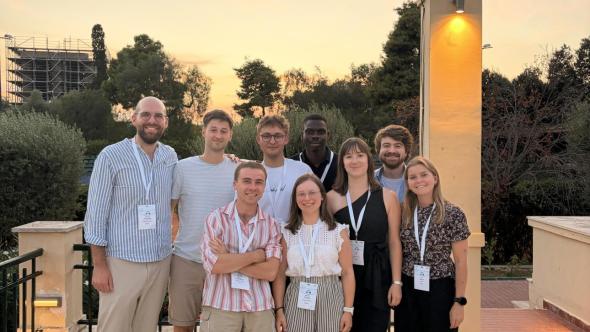
E-government, e-participation, algorithmic governance, and artificial intelligence: the IFIP EGOV International Conference brings together researchers studying digital transformations in the public sector and their implications for citizens and government agencies. UNamur was particularly well represented at the conference this year, with four papers and three posters presented. 

A Best Paper Award for Simon Dechamps

Simon Dechamps, a doctoral student in management at UNamur and a member of the MINDIT center, received the 2026 Best Paper Award for his article “From the Modern Citizen to Citizens as Multiplicities: Citizen-Centricity as a Sign of a New Episteme?”His work examines how government agencies seek to better tailor their digital services to citizens’ needs. 

Based on fourteen interviews conducted within Belgian public administrations, Simon Dechamps demonstrates that it is difficult to speak of the “citizen” as a single, uniform profile. Needs vary greatly from one person to another, and public services must therefore take this diversity into account. His work thus highlights the need to better equip public officials to tailor services to different user profiles.

Lisa Dewulf Wins the Best Poster Award

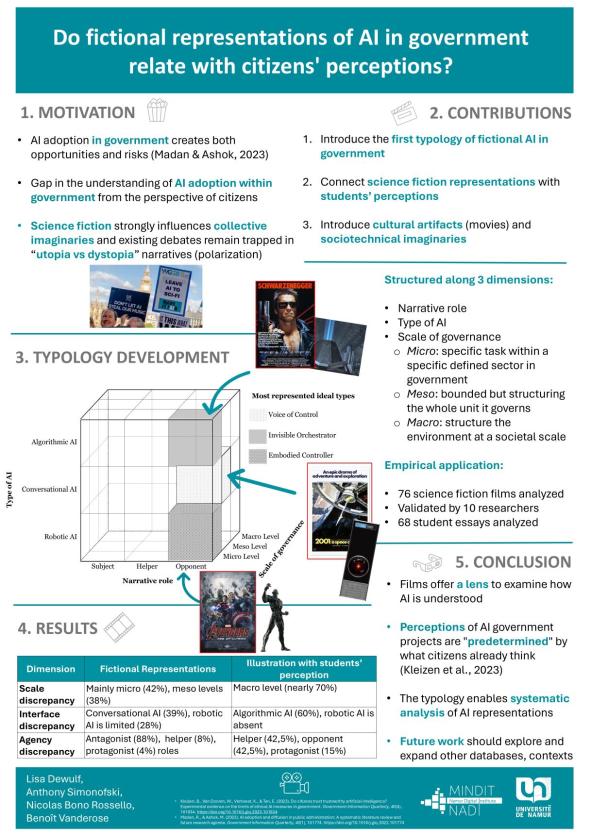
Lisa Dewulf, a doctoral student at the UNamur School of Management and a member of the MINDIT center and the NaDI institute, received the Best Poster Award for “Do Fictional Representations of AI in Government Relate to Citizens’ Perceptions?” 

Her research focuses on representations of digital technologies in fiction and how these representations can influence our perception of such technologies. Her work is part of the ARC Di-Fic project, which explores, among other things, the use of films, TV series, and video games in digital citizenship education. Her poster presents a typology of representations of artificial intelligence in the government sector based on three dimensions: the level of governance, the type of AI depicted, and its role in the narrative. 

The goal is to better understand how fiction helps shape collective imaginaries surrounding artificial intelligence, as it plays an increasingly significant role in government agencies. The jury particularly praised the practical relevance of the work and its contribution to research on AI and digital government. 

Le poster de Lisa Dewulf
Le poster de Lisa Dewulf, présenté à l'occasion de l'EGOV 2026

Eudes Adiba Among the Most Innovative Contributions

Mahougnon Sedjro Eudes Adiba, a doctoral student at UNamur in the MINDIT–NaDI program, had his article selected as one of the three most innovative research contributions out of nearly 200 submissions. His work focuses on the accessibility of public data and, more specifically, on how citizens search for information on open data portals, such as that of the City of Namur. 

His study analyzes how users actually navigate these platforms. By examining their interaction patterns, the research aims to better understand how citizens go about finding public information, with the ultimate goal of designing portals that are simpler, more intuitive, and better suited to their actual needs. 

A particularly successful event for UNamur

With seven presentations, two awards, and one nomination, EGOV 2026 highlights the diversity of research conducted at UNamur on digital transformation, public services, and citizenship. This is also a wonderful recognition for the MINDIT center, to which several of these researchers are affiliated. Congratulations to all the researchers who contributed to the work presented at this year’s conference!