Under his leadership, the Department has developed a curriculum designed to train professionals who meet the needs of the biotechnology and biopharmaceutical industries, closely integrating basic research with preclinical and clinical development. This curriculum also incorporates quality and regulatory aspects, which are essential to the development of healthcare products.
The Department has also developed a close partnership with its counterpart at ULiège. This collaboration has led to the establishment of several joint degree programs: an interuniversity certificate in regulatory affairs for health products in 2017–18, as well as two specialized tracks in 2019–2020. One, in clinical research management, is led by UNamur; the other, in data management—a bioinformatics program—is led by ULiège. In 2019, the Department of Biomedical Sciences also joined the consortium responsible for the European Master in Translational Cosmetic and Dermatological Sciences, as part of the prestigious Erasmus Mundus program. It provides instruction in clinical research, under the leadership of Professor Charlotte Beaudart, who joined the Department in 2023.
Over the past nine years, the Department has overcome numerous challenges to offer its students a unique program of study within the Wallonia-Brussels Federation. It has also taken the lead in defining a legal framework for graduates of a master’s degree in biomedical sciences. The administrations of the 10 Belgian universities are now working together to bring this initiative to the federal level.
Finally, at the end of his third term, Professor Gillet, in collaboration with his colleagues Professors Marielle Boonen, Patsy Renard, and Thierry Arnould, helped strengthen the biomedical sciences curriculum by further developing its focus on fundamental research, thereby complementing the already established biopharmaceutical and industrial dimensions.
Today, the biomedical sciences program at UNamur brings together nearly 400 undergraduate students, 65 graduate students—representing more than 40 nationalities since 2012—as well as 20 doctoral and postdoctoral students.
A recognized expert in ABC transporters and cancer resistance to treatment, Professor Gillet and his team are pursuing two research tracks—both fundamental and translational—within a network of national and international collaborators. The first is dedicated to the molecular and functional characterization of the ABCB5 transporter. The second aims to explore and develop new therapeutic approaches for two gastrointestinal cancers: esophageal adenocarcinoma and hepatocellular carcinoma.
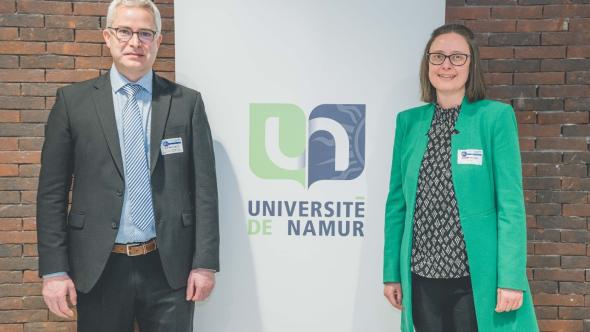
Professor Marielle Boonen, who succeeds him, is a renowned researcher in the field of cellular and molecular biology. Her research focuses in particular on lysosomal diseases and the intracellular transport mechanisms involved in rare pathologies. With a solid academic background and an international career (including a postdoctoral fellowship at Washington University in St. Louis, Missouri, USA), she intends to continue the tradition of excellence while supporting the emergence of innovative projects.
A first project is the implementation of the conceptual work on the reform of the master’s programs in biomedical sciences and BBMC (Biochemistry, Molecular and Cellular Biology), which has resulted in the new program proposed for the 2026–2027 academic year. Efforts are also underway to familiarize bachelor’s students with learning scientific subjects in English, as well as to open the program to technological advancements in bioinformatics and artificial intelligence.
This change in direction is part of a commitment to continuity and renewal. By combining Professor Gillet’s legacy with Professor Boonen’s vision, the Department of Biomedical Sciences at UNamur is affirming more than ever its central role in research and training in basic, translational, and clinical research.