
Bachelor in History
-
Schedule
regular course
- ECTS Credits 180
Overview
Your bachelor’s program begins with a general introduction to history, art history, and archaeology. You will explore the various historical periods: Antiquity, the Middle Ages, the Modern Era, and the Contemporary Era.
Throughout your program, you will learn to master discipline-specific methods (bibliographic methods, historical criticism, analysis of iconographic documents, etc.).
To understand documents from the past and present, you will develop your knowledge of several ancient (Latin, Greek) or modern (English, Dutch, German, etc.) foreign languages.
To understand the human experience, you will also be trained in philosophy, literature, art history, as well as human geography, economics, political science, and law.
It is in Block 3 that you specialize in one of the major periods of history. You select your track of study from among the ancient, medieval, modern, or contemporary periods.
You're off to a good start
- you are passionate about historical events and their implications for the present;
- you are curious and persistent in finding the documents where information is hidden;
- you express yourself with rigor and precision, both verbally and in writing;
- you have a critical and analytical mind to understand and interpret documents.

Teaching Methods
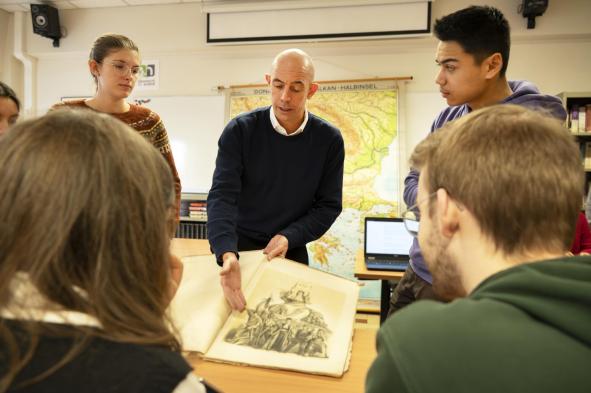
Lectures, hands-on exercises, visits to libraries and archives… we do everything we can to help you learn how to analyze and make use of the written and visual records, oral accounts, and artifacts left to us by our ancestors.
Technical Courses
Technical courses (heuristics, bibliography, paleography, etc.) always include a practical component: you are therefore constantly assessing your understanding of the subject matter and the quality of your study methods. Individual interactions with professors and teaching assistants help you make progress.
Introduction to Historical Research
From the start of the bachelor’s program, you are trained in the methodology of historical research and engage with sources and documents.
How do you interpret, analyze, and make use of written documents, audiovisual sources, and landscapes transformed by human activity? How do you find studies or original documentation on a subject?
Throughout the year, you combine these technical courses to address original research questions. You conclude this methodological introduction by writing an academic paper. The Art of Communication
Once their research is complete, historians must share and communicate their findings. You will therefore be trained in the art of communicating orally and in writing, for example by curating an exhibition, creating a guided tour, or producing a podcast, depending on your target audience.
Languages
To understand the traces of the past and the work of modern historians, you will take a Latin course (required) and a second language (of your choice). Beyond the first year, the choice of two languages is generally unrestricted, but it may be influenced by your choice of specialization (Antiquity, Middle Ages, Modern Era, Contemporary Era). Throughout the year, language courses are accompanied by regular assessments.
A week-long immersion in the past
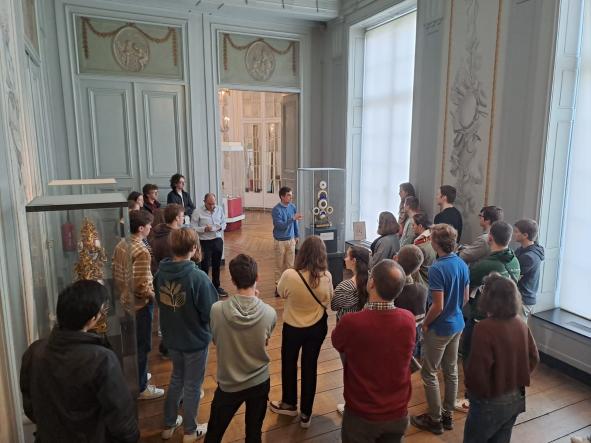
A study trip allows you to explore museums, heritage sites, cities, and historical locations from each period to deepen your knowledge and broaden your horizons.
In the second year, this field week also exposes you to various methods of communicating history (guided tours, audio guides, museum tours, etc.). You build connections with fellow students and lay the groundwork for your future professional network.
The varied and constantly updated selection of visits helps you put the knowledge gained during class periods into perspective.
Support for Success
Succeeding in a year of university studies involves many challenges.
To help you overcome them, UNamur supports you in developing your academic, methodological, and interpersonal skills—with the help of many professionals.
Preparatory courses, personalized assistance…
Discover the resources available to support your education.
After a bachelor's degree: a master's degree
In the Wallonia-Brussels Federation, a bachelor’s degree in history automatically qualifies you for a master’s degree in history.
During this second cycle, you choose a Master’s program that specifically prepares you for teaching, research, or another professional specialization, such as archival science, library science, or communication.
The objectives of the Master’s in History are to deepen your understanding of methodology and critical analysis in the identification and use of information, and to apply these skills to a specific period (Antiquity, the Middle Ages, the Modern Era, the Contemporary Era) or a specific field of history, with the aim of producing a personal synthesis on a chosen topic (Master’s thesis).
If you wish, you can supplement your studies at UNamur by enrolling in the Bachelor’s program in Art History and Archaeology, for which you will receive numerous course exemptions (including all first-year courses, which are common to the Art History and History programs), allowing you—by adding Art History courses to your second- and third-year History curriculum—to earn this second degree in one additional academic year.
Contacts
School of Philosophy and Letters
Office
1 Rue Grafé • B-5000 Namur
Tel.: +32 (0) 81 72 42 07
Ms. E. Debu and Ms. S. Favero: secretariat-etudiants.lettres@unamur.be
-
History
Code Name Staff Th.+Ex. Credits/Block 1 2 3 LCLAB101 History of Antiquity Liard Florence Flament Christophe 45h th. 4 LHISB004_Bloc 1 History of the Middle Ages Hermand Xavier 30h th. 3 LHISB003 History of Modern Times Delleaux Fulgence 30h th. 3 Soft skillsImage
LHISB002 History of the Contemporary Era Tixhon Axel 30h th. 3 LHISB223 Political structures and institutions of the ancient world Flament Christophe 30h th. 3 LHISB220 Political structures and institutions in the Western Middle Ages Renard Etienne 30h th. 3 LHISB221 Political structures and institutions of the Belgian space in the modern period Parmentier Isabelle 30h th. 3 LHISB204 Belgian political structures and institutions in contemporary times Dodeigne Jérémy Tixhon Axel Vertongen Youri Lou 45h th. 4 Soft skillsImage
LHISB305 Epistemology of history Renard Etienne 15h th. 2 LHISB318 Historiography Delleaux Fulgence 15h th. 2 -
Choice of courses
Code Name Staff Th.+Ex. Credits/Block 1 2 3 LCLAB301 Questions of ancient history Flament Christophe 30h th. 3 LHISB302 Questions on the history of the Middle Ages Renard Etienne 30h th. 3 Sustainable developmentImage English Friendly CoursesImage
LHISB303 Questions on the history of Modern Times Parmentier Isabelle Delleaux Fulgence 30h th. 3 Soft skillsImage
LHISB304 Questions of Contemporary History Roekens Anne 30h th. 3
-
-
Archaeology and art history
Code Name Staff Th.+Ex. Credits/Block 1 2 3 Sustainable developmentImage
LARTB109_Bloc 1 Archaeology and Art History. Prehistory and Protohistory Martin Fanny 30h th. 3 LARTB110_Bloc 1 Archeology and Art History. Antiquity - Ancien Near East-Egypt Preys René 30h th. 3 LARTB111_Bloc 1 Archaeology and Art history : Greek and Roman Antiquity Richard Julian 30h th. 3 LARTB011_Bloc 1 Archaeology and art history. Middle Ages Piavaux Mathieu 30h th. 3 LARTB012_Bloc 1 Archaeology and Art History. Modern times Lefftz Michel Fagnart Laure 30h th. 3 LARTB028 Archaeology and Art History. Contemporary period Leenaerts Danielle 30h th. 3 -
Methods and implementation in history, art history and archaeology
-
Research seminar
Code Name Staff Th.+Ex. Credits/Block 1 2 3 Soft skillsImage
LCLAB213 Research pre-seminar: Antiquity Liard Florence Flament Christophe 15h th. 5 Soft skillsImage
LHISB213 Research pre-seminar: Middle Ages Renard Etienne Ruffini-Ronzani Nicolas 15h th. 5 LHISB214 Pre-seminar Research: Modern Times Delleaux Fulgence 15h th. 5 Soft skillsImage
LHISB227 Research seminar: revolutionary period (ca 1750-1815) Tixhon Axel 15h th. 5 Soft skillsImage
LHISB215 Research seminar: Contemporary Era Puchenkina Nataliya Puchenkina Nataliya Puchenkina Nataliya Rochet Bénédicte Roekens Anne Tixhon Axel 15h th. 5 -
End-of-cycle work
Code Name Staff Th.+Ex. Credits/Block 1 2 3 Soft skillsImage
LCLAB304 Research Seminar: Antiquity Liard Florence Flament Christophe 30h th. 12 Soft skillsImage
LHISB307 Research Seminar: Middle Ages Ruffini-Ronzani Nicolas Hermand Xavier Renard Etienne Michel Nicolas 30h th. 12 Sustainable developmentImage
Soft skillsImage
LHISB308 Research Seminar: Modern Times Parmentier Isabelle 30h th. 12 Soft skillsImage
LHISB309 Research Seminar: Contemporary Era Rochet Bénédicte Tixhon Axel Roekens Anne 30h th. 12
-
-
Introduction to humanities
Code Name Staff Th.+Ex. Credits/Block 1 2 3 LHISB101 Religious Studies Hermans Michel 30h th. 3 LPHIB105 General introduction to philosophy De Meyer Thibault 45h th. 5 LHISB222 Introduction to law Jouan Quentin 30h th. 3 LHISB219 Introduction to political economy Weynants Stéphanie 30h th. + 15h ex. 4 Cyclic course not organized this yearImage
LHISB006 Historical introduction to the main non-European civilisations (India-China module) 45h th. 4 4 Cyclic course organized this yearImage
LHISB005 Historical introduction to the main non-European civilisations ("Arab-Muslim world - Sub-Saharan Africa" module) Cornet Anne Renard Etienne 45h th. 4 4 LHISB324 Sociology, anthropology and history Parmentier Isabelle 15h th. 2 LPHIB201 General epistemology De Meyer Thibault 30h th. 3 LHISB322 Religious Studies Issues Hermans Michel 15h th. 2 -
Choice of courses
Code Name Staff Th.+Ex. Credits/Block 1 2 3 Cyclic course not organized this yearImage
LHISB006 Historical introduction to the main non-European civilisations (India-China module) 45h th. 4 4 Cyclic course organized this yearImage
LHISB005 Historical introduction to the main non-European civilisations ("Arab-Muslim world - Sub-Saharan Africa" module) Cornet Anne Renard Etienne 45h th. 4 4 LHISB224 Foundations and methodology of geography Dendoncker Nicolas Linard Catherine 30h th. 3 LPHIB010 Introduction to the Humanities 30h th. 3 Sustainable developmentImage
Soft skillsImage
Cyclic course not organized this yearImage
SGOGB309 Geography of the population Henry Sabine 30h th. + 23h ex. 4
-
-
Literature
Code Name Staff Th.+Ex. Credits/Block 1 2 3 LLETB103 Introduction to Western literature De Mulder Caroline François Jéromine 30h th. 3 -
Languages
-
Channel
-
"Antiquity" sector
-
<unknown>
Code Name Staff Th.+Ex. Credits/Block 1 2 3 Cyclic course not organized this yearImage
LARTB023 Ancient Near East Preys René 30h th. 3 Cyclic course organized this yearImage
LARTB032 Egypt Preys René 30h th. 3 Cyclic course not organized this yearImage
LARTB024 Pre-Hellenic and Greek Antiquity I Richard Julian 30h th. 3 Cyclic course organized this yearImage
LARTB035 Pre-Hellenic and Greek Antiquity II Richard Julian 30h th. 3 Cyclic course not organized this yearImage
LARTB009 Italic and Etruscan Antiquity Richard Julian 30h th. 3 Cyclic course organized this yearImage
LARTB038 Roman antiquity Richard Julian 30h th. 3 -
Choice of courses
Code Name Staff Th.+Ex. Credits/Block 1 2 3 LARTB210_15h Iconology Dekoninck Ralph Richard Julian Lefftz Michel 15h th. 2 LARTB048 Introduction to Ancient Egyptian Preys René 30h th. 3 LARTB213 Excavation methods and archaeological site management Martin Fanny 15h th. 3 LLETB002 History of ancient literature and its legacies Minet Mathieu 30h th. 3 Sustainable developmentImage
Service learningImage Soft skillsImage
LHISB321 Cultural project in history Parmentier Isabelle Parmentier Isabelle 15h th. 2 LHISB302 Questions on the history of the Middle Ages Renard Etienne 30h th. 3 Sustainable developmentImage
English Friendly CoursesImage
LHISB303 Questions on the history of Modern Times Parmentier Isabelle Delleaux Fulgence 30h th. 3 Soft skillsImage
LHISB304 Questions of Contemporary History Roekens Anne 30h th. 3 -
Choice of courses
Code Name Staff Th.+Ex. Credits/Block 1 2 3 LCLAB005 Reading of Greek texts Obsomer Claude 45h th. 3 3 Cyclic course organized this yearImage
LCLAB003 Explanation of Latin authors A Assenmaker Pierre 30h th. 3 3 Cyclic course not organized this yearImage
LCLAB011 Explanation of Latin authors B Assenmaker Pierre 30h th. 3 3 Cyclic course not organized this yearImage
LCLAB012 Explanation of Latin authors C Assenmaker Pierre 30h th. 3 3 Cyclic course organized this yearImage
LCLAB006 Explanation of Greek authors A Fontaine Elise 45h th. 3 3 Cyclic course not organized this yearImage
LCLAB013 Explanation of Greek authors 45h th. 3 3 Cyclic course not organized this yearImage
LCLAB014 Explanation of Greek authors C 45h th. 3 3
-
-
"Middle Ages" sector
Code Name Staff Th.+Ex. Credits/Block 1 2 3 LHISB311 Codicology Hermand Xavier 15h th. 3 LHISB312 Diplomatic Nieus Jean-François 15h th. 3 LHISB317 Special palaeography of the medieval period Nieus Jean-François 15h th. 2 -
Choice of courses
-
Languages
Code Name Staff Th.+Ex. Credits/Block 1 2 3 LHISB316 Translation of medieval Latin texts II Pignot Matthieu Nieus Jean-François 30h th. 3
-
-
"Modern Times" sector
Code Name Staff Th.+Ex. Credits/Block 1 2 3 LHISB315 Special Palaeography of the Modern Period Delleaux Fulgence 15h th. 2 -
Choice of courses
-
Languages
Code Name Staff Th.+Ex. Credits/Block 1 2 3 LNRLB001 Geschiedenis van de Nederlandstalige literatuur I (1100-1650) Leijnse Elisabeth 30h th. 3 3 LNRLB002 Geschiedenis van de Nederlandstalige literatuur II (1650-nu) Leijnse Elisabeth 37.5h th. 3 LCDLB032 Nederlands 2 (level B1 of hoger) Naveau Sophie Malcolm Ophélie 60h th. 3 3
-
-
"Contemporary period" sector
Code Name Staff Th.+Ex. Credits/Block 1 2 3 Soft skillsImage
LHISB320 Critique of film sources Roekens Anne 15h th. 2 -
Choice of courses
-
Languages
Code Name Staff Th.+Ex. Credits/Block 1 2 3 LNRLB001 Geschiedenis van de Nederlandstalige literatuur I (1100-1650) Leijnse Elisabeth 30h th. 3 3 LNRLB002 Geschiedenis van de Nederlandstalige literatuur II (1650-nu) Leijnse Elisabeth 37.5h th. 3 LCDLB032 Nederlands 2 (level B1 of hoger) Naveau Sophie Malcolm Ophélie 60h th. 3 3
-
-
-
History
Code Name Staff Credits Hours/Quarter 1 2 LCLAB101 History of Antiquity Liard Florence Flament Christophe 4 45h th. LHISB004_Bloc 1 History of the Middle Ages Hermand Xavier 3 30h th. LHISB003 History of Modern Times Delleaux Fulgence 3 30h th. Soft skillsImage
LHISB002 History of the Contemporary Era Tixhon Axel 3 30h th. -
Archaeology and art history
Code Name Staff Credits Hours/Quarter 1 2 Sustainable developmentImage
LARTB109_Bloc 1 Archaeology and Art History. Prehistory and Protohistory Martin Fanny 3 30h th. LARTB110_Bloc 1 Archeology and Art History. Antiquity - Ancien Near East-Egypt Preys René 3 30h th. LARTB111_Bloc 1 Archaeology and Art history : Greek and Roman Antiquity Richard Julian 3 30h th. LARTB011_Bloc 1 Archaeology and art history. Middle Ages Piavaux Mathieu 3 30h th. LARTB012_Bloc 1 Archaeology and Art History. Modern times Lefftz Michel Fagnart Laure 3 30h th. LARTB028 Archaeology and Art History. Contemporary period Leenaerts Danielle 3 30h th. -
Methods and implementation in history, art history and archaeology
Code Name Staff Credits Hours/Quarter 1 2 LLETB101 Introduction to writing a scientific paper Piavaux Mathieu Tixhon Axel 3 15h th. Soft skillsImage
LLETB102 Bibliographic methods: libraries and the internet Preys René Parmentier Isabelle 5 30h th. + 15h ex. LHISB001 Historical criticism Hermand Xavier 3 30h th. + 15h ex. LARTB101 Research approaches in art history and archaeology Richard Julian Lefftz Michel 5 15h th. Soft skillsImage
LHISB102 Research approaches in history Renard Etienne Roekens Anne 5 15h th. -
Introduction to humanities
Code Name Staff Credits Hours/Quarter 1 2 LHISB101 Religious Studies Hermans Michel 3 30h th. LPHIB105 General introduction to philosophy De Meyer Thibault 5 22.5h th. 22.5h th. -
Literature
Code Name Staff Credits Hours/Quarter 1 2 LLETB103 Introduction to Western literature De Mulder Caroline François Jéromine 3 30h th. -
Languages
Code Name Staff Credits Hours/Quarter 1 2 LCLAB009 Introduction to the Latin language Assenmaker Pierre 3 30h th. 30h th. LCDLB011_Bloc 1 German as a Receptive Language: Reading and Listening (German I) Hansel Aude Drese Mathilde 3 30h th. Cyclic course organized this yearImage
LCLAB003_Bloc 1 Explanation of Latin authors A Assenmaker Pierre 3 30h th. Cyclic course not organized this yearImage
LCLAB011_Bloc 1 Explanation of Latin authors B Assenmaker Pierre 3 30h th. Cyclic course not organized this yearImage
LCLAB012_Bloc 1 Explanation of Latin authors C Assenmaker Pierre 3 30h th. LCLAB004_Bloc 1 Introduction to the Greek language Obsomer Claude 3 30h th. 30h th. LCLAB005_Bloc 1 Reading of Greek texts Obsomer Claude 3 22.5h th. 22.5h th. Cyclic course organized this yearImage
LCLAB006_Bloc 1 Explanation of Greek authors A Fontaine Elise 3 30h th. 15h th. Cyclic course not organized this yearImage
LCLAB013_Bloc 1 Explanation of Greek authors 3 30h th. 15h th. Cyclic course not organized this yearImage
LCLAB014_Bloc 1 Explanation of Greek authors C 3 30h th. 15h th. LCDLB021_Bloc 1 Introduction to the English language (level A2) Bar Vanina 3 30h th. 30h th. Soft skillsImage
LCDLB022_Bloc 1 English 2 (level B1 or higher) Bar Vanina 3 30h th. 30h th. LCDLB031_Bloc 1 Introduction to the Dutch language (level B1) Naveau Sophie 3 30h th. 30h th. LCLAB007 Reading of Latin texts Assenmaker Pierre 3 30h th. 15h th.
-
History
Code Name Staff Credits Hours/Quarter 1 2 LHISB223 Political structures and institutions of the ancient world Flament Christophe 3 30h th. LHISB220 Political structures and institutions in the Western Middle Ages Renard Etienne 3 30h th. LHISB221 Political structures and institutions of the Belgian space in the modern period Parmentier Isabelle 3 30h th. LHISB204 Belgian political structures and institutions in contemporary times Dodeigne Jérémy Tixhon Axel Vertongen Youri Lou 4 45h th. -
Methods and implementation in history, art history and archaeology
Code Name Staff Credits Hours/Quarter 1 2 LHISB216 Introduction to oral communication of historical knowledge Tixhon Axel 3 15h th. LHISB228 Introduction to quantitative methods Parmentier Isabelle 2 15h th. Soft skillsImage
LCLAB212 Heuristics of Antiquity Flament Christophe 3 30h th. LHISB210 Heuristics of the Middle Ages Hermand Xavier 3 15h th. + 7.5h ex. 15h th. + 7.5h ex. Soft skillsImage
LHISB211 Modern Day Heuristics Parmentier Isabelle 3 15h th. 15h th. + 15h ex. Soft skillsImage
LHISB212 Heuristics of the Contemporary Era Rochet Bénédicte 3 30h th. 15h ex. LHISB225 Analysis of iconographic documents Tixhon Axel 2 15h th. LHISB226 Text analysis: methods and applications Delleaux Fulgence Roekens Anne 2 15h th. -
Research seminar
Code Name Staff Credits Hours/Quarter 1 2 Soft skillsImage
LCLAB213 Research pre-seminar: Antiquity Liard Florence Flament Christophe 5 7.5h th. 7.5h th. Soft skillsImage
LHISB213 Research pre-seminar: Middle Ages Renard Etienne Ruffini-Ronzani Nicolas 5 7.5h th. 7.5h th. LHISB214 Pre-seminar Research: Modern Times Delleaux Fulgence 5 7.5h th. 7.5h th. Soft skillsImage
LHISB227 Research seminar: revolutionary period (ca 1750-1815) Tixhon Axel 5 7.5h th. 7.5h th. Soft skillsImage
LHISB215 Research seminar: Contemporary Era Puchenkina Nataliya Puchenkina Nataliya Puchenkina Nataliya Rochet Bénédicte Roekens Anne Tixhon Axel 5 7.5h th. 7.5h th.
-
-
Introduction to humanities
Code Name Staff Credits Hours/Quarter 1 2 LHISB222 Introduction to law Jouan Quentin 3 30h th. LHISB219 Introduction to political economy Weynants Stéphanie 4 30h th. + 15h ex. -
Choice of courses
Code Name Staff Credits Hours/Quarter 1 2 Cyclic course not organized this yearImage
LHISB006 Historical introduction to the main non-European civilisations (India-China module) 4 22.5h th. 22.5h th. Cyclic course organized this yearImage
LHISB005 Historical introduction to the main non-European civilisations ("Arab-Muslim world - Sub-Saharan Africa" module) Cornet Anne Renard Etienne 4 22.5h th. 22.5h th. LHISB224 Foundations and methodology of geography Dendoncker Nicolas Linard Catherine 3 30h th. LPHIB010 Introduction to the Humanities 3 30h th. Sustainable developmentImage
Soft skillsImage
Cyclic course not organized this yearImage
SGOGB309 Geography of the population Henry Sabine 4 30h th. + 23h ex.
-
-
Languages
-
History
Code Name Staff Credits Hours/Quarter 1 2 Soft skillsImage
LHISB305 Epistemology of history Renard Etienne 2 15h th. LHISB318 Historiography Delleaux Fulgence 2 15h th. -
Choice of courses
Code Name Staff Credits Hours/Quarter 1 2 LCLAB301 Questions of ancient history Flament Christophe 3 30h th. LHISB302 Questions on the history of the Middle Ages Renard Etienne 3 30h th. Sustainable developmentImage
English Friendly CoursesImage
LHISB303 Questions on the history of Modern Times Parmentier Isabelle Delleaux Fulgence 3 30h th. Soft skillsImage
LHISB304 Questions of Contemporary History Roekens Anne 3 30h th.
-
-
Methods and implementation in history, art history and archaeology
Code Name Staff Credits Hours/Quarter 1 2 LHISB310 Western Palaeography: General Introduction Hermand Xavier 2 15h th. + 15h ex. LHISB323 Statistics and data science in history Parmentier Isabelle Ruffini-Ronzani Nicolas 3 15h th. 15h th. -
End-of-cycle work
Code Name Staff Credits Hours/Quarter 1 2 Soft skillsImage
LCLAB304 Research Seminar: Antiquity Liard Florence Flament Christophe 12 15h th. 15h th. Soft skillsImage
LHISB307 Research Seminar: Middle Ages Ruffini-Ronzani Nicolas Hermand Xavier Renard Etienne Michel Nicolas 12 15h th. 15h th. Sustainable developmentImage
Soft skillsImage
LHISB308 Research Seminar: Modern Times Parmentier Isabelle 12 15h th. 15h th. Soft skillsImage
LHISB309 Research Seminar: Contemporary Era Rochet Bénédicte Tixhon Axel Roekens Anne 12 15h th. 15h th.
-
-
Introduction to humanities
Code Name Staff Credits Hours/Quarter 1 2 Cyclic course not organized this yearImage
LHISB006 Historical introduction to the main non-European civilisations (India-China module) 4 22.5h th. 22.5h th. Cyclic course organized this yearImage
LHISB005 Historical introduction to the main non-European civilisations ("Arab-Muslim world - Sub-Saharan Africa" module) Cornet Anne Renard Etienne 4 22.5h th. 22.5h th. LHISB324 Sociology, anthropology and history Parmentier Isabelle 2 15h th. LPHIB201 General epistemology De Meyer Thibault 3 30h th. LHISB322 Religious Studies Issues Hermans Michel 2 15h th. -
Languages
-
Channel
-
"Antiquity" sector
-
<unknown>
Code Name Staff Credits Hours/Quarter 1 2 Cyclic course not organized this yearImage
LARTB023 Ancient Near East Preys René 3 30h th. Cyclic course organized this yearImage
LARTB032 Egypt Preys René 3 30h th. Cyclic course not organized this yearImage
LARTB024 Pre-Hellenic and Greek Antiquity I Richard Julian 3 30h th. Cyclic course organized this yearImage
LARTB035 Pre-Hellenic and Greek Antiquity II Richard Julian 3 30h th. Cyclic course not organized this yearImage
LARTB009 Italic and Etruscan Antiquity Richard Julian 3 30h th. Cyclic course organized this yearImage
LARTB038 Roman antiquity Richard Julian 3 30h th. -
Choice of courses
Code Name Staff Credits Hours/Quarter 1 2 LARTB210_15h Iconology Dekoninck Ralph Richard Julian Lefftz Michel 2 15h th. LARTB048 Introduction to Ancient Egyptian Preys René 3 30h th. LARTB213 Excavation methods and archaeological site management Martin Fanny 3 15h th. LLETB002 History of ancient literature and its legacies Minet Mathieu 3 30h th. Sustainable developmentImage
Service learningImage
Soft skillsImage
LHISB321 Cultural project in history Parmentier Isabelle Parmentier Isabelle 2 15h th. LHISB302 Questions on the history of the Middle Ages Renard Etienne 3 30h th. Sustainable developmentImage
English Friendly CoursesImage
LHISB303 Questions on the history of Modern Times Parmentier Isabelle Delleaux Fulgence 3 30h th. Soft skillsImage
LHISB304 Questions of Contemporary History Roekens Anne 3 30h th. -
Choice of courses
Code Name Staff Credits Hours/Quarter 1 2 LCLAB005 Reading of Greek texts Obsomer Claude 3 22.5h th. 22.5h th. Cyclic course organized this yearImage
LCLAB003 Explanation of Latin authors A Assenmaker Pierre 3 30h th. Cyclic course not organized this yearImage
LCLAB011 Explanation of Latin authors B Assenmaker Pierre 3 30h th. Cyclic course not organized this yearImage
LCLAB012 Explanation of Latin authors C Assenmaker Pierre 3 30h th. Cyclic course organized this yearImage
LCLAB006 Explanation of Greek authors A Fontaine Elise 3 30h th. 15h th. Cyclic course not organized this yearImage
LCLAB013 Explanation of Greek authors 3 30h th. 15h th. Cyclic course not organized this yearImage
LCLAB014 Explanation of Greek authors C 3 30h th. 15h th.
-
-
"Middle Ages" sector
Code Name Staff Credits Hours/Quarter 1 2 LHISB311 Codicology Hermand Xavier 3 15h th. LHISB312 Diplomatic Nieus Jean-François 3 15h th. LHISB317 Special palaeography of the medieval period Nieus Jean-François 2 15h th. -
Choice of courses
-
Languages
Code Name Staff Credits Hours/Quarter 1 2 LHISB316 Translation of medieval Latin texts II Pignot Matthieu Nieus Jean-François 3 15h th. 15h th.
-
-
"Modern Times" sector
Code Name Staff Credits Hours/Quarter 1 2 LHISB315 Special Palaeography of the Modern Period Delleaux Fulgence 2 15h th. -
Choice of courses
-
Languages
Code Name Staff Credits Hours/Quarter 1 2 LNRLB001 Geschiedenis van de Nederlandstalige literatuur I (1100-1650) Leijnse Elisabeth 3 30h th. LNRLB002 Geschiedenis van de Nederlandstalige literatuur II (1650-nu) Leijnse Elisabeth 3 37.5h th. LCDLB032 Nederlands 2 (level B1 of hoger) Naveau Sophie Malcolm Ophélie 3 30h th. 30h th.
-
-
"Contemporary period" sector
Code Name Staff Credits Hours/Quarter 1 2 Soft skillsImage
LHISB320 Critique of film sources Roekens Anne 2 15h th. -
Choice of courses
-
Languages
Code Name Staff Credits Hours/Quarter 1 2 LNRLB001 Geschiedenis van de Nederlandstalige literatuur I (1100-1650) Leijnse Elisabeth 3 30h th. LNRLB002 Geschiedenis van de Nederlandstalige literatuur II (1650-nu) Leijnse Elisabeth 3 37.5h th. LCDLB032 Nederlands 2 (level B1 of hoger) Naveau Sophie Malcolm Ophélie 3 30h th. 30h th.
-
-
The Roles of Historians
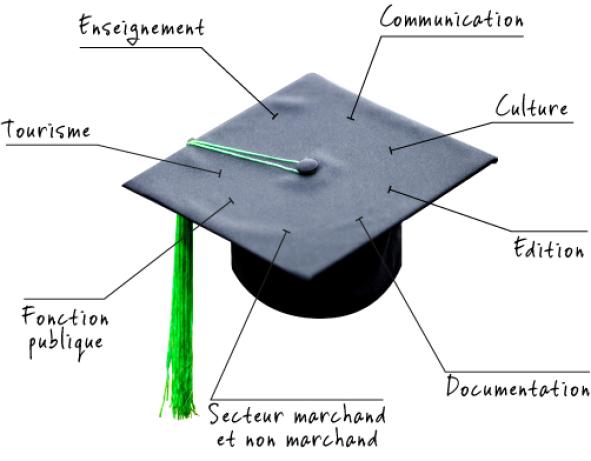
Jobs that require a master's degree in history
Heritage management
- Research Associate (or equivalent title) at certain institutions such as the Army Museum, the Museum of African History in Tervuren, the Royal Museums of Art and History, the Royal Library…
- Archivist, Curator: In Belgium, there are numerous state archives and a number of private archives that regularly recruit history graduates.
Teaching
- Teacher in upper secondary school: 4th, 5th, and 6th grades of secondary school. A master’s degree in education (Section 4 or 5) is required.
- Teacher at colleges where future lower secondary (1st, 2nd, 3rd years of secondary school) and elementary school teachers are trained, and at other higher education institutions whose programs include history courses (Tourism, Communication, etc.). Subject to obtaining a Master’s degree in teacher education (MSFE) or a Certificate of Pedagogical Aptitude for Higher Education (CAPAES) during the first years of service.
Research
- Teacher and researcher at a university or the National Fund for Scientific Research (or equivalent institutions abroad). A Ph.D. in History is required to qualify for a professorship at a university.
Other career opportunities
Many history graduates pursue careers that are either directly related to their education or careers for which their studies did not directly prepare them, but for which a background in history proves to be relevant:
The book and documentation sector
- libraries, bookstores, traditional and multimedia publishing houses;
- documentation centers.
The world of communications and museums
- journalism (print, radio, or television);
- tour guide (public institutions, non-profit organizations, or foundations with a cultural or tourism focus);
- at the request of public agencies or private companies: organizing exhibitions, commemorations, publications…
The civil service
- Historians are employed in federal, community, regional, provincial, or local government agencies: urban planning, culture, international relations…
Businesses in the commercial and non-commercial sectors
- As heads of documentation departments or in other roles, historians are employed in fields such as insurance, banking, and NGOs…
Additional training—particularly in computer science or languages—broadens the range of accessible professions. Experience shows that a basic education in history enables students to pursue such additional studies successfully and that holders of these supplementary degrees find employment easily.
A look at the careers of a few alumni…
Teaching
- Sarah, professor of History and Education at the École Normale Catholique du Brabant Wallon in Louvain-la-Neuve.
- Alizée, history teacher at the Institut de la Providence in Champion.
Heritage Management
- Marie-Françoise, head of the “Cultural Heritage Service” for the Province of Namur: listed monuments and sites, landscapes…
- Emmanuel, head of the State Archives in Namur: medieval charters, judicial records, maps and plans…
- Marie, head of the Medical Archives Department at the Centre Hospitalier de Wallonie Picarde (CHwapi) in Tournai.
The World of Communication
- Lionelle, journalist at RTBF.
- Sophie, Internet Project Manager in the Communications Unit of the BEP — Economic Office of the Province of Namur.
The civil service
- Jean-François, staff member in the Research Department at Forem.
- Jérémy, human resources officer (HR analyst) at Fedasil (Federal Agency for the Reception of Asylum Seekers).
Research and scientific publishing
- Cédric, editor-in-chief of the Courrier hebdomadaire at the Center for Socio-Political Research and Information (CRISP).
- Charlotte, assistant in the Manuscripts Section of the Royal Library of Belgium in Brussels.
The book and documentation sector
- Anouk, bookseller in Namur, specializing in literature and the humanities.
- Sébastien, head librarian at the “Jean de La Fontaine Library” in Ath and educational coordinator for the implementation of IT in municipal schools.
- Thierry, assistant librarian—information manager at the General Commission for Refugees and Stateless Persons (FPS Interior).
Tourism
- Julie, head of guided tours, events, and historical research at the Citadel of Dinant.
- Virginie, tourism trainer at a socio-professional integration organization (Alternatives Formations) and facilitator and organizer of socio-cultural events.
Businesses in the for-profit and nonprofit sectors
- François-Xavier, Multi-Residential and Single-Family Development Manager at Thomas & Piron.