
Bachelor in Chemistry
-
Schedule
regular course
- ECTS Credits 180
Overview
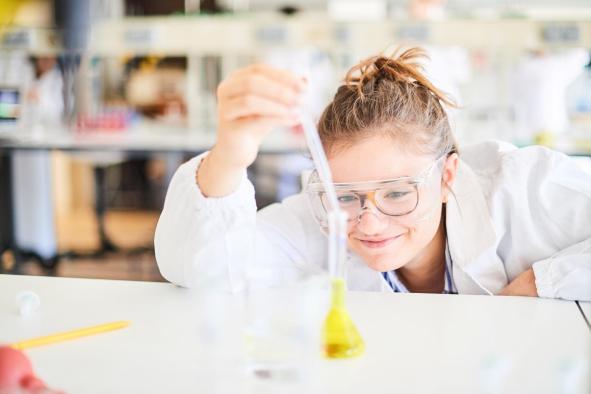
Chemistry touches on all areas of science. It is essential for understanding matter, its properties, its transformations, and its applications, and is closely linked to the other disciplines with which it interacts. Your bachelor’s program therefore begins with a general introduction to chemistry, as well as other scientific subjects such as physics, mathematics, biology, and geology.
You will then delve deeper into the various fields of chemistry: organic chemistry, macromolecular chemistry, inorganic chemistry, analytical chemistry, biological chemistry, physical chemistry, quantum chemistry, crystallography, spectroscopy…
In addition to scientific training, the bachelor’s program also enables you to master certain computer tools and scientific English, the language of communication among researchers.
A human dimension rounds out your education. Courses that encourage reflection on scientific methodologies and their limitations, on psychology, and on the scientist’s responsibility toward the environment.
You're off to a good start
- You are highly curious and open-minded when it comes to scientific problems;
- you feel comfortable with math and science even if you didn’t take advanced courses in high school;
- You demonstrate rigor and precision;
- you have the ability to synthesize information.
Teaching Methods
Lectures, seminars, labs, practical exercises, independent study, and practice sessions—we do everything we can to ensure you master the concepts.
Organized in small groups, the practical work, independent study, and practice sessions introduce you to the techniques specific to each discipline. You learn to use equipment, take measurements, interpret them, and present your findings. In this way, you experimentally observe certain laws or phenomena covered in the theoretical lectures.
Independence and initiative are encouraged throughout the program. You will complete your bachelor’s degree by independently completing a final-year project based on your chemistry lab work.
Support for Success
Succeeding in a year of university studies involves many challenges.
To help you overcome them, we support you in developing your academic, methodological, and interpersonal skills—with the help of many professionals.
Preparatory courses, personalized assistance… Discover the resources available to support your education.
After a bachelor's degree: a master's degree
The University of Namur organizes
- the master 120 in chemical sciences
- the master 60 in chemical sciences
- the master 60 in chemistry
- the master in chemistry education
- 120 credits - section 4 (from 2025)
- 60 credits - section 5 (from 2025)
Contacts
Faculty of Science
2 Grafé Street • B-5000 Namur
Office
Ms. A. Brouir, Ms. S. Duvivier, and Ms. C. Haeck
Tel.: +32 (0) 81 72 45 00
secretariat.sciences@unamur.be
-
Chemical sciences
-
General scientific training
-
Humanities
Code Name Staff Th.+Ex. Credits/Block 1 2 3 SSPSB101 Philosophical questions Modera Astrid Sartenaer Olivier 22h th. + 7h ex. 2 Service learningImage
SSPSB102_Bloc1 Religious Studies: Anthropology, Metaphysics and Science Cazalis Roland Leyens Stéphane 30h th. 2 -
Choice of courses
Code Name Staff Th.+Ex. Credits/Block 1 2 3 SSPSB204 Logic and argumentation Sartenaer Olivier Sartenaer Olivier 22.5h th. 2 SSPSB202 History of science Sartenaer Olivier 22.5h th. 2 SSPSB203 Psychology Ravez Laurent 22.5h th. 2 SSPSB307 Formal logic Sartenaer Olivier 15h th. 2 SSPSB308 Philosophy of science Sartenaer Olivier 15h th. 2 SSPSB309 Ethical LAURENT Nathanaël Leyens Stéphane 15h th. 2
-
-
Language
Code Name Staff Th.+Ex. Credits/Block 1 2 3 SCDLB102 Introduction to Scientific English (level B1 and higher) Bouchat Hélène 30h th. 3 SCDLB202 English : Communicating Science Effectively (level B2 and above) Bouchat Hélène 30h th. 3 SCDLB302 English: Presentation Skills (level B2 and above) Bouchat Hélène 30h th. 3

-
Chemical sciences
Code Name Staff Credits Hours/Quarter 1 2 SCHIB113 In-depth general chemistry Dehon Jérémy 3 20h th. + 12.5h ex. SCHIB115 Practical work in chemistry Wouters Johan Dehon Jérémy 3 11h ex. 11.5h ex. SCHIB105 Organic Chemistry Baillieul Diane 6 30h th. + 30h ex. SCHIB112 General solution chemistry Dehon Jérémy 3 25h th. + 10h ex. SCHIB111 General chemistry Wouters Johan 6 50h th. + 20h ex. -
General scientific training
Code Name Staff Credits Hours/Quarter 1 2 SPHYB124_Chimie et Géo² General physics: Mechanics Caporaletti Federico 6 46h th. + 30h ex. Sustainable developmentImage
SPHYB125 General physics: Optics Lepere Muriel 3 22h th. + 14h ex. SGOLB102_Chimie Introduction to geology Collinet Max 3 20h th. + 17h ex. SMATB106 Mathematical tools for chemistry 2 Mauroy Alexandre 3 22.5h th. + 22.5h ex. SBIOB121 Biology I Michiels Carine 4 30h th. + 12.5h ex. SBIOB122 Biology II Michiels Carine 4 30h th. + 13h ex. SPHYB126_Chimie General physics: Electricity Sporken Robert 6 46h th. + 36h ex. SMATB104 Mathematical tools of chemistry 1 Hastir Anthony Gulina Marvyn 3 22.5h th. + 22.5h ex. -
Humanities
Code Name Staff Credits Hours/Quarter 1 2 SSPSB101 Philosophical questions Modera Astrid Sartenaer Olivier 2 22h th. + 7h ex. Service learningImage
SSPSB102_Bloc1 Religious Studies: Anthropology, Metaphysics and Science Cazalis Roland Leyens Stéphane 2 30h th. -
Language
Code Name Staff Credits Hours/Quarter 1 2 SCDLB102 Introduction to Scientific English (level B1 and higher) Bouchat Hélène 3 15h th. 15h th.
-
Chemical sciences
Code Name Staff Credits Hours/Quarter 1 2 SCHIB203 Analytical chemistry Mekhalif Zineb 7 30h th. + 51h ex. SCHIB205 Group theory applied to chemistry Champagne Benoît Beaujean Pierre 5 37.5h th. + 20h ex. SCHIB209 Tools and methods applied to Chemistry and Geology Leherte Laurence 3 22.5h th. + 10h ex. SCHIB201 Chimie physique : équilibre Liégeois Vincent Leherte Laurence 10 30h th. + 7.5h ex. 15h th. + 37.5h ex. SCHIB202 Organic Chemistry Vincent Stéphane 10 22.5h th. + 33h ex. 22.5h th. + 33h ex. SCHIB204 Quantum Chemistry Liégeois Vincent Champagne Benoît 3 22.5h th. + 7.5h ex. SCHIB208 Introduction à la chimie inorganique Aprile Carmela 3 22.5h th. -
General scientific training
Code Name Staff Credits Hours/Quarter 1 2 SBIOB210_Chimie General biochemistry I Michaux Catherine Renard Patricia 4 45h th. + 15h ex. SPHYB214 Theoretical physics Henrard Luc 4 30h th. + 15h ex. SCHIB206 Introduction to scientific software Leherte Laurence 3 15h th. + 30h ex. SCHIB207 Introduction to crystallography Wouters Johan Yans Johan 3 22.5h th. + 30h ex. -
Humanities
-
Choice of courses
Code Name Staff Credits Hours/Quarter 1 2 SSPSB204 Logic and argumentation Sartenaer Olivier Sartenaer Olivier 2 22.5h th. SSPSB202 History of science Sartenaer Olivier 2 22.5h th. SSPSB203 Psychology Ravez Laurent 2 22.5h th.
-
-
Language
Code Name Staff Credits Hours/Quarter 1 2 SCDLB202 English : Communicating Science Effectively (level B2 and above) Bouchat Hélène 3 15h th. 15h th.
-
Chemical sciences
-
Humanities
-
Choice of courses
Code Name Staff Credits Hours/Quarter 1 2 SSPSB307 Formal logic Sartenaer Olivier 2 15h th. SSPSB308 Philosophy of science Sartenaer Olivier 2 15h th. SSPSB309 Ethical LAURENT Nathanaël Leyens Stéphane 2 15h th.
-
-
Language
Code Name Staff Credits Hours/Quarter 1 2 SCDLB302 English: Presentation Skills (level B2 and above) Bouchat Hélène 3 15h th. 15h th.
Jury
Careers in Chemistry
At the University of Namur, master’s students in chemistry receive training that prepares them for both basic and applied research. The scientific knowledge they acquire during their studies also opens doors for them in the corporate sector, the education sector, and the public sector…
It is difficult to find a product or object in our daily lives in which chemists have not been involved at some stage of design, manufacturing, or evaluation: packaging, medicines, dyes, perfumes, computer components… In short, “Chemistry is life,” as proclaimed by Essenscia, the Belgian Federation of Chemical and Life Sciences Industries.
In Belgium, the chemical industry directly employs nearly 100,000 people (just under a quarter of whom are in the Walloon Region) and several hundred thousand indirectly. The jobs offered by the chemical industry are often exciting and versatile. Chemists with bachelor’s, master’s, or doctoral degrees contribute to the research and development of new products and processes, to their production in accordance with current quality standards, and finally to their commercialization.
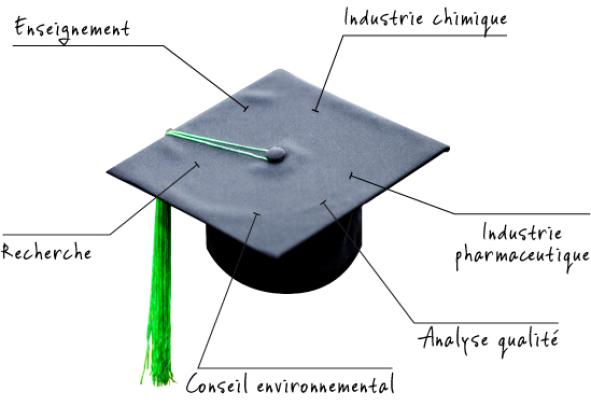
The majority of our chemistry graduates enter the industrial sector at the national or international level (38% of UNamur graduates), within which four main sectors can be identified:
- basic chemistry: extraction and/or production of raw materials;
- parachemicals: consumer products, such as cosmetics and cleaning products;
- the pharmaceutical industry: medicines for human and animal use;
- process chemistry: rubbers, bio-based plastics.
In addition to research and development laboratories, other departments within the chemical industry are open to master’s and doctoral graduates in chemistry: quality control, sales and marketing (e.g., as medical representatives or market managers), regulatory affairs (preparing registration dossiers for new products), patents, etc.
Pushing the boundaries of knowledge
Nearly a quarter of our alumni pursue research activities at universities or in public research organizations such as the FRS-FNRS in Belgium, the CNRS in France, or the Ludwig Institute for Cancer Research. For most of them, their personal research has led to original findings and the completion of a doctoral thesis.
Passing on a passion for science and life
Nearly one-fifth of chemistry graduates hold the title of agrégé for upper secondary education. Many of them teach science in secondary schools, higher education institutions, or adult education programs. Those with a Ph.D. may pursue an academic or scientific career at a university.
Protecting our environment
Chemists contribute to protecting our environment. They analyze and help monitor the quality of our natural resources (water, gas), measure air pollution, and work to implement new processes for waste and wastewater treatment, as well as air and gas purification and control.
Protecting our health
Chemists work alongside biologists, pharmacists, and doctors to develop and improve new drugs and vaccines.
Other fields of activity
In addition to academic, industrial, or public laboratories, chemists may also work in private or hospital laboratories, where they lead a team of technicians. Chemists are also found in companies that manufacture and market analytical equipment for these laboratories.
Chemists’ scientific background enables them to advise policymakers, particularly on matters related to environmental policy.
At the federal and regional levels, many public service positions are open to university graduates upon passing an entrance exam and completing appropriate training.
Finally, a significant proportion of chemists pursue careers in the IT sector.
L'aide à la recherche d'emploi
La Cellule Emploi accompagne les étudiants de dernière année et les diplômés dans leur parcours professionnel, via plusieurs services : diffusion d’offres d’emploi et de stage, entretiens d’orientation, ateliers sur les thématiques liées à l’insertion professionnelle, information et documentation sur le monde du travail.