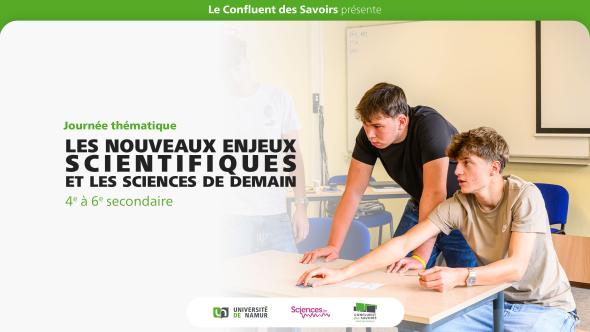
Practical Information:
- Audience: 4th through 6th year of secondary school
- Date: Tuesday, November 10, 2026
- Time: 8:30 a.m. to 4:00 p.m.
- Cost: Free
- Language: French
- Address: University of Namur
On the agenda:
Artificial intelligence, space exploration, the world of tomorrow, and diseases: four major questions to help us understand the scientific challenges that lie ahead!
How does artificial intelligence work? Why explore space? What will the world of tomorrow look like? And why can’t we cure all diseases yet?
These are all questions that concern us all and lie at the heart of current scientific research. Through this themed day designed for students in grades 4 through 6 of secondary school, invite your classes to discover science in a new way by exploring the big questions that shape our future.
The day will be structured around four one-hour activities, each dedicated to a scientific topic. Drawing on episodes from the podcast *Au fait…*, students will be able to delve deeper into these topics, compare their ideas, and engage directly with researchers and experts from the University of Namur (UNamur).
This is an opportunity to get a behind-the-scenes look at research, gain a better understanding of the challenges of today and tomorrow, and meet the people who are helping to advance knowledge.
Topics covered:
- What is artificial intelligence?
ChatGPT, Gemini, and other generative AIs are transforming our daily lives. How do they work? What can they do, and what ethical, environmental, and educational questions do they raise? (Focus on how neural networks work) - Why space?
From the Moon to Mars, via satellite constellations, space has become a true frontier for scientific exploration. But why send astronauts there, and what does space research offer us? (Highlighting the BeBLOB project, a groundbreaking space mission aboard the International Space Station (ISS) to study the DNA repair capacity of the “blob” (Physarum polycephalum) in microgravity) - Why can’t we cure all diseases?
Despite advances in medicine, many diseases still resist treatment. How does medical research work? What are the challenges associated with cancer, and what breakthroughs could transform the care of the future? - What will the world of tomorrow look like?
Climate change, the energy transition, natural resources, and new technologies: how can we address the environmental challenges of the 21st century? What scientific solutions will help build a more sustainable future?