The Chronoxyle project was born out of a feeling—the one you experience when standing at the foot of a majestic dead tree. Walking around a worm-eaten colossus evokes admiration, humility, and an inner questioning about the future of forest ecosystems that are under ever-greater threat. After traveling the length and breadth of Wallonia in search of these forest gems, one thing became clear to me: the living forest—diverse and rich in deadwood—has become far too rare. The urgent need, therefore, is to bear witness to the beauty of this disappearing forest and to show just how essential its preservation is. As I set out to meet the forest managers of these Walloon showcases of the living forest, a new horizon begins to take shape. We can view the forest differently, place greater emphasis on its resilience, and stop trying to exploit its entire surface—because a new balance is needed to better integrate living organisms.

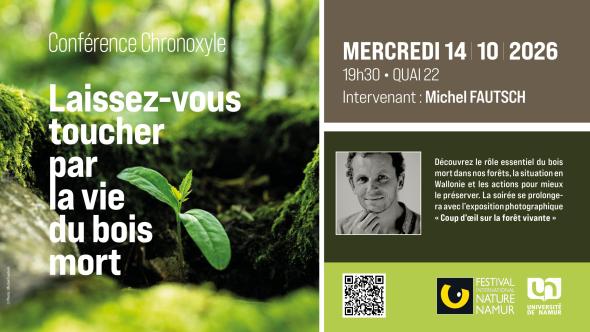
The conference will provide an opportunity to assess the current state of deadwood in Wallonia, to discover why this deadwood is essential to the forest, and to explore what steps can be taken to improve the situation. Discussions and debates can continue with a visit to the photography exhibition “A Glimpse of the Living Forest,” on view at Quai 22 from October 12–22. 

Admission is free with registration.