Today, more than half of Wallonia’s municipalities are facing a shortage of general practitioners, with particularly concerning situations in Hainaut, the southern part of the province of Namur, and the province of Luxembourg. Rural areas are the hardest hit. 

Médecine rurale - carte des territoires ruraux de Wallonie touchés par la pénurie
Map of rural areas affected by a shortage of general practitioners in rural settings.

For Dr. Dominique Henrion, a general practitioner and director of the master’s program in general medicine at UNamur (joint degree with UCLouvain), it is essential to take action as early as the training phase:

Repeated clinical rotations in rural areas significantly increase the likelihood that a young doctor will later choose to set up practice there. We also know that students are largely in favor of this. So we needed to turn this interest into a real opportunity.”

However, several obstacles still hinder these hands-on experiences: housing, mobility, and the fear of isolation. It was to address these challenges that the concept of a rural training hub was developed.

An integrated approach to overcoming obstacles

In practical terms, these centers offer third-year medical students an internship structured around three key elements: a supervising physician, nearby housing, and transportation arrangements for the entire duration of the internship.

Aurélie Strickaert, a project manager in the Department of Medicine at UNamur, highlights the practical rationale behind the program:

We wanted to create a simple and effective solution that focuses directly on students’ needs. By combining supervision, housing, and transportation, we’re creating the conditions that make a rural internship truly accessible and attractive.”

This year, nine host centers were established in the provinces of Namur, Hainaut, and Luxembourg, enabling 26 students to gain a diverse hands-on internship experience in the field.

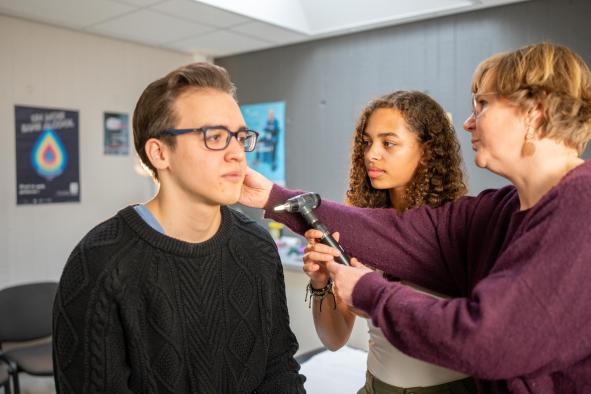
Un médecine qui examine un patient

Chevetogne, an exemplary pilot project

Among these various centers, the one in Chevetogne stands out for its foundational and replicable nature. Its uniqueness lies in the provision of housing within the Chevetogne Provincial Estate, capable of accommodating seven students completing their internships with physicians practicing in the municipalities of Ciney, Houyet, and Rochefort. To facilitate their commutes, each partner municipality provides a CPAS shuttle or a municipal vehicle.

For the Province of Namur, this project is fully aligned with its territorial and well-being priorities. Virginie Solbreux, chief of staff representing Provincial Deputy Isabelle Joiret, explains:

By supporting this initiative, the Province of Namur is contributing to a concrete solution to the shortage of doctors in rural areas. It is a way to support local stakeholders, enhance the region’s appeal, and participate in an initiative that is meaningful to citizens.”

A welcoming environment designed for students

The Chevetogne Provincial Estate plays a central role in this pilot phase. In addition to providing suitable accommodations, it helps reduce feelings of isolation by bringing the trainees together in a single living space.

For Marie-Julie Baeken, director of the Chevetogne Provincial Estate, this involvement is a natural extension of the site’s mission:

The Chevetogne Provincial Estate offers a comfortable, welcoming living environment that is well-suited to temporarily hosting students. By participating in this project, we are putting our facilities to work in support of an important societal issue and an innovative regional initiative.”

Beyond providing practical accommodations, the project also helps foster local collaboration between the university, provincial authorities, municipalities, and healthcare professionals.

A Local Response to a Social Issue

By exposing students to real-world situations, rural training centers have a twofold objective: to improve internship conditions and, in the longer term, to encourage the establishment of medical facilities in areas that are currently underserved.

Through this initiative, UNamur and its partners demonstrate that an innovative solution to the shortage of medical professionals can emerge from collaboration between academia, public authorities, and local stakeholders. In Chevetogne and the Ciney region, this initiative is now well underway.

An interactive map for objective analysis It is thanks to the fruitful interdisciplinary collaboration between geographers Aliz Hevesi and Catherine Linard, computer scientist Nicolas Matton, and Dr. Dominique Henrion that we owe the launch of an online map presenting a new rurality index specific to Wallonia, which combines population density, urban typology, and travel time to centers of activity. This interactive map aims to improve the planning of healthcare services in rural areas and to guide future general practitioners in their choice of practice location. This new tool has already been featured in the specialized press with a view to making it available to professionals. Published as open source, the interactive map is accessible for free below. 

Logos des partenaires de l'Obeservatoire de médecine rurale

The UNamur Rural Medicine Observatory

Since 2023, the UNamur University Observatory on Rural Medicine (OUMRu) has been working on the issue of the declining availability of general practice services, particularly in underserved areas of Wallonia, with the aim of identifying potential solutions in collaboration with stakeholders on the ground. 

The UNamur Master's Degree in Rural Medicine

(UNamur-UCLouvain joint degree program)