This article is taken from the "Issues" section of Omalius magazine #40 (March 2026).

“August 6, 1945, was Day Zero. The day it was demonstrated that universal history might not continue, that we are in any case capable of severing its thread—that day ushered in a new age in world history ,” wrote Günter Anders, considered the first “philosopher of the bomb,” in “Hiroshima Is Everywhere” (1982). 

For many thinkers, the invention of the atomic bomb and its use against Japan by the United States constitute a turning point in the destiny of humanity. The Chernobyl accident in 1986—40 years ago this April—and the Fukushima disaster in 2011, whose 15th anniversary was just marked, are two other landmark events, serving as a reminder of the potential dangers of nuclear energy. 

“Günter Anders also speaks of ‘globocide,’ that is, the possibility that emerged with nuclear technology to ‘make everything disappear,’” explains Danielle Leenaerts, a researcher in art history at UNamur.  “He also emphasizes the impossibility of separating the risks of military nuclear power from those of civilian nuclear power, since radioactive fallout is a possibility in both areas.” 

Hiroshima survivors

Today, however, nuclear energy is ubiquitous in our lives. Every day, for example, many workers are exposed to ionizing radiation. In Belgium, anyone professionally exposed to this radiation must wear a dosimeter at chest level (Article 30.6 of the Royal Decree of July 20, 2001). This data is then centralized, analyzed, and archived monthly by the AFCN (Federal Agency for Nuclear Control). An epidemiologist, researcher at the Faculty of Medicine, and member of the Namur Research Institute for Life Sciences (NARILIS) at UNamur, Médéa Locquet is also a member of the Belgian delegation to the United Nations Scientific Committee on the Effects of Atomic Radiation (UNSCEAR), whose mission is to assess the levels and effects of exposure to ionizing radiation on human health and the environment. In this context, she studies in particular the effects of occupational exposure (“occupational studies”) —whether among airline pilots exposed to cosmic rays, uranium mine workers, or healthcare personnel—as well as environmental exposures, particularly the impact of radon, 

“a naturally occurring radioactive gas emitted by the soil that can accumulate in buildings, and which is now the second leading cause of lung cancer after tobacco,” she notes. 

As part of her collaboration with UNSCEAR, Médéa Locquet is working with her colleagues in Japan on the “Lifespan Study,” which investigates the consequences of the bombings of Hiroshima and Nagasaki on irradiated survivors and their descendants. While the dangers of acute exposure to ionizing radiation (so-called “deterministic” effects) are well understood, the effects of low-dose exposure (“stochastic effects”) remain more complex to understand and assess

“Generally, in medicine, we move from basic research to applied research. Here, it’s the opposite: by observing a military nuclear application, we directly study the effects on human beings to establish radiation protection standards and confirm certain mechanisms of action of the effects of ionizing radiation by returning to experimental research,” explains the researcher. 

Nuclear Energy Against Cancer

“Currently, more than 50% of cancer patients will undergo radiation therapy at least once.”

Carine Michiels, professor of cell biology, member of the NARILIS Research Institute and the Animal Cell Biology Research Unit (URBC).

Intérieur de la machine de dépôt ICS durant le dépôt d'une couche de cuivre
Carine Michiels

Bridges between researchers and entrepreneurs

Cancer cells are, in fact, characterized by their ability to proliferate continuously. 

Responding to current societal challenges

At UNamur, researchers actively participate in the transition towards a more sustainable, inclusive, and innovative society by putting their skills at the service of public policy, education, and local businesses. The Wallonia Recovery Plan (PRW) sets out the Walloon Government's broad guidelines on employment, the economy, the environment, and climate. Within this framework, UNamur is committed on several fronts: its researchers are designing new technological solutions, supporting the training of talent, and participating in the region's ecological and digital transition.

By using ionizing radiation, radiation therapy is able to strip electrons from the atoms of these cells, which leads to the production of free radicals that damage macromolecules, particularly DNA,explains Anne-Catherine Heuskin, a biophysicist and researcher in radiobiology. “Cancer cells will then have a much harder time replicating, especially if the DNA is severely damaged.”

L'équipe de chercheurs du projet BatFactory
Anne-Catherine Heuskin

Opening up Walloon markets to international trade

Radiotherapy traditionally uses an X-ray beam to target the tumor, but today, researchers are increasingly turning their attention to protons

“UNamur has the only proton irradiator in the Wallonia-Brussels Federation, which allows us to study their advantages over X-rays,” notes Carine Michiels. 

Read our previous article on this topic: ALTAïS – Penetrating the depths of matter to address current challenges

“Protons have a ballistic advantage,” explains Anne-Catherine Heuskin. “When you target a tumor with X-rays, part of the radiation is absorbed and part passes through to the other side. By irradiating upstream, we therefore also affect downstream tissue. Yet the goal is to spare healthy tissue as much as possible: in breast cancer, for example, we try to avoid irradiating the heart.” 

Because they interact differently with matter, protons deposit a small amount of energy continuously as they travel. 

“On the other hand, when they have only a few centimeters or millimeters left to travel, they release all their energy at once,” continues Anne-Catherine Heuskin. “Whatever lies downstream is then spared.” 

Proton therapy is particularly promising for treating pediatric cancers—that is, for patients who have a very long life expectancy and are therefore more likely to experience the long-term effects of radiation on their healthy tissues. 

In addition to these external radiation therapy techniques, it is also possible to treat tumors using internal radiation therapy, 

“by attaching a radioactive atom to a ‘carrier,’ such as gold nanoparticles, which will transport this atom to the tumor via the bloodstream,” explains Carine Michiels. 

This technique maximizes the effect on cancer cells while sparing normal cells as much as possible. 

“Over the past 5 to 10 years, the major breakthrough in cancer treatment has been immunotherapy,” she continues. “But we still don’t understand why some patients respond to it and others don’t. One hypothesis is that we need to boost the cancer cells so that they are recognized by the immune system. And this is where radiation therapy has a huge role to play, because by damaging the cancer cells, it helps boost the immune response. The combination of radiation therapy and immunotherapy is therefore set to play a leading role.” 

Effects that mimic aging

Today, the scientific community is paying increasing attention to the long-term risks (cancer, leukemia, etc.) associated with medical exposure to radiation

“Several recent studies highlight an increased risk of brain cancers and leukemias in patients who underwent repeated CT scans during childhood,” explains Médéa Locquet. “During childhood, the high rate of cell proliferation and differentiation makes cells more radiosensitive, which increases the risk of late effects, particularly in adulthood.” 

Similarly, radiation therapy can increase the risk of certain diseases, even though these risks are now well understood and generally well managed. 

“My research hypothesis,” says Médéa Locquet, “is that the effects of exposure to ionizing radiation mimic the aging process, since what we will find are mainly complications such as cancer, cardiovascular diseases, but also endocrine or neurodegenerative disorders—that is, diseases that appear in the general population as people age. Confirming this hypothesis would allow us to optimize doses to prevent this accelerated aging and the onset of treatment-related late effects. We could also try to prevent it by using senomorphs (editor’s note: agents that block the harmful effects of senescent cells), as well as through physical activity and nutrition programs in post-cancer care.”

The Atom Through the Eyes of Artists

“At the beginning of the 20th century, the first discoveries regarding the structure of the atom quickly captivated artists because they revolutionized our understanding of matter, ‘now understood as energy, which allowed for the conception of art liberated from the heaviness and opacity of nature’s appearances, explained the Musée d’Art Moderne de Paris, which in 2025 dedicated a major exhibition to this theme (“The Atomic Age. Artists Put to the Test of History”).

Research at UNamur in figures

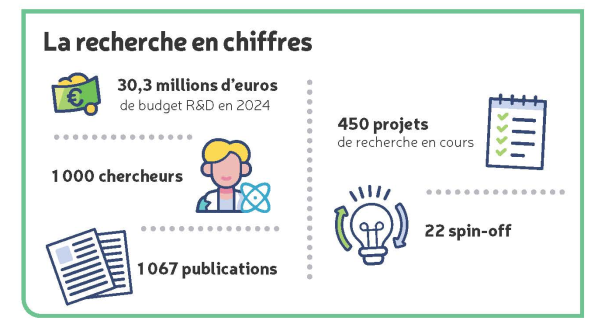
La recherche en chiffres : 30,3 millions d’euros de budget R&D en 2024, 1 000 chercheurs, 1 067 publications, 450 projets de recherche en cours, 22 spin-off

Financing tools: catalysts for collaboration and impact

In Belgium, there is a wide variety of research support programs, each contributing at a different stage of the innovation process. These programs are not only used to fund projects: they also promote inspiring and fruitful encounters, multidisciplinarity, and collaboration between researchers and all actors in society.

  • Supporting fundamental research - At the root of all progress is fundamental research: research that seeks to understand before applying. The Wallonia-Brussels Federation, through its Concerted Research Actions (ARC) or Special Research Funds (FSR), as well as the F.R.S.-FNRS, mainly supports this type of research.
  • Linking research to public and societal needs - At the federal level, the Federal Science Policy Office (BELSPO) supports research projects that inform public decisions: environmental management, health, space, mobility, and social policies.
  • Opening up European horizons - The European Union, through its Horizon Europe framework program (2021-2027) and the related ESA program, is another cornerstone of research funding. It encourages collaborative or individual projects, both fundamental and applied, and encourages teams to work across borders.
  • Promoting research for the benefit of the regional economy - The Walloon Region and the Brussels-Capital Region are focusing their efforts on applied research, the benefits of which are directly perceptible to businesses and citizens. SPW Research programs, such as Win4Doc, Win²Wal, Win4SpinOff, Walloon Competitiveness Clusters, and the Recovery Plan, enable university research to become embedded in the local socio-economic fabric, creating jobs, new technologies, and new dynamics. The Research and Innovation (R&I) Department of Wallonia-Brussels International (WBI), in collaboration with the F.R.S.-FNRS and SPEER (RW), supports the internationalization of R&I actors in the Wallonia-Brussels Federation, in particular by strengthening their presence and visibility in international research programs and networks.
  • B2B interactions - Universities, for their part, forge numerous direct partnerships with companies and regional, national, and international socio-economic players: research collaborations, analyses, expertise, continuing education, and the provision of cutting-edge infrastructure. These collaborations, rooted in the reality on the ground, ensure that every discovery finds its way into practical application, for the benefit of society.

From fundamentals to application: a journey of innovation and an ecosystem dedicated to impact

Before an idea becomes a concrete product, service, or solution, it goes through many stages. Little by little, researchers develop their work into tangible applications, testing them against the reality of the field. 

To measure this transition from concept to practice, a scale called the Technology Readiness Level (TRL) is used, ranging from level 1 (basic research) to level 9 (concrete application and market launch). This progression perfectly illustrates how research fuels innovation, step by step, often in close collaboration with institutional, economic, industrial, or civic partners.

While research produces knowledge, transforming it into useful innovations requires structured support. At UNamur, researchers are never alone: they can count on the expertise of the Research Administration (ADRE), which plays an essential facilitating role. Its scientific advisors support researchers at every stage, ensuring that their discoveries are exploited in the best possible way: creation of spin-offs, filing of patents, signing of licenses or industrial partnerships. 

Since 2008, the ADREs of the FWB universities have been brought together within the LiEU (Liaison Entreprises–Universités) network. Thanks to the joint support of the European Social Fund (ESF), then the ERDF, and the Walloon Region, this network has made it possible to professionalize the promotion of research through collective work via the MIRVAL, MIRVAL+, and MIRVALIS programs. Its ambition is to increase the economic and social impact of university research, in line with the S3 - Smart Specialization Strategy.

Cet article est tiré de la rubrique "Enjeux" du magazine Omalius #39 (Décembre 2025).


Cover Omalius décembre 2025