
Master in Pharmacy
You are viewing the program for
Master's Degree (120 credits) in Pharmaceutical Sciences, Specialized Track |
Overview
Since 2020, the University of Namur has been offering a Master’s degree in Pharmaceutical Sciences in partnership with UCLouvain.
After more than 50 years of teaching and research in the pharmaceutical field, UNamur is expanding its academic offerings and, since September 2020, has been offering a comprehensive pharmacy degree program.
The Master’s in Pharmaceutical Sciences, offered jointly with UCLouvain, combines the strengths and expertise of both universities to train you as specialists in drug therapies and health products.
Your goals
- responsibly dispense medications and health products, develop individualized care plans, and ensure optimal monitoring of patients’ medication use;
- inform and advise patients to promote the safe, correct, and rational use of medications and other health products, while encouraging the adoption of a healthy lifestyle (for the benefit of public health);
- prepare extemporaneous and compounded medications and understand the design and development process in the pharmaceutical industry;
- ensure the quality, safety, and traceability of medicinal products throughout the stages of production, transport, transfer, and storage;
- monitor scientific and regulatory developments regarding the safe use of medications (pharmacovigilance) and update patients’ pharmaceutical records (drug interactions, intolerances, allergies, adverse effects, contraindications, etc.);
- adapt your communication to your audience, build a relationship of trust with patients, and collaborate effectively with other healthcare professionals;
- adhere to ethical principles (professional integrity, ethics, rigor, precision, and respect for confidentiality) and the regulations governing the pharmacy profession;
- communicate with other stakeholders in the scientific and medical fields (e.g., contact physicians to establish a treatment plan in the event of a detected drug interaction, a missing product, or a product withdrawn from the market…).
The benefits of this master's program
Innovative and career-focused tracks
The unique tracks in “Drug Development” and “Public Health and Healthcare Innovations” train you either in the development of new therapeutic (bio)molecules or in the integration of biomedical innovations—such as personalized medicine, pharmacogenomics, data science, and artificial intelligence—into a public health approach aimed at improving the efficiency, equity, and sustainability of healthcare systems.
Specialized facilities at a university on a human scale
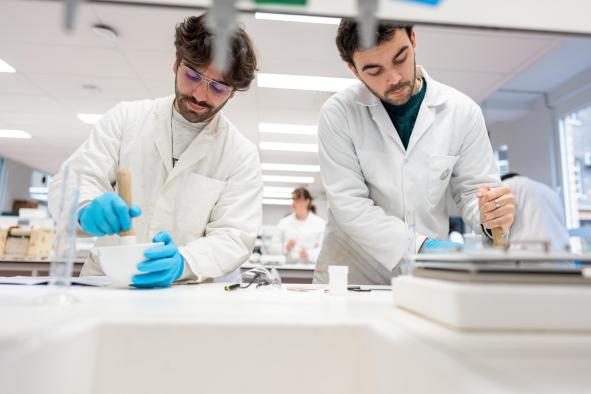
In the heart of Namur, you’ll have access to facilities specifically designed for future pharmacists: a galenic laboratory, a teaching pharmacy, a lab, a lecture hall, a study area…
A dual degree
You’ll benefit from instruction by expert professors from UNamur and UCLouvain and graduate with degrees from both universities. An added asset for your resume and your education!
The program
The two-year Master’s program in Pharmaceutical Sciences, held primarily on the UNamur campus, trains future pharmaceutical specialists to address current and future public health challenges.
This interdisciplinary program combines theoretical courses, practical and supervised work, as well as seminars, role-playing exercises, and simulations. It provides a rigorous scientific foundation for solving concrete problems encountered in the various professional fields of pharmacy—whether in a pharmacy, a research laboratory, or the pharmaceutical industry.
Ultimately, the program aims to promote professional excellence, critical thinking, and a sense of responsibility among pharmacists, in the service of patients and public health.
Depending on the direction you choose for your program, you select a major and a concentration.
The in-depth specialization prepares you for a career in research, notably through the development of a research project in pharmaceutical sciences in a private or university laboratory, in Belgium or abroad.
You will complete a practical thesis related to your research topic in the laboratory.
The options
- “Drug Development: Non-Clinical and Clinical”—offered at UNamur and taught in English—to explore all stages of developing a new therapeutic molecule and build your scientific and regulatory knowledge for a future career in the industry;
- “Public Health and Healthcare Innovations”—offered at UNamur—aims to develop key competencies in public health, healthcare systems analysis, and the integration of biomedical innovations (personalized medicine, data science, artificial intelligence) into pharmaceutical practice. Particular attention is given to the role of the pharmacist in improving the efficiency, equity, and quality of care, both in community pharmacies and within other healthcare sectors;
- “Dispensing”—organized partly at UNamur and UCLouvain on the Woluwé campus—to deepen your dispensing knowledge regarding specific populations (pregnant women, pediatrics, geriatrics), alternative medicine, addiction treatment, and dermatology.
A teaching pharmacy will immerse you in practical scenarios to help you develop a professional attitude, expand your knowledge, and improve your communication with patients: videos, role-playing, analysis of pharmacists at work...
Your training concludes with a pharmacy internship of the legally required duration of 6 months.
You will be offered first aid training to learn how to respond effectively in emergency situations, as well as theoretical and practical training on vaccination in the pharmacy setting.
Master's degrees in pharmaceutical sciences
The University of Namur also offers a 120-credit Master’s degree in Pharmaceutical Sciences with a specialized track.
Contacts
School of Medicine
Place du Palais de Justice • B-5000 Namur
Department of Pharmacy
- Secretariat: Ms. Amélie de Meesmaeker: secretariat.pharmacie@unamur.be
- Department Chair: Prof. Bernard Masereel: bernard.masereel@unamur.be
You are viewing the program for
Master's Degree (120 credits) in Pharmaceutical Sciences, with a Specialized Track |
Overview
Since 2020, the University of Namur has been offering a Master’s degree in Pharmaceutical Sciences in partnership with UCLouvain.
After more than 50 years of teaching and research in the pharmaceutical field, UNamur is expanding its academic offerings and, since September 2020, has been offering a comprehensive pharmacy degree program.
The Master’s in Pharmaceutical Sciences, offered jointly with UCLouvain, combines the strengths and expertise of both universities to train you as specialists in drug therapies and health products.
Your goals
- responsibly dispense medications and health products, develop individualized care plans, and ensure optimal monitoring of patients’ medication use;
- inform and advise patients to promote the safe, correct, and rational use of medications and other health products, while encouraging the adoption of a healthy lifestyle (for the benefit of public health);
- prepare extemporaneous and compounded medications and understand the design and development process in the pharmaceutical industry;
- ensure the quality, safety, and traceability of medicinal products throughout the stages of production, transport, transfer, and storage;
- monitor scientific and regulatory developments regarding the safe use of medications (pharmacovigilance) and update patients’ pharmaceutical records (drug interactions, intolerances, allergies, adverse effects, contraindications, etc.);
- adapt your communication to your audience, build a relationship of trust with patients, and collaborate effectively with other healthcare professionals;
- adhere to ethical principles (professional integrity, ethics, rigor, precision, and respect for confidentiality) and the regulations governing the profession of pharmacy;
- communicate with other stakeholders in the scientific and medical fields (e.g., contact physicians to establish a treatment plan in the event of a detected drug interaction, a missing product, or a product withdrawn from the market…).
The benefits of this master's program
Innovative and career-focused tracks
The unique tracks in “Drug Development” and “Public Health and Healthcare Innovations” train you either in the development of new therapeutic (bio)molecules or in the integration of biomedical innovations—such as personalized medicine, pharmacogenomics, data science, and artificial intelligence—into a public health approach aimed at improving the efficiency, equity, and sustainability of healthcare systems.
Specialized facilities at a university on a human scale
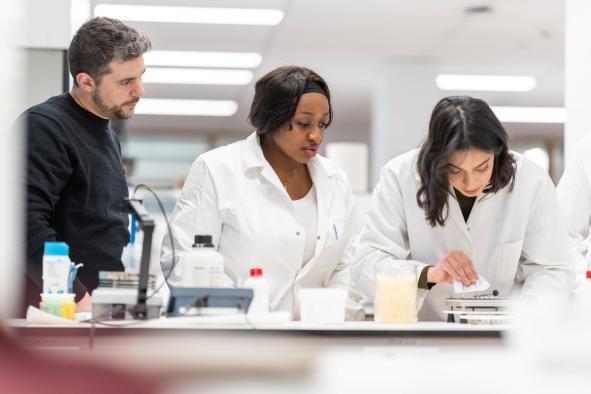
In the heart of Namur, you’ll have access to facilities specifically designed for future pharmacists: a galenic laboratory, a teaching pharmacy, a lab, a lecture hall, a study area…
A dual degree
You’ll benefit from instruction by expert professors from UNamur and UCLouvain and graduate with degrees from both universities. An added asset for your resume and your education!
The program
The two-year Master’s program in Pharmaceutical Sciences, held primarily on the UNamur campus, trains future pharmaceutical specialists to address current and future public health challenges.
This interdisciplinary program combines theoretical courses, practical and supervised work, as well as seminars, role-playing exercises, and simulations. It provides a rigorous scientific foundation for solving concrete problems encountered in the various professional fields of pharmacy—whether in a pharmacy, a research laboratory, or the pharmaceutical industry.
Ultimately, the program aims to promote professional excellence, critical thinking, and a sense of responsibility among pharmacists, in the service of patients and public health.
Depending on the direction you choose for your program, you will select a specialization and an elective.
The specialized track introduces you to career opportunities in community pharmacies and beyond (pharmacoeconomics, clinical biology, the pharmaceutical industry, etc.).
You will write a bibliographic thesis on a topic related to the pharmaceutical field that interests you.
The options
- “Drug Development: Non-Clinical and Clinical”—offered at UNamur and taught in English—to explore all stages of developing a new therapeutic molecule and build your scientific and regulatory knowledge for a future career in the industry;
- “Public Health and Healthcare Innovations”—offered at UNamur—aims to develop key competencies in public health, healthcare systems analysis, and the integration of biomedical innovations (personalized medicine, data science, artificial intelligence) into pharmaceutical practice. Particular attention is given to the role of the pharmacist in improving the efficiency, equity, and quality of care, both in community pharmacies and within other healthcare sectors;
- “Dispensing”—organized partly at UNamur and UCLouvain on the Woluwé campus—to deepen your pharmacy knowledge regarding specific populations (pregnant women, pediatrics, geriatrics), alternative medicine, addiction treatment, and dermatology.
A teaching pharmacy will immerse you in practical scenarios to help you develop a professional attitude, knowledge, and communication skills with patients: videos, role-playing, analysis of pharmacists at work...
Your training concludes with a pharmacy internship of the legally required duration of 6 months.
You will be offered first aid training to learn how to respond effectively in emergency situations, as well as theoretical and practical training on vaccination in the pharmacy setting.
Master's degrees in pharmaceutical sciences
The University of Namur also offers a 120-credit Master's degree in Pharmaceutical Sciences with a specialized track.
Contacts
School of Medicine
Place du Palais de Justice • B-5000 Namur
Department of Pharmacy
- Secretariat: Ms. Amélie de Meesmaeker: secretariat.pharmacie@unamur.be
- Department Chair: Prof. Bernard Masereel: bernard.masereel@unamur.be
-
Common core
-
In-depth purpose
Code Name Staff Th.+Ex. Credits/Block 1 2 MPHAM118 Scientific communication MORIMONT Laure 20h th. 3 MPHAM117 Introduction to scientific research MORIMONT Laure 20h th. + 20h ex. 4 MPHAM119 Experimental research work - Part I Douxfils Jonathan 80h ex. 8 MPHAM216 Integrated knowledge of advanced pharmaceutical sciences Douxfils Jonathan 8 MPHAM217 Research internship in Belgium or abroad Douxfils Jonathan 3 MPHAM215 Experimental Research Work - Part II MORIMONT Laure 35h th. 4 -
Options
-
Option A : Drug development - non clinical and clinical
Code Name Staff Th.+Ex. Credits/Block 1 2 MSBMM102_P38757 Preclinical Drug Development Gillet Jean-Pierre 24h th. 3 MSBMM108 Quality Assurance : GMP, GCP, GLP and Auditing Delforge Dominique Mortier Nicolas 24h th. 3 MPHAM131 Negociation, Communication, Networking Chaspierre Alain Douxfils Jonathan Dogne Jean-Michel 20h th. 4 Sustainable developmentImage
MSBMM103_pharma Clinical Trials Beaudart Charlotte 24h th. + 30h ex. 6 -
Option B: Public Health and Healthcare Innovations
Code Name Staff Th.+Ex. Credits/Block 1 2 MPHAM134 Locquet Médéa 30h th. 4 MPHAM135 Locquet Médéa 25h th. + 15h ex. 4 MPHAM136 Locquet Médéa 25h th. + 15h ex. 3 MPHAM137 Locquet Médéa 25h th. 3 MPHAM138 Locquet Médéa 15h th. + 5h ex. 2 -
Option C: Delivery
Code Name Staff Th.+Ex. Credits/Block 1 2 WFARM2514 Drug dependence and addiction De Messemaeker Amélie 22.5h th. 3 WFARM2509 Complementary medicine De Messemaeker Amélie 22.5h th. 3 WFARM2123 Complementary pharmacotherapy De Messemaeker Amélie 30h th. + 15h ex. 3 WFARM2504 Dermopharmacy - common pathologies and wound care De Messemaeker Amélie 22.5h th. 3 MPHAM124 Management in the pharmacy Masereel Bernard 20h th. 4
-
-
Common core
Code Name Staff Credits Hours/Quarter 1 2 MPHAM116 Pharmacotherapy and complementary pharmacology Dogne Jean-Michel Musuamba Tshinanu Flora Douxfils Jonathan Masereel Bernard 7 70h th. MPHAM115 Galenic Pharmacy - Part II SIRIEZ Romain 3 20h th. + 16h ex. MPHAM114 Galenic Pharmacy - Part I SIRIEZ Romain Soumoy Laura 3 40h th. MPHAM113 Pharmacogenetics and personalised medicine Musuamba Tshinanu Flora 3 20h th. MPHAM112 Toxicology Musuamba Tshinanu Flora Dogne Jean-Michel 3 30h th. MPHAM111 Nutrition Deflandre Eric 2 20h th. MPHAM110 In-depth pharmaceutical analysis and quality control of medicines FAVRESSE Julien Klinkenberg Réginald 4 40h th. MBIMB313_Partim Pharma Medical microbiology Tré-Hardy Marie 2 30h th. MMEDB308_pharma Immunopathology Graux Carlos 2 13h th. -
In-depth purpose
Code Name Staff Credits Hours/Quarter 1 2 MPHAM118 Scientific communication MORIMONT Laure 3 20h th. MPHAM117 Introduction to scientific research MORIMONT Laure 4 20h th. + 20h ex. MPHAM119 Experimental research work - Part I Douxfils Jonathan 8 80h ex. -
Options
-
Option A : Drug development - non clinical and clinical
Code Name Staff Credits Hours/Quarter 1 2 MSBMM102_P38757 Preclinical Drug Development Gillet Jean-Pierre 3 24h th. MSBMM108 Quality Assurance : GMP, GCP, GLP and Auditing Delforge Dominique Mortier Nicolas 3 24h th. MPHAM131 Negociation, Communication, Networking Chaspierre Alain Douxfils Jonathan Dogne Jean-Michel 4 20h th. Sustainable developmentImage
MSBMM103_pharma Clinical Trials Beaudart Charlotte 6 24h th. + 30h ex. -
Option B: Public Health and Healthcare Innovations
Code Name Staff Credits Hours/Quarter 1 2 MPHAM134 Locquet Médéa 4 30h th. MPHAM135 Locquet Médéa 4 25h th. + 15h ex. MPHAM136 Locquet Médéa 3 25h th. + 15h ex. MPHAM137 Locquet Médéa 3 25h th. MPHAM138 Locquet Médéa 2 15h th. + 5h ex. -
Option C: Delivery
Code Name Staff Credits Hours/Quarter 1 2 WFARM2514 Drug dependence and addiction De Messemaeker Amélie 3 22.5h th. WFARM2509 Complementary medicine De Messemaeker Amélie 3 22.5h th. WFARM2123 Complementary pharmacotherapy De Messemaeker Amélie 3 30h th. + 15h ex. WFARM2504 Dermopharmacy - common pathologies and wound care De Messemaeker Amélie 3 22.5h th. MPHAM124 Management in the pharmacy Masereel Bernard 4 20h th.
-
-
Common core
Code Name Staff Credits Hours/Quarter 1 2 MPHAM211 Practical work in galenic pharmacy VASSART Julie SIRIEZ Romain 4 50h ex. MPHAM212 Semi-pathology, including first aid Putz Laurie Tuerlinckx David Gourdin Maximilien 6 45h th. + 18h ex. WFARM2256 Pharmaceutical care in a pharmacy and internship De Messemaeker Amélie 12 15h th. 40h th. MPHAM214 End of cycle work - thesis Masereel Bernard 18 MPHAM210 Pharmaceutical legislation and ethics Rosart Thomas Roisin Thierry Hamdani Jamila Druez Catherine 5 42h th. -
In-depth purpose
Code Name Staff Credits Hours/Quarter 1 2 MPHAM216 Integrated knowledge of advanced pharmaceutical sciences Douxfils Jonathan 8 MPHAM217 Research internship in Belgium or abroad Douxfils Jonathan 3 MPHAM215 Experimental Research Work - Part II MORIMONT Laure 4 35h th.
-
Common core
-
Specialized purpose
Code Name Staff Th.+Ex. Credits/Block 1 2 MPHAM120 Integrated practical work Douxfils Jonathan SIRIEZ Romain 50h ex. 4 MPHAM129 Pharmacoeconomics and Health Technology Assessment Ethgen Olivier 20h th. 2 MPHAM121 Clinical biology Catry Emilie Mullier François Moreno Y Bañuls Laetitia Closset Mélanie 30h th. 3 MPHAM122 Specialised pharmacotherapy Musuamba Tshinanu Flora 40h th. + 20h ex. 6 MPHAM219 Integrated knowledge of specialised pharmaceutical sciences Masereel Bernard 8 MPHAM220 Work experience Masereel Bernard 4 MPHAM218 Evidence-based treatment Doyen Pierre 20h th. 3 -
Options
-
Option A : Drug development - non clinical and clinical
Code Name Staff Th.+Ex. Credits/Block 1 2 MSBMM108 Quality Assurance : GMP, GCP, GLP and Auditing Delforge Dominique Mortier Nicolas 24h th. 3 MPHAM131 Negociation, Communication, Networking Chaspierre Alain Douxfils Jonathan Dogne Jean-Michel 20h th. 4 MSBMM102_P38757 Preclinical Drug Development Gillet Jean-Pierre 24h th. 3 Sustainable developmentImage
MSBMM103_pharma Clinical Trials Beaudart Charlotte 24h th. + 30h ex. 6 -
Option B: Public Health and Healthcare Innovations
Code Name Staff Th.+Ex. Credits/Block 1 2 MPHAM134 Locquet Médéa 30h th. 4 MPHAM135 Locquet Médéa 25h th. + 15h ex. 4 MPHAM136 Locquet Médéa 25h th. + 15h ex. 3 MPHAM137 Locquet Médéa 25h th. 3 MPHAM138 Locquet Médéa 15h th. + 5h ex. 2 -
Option C : Delivery
Code Name Staff Th.+Ex. Credits/Block 1 2 WFARM2514 Drug dependence and addiction De Messemaeker Amélie 22.5h th. 3 WFARM2509 Complementary medicine De Messemaeker Amélie 22.5h th. 3 WFARM2123 Complementary pharmacotherapy De Messemaeker Amélie 30h th. + 15h ex. 3 MPHAM124 Management in the pharmacy Masereel Bernard 20h th. 4 WFARM2504 Dermopharmacy - common pathologies and wound care De Messemaeker Amélie 22.5h th. 3
-
-
Common core
Code Name Staff Credits Hours/Quarter 1 2 MPHAM116 Pharmacotherapy and complementary pharmacology Dogne Jean-Michel Musuamba Tshinanu Flora Douxfils Jonathan Masereel Bernard 7 70h th. MPHAM115 Galenic Pharmacy - Part II SIRIEZ Romain 3 20h th. + 16h ex. MPHAM114 Galenic Pharmacy - Part I SIRIEZ Romain Soumoy Laura 3 40h th. MPHAM113 Pharmacogenetics and personalised medicine Musuamba Tshinanu Flora 3 20h th. MPHAM111 Nutrition Deflandre Eric 2 20h th. MPHAM112 Toxicology Musuamba Tshinanu Flora Dogne Jean-Michel 3 30h th. MPHAM110 In-depth pharmaceutical analysis and quality control of medicines FAVRESSE Julien Klinkenberg Réginald 4 40h th. MBIMB313_Partim Pharma Medical microbiology Tré-Hardy Marie 2 30h th. MMEDB308_pharma Immunopathology Graux Carlos 2 13h th. -
Specialized purpose
Code Name Staff Credits Hours/Quarter 1 2 MPHAM120 Integrated practical work Douxfils Jonathan SIRIEZ Romain 4 50h ex. MPHAM129 Pharmacoeconomics and Health Technology Assessment Ethgen Olivier 2 20h th. MPHAM121 Clinical biology Catry Emilie Mullier François Moreno Y Bañuls Laetitia Closset Mélanie 3 30h th. MPHAM122 Specialised pharmacotherapy Musuamba Tshinanu Flora 6 40h th. + 20h ex. -
Options
-
Option A : Drug development - non clinical and clinical
Code Name Staff Credits Hours/Quarter 1 2 MSBMM108 Quality Assurance : GMP, GCP, GLP and Auditing Delforge Dominique Mortier Nicolas 3 24h th. MPHAM131 Negociation, Communication, Networking Chaspierre Alain Douxfils Jonathan Dogne Jean-Michel 4 20h th. MSBMM102_P38757 Preclinical Drug Development Gillet Jean-Pierre 3 24h th. Sustainable developmentImage
MSBMM103_pharma Clinical Trials Beaudart Charlotte 6 24h th. + 30h ex. -
Option B: Public Health and Healthcare Innovations
Code Name Staff Credits Hours/Quarter 1 2 MPHAM134 Locquet Médéa 4 30h th. MPHAM135 Locquet Médéa 4 25h th. + 15h ex. MPHAM136 Locquet Médéa 3 25h th. + 15h ex. MPHAM137 Locquet Médéa 3 25h th. MPHAM138 Locquet Médéa 2 15h th. + 5h ex. -
Option C : Delivery
Code Name Staff Credits Hours/Quarter 1 2 WFARM2514 Drug dependence and addiction De Messemaeker Amélie 3 22.5h th. WFARM2509 Complementary medicine De Messemaeker Amélie 3 22.5h th. WFARM2123 Complementary pharmacotherapy De Messemaeker Amélie 3 30h th. + 15h ex. MPHAM124 Management in the pharmacy Masereel Bernard 4 20h th. WFARM2504 Dermopharmacy - common pathologies and wound care De Messemaeker Amélie 3 22.5h th.
-
-
Common core
Code Name Staff Credits Hours/Quarter 1 2 MPHAM211 Practical work in galenic pharmacy VASSART Julie SIRIEZ Romain 4 50h ex. MPHAM212 Semi-pathology, including first aid Putz Laurie Tuerlinckx David Gourdin Maximilien 6 45h th. + 18h ex. WFARM2256 Pharmaceutical care in a pharmacy and internship De Messemaeker Amélie 12 15h th. 40h th. MPHAM214 End of cycle work - thesis Masereel Bernard 18 MPHAM210 Pharmaceutical legislation and ethics Rosart Thomas Roisin Thierry Hamdani Jamila Druez Catherine 5 42h th. -
Specialized purpose
Code Name Staff Credits Hours/Quarter 1 2 MPHAM219 Integrated knowledge of specialised pharmaceutical sciences Masereel Bernard 8 MPHAM220 Work experience Masereel Bernard 4 MPHAM218 Evidence-based treatment Doyen Pierre 3 20h th.
Pharmacy Careers
Pharmacy Careers
The dispensary is the historic and traditional domain of pharmacists. For a long time, all of a pharmacist’s duties were concentrated there. As medication preparers, following the doctor’s prescription, they would prepare “compounded medications,” tablets, pills, syrups from substances of biological or mineral origin, most of which were themselves prepared and analyzed in the dispensary. They then dispensed these medications to patients, assuming full responsibility for them.
Scientific and social developments, particularly the emergence of pharmaceutical specialties, have shifted the balance of these roles. Adapting to this new situation means that, faced with an increasingly complex and diverse therapeutic arsenal, the primary role of pharmacists today is to have a thorough understanding of the medications they dispense and their effects. More than ever, they are the last line of defense between the medication and the patients, whom they must be able to guide and advise on its use.
Approximately 70% of graduates pursue careers as community pharmacists. Consulted twice as often as doctors and enjoying a high level of trust among the public, community pharmacists are frontline public health professionals. Their role as advisors in dispensing medications, providing pharmaceutical follow-up, and supporting patients is essential.
Fulfilling this mission requires solid knowledge of pharmacology and medical conditions, as well as strong listening, communication, and teaching skills.
Pharmacists can also play an important role in a wide variety of other fields that are difficult to categorize. For example, pharmacists apply their expertise in toxicology, hygiene and environmental protection, food analysis, cosmetology, dietetics, and herbal medicine, as well as in the fields of research and higher education.
In the pharmaceutical industry, industrial pharmacists play a key role in research and development (drug development, formulation, analysis, etc.), contribute to clinical trials, are involved in regulatory affairs concerning, among other things, drug registration, and are responsible for drug production, quality control (QC), and quality assurance (QA). Finally, certain key positions must be held by industrial pharmacists.
In a hospital setting, hospital pharmacists manage and oversee the pharmacy department. They are responsible for the manufacturing, control, analysis, sterilization, and dispensing of medications, as well as the management of the hospital pharmacy. As specialists in medications and medical equipment (prosthetics, surgical equipment, etc.), they are in constant contact with healthcare staff (doctors, nurses, etc.).
In hospitals, clinical pharmacists are part of the healthcare team. They also interact with patients, and their goal is to optimize medication use (rational selection, adverse effects, cost, etc.).
Clinical laboratory scientists manage private or hospital-affiliated clinical laboratory (or medical testing) facilities. They are responsible for the quality of the tests as well as their interpretation. Through the information they provide, they contribute, in collaboration with physicians, to establishing a diagnosis of the disease. Clinical biology comprises three main fields: medical chemistry (analysis of chemical and biochemical components, toxicology, etc.), hematology (analysis of blood cells and proteins, immunology, etc.), and microbiology (analysis of bacteria, viruses, parasites, etc.).
Radiopharmacists, for their part, are responsible for the production and control of radioisotopes for diagnostic (medical imaging) and therapeutic (radiotherapy) use.
A number of government agencies and organizations rely on the expertise of pharmacists. These include public authorities (e.g., the Federal Agency for Medicines and Health Products, which oversees the Pharmacy Inspectorate), the military (Health Service), public agencies (INAMI, mutual insurance companies), professional organizations (Belgian Pharmaceutical Association, Medicines Control Service, etc.), and humanitarian organizations (Pharmacists Without Borders).
Pharmacy Careers
Pharmacy Careers
The dispensary is the historic and traditional domain of pharmacists. For a long time, all of a pharmacist’s duties were concentrated there. As medication preparers, following the doctor’s prescription, they would prepare “compounded medications,” tablets, pills, syrups from substances of biological or mineral origin, most of which were themselves prepared and analyzed in the dispensary. They then dispensed these medications to patients, assuming full responsibility for them.
Scientific and social developments, particularly the emergence of pharmaceutical specialties, have shifted the balance of these roles. Adapting to this new situation means that, faced with an increasingly complex and diverse therapeutic arsenal, the primary role of pharmacists today is to have a thorough understanding of the medications they dispense and their effects. More than ever, they are the last line of defense between the medication and the patients, whom they must be able to guide and advise on its use.
Approximately 70% of graduates pursue careers as community pharmacists. Consulted twice as often as doctors and enjoying a high level of trust among the public, community pharmacists are frontline public health professionals. Their role as advisors in dispensing medications, providing pharmaceutical follow-up, and supporting patients is essential.
Fulfilling this mission requires solid knowledge of pharmacology and medical conditions, as well as strong listening, communication, and teaching skills.
Pharmacists can also play an important role in a wide variety of other fields that are difficult to categorize. For example, pharmacists apply their expertise in toxicology, hygiene and environmental protection, food analysis, cosmetology, dietetics, and herbal medicine, as well as in the fields of research and higher education.
In the pharmaceutical industry, industrial pharmacists play a key role in research and development (drug development, formulation, analysis, etc.), contribute to clinical trials, are involved in regulatory affairs concerning, among other things, drug registration, and are responsible for drug production, quality control (QC), and quality assurance (QA). Finally, certain key positions must be held by industrial pharmacists.
In a hospital setting, hospital pharmacists manage and oversee the pharmacy department. They are responsible for the manufacturing, control, analysis, sterilization, and dispensing of medications, as well as the management of the hospital pharmacy. As specialists in medications and medical equipment (prosthetics, surgical equipment, etc.), they are in constant contact with healthcare staff (doctors, nurses, etc.).
In hospitals, clinical pharmacists are part of the healthcare team. They also interact with patients, and their goal is to optimize medication use (rational selection, adverse effects, cost, etc.).
Clinical laboratory scientists manage private or hospital-affiliated clinical laboratory (or medical testing) facilities. They are responsible for the quality of the tests as well as their interpretation. Through the information they provide, they contribute, in collaboration with physicians, to establishing a diagnosis of the disease. Clinical biology comprises three main fields: medical chemistry (analysis of chemical and biochemical components, toxicology, etc.), hematology (analysis of blood cells and proteins, immunology, etc.), and microbiology (analysis of bacteria, viruses, parasites, etc.).
Radiopharmacists, for their part, are responsible for the production and control of radioisotopes for diagnostic (medical imaging) and therapeutic (radiotherapy) use.
A number of government agencies and organizations rely on the expertise of pharmacists. These include public authorities (e.g., the Federal Agency for Medicines and Health Products, which oversees the Pharmacy Inspectorate), the military (Health Service), public agencies (INAMI, mutual insurance companies), professional organizations (Belgian Pharmaceutical Association, Medicines Control Service, etc.), and humanitarian organizations (Pharmacists Without Borders).