
Bachelor in Medicine
-
Schedule
regular course
- ECTS Credits 180
Admissions Exam
In addition to the general terms and conditions listed on the registration website, admission to the bachelor’s program in medicine is contingent upon achieving a qualifying rank determined through the single entrance exam for all universities in the Wallonia-Brussels Federation.
Overview
To help you understand the human body in all its intricacies, the early part of your bachelor’s program broadens the foundation of knowledge you’ve acquired in the basic sciences (physics, chemistry, biology).
You will quickly learn to describe the human body in its normal functioning from both a morphological (histology, anatomy) and functional (biochemistry, physiology) perspective, and you will deepen your knowledge in these areas, particularly through genetics, embryology, and immunology...
You then gradually move on to the study of diseases (pathological anatomy, pathophysiology, immunopathology), their diagnosis (symptomatology), and treatments (pharmacology). You then begin your clinical training: you learn how to examine patients, take courses in pulmonology and cardiology, and complete a three-week clinical rotation with a general practitioner.
At the same time, psychology courses introduce you to the unique aspects of the patient-physician relationship and develop your communication skills, while training in the humanities encourages you to reflect on the bioethical issues related to medical practice and the healthcare system.
Ultimately, this program helps you become open-minded practitioners and teaches you to listen to others and to view patients as unique individuals. It instills in you a passion for continuing education that will stay with you throughout your career.
You're off to a good start
- You are passionate about the medical field;
- you are empathetic toward others’ suffering and are a good listener;
- you enjoy working as part of a team;
- you have excellent observational and analytical skills and work with precision;
- you feel comfortable with scientific subjects and enjoy sharing your knowledge.
Teaching Methods
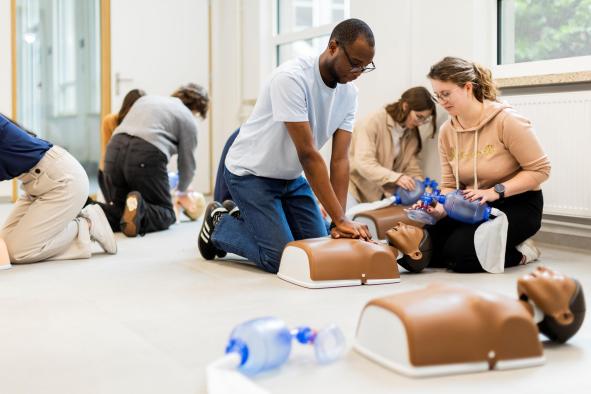
Theory, practice sessions, labs… every effort is made to ensure you master the concepts and develop practical skills.
Organized into small groups, the lab sessions and practice sessions allow you to delve deeper into specific aspects of the subject matter and introduce you to the techniques specific to each discipline. You learn to observe and experimentally verify certain laws or phenomena covered in the theoretical course units (CUs).
I really like the “flipped classroom” concept used in the respiratory physiology course. The professor explains the syllabus content in a video. We can rewatch the videos and take notes at our own pace… Then, we attend the in-class session to complete exercises and see if we’ve truly understood the material.
It’s a very effective teaching and learning technique that doesn’t take any longer than a traditional class, after which you’d have to organize your notes at home and review the material anyway.
This course taught me to be more efficient in my work habits.
Amélie
, Medical Student

In the physics, chemistry, and biology labs, you’ll conduct experiments and learn about the anatomy and physiology of a small mammal before moving on to that of the human body.
In histology, you’ll observe tissues and organs while practicing differential diagnosis.
You’ll have access to extensive resources to help you easily learn the basics of microscopy: a collection of microscopic sections of human specimens, binocular microscopes, electron micrographs, videos, and permanent online access to a virtual microscopic atlas.
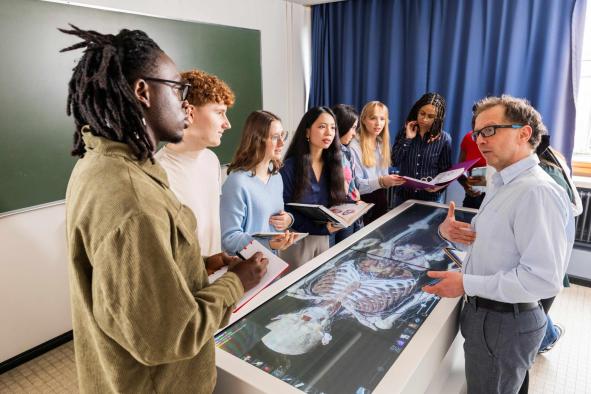
Thanks to the magnificent collection of anatomical specimens (skeletons, plastinated organs, 3D models) in the anatomy library and digital tools, you will study the structure of the human body.
In the epistemology and philosophy of biomedicine, you will take a critical look at the medical discipline and, using conceptual tools, explore other forms of medicine from around the world.
To Go Further
In addition to complementary activities such as “Artificial Intelligence” and “Student-Researcher,” you’ll have the opportunity to proactively broaden your learning horizons by attending conferences organized by the faculties.
General Practice Observation Internship
In your third year of the bachelor’s program, a three-week internship with a general practitioner gives you a chance to experience the day-to-day reality of the profession.
UNamur offers internships in various regions of Wallonia.
Did you know?
UNamur is committed to addressing the shortage of doctors in rural areas.
To address the challenge of the uneven geographic distribution of general practitioners, UNamur is breaking new ground by offering internship placements in rural areas that combine housing, transportation options, and mentorship from experienced general practitioners.
This is an opportunity to truly immerse yourself in the day-to-day practice of general medicine in a rural setting—and who knows, it might even inspire you to build your future career there.
Support for Success
Succeeding in a year of college involves many challenges.
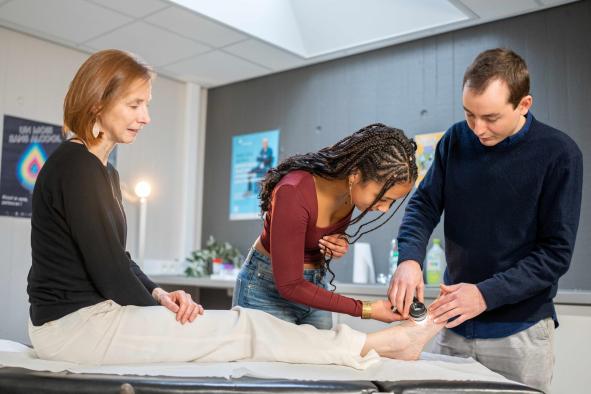
To help you overcome them, UNamur supports you in developing your academic, methodological, and interpersonal skills—with the help of many professionals.
Preparatory courses, individualized assistance…
After high school
After earning a bachelor’s degree in medicine, you are eligible to enroll in a master’s program in medicine (3 years) offered at other universities in the Wallonia-Brussels Federation: the Catholic University of Louvain, the Free University of Brussels, and the University of Liège.
The Master’s degree qualifies you to practice medicine, but must be followed by a specialized Master’s program, the duration of which varies depending on the specialty chosen (general medicine or another specialty).
During this specialization master’s program, you will hone your skills by practicing medicine under the supervision of a clinical instructor, and you will, of course, be paid.
As graduates with a bachelor’s degree in medicine, you may also pursue:
- a 120-credit Master’s in Pharmaceutical Sciences
- Master’s 120 in Biomedical Sciences
- 60-credit Master's in Biomedical Sciences
offered at UNamur.

Contacts
School of Medicine
Place du Palais de Justice • B-5000 Namur
Administrative Office
Tel.: +32 (0) 81 72 43 47
administration-medecine@unamur.be
-
Basic sciences
Code Name Staff Th.+Ex. Credits/Block 1 2 3 MBIOB105 Biology Renard Henri-François 13h th. 2 MCHIB108 Medicinal chemistry Wouters Johan Vincent Stéphane 39h th. + 10h ex. 5 MPHYB111 Medical physics Houssiau Laurent Houssiau Laurent 39h th. + 18h ex. 6 -
Humanities
Code Name Staff Th.+Ex. Credits/Block 1 2 3 Sustainable developmentImage Soft skillsImage
 English Friendly CoursesImage
MMEDB272_B1 General psychology Givron Hélène Fryns Delphine Bayot Marie Desseilles Martin 26h th. + 15h ex. 3 MSPSB242 Philosophy of biomedicine LAURENT Nathanaël Leyens Stéphane 20h th. + 6h ex. 2 Sustainable developmentImage
Soft skillsImage
English Friendly CoursesImage
MMEDB272 General psychology Givron Hélène Fryns Delphine Bayot Marie Desseilles Martin 26h th. + 15h ex. 3 -
Morphology
Code Name Staff Th.+Ex. Credits/Block 1 2 3 MMEDB103 Histology I and cytology Nicaise Charles Balligand Thomas Canon Caroline 39h th. + 20h ex. 6 MMEDB113 Histology II Nicaise Charles Balligand Thomas Canon Caroline 39h th. + 20h ex. 5 MMEDB101 General anatomy I Garin Pierre 39h th. 5 MMEDB253 Embryology Maystadt Isabelle 26h th. 3 MMEDB224 General anatomy II Garin Pierre 39h th. 5 MMEDB225 General anatomy III Garin Pierre 39h th. 5 MMEDB200 Pathological anatomy Nollevaux Marie-Cécile Canon Caroline 39h th. + 30h ex. 5 MMEDB235 Anatomy of the central nervous system Vandermeeren Yves 26h th. 3 MMEDB308 Immunopathology Graux Carlos 13h th. 2 MMEDB301 Medical imaging Nisolle Jean-François 35h th. 3 MMEDB337 Topographical anatomy Garin Pierre 75h ex. 3 -
Physiology and pharmacology
Code Name Staff Th.+Ex. Credits/Block 1 2 3 Sustainable developmentImage
English Friendly CoursesImage
MMEDB102 Physiology Kirschvink Nathalie 57h th. + 10h ex. 6 Sustainable developmentImage
MMEDB207 Physiology (kidneys, digestive system, reproduction) Castanares Zapatero Diego Wieërs Grégoire 39h th. + 20h ex. 4 MBIMB253 Neurophysiology and the central nervous system De Backer Olivier Vandermeeren Yves 39h th. 4 Sustainable developmentImage
MMEDB219 Endocrinology and Reproductive Physiology Wieërs Grégoire Maystadt Isabelle 26h th. 3 MMEDB208 Physiologie respiratoire Marchand Éric 13h th. 2 MMEDB209 Cardiovascular physiology and ECG Demeure Fabian 39h th. + 20h ex. 5 MMEDB340 General pharmacology Gourdin Maximilien 26h th. + 10h ex. 4 MMEDB341 Clinical Pharmacology Gourdin Maximilien 30h th. + 10h ex. 4 -
Molecular sciences
Code Name Staff Th.+Ex. Credits/Block 1 2 3 MMEDB105 Biochemistry and Cell Biology I Hennequart Marc Boonen Marielle Arnould Thierry 39h th. 5 MMEDB106 Biochemistry and Cell Biology II Boonen Marielle Hennequart Marc Hennequart Marc Arnould Thierry 39h th. 5 MBIMB109 Genetics Maystadt Isabelle De Backer Olivier 52h th. + 17h ex. 6 MMEDB205 General Immunology Graux Carlos 26h th. 3 MMEDB244 Biochemistry and Cell Biology IV Arnould Thierry Boonen Marielle Hennequart Marc Hennequart Marc Hamer Isabelle 52h th. + 15h ex. 7 MMEDB243 Biochemistry and Cell Biology III Hennequart Marc Hamer Isabelle 26h th. + 15h ex. 3 MBIMB350 Cancer cell biology, including alternative methods to animal testing D'Hondt Lionel Maystadt Isabelle Arnould Thierry Graux Carlos Graux Carlos Balligand Thomas De Backer Olivier Balligand Thomas Muylkens Benoît 30h th. 3 MMEDB345 Medical microbiology I Van der Linden Dimitri 26h th. + 12h ex. 3 MMEDB346 Medical Microbiology II Van der Linden Dimitri 26h th. 3 -
Clinical sciences
Code Name Staff Th.+Ex. Credits/Block 1 2 3 MMEDB323 Pneumology module Ocak Sebahat Bodart Eddy Hoton Delphine Nisolle Jean-François Rondelet Benoît Marchand Éric 70h th. 7 MMEDB322 Cardiology module Belhaj Asmae Vanolande Brieuc Beauloye Christophe Vanhoutte Laetitia Demeure Fabian Stanciu Claudia Xhaet Olivier Guédès Antoine Michaux Isabelle 70h th. 7 Service learningImage
MMEDB339 Internship Dejardin Cécile HENRION Dominique ABSIL Simon Magnette Catherine de Thier Tanguy Petit Jean Garin Pierre 3 MMEDB317 Introduction to clinical practice Gourdin Maximilien 20h th. + 4h ex. 4 -
Cross-disciplines
Code Name Staff Th.+Ex. Credits/Block 1 2 3 MBIOB132 Biostatistics I Bihin Benoît Bihin Benoît 26h th. 2 MBIOB133 Biostatistics II Bihin Benoît Bihin Benoît 26h th. + 16h ex. 2 MMEDB220 Medical epidemiology and EBM Roberfroid Dominique 26h th. + 15h ex. 3 MSPSB340 Medical bioethics Ravez Laurent 26h th. 3 MMEDB306 Public health Ravez Laurent Roberfroid Dominique 20h th. 2 Sustainable developmentImage
Soft skillsImage
English Friendly CoursesImage
MMEDB307 Medical psychology Givron Hélène Desseilles Martin 13h th. + 20h ex. 3 MMEDB338 General semiology Gabriel Laurence Dili Alexandra Gourdin Maximilien Vandermeeren Yves Vandermeeren Yves Marchand Éric 20h th. + 6h ex. 3 Sustainable developmentImage
MMEDB360 One Health Wieërs Grégoire Lachapelle Amélie Canon Caroline 15h th. 3 -
Language
Code Name Staff Th.+Ex. Credits/Block 1 2 3 MCDLB160 Medical English : reading scientific articles (level B2) Tréfois Cindy 26h th. 2
-
Basic sciences
Code Name Staff Credits Hours/Quarter 1 2 MBIOB105 Biology Renard Henri-François 2 13h th. MCHIB108 Medicinal chemistry Wouters Johan Vincent Stéphane 5 39h th. + 10h ex. MPHYB111 Medical physics Houssiau Laurent Houssiau Laurent 6 39h th. + 18h ex. -
Humanities
Code Name Staff Credits Hours/Quarter 1 2 Sustainable developmentImage
Soft skillsImage
English Friendly CoursesImage
MMEDB272_B1 General psychology Givron Hélène Fryns Delphine Bayot Marie Desseilles Martin 3 26h th. + 10h ex. 5h ex. -
Morphology
Code Name Staff Credits Hours/Quarter 1 2 MMEDB103 Histology I and cytology Nicaise Charles Balligand Thomas Canon Caroline 6 39h th. + 20h ex. MMEDB113 Histology II Nicaise Charles Balligand Thomas Canon Caroline 5 39h th. + 20h ex. MMEDB101 General anatomy I Garin Pierre 5 39h th. -
Physiology and pharmacology
Code Name Staff Credits Hours/Quarter 1 2 Sustainable developmentImage
English Friendly CoursesImage
MMEDB102 Physiology Kirschvink Nathalie 6 57h th. + 10h ex. -
Molecular sciences
Code Name Staff Credits Hours/Quarter 1 2 MMEDB105 Biochemistry and Cell Biology I Hennequart Marc Boonen Marielle Arnould Thierry 5 39h th. MMEDB106 Biochemistry and Cell Biology II Boonen Marielle Hennequart Marc Hennequart Marc Arnould Thierry 5 39h th. MBIMB109 Genetics Maystadt Isabelle De Backer Olivier 6 52h th. + 17h ex. -
Cross-disciplines
Code Name Staff Credits Hours/Quarter 1 2 MBIOB132 Biostatistics I Bihin Benoît Bihin Benoît 2 26h th. MBIOB133 Biostatistics II Bihin Benoît Bihin Benoît 2 26h th. + 16h ex. -
Language
Code Name Staff Credits Hours/Quarter 1 2 MCDLB160 Medical English : reading scientific articles (level B2) Tréfois Cindy 2 13h th. 13h th.
-
Humanities
Code Name Staff Credits Hours/Quarter 1 2 MSPSB242 Philosophy of biomedicine LAURENT Nathanaël Leyens Stéphane 2 20h th. + 6h ex. Sustainable developmentImage
Soft skillsImage
English Friendly CoursesImage
MMEDB272 General psychology Givron Hélène Fryns Delphine Bayot Marie Desseilles Martin 3 26h th. + 10h ex. 5h ex. -
Morphology
Code Name Staff Credits Hours/Quarter 1 2 MMEDB253 Embryology Maystadt Isabelle 3 26h th. MMEDB224 General anatomy II Garin Pierre 5 39h th. MMEDB225 General anatomy III Garin Pierre 5 39h th. MMEDB200 Pathological anatomy Nollevaux Marie-Cécile Canon Caroline 5 39h th. + 30h ex. MMEDB235 Anatomy of the central nervous system Vandermeeren Yves 3 26h th. -
Physiology and pharmacology
Code Name Staff Credits Hours/Quarter 1 2 Sustainable developmentImage
MMEDB207 Physiology (kidneys, digestive system, reproduction) Castanares Zapatero Diego Wieërs Grégoire 4 39h th. + 20h ex. MBIMB253 Neurophysiology and the central nervous system De Backer Olivier Vandermeeren Yves 4 39h th. Sustainable developmentImage
MMEDB219 Endocrinology and Reproductive Physiology Wieërs Grégoire Maystadt Isabelle 3 26h th. MMEDB208 Physiologie respiratoire Marchand Éric 2 13h th. MMEDB209 Cardiovascular physiology and ECG Demeure Fabian 5 39h th. + 20h ex. -
Molecular sciences
Code Name Staff Credits Hours/Quarter 1 2 MMEDB205 General Immunology Graux Carlos 3 26h th. MMEDB244 Biochemistry and Cell Biology IV Arnould Thierry Boonen Marielle Hennequart Marc Hennequart Marc Hamer Isabelle 7 52h th. + 15h ex. MMEDB243 Biochemistry and Cell Biology III Hennequart Marc Hamer Isabelle 3 26h th. + 15h ex. -
Cross-disciplines
Code Name Staff Credits Hours/Quarter 1 2 MMEDB220 Medical epidemiology and EBM Roberfroid Dominique 3 26h th. + 15h ex.
-
Morphology
Code Name Staff Credits Hours/Quarter 1 2 MMEDB308 Immunopathology Graux Carlos 2 13h th. MMEDB301 Medical imaging Nisolle Jean-François 3 35h th. MMEDB337 Topographical anatomy Garin Pierre 3 75h ex. -
Physiology and pharmacology
Code Name Staff Credits Hours/Quarter 1 2 MMEDB340 General pharmacology Gourdin Maximilien 4 26h th. + 10h ex. MMEDB341 Clinical Pharmacology Gourdin Maximilien 4 30h th. + 10h ex. -
Molecular sciences
Code Name Staff Credits Hours/Quarter 1 2 MBIMB350 Cancer cell biology, including alternative methods to animal testing D'Hondt Lionel Maystadt Isabelle Arnould Thierry Graux Carlos Graux Carlos Balligand Thomas De Backer Olivier Balligand Thomas Muylkens Benoît 3 30h th. MMEDB345 Medical microbiology I Van der Linden Dimitri 3 26h th. + 12h ex. MMEDB346 Medical Microbiology II Van der Linden Dimitri 3 26h th. -
Clinical sciences
Code Name Staff Credits Hours/Quarter 1 2 MMEDB323 Pneumology module Ocak Sebahat Bodart Eddy Hoton Delphine Nisolle Jean-François Rondelet Benoît Marchand Éric 7 70h th. MMEDB322 Cardiology module Belhaj Asmae Vanolande Brieuc Beauloye Christophe Vanhoutte Laetitia Demeure Fabian Stanciu Claudia Xhaet Olivier Guédès Antoine Michaux Isabelle 7 70h th. Service learningImage
MMEDB339 Internship Dejardin Cécile HENRION Dominique ABSIL Simon Magnette Catherine de Thier Tanguy Petit Jean Garin Pierre 3 MMEDB317 Introduction to clinical practice Gourdin Maximilien 4 20h th. + 4h ex. -
Cross-disciplines
Code Name Staff Credits Hours/Quarter 1 2 MSPSB340 Medical bioethics Ravez Laurent 3 26h th. MMEDB306 Public health Ravez Laurent Roberfroid Dominique 2 20h th. Sustainable developmentImage
Soft skillsImage
English Friendly CoursesImage
MMEDB307 Medical psychology Givron Hélène Desseilles Martin 3 13h th. + 10h ex. 10h ex. MMEDB338 General semiology Gabriel Laurence Dili Alexandra Gourdin Maximilien Vandermeeren Yves Vandermeeren Yves Marchand Éric 3 20h th. + 6h ex. Sustainable developmentImage
MMEDB360 One Health Wieërs Grégoire Lachapelle Amélie Canon Caroline 3 15h th.
Medical Professions
Doctors' professions
For various health policy reasons, the number of doctors who will be admitted to practice general or specialized medicine under the INAMI—that is, the Belgian Social Security system—is limited.
General Practitioners and Specialists
After completing a 6-year core curriculum (3 years of undergraduate study and 3 years of graduate study), students who have become doctors can complete their education with a specialized master’s degree in either general medicine or a medical specialty.
General practice is a clinical specialty focused on primary care with its own distinct characteristics: a varied practice encompassing all fields of medicine with a holistic and longitudinal (over time) approach, centered on the individual, and intervening at an early and undifferentiated stage of disease development. The general practitioner establishes a lasting and privileged relationship of trust with their patients, which allows them to play a central role in patient care. General practice settings are varied (solo practice, group practice, network practice, medical centers, etc.).
Specialized medicine is characterized by the physician’s focus on a specific field of interest, which allows them to acquire in-depth expertise and accumulate specific experience over time. Some specialties are practiced exclusively in hospitals, while others are practiced either in private practice or in hospitals. Some involve close contact with patients, while others do not (e.g., laboratory work). Some involve heavy workloads and demanding schedules, while others—which are less demanding—are compatible with a flexible schedule. All provide great intellectual satisfaction. All are of great benefit to those who are suffering.
Other Opportunities
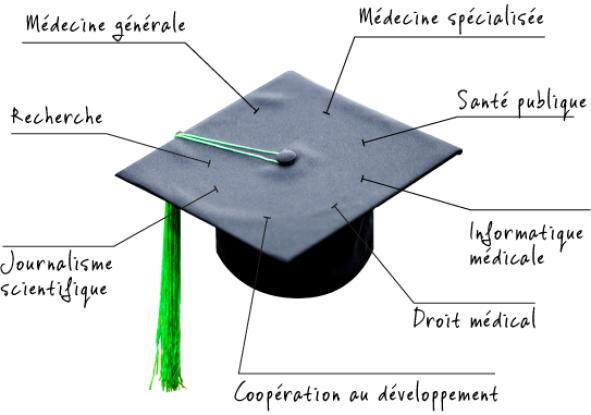
Other career paths include scientific research—for example, through the National Fund for Scientific Research, which awards research fellowships—public health (occupational medicine, expert assessments, hygiene, hospital management), tropical medicine and development cooperation, medical informatics, pharmacology, toxicology, science journalism, and medical law.