Bachelor in Mathematics
-
Schedule
regular course
- ECTS Credits 180
Overview
Your bachelor’s program begins with a solid foundation in general mathematics (logic, analysis, algebra, geometry, and probability).
You’ll quickly be exposed to current issues in applied mathematics through specialized courses in optimization, control theory, statistics, networks, and dynamic systems.
Your education is open to other disciplines such as economics, management, computer science, and the natural sciences. In fact, upon completing your bachelor’s degree in mathematical sciences, you can easily transition into master’s programs in other fields (such as computer science and economics).
Throughout the bachelor’s program, you’ll receive in-depth training in scientific programming and develop your English proficiency to read and write scientific articles.
A humanistic dimension complements your bachelor’s degree by fostering a reflective approach to the role and impact of science in society.
You're off to a good start
- You enjoy working with formulas;
- you feel comfortable with math;
- you demonstrate rigor and an abstract mindset in your reasoning;
- you enjoy solving real-world problems.
Teaching Methods
Lectures, exercise sessions, hands-on assignments, computer programming workshops… every effort is made to ensure you master the concepts and develop your communication, independence, organizational, teamwork, creativity, critical thinking, and scientific research skills.
Organized into small teams (3 to 5 students) and supervised by a teaching assistant, group projects allow you to explore certain aspects of the subject matter in greater depth on your own.
Through the “student-researcher” project, you can gain an introduction to research under the supervision of a researcher from the department. This experience also helps you develop your independence, creativity, and critical thinking skills.
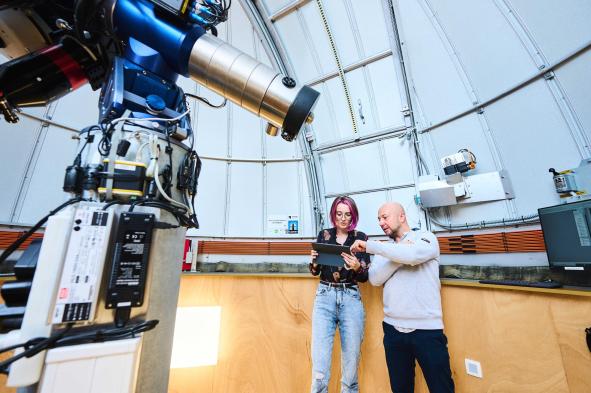
As part of our innovative educational projects, you organize evening observation sessions from the dome of the Antoine Thomas Astronomical Observatory, located in the center of campus, as part of the Astronomy course. You’ll design an observation project and present it as if it were an event for the general public.
You’ll round out your education by completing an interdisciplinary project. This project, which involves applied mathematics, includes an individual research and writing component followed by a group component. Exhibitions, lectures, interactive games, and writing articles—this project takes many forms and aims to develop your initiative, organizational skills, and oral and written communication abilities. The work produced is presented as part of the Printemps des Sciences.
Support for Success
Succeeding in a year of college involves many challenges.
To help you overcome these challenges, UNamur supports you in developing your academic, methodological, and interpersonal skills—with the help of many professionals.
Preparatory courses, individualized assistance… Discover the resources available to support your education.
After the bachelor's degree: the master's degree
The University of Namur is organizing:
- the master 120 in mathematical sciences
- the master 60 in mathematical sciences
- the master in mathematics education
- 120 credits - section 4 (from 2025)
- 60 credits - section 5 (from 2025)
directly accessible after earning your bachelor’s degree in mathematical sciences.
If you earned the credits for the “Economics and Management” track during your bachelor’s degree in mathematics, you can enroll in the master’s programs in economics at the University of Namur.
If you earned credits in the “Scientific Programming” track during your bachelor’s degree in mathematics, you can pursue master’s programs in computer science at the University of Namur.
Contacts
Faculty of Science
2 Grafé Street • B-5000 Namur
Office
Ms. A. Brouir, Ms. S. Duvivier, and Ms. C. Haeck
Tel.: +32 (0) 81 72 45 00
secretariat.sciences@unamur.be
-
General mathematics
Code Name Staff Th.+Ex. Credits/Block 1 2 3 SMATB102 Real analysis II Lucas Maxime Sonveaux Candy 30h th. + 32.5h ex. 7 SMATB107 Linear Algebra and Analytic Geometry Fuzfa André 30h th. + 32h ex. 5 SMATB101 Linear algebra Mauroy Alexandre 30h th. + 32h ex. 5 SMATB103 Real analysis Dubussy Christophe 30h th. + 32.5h ex. 7 SMATB112_Bloc1 Introduction to mathematical thinking Libert Anne-Sophie 30h th. + 30h ex. 5 SMATB202 Advanced algebra Mauroy Alexandre 15h th. + 19h ex. 3 SMATB240 Linear algebra II Lucas Maxime Sonveaux Candy 22h th. + 26h ex. 3 SMATB203_Partim Complex analysis Carletti Timoteo 22.5h th. + 26.5h ex. 5 SMATB214 Differential Geometry Fuzfa André 30h th. + 22.5h ex. 4 SMATB216 General Topology Hastir Anthony Hastir Anthony 15h th. + 19h ex. 3 SMATB222 Ordinary Differential Equations Carletti Timoteo 30h th. + 22.5h ex. 5 Sustainable developmentImage
SECOB201 Economy De Crombrugghe De Picquendaele Alain 30h th. + 7.5h ex. 3 SMATB254 Graph Theory Franco Nicolas 30h th. + 22.5h ex. 5 SMATB307 Symplectic geometry Libert Anne-Sophie 22.5h th. + 15h ex. 5 English Friendly CoursesImage
SMATB301 Functional analysis Hastir Anthony 30h th. + 22.5h ex. 5 English Friendly CoursesImage
SMATB302 Measure and Integration Theory Hastir Anthony 30h th. + 30h ex. 5 -
Applied mathematics and programming
Code Name Staff Th.+Ex. Credits/Block 1 2 3 SMATB109 Discrete Probability Theory Franco Nicolas 22.5h th. + 22.5h ex. 4 English Friendly CoursesImage
SINFB103 Programming I Tuci Elio 30h th. + 16h ex. 3 English Friendly CoursesImage
SINFB104 Programming II Tuci Elio 19h ex. 3 English Friendly CoursesImage
SMATB211 Statistics De Bodt Cyril 30h th. + 22.5h ex. 5 SMATB208 Point and solid mechanics Coyette Alexis Lucas Maxime Libert Anne-Sophie 22.5h th. + 22.5h ex. 3 English Friendly CoursesImage
SINFB206 Programming project Tuci Elio 7h th. + 15h ex. 2 English Friendly CoursesImage
SINFB207 Advanced programming HUBERMONT Antoine Tuci Elio 22h th. + 15h ex. 2 SMATB315 Mathematical algorithms for scientific computing Franco Nicolas 30h th. + 45h ex. 5 SMATB317 Partial differential equations and numerical methods 30h th. + 22.5h ex. 5 English Friendly CoursesImage
SMATB304 Optimization Sartenaer Annick 30h th. + 22.5h ex. 5 English Friendly CoursesImage
SMATB305 Probability II Swan Yves-Caoimhin De Bodt Cyril 30h th. + 22.5h ex. 5 SMATB303 Numerical analysis Sartenaer Annick 30h th. + 22.5h ex. 5 SMATB310 Interdisciplinary supervised work Lucas Maxime 25h th. + 25h ex. 5 -
Physics
Code Name Staff Th.+Ex. Credits/Block 1 2 3 SPHYB124_Math General physics: Mechanics Caporaletti Federico 60h th. + 24h ex. 8 Soft skillsImage English Friendly CoursesImage
SPHYB213 Astronomie Fuzfa André 15h th. 2 -
Humanities
Code Name Staff Th.+Ex. Credits/Block 1 2 3 SSPSB101 Philosophical questions Modera Astrid Sartenaer Olivier 22h th. + 7h ex. 2 Service learningImage
SSPSB102_Bloc1 Religious Studies: Anthropology, Metaphysics and Science Cazalis Roland Leyens Stéphane 30h th. 2 -
Choice of courses
Code Name Staff Th.+Ex. Credits/Block 1 2 3 SSPSB204 Logic and argumentation Sartenaer Olivier Sartenaer Olivier 22.5h th. 2 SSPSB202 History of science Sartenaer Olivier 22.5h th. 2 SSPSB203 Psychology Ravez Laurent 22.5h th. 2 SSPSB307 Formal logic Sartenaer Olivier 15h th. 2 SSPSB308 Philosophy of science Sartenaer Olivier 15h th. 2 SSPSB309 Ethical LAURENT Nathanaël Leyens Stéphane 15h th. 2
-
-
Languages
Code Name Staff Th.+Ex. Credits/Block 1 2 3 SCDLB104 Introduction to Scientific English (level B1 and above) Zimmer Carole 30h th. 3 SCDLB204 English and maths (level B1 and above) Zimmer Carole 30h th. 3 Soft skillsImage
SCDLB304 English, maths and communication (level B2 and above) Zimmer Carole 30h th. 3 -
Optional opening activity
Code Name Staff Th.+Ex. Credits/Block 1 2 3 UNAM0066-02 Introduction to Space Sciences Fuzfa André Zimmer Carole 3
-
-
Choice of courses and training
Code Name Staff Th.+Ex. Credits/Block 1 2 3 English Friendly CoursesImage
INFOB126 Computer Architecture Schumacher Laurent 30h th. + 15h ex. 6 6 SPHYB126_Math General physics: Electricity Sporken Robert 50h th. + 21h ex. 6 -
Cross-cutting activities option
Code Name Staff Th.+Ex. Credits/Block 1 2 3 UNAM0048 Artificial intelligence: challenges and opportunities Frenay Benoît 24h th. 3 3 Soft skillsImage
UNAM0049 Science for all : Introduction to popular science Schutz Natassia Hansel Aude 24h th. 3 3 UNAM0065 Thinking in systems Béreau Sophie 26h th. 3 3 -
Didactic mathematics option
Code Name Staff Th.+Ex. Credits/Block 1 2 3 SMATB318 Introduction to the didactics of mathematics Dubussy Christophe 30h th. + 30h ex. 5 -
Mathematical modeling option
Code Name Staff Th.+Ex. Credits/Block 1 2 3 Cyclic course organized this yearImage
SMATB210 Mathematical tools for modeling Mauroy Alexandre 30h th. + 22.5h ex. 5 English Friendly CoursesImage
Cyclic course not organized this yearImage
SMATB334 Problem solving and mathematical modelling Mauroy Alexandre 30h th. + 22.5h ex. 5 SMATB325 Regression models De Bodt Cyril 30h th. + 22.5h ex. 5 -
Scientific programming option
Code Name Staff Th.+Ex. Credits/Block 1 2 3 English Friendly CoursesImage
INFOB126 Computer Architecture Schumacher Laurent 30h th. + 15h ex. 6 6 INFOB234_UES Object-oriented design and programming Heymans Patrick 30h th. + 30h ex. 5 Soft skillsImage
INFOB212_UES Database Engineering Cleve Anthony 45h th. + 15h ex. 3 INFOB313_UES Analysis and Modelling of Information Systems Heymans Patrick 30h th. + 30h ex. 5 -
Natural sciences option
Code Name Staff Th.+Ex. Credits/Block 1 2 3 SBIOB219 Biology Messiaen Johan 30h th. 5 SBIOB003 Pluridisciplinary scientific field trip Silvestre Frédéric Yans Johan Yans Johan Silvestre Frédéric 48h th. + 48h ex. 3 3 SPHYB209 Electrodynamics I Deparis Olivier Deparis Olivier 30h th. + 15h ex. 5 Sustainable developmentImage
SGOGB314 Climatology Houssiau Laurent 30h th. + 40h ex. 5 SCHIB309 Mathematical chemistry Liégeois Vincent Champagne Benoît 30h th. + 22.5h ex. 5 Sustainable developmentImage
SGOLB313_Bac Math et Physique Geophysics Louette Pierre Collinet Max 15h th. + 15h ex. 3 -
Economics and management option
Code Name Staff Th.+Ex. Credits/Block 1 2 3 English Friendly CoursesImage
EFASB357 Macroeconomics Kiedaisch Christian Frogneux Vincent 45h th. 5 EFASB354 Financial and cost accounting Bernal Diaz Oscar 45h th. 5 Sustainable developmentImage
ECONB311 Environmental economics Do Nascimento Miguel Jeremy 30h th. + 15h ex. 5 5 Sustainable developmentImage
Soft skillsImage
English Friendly CoursesImage
ECONB312 Growth and development Houssa Romain Guirkinger Catherine 45h th. + 15h ex. 5 5 ECONB313 Economy and AI: Transformations and challenges Hungerbuhler Mathias 45h th. 5 5 ECONB907 History of Economic Thought Lefebvre Perrin 30h th. 5 5 ECGEB383_autres Finance Gnabo Jean-Yves 45h th. + 15h ex. 5 -
Participation in a research project option
Code Name Staff Th.+Ex. Credits/Block 1 2 3 SMATB292 Student researcher project Q1-Q2 Henry Valérie 10 SMATB290 Student-researcher" project Q2 Henry Valérie 5 SMATB291 Student-researcher" project Q1 Henry Valérie 5 SMATB392 Student researcher project Q1-Q2 Henry Valérie 10 SMATB390 Student-researcher" project Q2 Henry Valérie 5 SMATB391 Student-researcher" project Q1 Henry Valérie 5
-
-
General mathematics
Code Name Staff Credits Hours/Quarter 1 2 SMATB102 Real analysis II Lucas Maxime Sonveaux Candy 7 30h th. + 32.5h ex. SMATB107 Linear Algebra and Analytic Geometry Fuzfa André 5 30h th. + 32h ex. SMATB101 Linear algebra Mauroy Alexandre 5 30h th. + 32h ex. SMATB103 Real analysis Dubussy Christophe 7 30h th. + 32.5h ex. SMATB112_Bloc1 Introduction to mathematical thinking Libert Anne-Sophie 5 30h th. + 30h ex. -
Applied mathematics and programming
Code Name Staff Credits Hours/Quarter 1 2 SMATB109 Discrete Probability Theory Franco Nicolas 4 22.5h th. + 22.5h ex. English Friendly CoursesImage
SINFB103 Programming I Tuci Elio 3 30h th. + 16h ex. English Friendly CoursesImage
SINFB104 Programming II Tuci Elio 3 19h ex. -
Physics
Code Name Staff Credits Hours/Quarter 1 2 SPHYB124_Math General physics: Mechanics Caporaletti Federico 8 60h th. + 24h ex. -
Humanities
Code Name Staff Credits Hours/Quarter 1 2 SSPSB101 Philosophical questions Modera Astrid Sartenaer Olivier 2 22h th. + 7h ex. Service learningImage
SSPSB102_Bloc1 Religious Studies: Anthropology, Metaphysics and Science Cazalis Roland Leyens Stéphane 2 30h th. -
Languages
Code Name Staff Credits Hours/Quarter 1 2 SCDLB104 Introduction to Scientific English (level B1 and above) Zimmer Carole 3 15h th. 15h th. -
Choice of courses and training
Code Name Staff Credits Hours/Quarter 1 2 English Friendly CoursesImage
INFOB126 Computer Architecture Schumacher Laurent 6 30h th. + 15h ex. SPHYB126_Math General physics: Electricity Sporken Robert 6 50h th. + 21h ex.
-
General mathematics
Code Name Staff Credits Hours/Quarter 1 2 SMATB202 Advanced algebra Mauroy Alexandre 3 15h th. + 19h ex. SMATB240 Linear algebra II Lucas Maxime Sonveaux Candy 3 22h th. + 26h ex. SMATB203_Partim Complex analysis Carletti Timoteo 5 22.5h th. + 26.5h ex. SMATB214 Differential Geometry Fuzfa André 4 30h th. + 22.5h ex. SMATB216 General Topology Hastir Anthony Hastir Anthony 3 15h th. + 19h ex. SMATB222 Ordinary Differential Equations Carletti Timoteo 5 30h th. + 22.5h ex. Sustainable developmentImage
SECOB201 Economy De Crombrugghe De Picquendaele Alain 3 30h th. + 7.5h ex. SMATB254 Graph Theory Franco Nicolas 5 30h th. + 22.5h ex. -
Applied mathematics and programming
Code Name Staff Credits Hours/Quarter 1 2 English Friendly CoursesImage
SMATB211 Statistics De Bodt Cyril 5 30h th. + 22.5h ex. SMATB208 Point and solid mechanics Coyette Alexis Lucas Maxime Libert Anne-Sophie 3 22.5h th. + 22.5h ex. English Friendly CoursesImage
SINFB206 Programming project Tuci Elio 2 7h th. + 15h ex. English Friendly CoursesImage
SINFB207 Advanced programming HUBERMONT Antoine Tuci Elio 2 22h th. + 15h ex. -
Physics
Code Name Staff Credits Hours/Quarter 1 2 Soft skillsImage
English Friendly CoursesImage
SPHYB213 Astronomie Fuzfa André 2 7.5h th. 7.5h th. -
Humanities
-
Choice of courses
Code Name Staff Credits Hours/Quarter 1 2 SSPSB204 Logic and argumentation Sartenaer Olivier Sartenaer Olivier 2 22.5h th. SSPSB202 History of science Sartenaer Olivier 2 22.5h th. SSPSB203 Psychology Ravez Laurent 2 22.5h th.
-
-
Languages
Code Name Staff Credits Hours/Quarter 1 2 SCDLB204 English and maths (level B1 and above) Zimmer Carole 3 15h th. 15h th. -
Optional opening activity
Code Name Staff Credits Hours/Quarter 1 2 UNAM0066-02 Introduction to Space Sciences Fuzfa André Zimmer Carole 3
-
-
Choice of courses and training
-
Cross-cutting activities option
Code Name Staff Credits Hours/Quarter 1 2 UNAM0048 Artificial intelligence: challenges and opportunities Frenay Benoît 3 24h th. Soft skillsImage
UNAM0049 Science for all : Introduction to popular science Schutz Natassia Hansel Aude 3 12h th. 12h th. UNAM0065 Thinking in systems Béreau Sophie 3 26h th. -
Mathematical modeling option
Code Name Staff Credits Hours/Quarter 1 2 Cyclic course organized this yearImage
SMATB210 Mathematical tools for modeling Mauroy Alexandre 5 30h th. + 22.5h ex. -
Scientific programming option
Code Name Staff Credits Hours/Quarter 1 2 English Friendly CoursesImage
INFOB126 Computer Architecture Schumacher Laurent 6 30h th. + 15h ex. INFOB234_UES Object-oriented design and programming Heymans Patrick 5 30h th. + 30h ex. -
Natural sciences option
Code Name Staff Credits Hours/Quarter 1 2 SBIOB219 Biology Messiaen Johan 5 30h th. SBIOB003 Pluridisciplinary scientific field trip Silvestre Frédéric Yans Johan Yans Johan Silvestre Frédéric 3 48h th. + 48h ex. SPHYB209 Electrodynamics I Deparis Olivier Deparis Olivier 5 30h th. + 15h ex. -
Economics and management option
Code Name Staff Credits Hours/Quarter 1 2 English Friendly CoursesImage
EFASB357 Macroeconomics Kiedaisch Christian Frogneux Vincent 5 45h th. EFASB354 Financial and cost accounting Bernal Diaz Oscar 5 45h th. Sustainable developmentImage
ECONB311 Environmental economics Do Nascimento Miguel Jeremy 5 30h th. + 15h ex. Sustainable developmentImage
Soft skillsImage
English Friendly CoursesImage
ECONB312 Growth and development Houssa Romain Guirkinger Catherine 5 45h th. + 15h ex. ECONB313 Economy and AI: Transformations and challenges Hungerbuhler Mathias 5 45h th. ECONB907 History of Economic Thought Lefebvre Perrin 5 30h th. -
Participation in a research project option
Code Name Staff Credits Hours/Quarter 1 2 SMATB292 Student researcher project Q1-Q2 Henry Valérie 10 SMATB290 Student-researcher" project Q2 Henry Valérie 5 SMATB291 Student-researcher" project Q1 Henry Valérie 5
-
-
General mathematics
Code Name Staff Credits Hours/Quarter 1 2 SMATB307 Symplectic geometry Libert Anne-Sophie 5 22.5h th. + 15h ex. English Friendly CoursesImage
SMATB301 Functional analysis Hastir Anthony 5 30h th. + 22.5h ex. English Friendly CoursesImage
SMATB302 Measure and Integration Theory Hastir Anthony 5 30h th. + 30h ex. -
Applied mathematics and programming
Code Name Staff Credits Hours/Quarter 1 2 SMATB315 Mathematical algorithms for scientific computing Franco Nicolas 5 30h th. + 45h ex. SMATB317 Partial differential equations and numerical methods 5 30h th. + 22.5h ex. English Friendly CoursesImage
SMATB304 Optimization Sartenaer Annick 5 30h th. + 22.5h ex. English Friendly CoursesImage
SMATB305 Probability II Swan Yves-Caoimhin De Bodt Cyril 5 30h th. + 22.5h ex. SMATB303 Numerical analysis Sartenaer Annick 5 30h th. + 22.5h ex. SMATB310 Interdisciplinary supervised work Lucas Maxime 5 25h th. + 25h ex. -
Humanities
-
Choice of courses
Code Name Staff Credits Hours/Quarter 1 2 SSPSB307 Formal logic Sartenaer Olivier 2 15h th. SSPSB308 Philosophy of science Sartenaer Olivier 2 15h th. SSPSB309 Ethical LAURENT Nathanaël Leyens Stéphane 2 15h th.
-
-
Languages
Code Name Staff Credits Hours/Quarter 1 2 Soft skillsImage
SCDLB304 English, maths and communication (level B2 and above) Zimmer Carole 3 15h th. 15h th. -
Choice of courses and training
-
Cross-cutting activities option
Code Name Staff Credits Hours/Quarter 1 2 Soft skillsImage
UNAM0049 Science for all : Introduction to popular science Schutz Natassia Hansel Aude 3 12h th. 12h th. UNAM0048 Artificial intelligence: challenges and opportunities Frenay Benoît 3 24h th. UNAM0065 Thinking in systems Béreau Sophie 3 26h th. -
Didactic mathematics option
Code Name Staff Credits Hours/Quarter 1 2 SMATB318 Introduction to the didactics of mathematics Dubussy Christophe 5 30h th. + 30h ex. -
Mathematical modeling option
Code Name Staff Credits Hours/Quarter 1 2 English Friendly CoursesImage
Cyclic course not organized this yearImage
SMATB334 Problem solving and mathematical modelling Mauroy Alexandre 5 30h th. + 22.5h ex. SMATB325 Regression models De Bodt Cyril 5 30h th. + 22.5h ex. -
Scientific programming option
Code Name Staff Credits Hours/Quarter 1 2 Soft skillsImage
INFOB212_UES Database Engineering Cleve Anthony 3 30h th. + 7h ex. 15h th. + 8h ex. INFOB313_UES Analysis and Modelling of Information Systems Heymans Patrick 5 30h th. + 30h ex. -
Natural sciences option
Code Name Staff Credits Hours/Quarter 1 2 SBIOB003 Pluridisciplinary scientific field trip Silvestre Frédéric Yans Johan Yans Johan Silvestre Frédéric 3 48h th. + 48h ex. Sustainable developmentImage
SGOGB314 Climatology Houssiau Laurent 5 30h th. + 40h ex. SCHIB309 Mathematical chemistry Liégeois Vincent Champagne Benoît 5 30h th. + 22.5h ex. Sustainable developmentImage
SGOLB313_Bac Math et Physique Geophysics Louette Pierre Collinet Max 3 15h th. + 15h ex. -
Economics and management option
Code Name Staff Credits Hours/Quarter 1 2 ECGEB383_autres Finance Gnabo Jean-Yves 5 45h th. + 15h ex. Sustainable developmentImage
ECONB311 Environmental economics Do Nascimento Miguel Jeremy 5 30h th. + 15h ex. Sustainable developmentImage
Soft skillsImage
English Friendly CoursesImage
ECONB312 Growth and development Houssa Romain Guirkinger Catherine 5 45h th. + 15h ex. ECONB313 Economy and AI: Transformations and challenges Hungerbuhler Mathias 5 45h th. ECONB907 History of Economic Thought Lefebvre Perrin 5 30h th. -
Participation in a research project option
Code Name Staff Credits Hours/Quarter 1 2 SMATB392 Student researcher project Q1-Q2 Henry Valérie 10 SMATB390 Student-researcher" project Q2 Henry Valérie 5 SMATB391 Student-researcher" project Q1 Henry Valérie 5
-
Jury
Careers for Mathematicians
Careers in mathematics
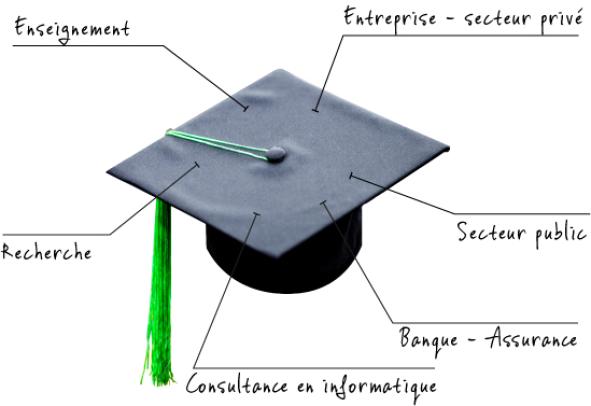
For graduates in applied mathematics from the University of Namur, the transition from studies to the world of work presents no major difficulties: schools are short of mathematics teachers; the business world is looking for skills in networks, dynamic systems, optimization, control, modeling and programming, all assets that mathematicians trained at UNamur possess.
Confronting mathematics with reality
Many mathematicians invest their knowledge within companies. Many business sectors appreciate their analytical and synthesizing skills, as well as their rigor. Whether in consultancy or in the economic and industrial world, mathematicians have plenty of room to model phenomena and situations and, more broadly, put their mathematical baggage at the service of society.
Building IT solutions
Mathematicians at UNamur receive a solid training in scientific programming, an asset that many of them put to good use within various organizations (private or public), or in IT service companies. After a few years in applications development, mathematicians generally move on to project management.
Whatever their job title and level of responsibility, they work to bring human beings and an information management and processing system into harmonious interaction... an ongoing challenge that demands a good sense of interpersonal relations and an excellent knowledge of technology and the business world.
My job as an IT manager is at times akin to a mathematical demonstration. I start with a hypothesis, i.e. the existing situation, the budget, the resources, and I have to arrive at a thesis, in this case a major business project, such as setting up a company abroad. To achieve this, I conduct a real demonstration using lemmas, i.e. small implementations of IT solutions. To set up a company abroad, for example, you need to secure your IT network.
Alain Dieudonné, IT Manager
Evaluating financial or economic risks
Risk management is a strategic issue in banking and financial organizations, stock markets, insurance companies, but also parastatal institutions for social security, pension control, etc. Thanks to their sound knowledge of modeling, mathematicians often perform functions linked to controlling the uncertainty inherent in most economic activities.
Producing statistics
Statistics play an important role in today's society: opinion polls and surveys are part of our daily lives. Some consultancies specializing in conducting this type of analysis call on mathematicians.
Modeling reality
Whether it's the shape of contact lenses, the dynamics of a population, the concentration of space debris, the movements of the oceans, the understanding of social networks, the work of mathematicians is always linked to modeling: being able to understand, simplify, conceptualize and visualize a situation, to come out with a more abstract model likely to provide a global description of a phenomenon.
I've been working for a few years as an actuary in a consultancy firm in the field of supplementary pensions. We live in a world full of hazards: the actuary's role is to quantify, to model uncertainties... Above all, mathematics enables us to develop our way of thinking, which makes our capacity for analysis our main working tool.
Noémie Laloux, actuary
Transmitting a passion for reality
Teaching and the world of training still represent one of the major outlets for mathematicians. Almost a third of our young, professionally active graduates communicate their passion for the real world by teaching mathematics and/or science in upper secondary schools, colleges and universities.
The subject we teach is not particularly difficult. Above all, we need to give young people a taste for mathematics and help those with difficulties to understand it. It's a daily challenge.
Marie Matelart, Secondary school mathematics teacher
Pushing the limits of our knowledge
Mathematicians pursue research mainly in academic settings, in Belgium or abroad. Universities and public funds (FNRS, FRIA, etc.) finance the completion of a PhD (between 4 and 6 years) or award time-limited grants for participation in a research program, sometimes in partnership with the business world.
Aside from fundamental research, mathematics is often a valuable tool for scientific progress in other disciplines: computer science, astrophysics and physics, meteorology, economics, transport, biology... In these multidisciplinary contexts, dual skills often represent an asset.