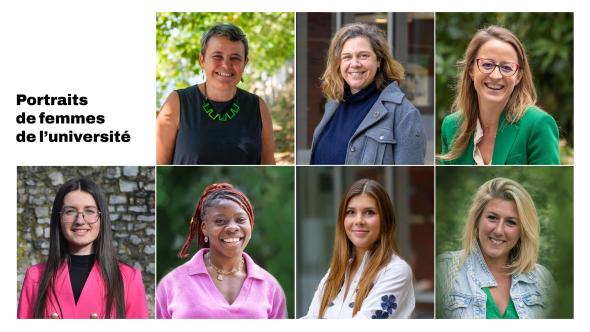
Séphora Boucenna, Dean of the Faculty of Education and Training Sciences (FaSEF)

An unusual and evolving career path

A professor and now dean of the Faculty of Education and Training Sciences, Séphora joined the University of Namur in November 1999. She teaches in initial teacher training as well as in the master's degree program specializing in professional support (Mapemass). 


Séphora Boucenna doyenne faculté des sciences éducation et formation

Justine Bodart, doctoral student at the Faculty of Science

A journey built step by step

After high school, Justine entered university without any clear idea of the direction she wanted to take, except that she wanted to study science. She finally chose mathematics, without any certainty at first, but gradually discovered a real interest in the subject.  

Photo de Justine Bodart

Duvernelle Ngouzon Nguimdo, student at the Faculty of Computer Science

An international academic background

Duvernelle completed all her schooling in Cameroon, where she chose to focus on mathematics and physical sciences when she entered secondary school. After two years of studying animal biology at university, she decided to change direction and applied to the University of Namur in Belgium to study computer science. 

Photo de Durvenelle Ngouzon Nguimdo, étudiante à la Faculté d’informatique

Alisson Kabili, laboratory technician at the Faculty of Medicine

Finding her calling in the laboratory

Alisson has been working at the University of Namur for a year and a half as a laboratory technician in the Faculty of Medicine. Her role is essential: assisting researchers with their experiments, preparing practical work for students, and managing the day-to-day running of the laboratory, from ordering reagents to monitoring equipment. 

Alisson Kabili

Virginie Di Luca, administrative assistant at the EMCP Faculty

A rich, multifaceted, and resolutely human career path

Virginie joined the University of Namur in February 2023 as secretary of the Department of Political Science, Information, and Communication. It is a pivotal role at the heart of student and academic life. Her career path has not been a straight line, and that is what she loves about it today. 

Virginie Di Luca

Amélie Lachapelle, professor at the Faculty of Law

A journey marked by chance, encounters, and convictions

A lecturer at the Faculty of Law at UNamur and at Saint-Louis University, Amélie has also held the position of Project Manager for "Transitions & Sustainable Development" since 2025. Hers has been a rich journey, marked by curiosity and detours, but always guided by a desire to understand the law in a different way. 

Amélie Lachapelle (c) Sebastien Roberty

Anne Roekens, professor at the Faculty of Philosophy and Letters

Teaching at the heart of her career 

Anne immediately presents herself as passionate about teaching. A professor of contemporary history, she describes her academic career as "fairly linear," naturally leading her to the classroom. After studying history, she quickly decided to pursue a doctorate focused on language and diversity issues. 

Anne Roekens

March 8, International Women's Rights Day

International Women's Day (UN), also known as "International Day of Struggle for Women's Rights" (UN Women), is celebrated every year on March 8. This day highlights the struggles for women's rights and, more broadly, for the elimination of inequalities between women and men.  

Although International Women's Day was made official by the United Nations in 1977, following on from the International Women's Year proclaimed in 1975 by the UN General Assembly, its origins date back to the social movements that emerged in North America and Europe at the turn of the 20th century. 

The University of Namur fights against gender discrimination

The fight against gender discrimination is a priority at UNamur, which is firmly committed to promoting gender equality, non-discrimination, and respect for diversity.  

UNamur's goal is to create an inclusive university community where everyone can thrive, regardless of gender. By embracing diversity and taking concrete measures, the university affirms its commitment to a more equitable society based on the values of justice, inclusion, and respect for human dignity.