Cooperation lies at the heart of many human societies, ecosystems, and microbial communities. Yet it is constantly threatened by individuals who benefit from collective efforts without contributing themselves. A new study driven by an international collaboration between the teams lead by, Professor Dibakar Ghosh (ISI, Kolkata, India), Professor Matjaž Perc (University of Maribor, Slovenia) and Professor Timoteo Carletti (UNamur, naXys institute, Belgium) shows that the way individuals move within a network can play a decisive role in sustaining cooperation.

For decades, scientists have sought to understand why cooperation persists even though selfish behaviour often appears more advantageous in the short term. Classical theoretical models generally predict that “defectors” — individuals who benefit from a common resource without contributing to it — should eventually dominate.

The unexpected role of movement

Reality, however, tells a different story. In nature as well as in human societies, cooperation remains remarkably widespread. To investigate this apparent paradox, the researchers developed a mathematical model describing populations organized in groups modelled as nodes of a network, where cooperators and defectors can move between groups. Their analysis reveals an unexpected phenomenon: when defectors move faster than cooperators, their advantage can actually diminish. Because cooperators are less mobile, they tend to remain clustered together. These clusters create favourable conditions for mutual support and allow cooperation to persist despite the presence of opportunistic individuals.

The researchers also found that the structure of the network itself plays an important role. Highly connected nodes — comparable to transportation hubs or highly influential individuals in a social network — are particularly effective at sustaining cooperation. By contrast, more peripheral areas remain more vulnerable to defection.

New insights into collective behaviour

These findings highlight a simple yet powerful mechanism: differences in mobility can promote the spontaneous emergence of stable cooperative communities. The results offer new insights into the dynamics of collective behaviour across a wide range of systems, from ecosystems and human societies to microbial populations.

Image
Timoteo Carletti

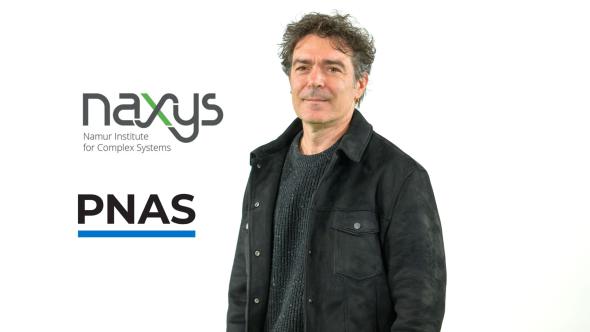
“Our work shows that movement is not merely a secondary feature of a system. It can fundamentally alter the balance between cooperation and selfish behaviour. Cooperation may emerge not despite mobility, but because of it, when different actors move in different ways.”

Timoteo Carletti Chair of the Department of Mathematics

The journal "Proceedings of the National Academy of Sciences" (PNAS), a peer-reviewed publication of the National Academy of Sciences (NAS), is a leading venue for high-impact original research spanning the biological, physical, and social sciences. The journal has a global reach and welcomes submissions from researchers around the world.

Congratulations to the researchers on this publication!

Timoteo Carletti – Short Biography

After earning a master’s degree in physics from the University of Florence in June 1995, Timoteo Carletti pursued doctoral studies in Florence and Paris, notably at the Institut de mécanique céleste et de calcul des éphémérides. He completed his PhD in Mathematics in February 2000.

In 2005, he moved to Belgium and joined the University of Namur as a Lecturer. He was subsequently appointed Professor in 2008 and Full Professor in 2011 within the Department of Mathematics of the Faculty of Science. In 2010, he was among the founders of the Namur Center for Complex Systems, which later became the Namur Institute for Complex Systems. He served as its Director until December 2014.

About Timoteo Carletti: https://www.unamur.be/en/profil/tcarlett

Timoteo Carletti