Long COVID remains difficult to diagnose and treat, particularly in Belgium. A recent report estimated that this hidden epidemic will impose an annual societal cost of tens of billions of euros on OECD member countries. In the absence of clear biomarkers, many practitioners still sometimes mistakenly attribute some of the symptoms to psychosomatic causes. Since 2022, the team led by Prof. Charles Nicaise (Molecular Physiology Research Unit - Namur Research Institute for Life Sciences (NARILIS) - UNamur), notably through the work of Margaux Mignolet, a FRIA researcher and PhD student, has been exploring the hypothesis of immune dysregulation occurring during acute infection and leading to the production of autoantibodies directed against components of the nervous system.

With this in mind, a collaboration has been established between the UNamur team and the team led by Prof. Pierre Bulpa (Intensive Care Unit – UCL Namur University Hospital – Godinne Campus). Patients suffering from long COVID were recruited under the coordination of Prof. Bulpa and Catherine Deroux, a neuropsychologist at the Memory Clinic. 

Pierre Bulpa (CHU UCL Namur)
Prof. Pierre Bulpa (Intensive Care – UCL Namur University Hospital – Godinne Campus)

Thirteen patients whose symptoms were consistent with long neurological COVID and were confirmed by tests assessing their cognitive and pain-related complaints were included in this study. 

After collecting blood samples, the researchers isolated the patients’ immunoglobulin G (IgG) antibodies and studied their effects in a passive transfer mouse model at Professor Charles Nicaise’s LNR laboratory. The animals underwent a battery of behavioural tests assessing, in particular, pain sensitivity thresholds, as well as other cognitive, anxiety, or depressive disorders.

Several major discoveries have been made

  • IgG transfer and pain: After transfer of IgG from patients, mice develop painful hypersensitivity, specifically mechanical allodynia—meaning that a tactile stimulus that is usually painless becomes painful—as well as thermal hyperalgesia—meaning that an uncomfortable hot or cold stimulus becomes very painful.
  • Specificity of the effect: the transfer of these IgG to laboratory mice does not induce cognitive (e.g., memory), anxiety, or depressive disorders, suggesting distinct mechanisms depending on the symptoms.
  • Proof of causality: when the antibodies are destroyed before injection, or when serum from which IgG has been removed is injected, the painful effect disappears.
  • Target of autoantibodies: IgG binds to the spinal ganglia along the spinal column, structures containing sensory neurons that relay information, for example, between the skin and the brain. Autoantibodies recognize peripheral neurons involved in pain (nociception) and the perception of body position or deep sensation (proprioception).
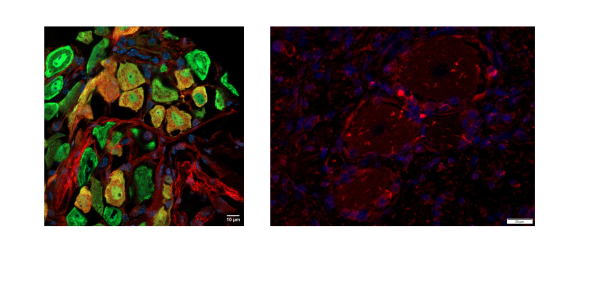
Ganglions de souris (à gauche) et humains (à droite)

Left: Mouse ganglion (a structure located along the spine). Green indicates sensory neurons; red indicates antibodies from long-COVID patients; yellow indicates the colocalization of neurons and antibodies. This demonstrates that the patients’ antibodies target sensory neurons.  

Right: Human ganglion to which antibodies from long-COVID patients were applied to verify whether binding to sensory neurons occurs as in mice. In blue, cell nuclei; in red, antibodies from long-COVID patients, proving that antibodies from long-COVID patients bind to human sensory neurons. 

“We are the second group in the world, following UMC Utrecht just a few weeks ago, to demonstrate that painful symptoms in long-COVID patients are mediated by an autoimmune reaction, based on the presence of immunoglobulin G-type autoantibodies,” summarizes Prof. Charles Nicaise. 

Other studies conducted independently at Yale University and King’s College London are currently undergoing peer review and appear to support these findings. 

Therapeutic prospects

These findings help to provide scientific evidence for some aspects of long COVID by establishing a biological basis for the pain component. They open up therapeutic avenues aimed at identifying and then eliminating circulating pathogenic autoantibodies—for example, through plasmapheresis (plasma filtration) or targeted therapies based on anti-autoantibodies. The study suggests, however, that the frequently reported cognitive impairments may stem from other mechanisms that have yet to be elucidated.

A strong partnership between UNamur and CHU UCL Namur

The study is based on multidisciplinary work involving clinicians, neurobiologists, and technology platforms, building on the collaborations established during the pandemic. The proximity between UNamur—and more specifically the Narilis Institute—and the UCL Namur University Hospital facilitates the rapid translation of clinical observations into laboratory experiments and contributes to our understanding of public health issues such as long COVID.

Logos Unamur - Institut de recherche NARILIS et CHU UCL Namur (site Godinne)

The research team

  • Charles Nicaise, URPhyM, NARILIS, UNamur
  • Margaux Mignolet, URPhyM, NARILIS, UNamur
  • Catherine Deroux, Memory Clinic, UCL Namur University Hospital (Godinne campus)
  • Prof. Pierre Bulpa, Intensive Care, CHU UCL Namur (Godinne site)

As well as all the staff, doctors, virologists, students, laboratory technicians, patients, and volunteers whom the team thanks for their dedication.

The COVID-19 pandemic is a human tragedy that has claimed millions of lives worldwide and placed our entire society under immense strain. But it has also been a powerful collective experience for many scientists at UNamur, whose research continues in an effort to better understand this disease and its consequences.

Read our article: Covid-19, Five Years On: A Look Back at UNamur’s Major Role in Addressing the Pandemic