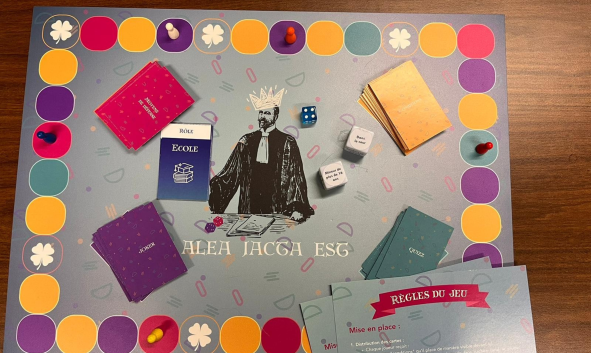
Game-based learning is based on a simple principle: learning through play. Introduced at the School of Law in 2023 by Sarah Larielle, a teaching assistant, this approach has been gradually developed and expanded during the practical sessions of the contract law course. “The goal is twofold: to increase our students’ engagement in class while raising their awareness of certain societal issues, using real-world cases that may resonate with their lives as students, explains Eva Gillard, a teaching assistant and doctoral student at the Faculty of Law.

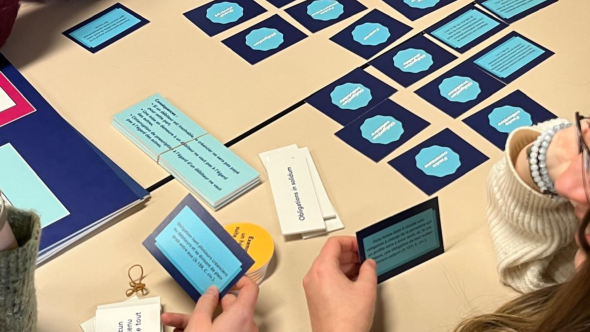
In practice, students explore concepts through engaging activities before applying them in various games and role-playing scenarios. “The sessions are varied and pursue different educational objectives: exploring and applying key concepts, developing argumentation skills, learning to structure responses, and so on,” explains Eva Gillard. This approach also transforms the role of teaching assistants. “We move from group to group, sit down with the students, and guide them through questioning rather than giving them the answers directly. They experiment, compare their ideas, and discuss among themselves and with the teaching assistant in order to gradually build their own reasoning.” 

To support this pedagogical shift, the team received funding from PUNCH (Namur University Pedagogy in Transition). This funding made it possible to design new sessions from scratch, as well as to customize and professionalize the teaching materials. The Faculty of Law now has robust, durable materials that can be reused year after year. 

See photos from a session

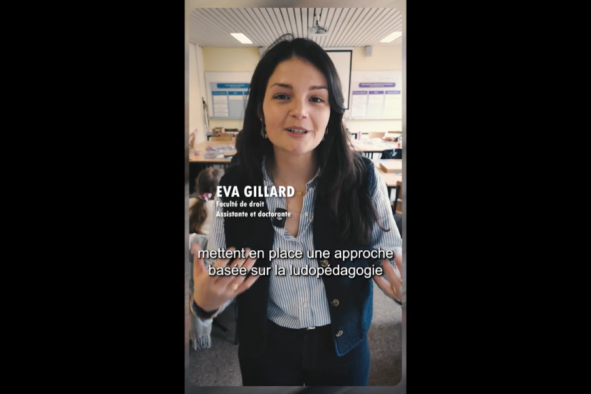
Vidéo ludopédagogie

An escape game to help prepare for the exam

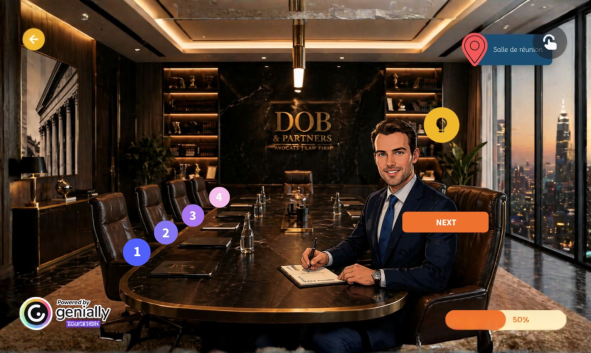
Among this year’s new features is an interactive escape game, designed entirely by the team of teaching assistants to help students prepare for the exam. Built on the Genially platform, it puts participants in the shoes of a trainee lawyer. Divided into groups of three, they receive a paper case file along with a mission: to demonstrate their mastery of the case in order to access the conclusions, which are locked in the firm’s safe.

Escape game G

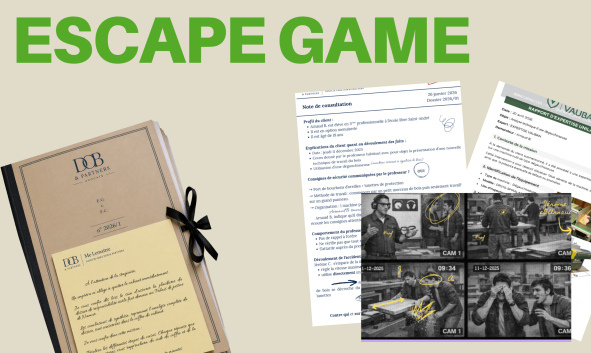
Using fabricated case files (consultation notes, expert reports, surveillance footage), the students analyze the facts before continuing their investigation online. As they progress, they answer a series of questions, solve various puzzles, and gather the clues needed to reconstruct the password that opens the safe. “With this exercise, students cover the entire subject matter through a practical case study similar to the one they’ll encounter on the exam.”

Escape game

The Benefits of This Teaching Approach

The benefits of this teaching method are evident among both students and teaching assistants. “This approach has been bearing fruit for the past three years. Our students are more motivated, more engaged, and develop a deeper level of critical thinking than they do in more traditional exercises,” notes Eva Gillard. 

This positive feedback was confirmed by a survey of students who have benefited from these new teaching methods:

  • The teaching method implemented was the primary factor that increased student participation and engagement during practical sessions.
  • The approach taken by the teaching assistants—who are present within the groups and sit among the students during discussions—is the second factor that has boosted student engagement.
  • The practical sessions received excellent ratings, with an average score of approximately 8.5 out of 10.
  • The board game and the escape room, both created entirely with PUNCH funding, are the students’ favorite sessions.

Student Testimonials

Pauline: “The lab sessions help us develop muscle memory and learn in a much more active way. They let us apply the theory we covered in lectures in a much more fun and engaging way.”

Chiara: “The lab sessions help me learn the material in a more hands-on way. When we go to a lab session, it’s more fun and more practical. We learn to combine certain types of diets that we might not have necessarily thought of during class.”

Foly: “Learning through game-based education is really interesting. We learn while having fun; it’s a change from the usual learning environment—whether in high school or in other subjects we’ve taken before—where classes are really very theoretical. Here, we have fun and discuss things at the same time. I also think it helps us bond.”

Plateau