Image

UDO
Contract law is a flagship discipline within the field of law. Given its scientific, educational, and methodological importance, a Contract Law Unit (UDO) was formally established at UNamur to bring together researchers, academics, and scholars who focus their work on this field and to ensure the consistency of their research.
At the heart of legal education, the law of obligations is one of the fundamental pillars of law. As the true foundation of many branches of law, it provides the concepts and mechanisms upon which contract law, tort law, and business law are all based.
Beyond its theoretical importance, this subject is an excellent training ground for legal reasoning. Through the analysis of fundamental concepts, it helps students develop the rigor, precision, and methodology essential to the practice of law.Its history offers a unique opportunity to understand the evolution of law through the interaction between legislation, case law, and legal doctrine.
The Contract Law Unit is following the various stages of the Civil Code reform with great interest. Several conferences have been organized on Books 5, 6, and 8 of the Civil Code, and three course textbooks have been published by Larcier and Anthemis.
The Unit works closely with the two research centers of the Law School, namely CRIDS and V&S.
Eva Gillard: From the Law of Evidence to the Right to Evidence: The New Role of the Civil Judge.
Margaux Thiry: Medical Liability Law in Light of Patients’ Fundamental Rights.
Sarah Larielle: The Right to Information Following an Injury to Physical and/or Mental Integrity Caused by a Liability-Giving Event.
Charles Devillers: Compensation for Ecological Damage: Breaking New Ground in Belgian Common Law on Non-Contractual Civil Liability.
Virginie Ronneau: Civil Liability and Smart Medical Devices: From a Redefinition of Liabilities to Effective Compensation for Patients.
Josephine Hougardy: The Nature of the Legal Relationship Between the User and the Public Service Provider.
Amani Picci: A balancing act : de-risking in light of the freedom (not) to contract and the freedom to conduct a business.

Authors: Andrea Cataldo, Audrey Pütz, Bérénice Fosséprez,Boris Goffaux, Céline Joisten, Charles Devillers, Emilie Vanstechelman, Eva Gillard, Florence George, Gabriel Maschiet, Margaux Thiry, Mathilde Moulin, Nicolas Schmitz, Olivier Evrard, Pauline Colson, Valéry De Wulf

Authors: Andrea Cataldo, Audrey Pütz, Bérénice Fosséprez, Bertrand De Coninck, Boris Goffaux, Charles Devillers, Coralie Marr, Dominique Mougenot, Emilie Vanstechelman, Florence George, Florence Reusens, Frédéric Lugentz, Grégory Schmit, Isabelle Reusens, Matthieu Dall'Armellina, Mona Giacometti, Nathalie Colette-Basecqz, Sarah Larielle, Simon Hardy, Valéry De Wulf
Publications by members of the Contract Law Unit are available through the University of Namur’s research portal. There you will find all of their scholarly contributions: articles, books, theses, and chapters in edited volumes.
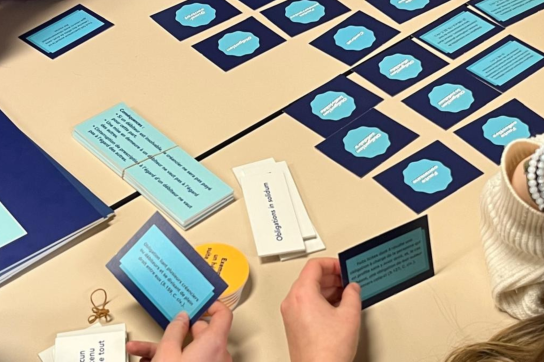
Role-playing games, card games, board games, escape rooms… For several years now, the teaching assistants in the Contract Law unit have been revitalizing their practical sessions through the use of game-based learning. This educational approach transforms classes into spaces for discussion and collaboration, while boosting student motivation and engagement.
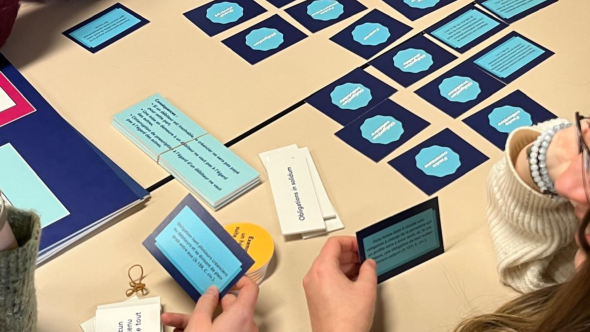
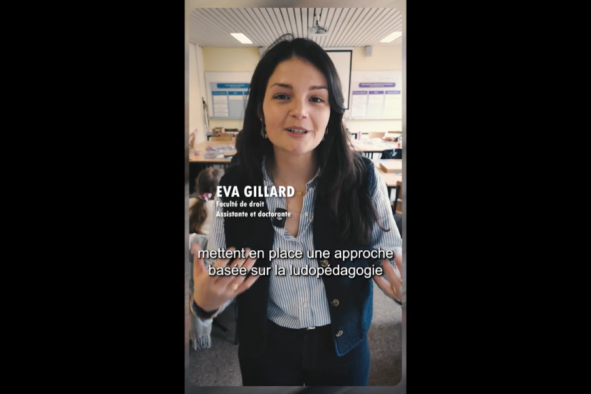
Game-based learning is based on a simple principle: learning through play. Introduced at the School of Law in 2023 by Sarah Larielle, a teaching assistant, this approach has been gradually developed and expanded during the practical sessions of the contract law course. “The goal is twofold: to increase our students’ engagement in class while raising their awareness of certain societal issues, using real-world cases that may resonate with their lives as students,” explains Eva Gillard, a teaching assistant and doctoral student at the Faculty of Law.
In practice, students explore concepts through engaging activities before applying them in various games and role-playing scenarios. “The sessions are varied and pursue different educational objectives: exploring and applying key concepts, developing argumentation skills, learning to structure responses, and so on,” explains Eva Gillard. This approach also transforms the role of teaching assistants. “We move from group to group, sit down with the students, and guide them through questioning rather than giving them the answers directly. They experiment, compare their ideas, and discuss among themselves and with the teaching assistant in order to gradually build their own reasoning.”
To support this pedagogical shift, the team received funding from PUNCH (Namur University Pedagogy in Transition). This funding made it possible to design new sessions from scratch, as well as to customize and professionalize the teaching materials. The Faculty of Law now has robust, durable materials that can be reused year after year.
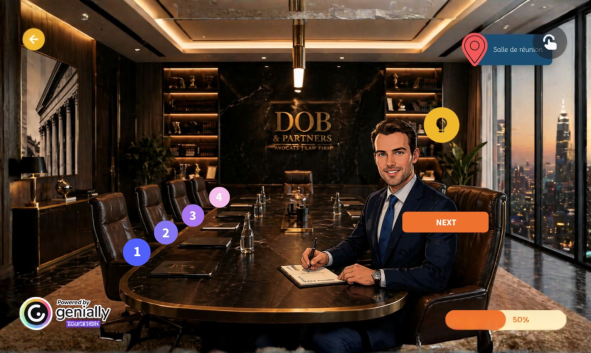
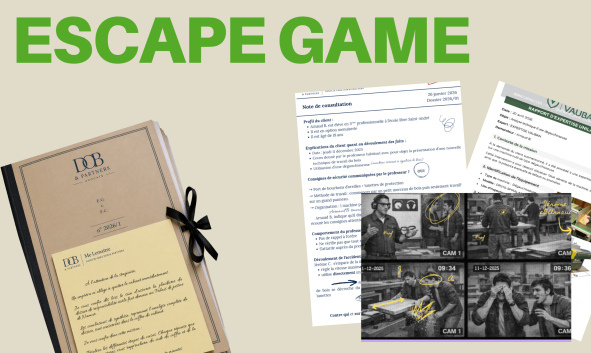
Among this year’s new features is an interactive escape game, designed entirely by the team of teaching assistants to help students prepare for the exam. Built on the Genially platform, it puts participants in the shoes of a trainee lawyer. Divided into groups of three, they receive a paper case file along with a mission: to demonstrate their mastery of the case in order to access the conclusions, which are locked in the firm’s safe.
Using fabricated case files (consultation notes, expert reports, surveillance footage), the students analyze the facts before continuing their investigation online. As they progress, they answer a series of questions, solve various puzzles, and gather the clues needed to reconstruct the password that opens the safe. “With this exercise, students cover the entire subject matter through a practical case study similar to the one they’ll encounter on the exam.”
The benefits of this teaching method are evident among both students and teaching assistants. “This approach has been bearing fruit for the past three years. Our students are more motivated, more engaged, and develop a deeper level of critical thinking than they do in more traditional exercises,” notes Eva Gillard.
This positive feedback was confirmed by a survey of students who have benefited from these new teaching methods:
Pauline: “The lab sessions help us develop muscle memory and learn in a much more active way. They let us apply the theory we covered in lectures in a much more fun and engaging way.”
Chiara: “The lab sessions help me learn the material in a more hands-on way. When we go to a lab session, it’s more fun and more practical. We learn to combine certain types of diets that we might not have necessarily thought of during class.”
Foly: “Learning through game-based education is really interesting. We learn while having fun; it’s a change from the usual learning environment—whether in high school or in other subjects we’ve taken before—where classes are really very theoretical. Here, we have fun and discuss things at the same time. I also think it helps us bond.”
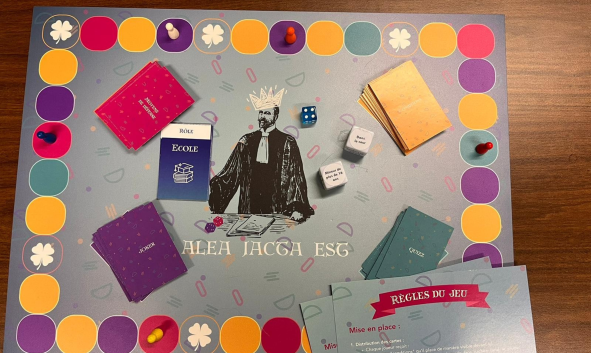
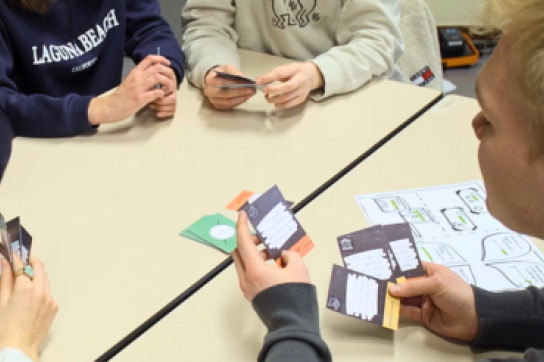
Making students active participants in their own success, getting them more involved and developing their soft skills - these are the challenges that assistants working on practical work in the law of obligations have set themselves. Since last year, they have been rethinking the way they teach by changing their posture with the aim of encouraging student success.
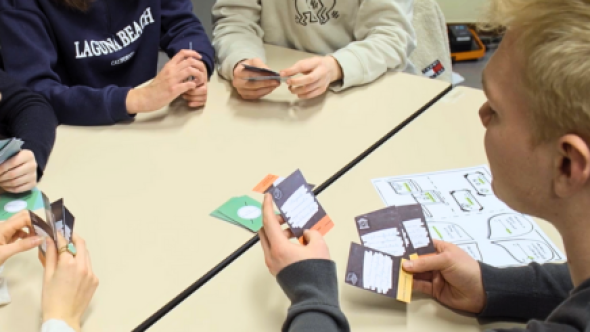
L'équipe d'assistants enseignant les travaux pratiques en droit des obligations s'est donné pour défi de rendre les étudiants davantage acteurs de leur réussite et de développer leurs soft skills. Depuis l'année dernière, ils repensent leur manière d'enseigner en changeant leur approche dans le but de favoriser la réussite des étudiants.
Cassant les codes, ils ont repensé de façon globale la manière d’enseigner. Des changements ont été opérés à de nombreux niveaux. Chaque séance est unique, avec des approches variées pour que chaque étudiant s’y retrouve. Les TP sont construits de façon à ce que, tout en les challengeant, ils parviennent à réaliser les activités proposées. Dès le début des séances, les étudiants ont la possibilité de choisir la thématique sur laquelle portera leur cas. L’objectif de ce choix : favoriser l’implication et la motivation des étudiants en leur offrant la possibilité d’influer sur l’activité.
Les activités proposées sont majoritairement contextualisées de façon à ce que les situations évoquées, basées sur de vrais cas de jurisprudence, soient parlantes pour les étudiants. Cela leur permet de pouvoir s’identifier à des cas réels.
Conscients que leur posture est un des éléments clés pour maintenir l’attention des étudiants, les assistants ont pu s’adapter en fonction : communication positive, questionnement, passage d’un groupe à l’autre pour échanger en s’asseyant avec eux…
La complexité de ce qui est demandé évolue progressivement au fil des séances. L’objectif est que lors du dernier cours, les étudiants soient capables de résoudre le casus proposé dans son entièreté et de pouvoir l’exposer seul à un autre groupe.
Parmi les nombreuses adaptations, on peut encore citer les suivantes : un changement de disposition du local, un travail par groupe, un feedback régulier et constructif, mettre les étudiants en mouvement pour les redynamiser, donner la possibilité aux étudiants d’évaluer le TP en se basant sur leur satisfaction, les méthodes pédagogiques, le contenu et les compétences transversales. Le tout dans une ambiance de travail agréable qui favorise l’apprentissage.
« En changeant notre manière d’enseigner, nous prenons en compte les différents profils et les formes d’intelligences de nos étudiants. Les plus visuels apprécieront les supports colorés et attrayants tandis que d’autres auront besoin de manipuler les cartes pour mieux s’en souvenir. Nous favorisons aussi les échanges entre eux. Expliquer la matière à leurs camarades permet de mieux intégrer la théorie, explique Sarah Larielle, et cela fait la différence ! »
Si certains étudiants ont pu se montrer déconcertés lors de la première séance de TP, ils ont finalement compris que cette manière d’enseigner leur permettait d’intégrer plus facilement les concepts théoriques, de manipuler la matière, voire même de trouver du sens à leurs études. « Ce qui est bien c’est d’aborder la matière d’une autre façon, c’est moins lourd qu’en cours. Le fait qu’on soit en groupe c’est plus rare à l’université. Ça permet vraiment de s’imprégner et d’être captivé par la matière. Personnellement ça me donne vraiment envie de participer » témoigne Louise, étudiante. Cela leur donne aussi une idée concrète de l’utilité du droit. Leurs retours sont encourageants, ainsi qu’en atteste leur présence aux TP et leurs évaluations.