This PUNCh project, led by Hélène Givron, associate professor and educational coordinator in the Department of Psychology at the University of Namur, is designed to address educational needs in interprofessional training. The goal was to develop a fun, flexible tool that could be adapted for use in various contexts, in order to address a significant challenge in the field. 

The main objective of this workshop was to strengthen interprofessional communication and collaboration in the healthcare field. A multidisciplinary team was therefore formed, composed of representatives from various sectors: Catherine Magnette (Instructor, Department of Medicine), Romain Siriez (Educational Coordinator, Department of Pharmacy), and Laura Demarthe (Assistant, Department of Psychology), to bring together students from the Master’s in General Practice and the Master’s in Pharmaceutical Sciences at UNamur, as well as the Master’s in Nursing (Hénallux), to address these issues.

An immersive game experience designed to explore collaboration in a hospital setting

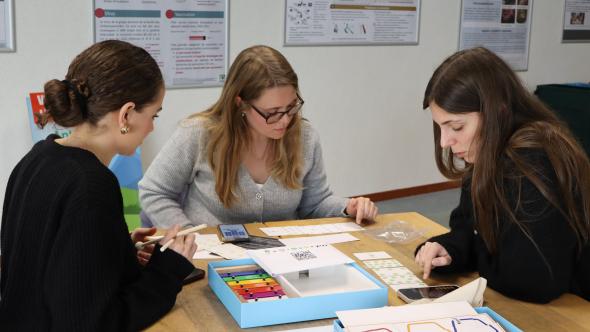
The workshop was based on the board game “Eugène’s Journey,” designed by Christine Laurent (a public health physician and educational game designer) and inspired by the concept of an escape room, with the aim of providing students with an immersive and collaborative experience. Participants were divided into teams of three to four players, consisting of a physician, a nurse, and one or two pharmacists, to encourage interprofessional collaboration. Each team had to progress through a scenario by solving a series of puzzles within 45 minutes, under the watchful eye of instructors. To succeed, students had to collaborate and rely on verbal communication to exchange ideas, share information, and coordinate their actions

Jeu de plateau

This educational tool draws on various skills essential to teamwork, such as active listening, the ability to clearly articulate ideas, task coordination, and collective decision-making. Each puzzle presented a challenge that required genuine cooperation among group members, as no solution could be found by working alone. 

A structured debriefing to turn experience into learning

Following the game phase, a debriefing session was held with all participants. This discussion aimed to reflect on the experience gained during the workshop and to encourage students to think about the concepts of collaboration and interprofessional communication in the healthcare context. The game served as a tool to illustrate certain cooperative scenarios, but also to highlight challenges related to coordination and information sharing. The debriefing thus facilitated a dialogue among students from different programs regarding the barriers and enablers of effective communication. Participants had the opportunity to share their feelings, compare their perspectives, and discuss strategies to promote better collaboration among healthcare professionals. 

The educational objectives of the workshop were clearly defined:

  • Address the skills necessary for interprofessional collaboration, such as communication and collective decision-making.
  • Identify the drivers and barriers to interprofessional collaboration.
  • Contribute to improving the quality and safety of care through better coordination among professionals.

In just 1 hour and 45 minutes, it is probably unrealistic to expect to see an improvement in students’ skills. However, we hope that they will gain a better understanding of interprofessional communication. We are trying to plant the seeds for their future collaborative practices. 

Hélène Givron Lecturer and Academic Coordinator

Student Testimonials

I hope this experience will lead to a change in practice. The game gives you the tools to assert yourself, especially as a young doctor when you have to integrate into teams with more experienced colleagues. It helps you stand your ground and build self-confidence.” — Yorick, medical student 

Based on the information we received, we expected an activity with exclusively ‘medical’ content. This unique experience takes us beyond the scope of typical role-playing scenarios.” - Margaux, medical student 

I found this workshop to be very useful; it adds value and is very interesting. We never have simulations focused on collaboration. It would be interesting to incorporate this into the curriculum.” – Nursing student

A versatile tool

The game “Eugène’s Journey” was designed by Dr. Christine Laurent, a public health physician and educational game designer, in collaboration with Emeline Boreux, a graphic designer and illustrator. “The game’s development spanned a year and a half, allowing time to create a structure robust enough to accommodate a variety of puzzles and multiple educational objectives. Its versatility lies in the ability to modify the central puzzle, adapt the clues, and tailor the debriefing to different skills depending on the audience. This tool can indeed be adapted to other disciplines, such as project management or engineering, for example,” explains Christine Laurent, the game’s designer.

Jeu Le Voyage d'Eugène

Interactivity at the heart of the general practice curriculum

This experience is part of a series of immersive sessions offered to students in the Master’s program in General Practice at UNamur. “Students spend most of their time on clinical rotations during their master’s program. However, they also have several more academic-focused days during which we strive to develop interactive activities, explains Catherine Magnette, lecturer and general practitioner. The upcoming workshops will therefore focus on interprofessional collaboration in the event of an outbreak in nursing homes and on collaboration with medical consultants and occupational physicians.

Etudiants autour d'un jeu de plateau