Transformative Service Research: Research That Serves People

Transformative Service Research (TSR) examines the transformative power of services in the lives of individuals, communities, and society. It focuses on how service systems—whether public, health, educational, digital, or technological—can serve as drivers of well-being, inclusion, and social justice. Moving beyond a vision focused solely on organizational performance, TSR places fundamental issues such as equity, access, dignity, the reduction of vulnerabilities, and the creation of positive societal impact at the heart of its analysis. It thus invites us to rethink services not only as spaces for exchange, but as instruments of transformation for a more just, inclusive, and humane society.

Research on corruption in public services, and a career marked by a commitment to social causes

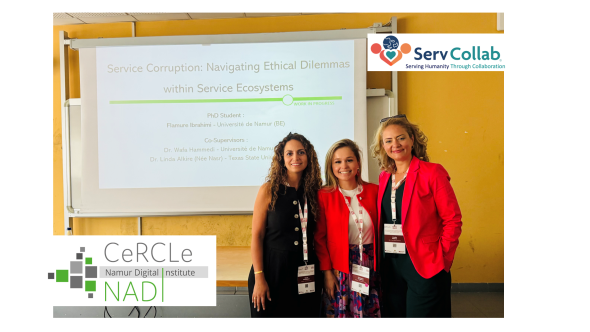
Flamure Ibrahimi’s research is rooted in this transformative perspective and focuses on corruption in service interactions involving frontline employees or service providers, particularly its implications for vulnerable and disadvantaged populations. Shaped by her personal journey as the daughter of refugees who did everything they could to rebuild their lives in a new country with limited resources, Flamure became aware at a very early age of the essential role that service systems play in access to rights, recognition, dignity, and well-being. This experience inspired her interest in the ethical and societal dimensions of service systems.

Her doctoral thesis examines corruption beyond its legal, structural, or normative aspects, focusing instead on the phenomenon from a more interactional, process-oriented, ethical, and behavioral perspective.  Her current research, in collaboration with Prof. Dr. Wafa Hammedi (University of Namur), Prof. Dr. Linda Alkire (Texas State University), and Prof. Dr. Gazi Islam (Grenoble Ecole de Management), further explores this perspective.  In the context of frontline service interactions, corruption can impair access to essential resources and undermine mechanisms of equity and trust. While these effects affect all users, they are particularly pronounced for people in vulnerable situations or from underserved populations, for whom access to services is often a decisive factor in their life trajectories.

Image
Flamure Ibrahimi

“Receiving this grant means much more than academic recognition. It is a profound encouragement to continue research aimed at understanding and improving concrete realities—realities that are sometimes invisible but essential to people’s lives. As a new mother, this endeavor takes on even greater significance: it strengthens my commitment to contributing, in my own way, to service systems that are more equitable, more humane, and more just—not only for current generations, but also for those to come.”

Flamure Ibrahimi Ph.D. student at NaDI-CeRCLe, UNamur

ServCollab: An international initiative to serve humanity

ServCollab is an international nonprofit organization at the forefront of global research in Service Research. Founded under the leadership of Prof. Dr. Raymond P. Fisk, a leading pioneer in the field, the organization draws on a network of top academic experts to translate scientific theory into drivers of societal impact. Transformative Service Research (TSR) is based on the idea that individuals operate within service systems that shape their access to resources and their well-being. When these systems malfunction, they can lead to inequality and suffering. The ServCollab Fellowship is awarded following a selection process by a jury composed of eminent researchers in this field, and supports doctoral students whose research aligns with this perspective and contributes to the betterment of humanity.