
Master in Physics
-
Schedule
regular course
- ECTS Credits 120
You are viewing the program for
Master's Degree (120 credits) in Physical Sciences, Specialized Track |
Matter, Energy, and the Environment
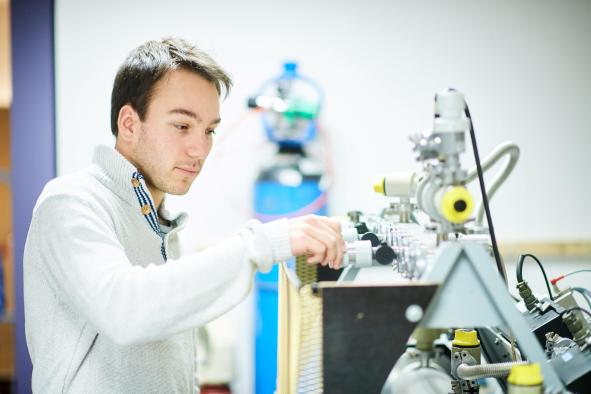
Numerous discoveries made by physicists have profoundly transformed our modern daily lives: semiconductors, lasers, plasma and QLED displays, hard drives… There is no shortage of challenges: the use of renewable energy, energy storage, waste management… To meet these challenges, society needs physicists who are experts in the properties of matter and its interaction with radiation.
Your goals
- Gain a deep understanding
of the world Develop a solid understanding of the fundamental physical phenomena that govern matter, energy, light, and waves, in order to better grasp major scientific and societal challenges. - Analyzing and solving complex problems
Developing critical thinking, analytical, and modeling skills, and learning to use experimental and digital tools to study real-world situations, particularly those related to the environment and climate. - Contribute to a more sustainable and enlightened society
Apply physics to address current challenges, such as the energy transition, environmental protection, and understanding the impacts of human activities, by linking science, responsibility, and innovation…
The benefits of the training program
- Critical Thinking and Adaptability
The program develops a thorough and rigorous approach to critical and analytical thinking, equipping you with the tools needed to learn and adapt quickly to a variety of professional contexts, building on the knowledge gained in your bachelor’s degree. - Project Management and Research
The master’s program emphasizes project management and an introduction to research, offering you a professional experience centered on current research topics. - Versatility and Career Opportunities
The program covers the major fields of physics—optics and lasers, new materials, atmospheric and space physics, ionizing radiation, biophysics, and data science—and equips you with solid skills that open the door to a wide range of career opportunities upon completion of the master’s degree. - Field immersion and international outlook
Your internship, in Belgium or abroad, broadens your perspective on society and enriches your training as a physicist through meaningful scientific and personal encounters and experiences. An Erasmus exchange or visits to internationally renowned laboratories are also strongly encouraged. - Responsibility and ethics
The program develops your ethical awareness by emphasizing the responsibility of physicists in building a fairer, more sustainable, and more environmentally friendly world.
Research and the thesis
The master’s program includes an introduction to scientific research, both fundamental and applied. Students learn to explore and understand complex physical phenomena, and then to apply this knowledge to real-world societal challenges.
The thesis is a personal capstone project that allows students to conduct an in-depth analysis of a scientific topic—often related to the environment, energy, or climate—and to develop independence, rigor, and critical thinking skills.
Other master's programs in physics
The University of Namur offers:
- the 120-credit Master's program in Physical Sciences
- the 60-credit Master's in Physical Sciences
And after the master's degree
You want to empower young people to learn and collaborate, guide them, help them become agents of change?
Discover how to become a teacher in upper secondary (secondary 4-6) after your master's degree.
Contacts
Faculty of Science
2 Rue Grafé • B-5000 Namur
Department of Physics
Tel.: +32 (0) 81 72 54 44 • +32 (0) 81 72 45 32 • +32 (0) 81 72 45 32
secretariat.physique@unamur.be
You are viewing the program for
Master's degree (120 credits) in Physical Sciences, with a specialization in Physics and Data |
Physics and data
Data is an integral part of a physicist’s daily work. Whether derived from measurements or simulations, and whether available in vast quantities or in small amounts, this data requires the application of appropriate methods to provide scientists with as much useful information as possible.
This program aims to complement physicists’ excellent foundational training in modeling and numerical methods by equipping them with the skills to develop specialized tools for data processing, visualization, and interpretation.
Your goals
- Acquire skills in data analysis, processing, and visualization;
- Be able to meet the needs of research laboratories and industry regarding the handling of scientific data;
- Develop innovative solutions at the intersection of artificial intelligence and physics.
The benefits of the training program
- Critical Thinking and Adaptability
The program develops a thorough and rigorous approach to critical and analytical thinking, equipping you with the tools needed to learn and adapt quickly to a variety of professional contexts, building on the knowledge gained in your bachelor’s degree. - Project Management and Research
The master’s program emphasizes project management and an introduction to research, offering you a professional experience centered on current research topics. - Versatility and Career Opportunities
The program covers the major fields of physics—optics and lasers, new materials, atmospheric and space physics, ionizing radiation, biophysics, and data science—and equips you with solid skills that open the door to a wide range of career opportunities upon completion of the master’s degree. - Field immersion and international outlook
Your internship, in Belgium or abroad, broadens your perspective on society and enriches your training as a physicist through meaningful scientific and personal encounters and experiences. An Erasmus exchange or visits to internationally renowned laboratories are also strongly encouraged. - Responsibility and ethics
The program develops your ethical awareness by emphasizing the responsibility of physicists in building a fairer, more sustainable, and more environmentally friendly world.
Research and the thesis
Research in physics and data science encompasses, among other things, the development of algorithms for the analysis and interpretation of spectroscopic data, the optimization of new materials based on numerical simulations and/or experimental data, and the analysis of electron microscopy images... For example, light extraction from LEDs has been optimized using genetic algorithms.
By classifying abstract data, machine learning enables intelligent decision-making based on the automatic analysis of this data. It also makes it possible to propose novel materials based on the properties of existing solids.
Other master's programs in physics
The University of Namur offers:
- the 120-credit Master's program in Physical Sciences
- the 60-credit Master's in Physical Sciences
And after the master's degree
You want to empower young people to learn and collaborate, guide them, help them become agents of change?
Discover how to become a teacher in upper secondary (secondary 4-6) after your master's degree.
Contacts
Faculty of Science
2 Rue Grafé • B-5000 Namur
Department of Physics
Tel.: +32 (0) 81 72 54 44 • +32 (0) 81 72 45 32 • +32 (0) 81 72 45 32
secretariat.physique@unamur.be
You are viewing the program for
Master's degree (120 credits) in Physical Sciences, with a specialization in Biophysics |
Biophysics
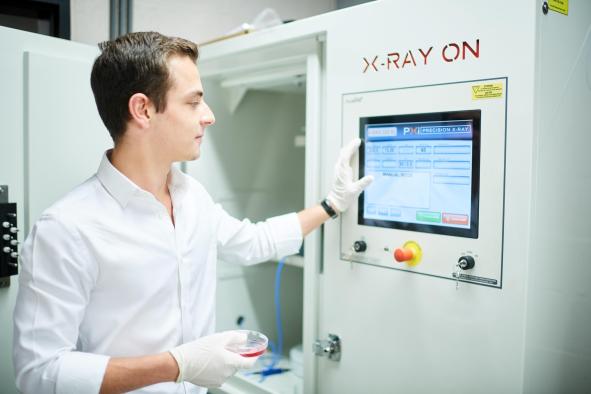
Physics plays a key role in understanding living matter, studying the effects of radiation on organisms, and improving medical imaging and treatments.
By analyzing interactions between molecules, tissues, and materials, physicists help explain the efficacy or side effects of drugs and design implants and biomaterials that are safer and more compatible with the human body.
The study of interactions between radiation and living matter—whether natural, environmental, or used in radiation therapy—enables the identification of damage mechanisms, the development of radiation protection strategies, and the creation of more targeted cancer treatments better tailored to each patient.
Biophysics thus sheds light on essential questions for health, personalized medicine, and the protection of people exposed to radiation.
Your goals
- Gain a thorough understanding of the interactions between radiation and biological matter;
- Master the scientific approach to investigating the physical properties of biological models and living matter;
- Analyze the properties of model systems to better understand biophysical processes and biological functions;
- Apply your skills to preclinical studies;
- Participate in interdisciplinary, fundamental, and applied research;
- Apply new knowledge in interdisciplinary practical work.
The benefits of the training program
- Critical Thinking and Adaptability
The program develops a thorough and rigorous approach to critical and analytical thinking, equipping you with the tools needed to learn and adapt quickly to a variety of professional contexts, building on the knowledge gained in your bachelor’s degree. - Project Management and Research
The master’s program emphasizes project management and an introduction to research, offering you a professional experience centered on current research topics. - Versatility and Career Opportunities
The program covers the major fields of physics—optics and lasers, new materials, atmospheric and space physics, ionizing radiation, biophysics, and data science—and equips you with solid skills that open the door to a wide range of career opportunities upon completion of the master’s degree. - Field immersion and international outlook
Your internship, in Belgium or abroad, broadens your perspective on society and enriches your training as a physicist through meaningful scientific and personal encounters and experiences. An Erasmus exchange or visits to internationally renowned laboratories are also strongly encouraged. - Responsibility and ethics
The program develops your ethical awareness by emphasizing the responsibility of physicists in building a fairer, more sustainable, and more environmentally friendly world.
Research and the thesis
Research in biophysics encompasses many areas: numerical modeling of biological systems, studying the interaction of biological models with drugs and nanomaterials, investigating the efficacy of various adjuvants in hadron therapy, and examining the response of microorganisms exposed to extreme doses of radiation…
Here are three examples of thesis topics chosen by students: the study of the role of the cell membrane in the action of anesthesia, the study of reactive oxygen species produced during the irradiation of cancer cells, and the optimization of biocompatible coatings for dental implants.
Other master's programs in physics
The University of Namur offers:
- the 120-credit Master's program in Physical Sciences
- the 60-credit Master's in Physical Sciences
And after the master's degree
You want to empower young people to learn and collaborate, guide them, help them become agents of change?
Discover how to become a teacher in upper secondary (secondary 4-6) after your master's degree.
Contacts
Faculty of Science
2 Rue Grafé • B-5000 Namur
Department of Physics
Tel.: +32 (0) 81 72 54 44 • +32 (0) 81 72 45 32 • +32 (0) 81 72 45 32
secretariat.physique@unamur.be
Vous consultez le programme de
Master 120 en sciences phsiques, à finalité didactique |
Point of attention |
This training program is suspended. Only current students (enrolled in 2024-2025) will be able to re-enroll and complete their course.
|
Other master's degrees in physics
The University of Namur offers:
- the 120-credit Master's program in Physical Sciences
- the 60-credit Master's in Physical Sciences
Contacts
Faculty of Science
2 Rue Grafé • B-5000 Namur
Department of Physics
Tel.: +32 (0) 81 72 54 44 • +32 (0) 81 72 45 32 • +32 (0) 81 72 45 32
secretariat.physique@unamur.be
-
Mandatory UE
Code Name Staff Th.+Ex. Credits/Block 1 2 SPHYM101 Radiation-matter interaction Lucas Stéphane Colaux Julien 30h th. + 30h ex. 6 SPHYM109 Laser physics, non-linear and quantum optics Lepere Muriel Caudano Yves 45h th. + 15h ex. 6 Sustainable developmentImage
SSPSM101 Science, ethics and development Tilman Valérie Leyens Stéphane 18h th. + 6h ex. 3 English Friendly CoursesImage
SPHYM106 Nanomaterials ans applications of solid state physics Sporken Robert Henrard Luc 45h th. + 15h ex. 6 SPHYM136 Data acquisition and digital processing Deparis Olivier 30h th. + 15h ex. 4 English Friendly CoursesImage
SPHYM138 Scientific communication Lobet Michaël 15h th. 2 SSPSM202 Philosophy of material sciences Sartenaer Olivier 12h th. 3 Sustainable developmentImage
English Friendly CoursesImage
SCHIM223_Physique Science and Energy Su Bao Lian Olivier Yoann 18h th. 3 -
Languages
Code Name Staff Th.+Ex. Credits/Block 1 2 SCDLM202_Partim Refresher course in Dutch (level B1) Tréfois Cindy 30h th. 3 Soft skillsImage
SCDLM201_Physique Advanced English (Level B2+) Zimmer Carole 30h th. 3 -
In-depth purpose
Code Name Staff Th.+Ex. Credits/Block 1 2 SPHYM222 Synthesis of materials Caporaletti Federico Sporken Robert Caporaletti Federico Haye Emile 30h th. 3 SPHYM226 Surface and interface characterisation techniques Colaux Julien Houssiau Laurent 30h th. 3 SPHYM133 Theoretical and digital photonics Lobet Michaël 30h th. + 15h ex. 3 English Friendly CoursesImage
SPHYM134 Plasmonics and applications Henrard Luc 15h th. + 15h ex. 3 SPHYM216 Molecular physics and the environment Lepere Muriel 30h th. 3 SPHYM233 Internship Cecchet Francesca Pignolet Jeanick 15 -
Project
Code Name Staff Th.+Ex. Credits/Block 1 2 English Friendly CoursesImage
SPHYM122 Supervised work: Research project Sporken Robert Fuzfa André Houssiau Laurent Henrard Luc HEUSKIN Anne-Catherine Olivier Yoann MAYER Alexandre Lobet Michaël Louette Pierre Lepere Muriel Deparis Olivier Colaux Julien Lucas Stéphane Cecchet Francesca Colomer Jean-François Dias De Carvalho Junior Gabriel 45h th. + 45h ex. 9 -
Dissertation
Code Name Staff Th.+Ex. Credits/Block 1 2 SPHYM205 Supervised master thesis Sporken Robert Lepere Muriel Fuzfa André Houssiau Laurent Lucas Stéphane Olivier Yoann Dias De Carvalho Junior Gabriel Lobet Michaël Colomer Jean-François Louette Pierre Deparis Olivier Colaux Julien Henrard Luc MAYER Alexandre Cecchet Francesca HEUSKIN Anne-Catherine 105h th. + 105h ex. 21 -
Choice of UE
Code Name Staff Th.+Ex. Credits/Block 1 2 SBIOB232_Physique System Histology Renard Patricia 15h th. 2 2 Sustainable developmentImage
SGOGB314_Physique Physical Partim : Climatology Houssiau Laurent 30h th. 3 3 Sustainable developmentImage
SGOLB313_Masters Geophysics Louette Pierre Collinet Max 15h th. + 15h ex. 3 3 English Friendly CoursesImage
SMATB304_Masters Optimization Sartenaer Annick 30h th. + 22.5h ex. 5 5 Cyclic course organized this yearImage
SPHYM112 Electron microscopy Colomer Jean-François 22h th. + 8h ex. 3 3 Cyclic course organized this yearImage
SPHYM119 Nuclear Astrophysics Colaux Julien 15h th. + 15h ex. 3 3 Cyclic course organized this yearImage
SPHYM123 Numerical Methods for Physics Problems MAYER Alexandre 15h th. + 15h ex. 3 3 Cyclic course organized this yearImage
SPHYM124 Experimental optics of surfaces and nanostructures Cecchet Francesca Cecchet Francesca 22h th. 3 3 Cyclic course organized this yearImage
SPHYM126 Programming Methods for High-Performance Computing MAYER Alexandre 15h th. + 15h ex. 3 3 Cyclic course not organized this yearImage
SPHYM127 Sounding and physics of the atmosphere Lepere Muriel 22h th. + 8h ex. 3 3 Cyclic course not organized this yearImage
SPHYM128 Introduction to medical imaging 22h th. + 8h ex. 3 3 Cyclic course organized this yearImage
SPHYM135 Quantum theory of information and measurement Caudano Yves 22h th. 3 3 English Friendly CoursesImage
Cyclic course organized this yearImage
SPHYM137 Simulation of dose deposition on biological targets HEUSKIN Anne-Catherine 15h th. + 15h ex. 3 3 English Friendly CoursesImage
SPHYM145 Physics of the Two Infinities: Foundations of General Relativity Fuzfa André 15h th. + 15h ex. 3 3 English Friendly CoursesImage
SPHYM146 Physics of the Two Infinities: Relativistic Astrodynamics and Cosmology Fuzfa André 15h th. + 15h ex. 3 3 Service learningImage Cyclic course organized this yearImage
SPHYM150 Physics practice and commitment Houssiau Laurent Dias De Carvalho Junior Gabriel Lobet Michaël 12h th. 3 3 Cyclic course organized this yearImage
SPHYM215 Spectral profiles Lepere Muriel 22h th. + 8h ex. 3 3 English Friendly CoursesImage
Cyclic course not organized this yearImage
SPHYM228 simulations in material physics Henrard Luc 15h th. + 15h ex. 3 3 Cyclic course not organized this yearImage
SPHYM231 Fundamental interactions 30h th. 3 3 SBIOM122 Cancer : from molecular to clinical aspects Michiels Carine 18h th. 3 3 SBIOM134 Protein Structure and Function Wouters Johan De Bolle Xavier 18h th. 3 3 SCHIM102 Advanced Theoretical Chemistry Olivier Yoann Champagne Benoît Nascimento Ramos Tárcius 36h th. + 24h ex. 6 6 SCHIM234 Magnetic properties and spin-dependent processes in nanomaterials Olivier Yoann Olivier Yoann 18h th. 4 4 SDASM101 Graph mining De Bodt Cyril 20h th. + 20h ex. 5 5 English Friendly CoursesImage
SMATM103 Numerical linear algebra: direct and iterative methods Sartenaer Annick 30h th. + 30h ex. 5 5 English Friendly CoursesImage
SMATM225 Chaos and determinism Libert Anne-Sophie Ramirez Avila Gonzalo Marcelo Ramirez Avila Gonzalo Marcelo Libert Anne-Sophie 30h th. + 30h ex. 5 5 Soft skillsImage
UNAM0049 Science for all : Introduction to popular science Schutz Natassia Hansel Aude 24h th. 3 3 UNAM0048 Artificial intelligence: challenges and opportunities Frenay Benoît 24h th. 3 3 SPHYM100 9 9 EMSGM235 Project management Georgin Thibaut Hogge Louis 20h th. 3 3
-
Mandatory UE
Code Name Staff Credits Hours/Quarter 1 2 SPHYM101 Radiation-matter interaction Lucas Stéphane Colaux Julien 6 30h th. + 30h ex. SPHYM109 Laser physics, non-linear and quantum optics Lepere Muriel Caudano Yves 6 45h th. + 15h ex. Sustainable developmentImage
SSPSM101 Science, ethics and development Tilman Valérie Leyens Stéphane 3 18h th. + 6h ex. English Friendly CoursesImage
SPHYM106 Nanomaterials ans applications of solid state physics Sporken Robert Henrard Luc 6 45h th. + 15h ex. SPHYM136 Data acquisition and digital processing Deparis Olivier 4 30h th. + 15h ex. English Friendly CoursesImage
SPHYM138 Scientific communication Lobet Michaël 2 15h th. -
In-depth purpose
Code Name Staff Credits Hours/Quarter 1 2 SPHYM222 Synthesis of materials Caporaletti Federico Sporken Robert Caporaletti Federico Haye Emile 3 30h th. SPHYM226 Surface and interface characterisation techniques Colaux Julien Houssiau Laurent 3 30h th. SPHYM133 Theoretical and digital photonics Lobet Michaël 3 30h th. + 15h ex. English Friendly CoursesImage
SPHYM134 Plasmonics and applications Henrard Luc 3 15h th. + 15h ex. SPHYM216 Molecular physics and the environment Lepere Muriel 3 30h th. -
Project
Code Name Staff Credits Hours/Quarter 1 2 English Friendly CoursesImage
SPHYM122 Supervised work: Research project Sporken Robert Fuzfa André Houssiau Laurent Henrard Luc HEUSKIN Anne-Catherine Olivier Yoann MAYER Alexandre Lobet Michaël Louette Pierre Lepere Muriel Deparis Olivier Colaux Julien Lucas Stéphane Cecchet Francesca Colomer Jean-François Dias De Carvalho Junior Gabriel 9 45h th. + 45h ex. -
Choice of UE
-
Mandatory UE
Code Name Staff Credits Hours/Quarter 1 2 SSPSM202 Philosophy of material sciences Sartenaer Olivier 3 12h th. Sustainable developmentImage
English Friendly CoursesImage
SCHIM223_Physique Science and Energy Su Bao Lian Olivier Yoann 3 18h th. -
Languages
Code Name Staff Credits Hours/Quarter 1 2 SCDLM202_Partim Refresher course in Dutch (level B1) Tréfois Cindy 3 30h th. Soft skillsImage
SCDLM201_Physique Advanced English (Level B2+) Zimmer Carole 3 30h th. -
In-depth purpose
Code Name Staff Credits Hours/Quarter 1 2 SPHYM233 Internship Cecchet Francesca Pignolet Jeanick 15 -
Dissertation
Code Name Staff Credits Hours/Quarter 1 2 SPHYM205 Supervised master thesis Sporken Robert Lepere Muriel Fuzfa André Houssiau Laurent Lucas Stéphane Olivier Yoann Dias De Carvalho Junior Gabriel Lobet Michaël Colomer Jean-François Louette Pierre Deparis Olivier Colaux Julien Henrard Luc MAYER Alexandre Cecchet Francesca HEUSKIN Anne-Catherine 21 105h th. + 105h ex. -
Choice of UE
-
Compulsory courses
Code Name Staff Th.+Ex. Credits/Block 1 2 SPHYM101 Radiation-matter interaction Lucas Stéphane Colaux Julien 30h th. + 30h ex. 6 SPHYM109 Laser physics, non-linear and quantum optics Lepere Muriel Caudano Yves 45h th. + 15h ex. 6 Sustainable developmentImage
SSPSM101 Science, ethics and development Tilman Valérie Leyens Stéphane 18h th. + 6h ex. 3 English Friendly CoursesImage
SPHYM106 Nanomaterials ans applications of solid state physics Sporken Robert Henrard Luc 45h th. + 15h ex. 6 SPHYM136 Data acquisition and digital processing Deparis Olivier 30h th. + 15h ex. 4 English Friendly CoursesImage
SPHYM138 Scientific communication Lobet Michaël 15h th. 2 SSPSM202 Philosophy of material sciences Sartenaer Olivier 12h th. 3 Sustainable developmentImage
English Friendly CoursesImage
SCHIM223_Physique Science and Energy Su Bao Lian Olivier Yoann 18h th. 3 -
Languages
Code Name Staff Th.+Ex. Credits/Block 1 2 SCDLM202_Partim Refresher course in Dutch (level B1) Tréfois Cindy 30h th. 3 Soft skillsImage
SCDLM201_Physique Advanced English (Level B2+) Zimmer Carole 30h th. 3 -
Specialized courses
Code Name Staff Th.+Ex. Credits/Block 1 2 Soft skillsImage
English Friendly CoursesImage
IDASM103 Visualisation of information Lahmar Hiba Dumas Bruno Dumas Bruno 30h th. + 15h ex. 4 English Friendly CoursesImage
IDASM102 Machine learning and data mining Frenay Benoît 30h th. + 15h ex. 6 SPHYM152 Programming for data science Mairesse Richard 10h th. + 10h ex. 2 SPHYM151 Deep Learning in Physics MAYER Alexandre 15h th. + 10h ex. 3 SPHYM253 Internship Cecchet Francesca Pignolet Jeanick 15 -
Project
Code Name Staff Th.+Ex. Credits/Block 1 2 English Friendly CoursesImage
SPHYM122 Supervised work: Research project Sporken Robert Fuzfa André Houssiau Laurent Henrard Luc HEUSKIN Anne-Catherine Olivier Yoann MAYER Alexandre Lobet Michaël Louette Pierre Lepere Muriel Deparis Olivier Colaux Julien Lucas Stéphane Cecchet Francesca Colomer Jean-François Dias De Carvalho Junior Gabriel 45h th. + 45h ex. 9 -
Dissertation
Code Name Staff Th.+Ex. Credits/Block 1 2 SPHYM205 Supervised master thesis Sporken Robert Lepere Muriel Fuzfa André Houssiau Laurent Lucas Stéphane Olivier Yoann Dias De Carvalho Junior Gabriel Lobet Michaël Colomer Jean-François Louette Pierre Deparis Olivier Colaux Julien Henrard Luc MAYER Alexandre Cecchet Francesca HEUSKIN Anne-Catherine 105h th. + 105h ex. 21 -
Choice of courses
Code Name Staff Th.+Ex. Credits/Block 1 2 SBIOB232_Physique System Histology Renard Patricia 15h th. 2 2 Sustainable developmentImage
SGOGB314_Physique Physical Partim : Climatology Houssiau Laurent 30h th. 3 3 Sustainable developmentImage
SGOLB313_Masters Geophysics Louette Pierre Collinet Max 15h th. + 15h ex. 3 3 English Friendly CoursesImage
SMATB304_Masters Optimization Sartenaer Annick 30h th. + 22.5h ex. 5 5 Cyclic course organized this yearImage
SPHYM112 Electron microscopy Colomer Jean-François 22h th. + 8h ex. 3 3 Cyclic course organized this yearImage
SPHYM119 Nuclear Astrophysics Colaux Julien 15h th. + 15h ex. 3 3 Cyclic course organized this yearImage
SPHYM123 Numerical Methods for Physics Problems MAYER Alexandre 15h th. + 15h ex. 3 3 Cyclic course organized this yearImage
SPHYM124 Experimental optics of surfaces and nanostructures Cecchet Francesca Cecchet Francesca 22h th. 3 3 Cyclic course organized this yearImage
SPHYM126 Programming Methods for High-Performance Computing MAYER Alexandre 15h th. + 15h ex. 3 3 Cyclic course not organized this yearImage
SPHYM127 Sounding and physics of the atmosphere Lepere Muriel 22h th. + 8h ex. 3 3 Cyclic course not organized this yearImage
SPHYM128 Introduction to medical imaging 22h th. + 8h ex. 3 3 Cyclic course organized this yearImage
SPHYM135 Quantum theory of information and measurement Caudano Yves 22h th. 3 3 English Friendly CoursesImage
Cyclic course organized this yearImage
SPHYM137 Simulation of dose deposition on biological targets HEUSKIN Anne-Catherine 15h th. + 15h ex. 3 3 English Friendly CoursesImage
SPHYM145 Physics of the Two Infinities: Foundations of General Relativity Fuzfa André 15h th. + 15h ex. 3 3 English Friendly CoursesImage
SPHYM146 Physics of the Two Infinities: Relativistic Astrodynamics and Cosmology Fuzfa André 15h th. + 15h ex. 3 3 Service learningImage
Cyclic course organized this yearImage
SPHYM150 Physics practice and commitment Houssiau Laurent Dias De Carvalho Junior Gabriel Lobet Michaël 12h th. 3 3 Cyclic course organized this yearImage
SPHYM215 Spectral profiles Lepere Muriel 22h th. + 8h ex. 3 3 English Friendly CoursesImage
Cyclic course not organized this yearImage
SPHYM228 simulations in material physics Henrard Luc 15h th. + 15h ex. 3 3 Cyclic course not organized this yearImage
SPHYM231 Fundamental interactions 30h th. 3 3 SBIOM122 Cancer : from molecular to clinical aspects Michiels Carine 18h th. 3 3 SBIOM134 Protein Structure and Function Wouters Johan De Bolle Xavier 18h th. 3 3 SCHIM102 Advanced Theoretical Chemistry Olivier Yoann Champagne Benoît Nascimento Ramos Tárcius 36h th. + 24h ex. 6 6 SCHIM234 Magnetic properties and spin-dependent processes in nanomaterials Olivier Yoann Olivier Yoann 18h th. 4 4 SDASM101 Graph mining De Bodt Cyril 20h th. + 20h ex. 5 5 English Friendly CoursesImage
SMATM103 Numerical linear algebra: direct and iterative methods Sartenaer Annick 30h th. + 30h ex. 5 5 English Friendly CoursesImage
SMATM225 Chaos and determinism Libert Anne-Sophie Ramirez Avila Gonzalo Marcelo Ramirez Avila Gonzalo Marcelo Libert Anne-Sophie 30h th. + 30h ex. 5 5 Soft skillsImage
UNAM0049 Science for all : Introduction to popular science Schutz Natassia Hansel Aude 24h th. 3 3 UNAM0048 Artificial intelligence: challenges and opportunities Frenay Benoît 24h th. 3 3 SPHYM100 9 9 EMSGM235 Project management Georgin Thibaut Hogge Louis 20h th. 3 3
-
Compulsory courses
Code Name Staff Credits Hours/Quarter 1 2 SPHYM101 Radiation-matter interaction Lucas Stéphane Colaux Julien 6 30h th. + 30h ex. SPHYM109 Laser physics, non-linear and quantum optics Lepere Muriel Caudano Yves 6 45h th. + 15h ex. Sustainable developmentImage
SSPSM101 Science, ethics and development Tilman Valérie Leyens Stéphane 3 18h th. + 6h ex. English Friendly CoursesImage
SPHYM106 Nanomaterials ans applications of solid state physics Sporken Robert Henrard Luc 6 45h th. + 15h ex. SPHYM136 Data acquisition and digital processing Deparis Olivier 4 30h th. + 15h ex. English Friendly CoursesImage
SPHYM138 Scientific communication Lobet Michaël 2 15h th. -
Specialized courses
Code Name Staff Credits Hours/Quarter 1 2 Soft skillsImage
English Friendly CoursesImage
IDASM103 Visualisation of information Lahmar Hiba Dumas Bruno Dumas Bruno 4 30h th. + 15h ex. English Friendly CoursesImage
IDASM102 Machine learning and data mining Frenay Benoît 6 30h th. + 15h ex. SPHYM152 Programming for data science Mairesse Richard 2 10h th. + 10h ex. SPHYM151 Deep Learning in Physics MAYER Alexandre 3 15h th. + 10h ex. -
Project
Code Name Staff Credits Hours/Quarter 1 2 English Friendly CoursesImage
SPHYM122 Supervised work: Research project Sporken Robert Fuzfa André Houssiau Laurent Henrard Luc HEUSKIN Anne-Catherine Olivier Yoann MAYER Alexandre Lobet Michaël Louette Pierre Lepere Muriel Deparis Olivier Colaux Julien Lucas Stéphane Cecchet Francesca Colomer Jean-François Dias De Carvalho Junior Gabriel 9 45h th. + 45h ex. -
Choice of courses
-
Compulsory courses
Code Name Staff Credits Hours/Quarter 1 2 SSPSM202 Philosophy of material sciences Sartenaer Olivier 3 12h th. Sustainable developmentImage
English Friendly CoursesImage
SCHIM223_Physique Science and Energy Su Bao Lian Olivier Yoann 3 18h th. -
Languages
Code Name Staff Credits Hours/Quarter 1 2 SCDLM202_Partim Refresher course in Dutch (level B1) Tréfois Cindy 3 30h th. Soft skillsImage
SCDLM201_Physique Advanced English (Level B2+) Zimmer Carole 3 30h th. -
Specialized courses
Code Name Staff Credits Hours/Quarter 1 2 SPHYM253 Internship Cecchet Francesca Pignolet Jeanick 15 -
Dissertation
Code Name Staff Credits Hours/Quarter 1 2 SPHYM205 Supervised master thesis Sporken Robert Lepere Muriel Fuzfa André Houssiau Laurent Lucas Stéphane Olivier Yoann Dias De Carvalho Junior Gabriel Lobet Michaël Colomer Jean-François Louette Pierre Deparis Olivier Colaux Julien Henrard Luc MAYER Alexandre Cecchet Francesca HEUSKIN Anne-Catherine 21 105h th. + 105h ex. -
Choice of courses
-
Compulsory courses
Code Name Staff Th.+Ex. Credits/Block 1 2 SPHYM101 Radiation-matter interaction Lucas Stéphane Colaux Julien 30h th. + 30h ex. 6 SPHYM109 Laser physics, non-linear and quantum optics Lepere Muriel Caudano Yves 45h th. + 15h ex. 6 Sustainable developmentImage
SSPSM101 Science, ethics and development Tilman Valérie Leyens Stéphane 18h th. + 6h ex. 3 English Friendly CoursesImage
SPHYM106 Nanomaterials ans applications of solid state physics Sporken Robert Henrard Luc 45h th. + 15h ex. 6 SPHYM136 Data acquisition and digital processing Deparis Olivier 30h th. + 15h ex. 4 English Friendly CoursesImage
SPHYM138 Scientific communication Lobet Michaël 15h th. 2 SSPSM202 Philosophy of material sciences Sartenaer Olivier 12h th. 3 Sustainable developmentImage
English Friendly CoursesImage
SCHIM223_Physique Science and Energy Su Bao Lian Olivier Yoann 18h th. 3 -
Languages
Code Name Staff Th.+Ex. Credits/Block 1 2 SCDLM202_Partim Refresher course in Dutch (level B1) Tréfois Cindy 30h th. 3 Soft skillsImage
SCDLM201_Physique Advanced English (Level B2+) Zimmer Carole 30h th. 3 -
Specialized courses
Code Name Staff Th.+Ex. Credits/Block 1 2 SPHYM142 Accelerator physics Lucas Stéphane 15h th. + 15h ex. 3 SPHYM143 Cell Biology for Life Physics I Renard Henri-François 10h th. 3 English Friendly CoursesImage
SPHYM139 Physics of bio-assays HEUSKIN Anne-Catherine 15h th. + 15h ex. 3 English Friendly CoursesImage
SPHYM140 Post irradiation mechanisms in cells Penninckx Sébastien HEUSKIN Anne-Catherine 15h th. + 15h ex. 3 SPHYM144 Cell Biology for Life Physics II Balligand Thomas Michiels Carine 10h th. 3 SPHYM234 Internship Cecchet Francesca Pignolet Jeanick 15 -
Project
Code Name Staff Th.+Ex. Credits/Block 1 2 English Friendly CoursesImage
SPHYM122 Supervised work: Research project Sporken Robert Fuzfa André Houssiau Laurent Henrard Luc HEUSKIN Anne-Catherine Olivier Yoann MAYER Alexandre Lobet Michaël Louette Pierre Lepere Muriel Deparis Olivier Colaux Julien Lucas Stéphane Cecchet Francesca Colomer Jean-François Dias De Carvalho Junior Gabriel 45h th. + 45h ex. 9 -
Dissertation
Code Name Staff Th.+Ex. Credits/Block 1 2 SPHYM205 Supervised master thesis Sporken Robert Lepere Muriel Fuzfa André Houssiau Laurent Lucas Stéphane Olivier Yoann Dias De Carvalho Junior Gabriel Lobet Michaël Colomer Jean-François Louette Pierre Deparis Olivier Colaux Julien Henrard Luc MAYER Alexandre Cecchet Francesca HEUSKIN Anne-Catherine 105h th. + 105h ex. 21 -
Choice of courses
Code Name Staff Th.+Ex. Credits/Block 1 2 SBIOB232_Physique System Histology Renard Patricia 15h th. 2 2 Sustainable developmentImage
SGOGB314_Physique Physical Partim : Climatology Houssiau Laurent 30h th. 3 3 Sustainable developmentImage
SGOLB313_Masters Geophysics Louette Pierre Collinet Max 15h th. + 15h ex. 3 3 English Friendly CoursesImage
SMATB304_Masters Optimization Sartenaer Annick 30h th. + 22.5h ex. 5 5 Cyclic course organized this yearImage
SPHYM112 Electron microscopy Colomer Jean-François 22h th. + 8h ex. 3 3 Cyclic course organized this yearImage
SPHYM119 Nuclear Astrophysics Colaux Julien 15h th. + 15h ex. 3 3 Cyclic course organized this yearImage
SPHYM123 Numerical Methods for Physics Problems MAYER Alexandre 15h th. + 15h ex. 3 3 Cyclic course organized this yearImage
SPHYM124 Experimental optics of surfaces and nanostructures Cecchet Francesca Cecchet Francesca 22h th. 3 3 Cyclic course organized this yearImage
SPHYM126 Programming Methods for High-Performance Computing MAYER Alexandre 15h th. + 15h ex. 3 3 Cyclic course not organized this yearImage
SPHYM127 Sounding and physics of the atmosphere Lepere Muriel 22h th. + 8h ex. 3 3 Cyclic course not organized this yearImage
SPHYM128 Introduction to medical imaging 22h th. + 8h ex. 3 3 Cyclic course organized this yearImage
SPHYM135 Quantum theory of information and measurement Caudano Yves 22h th. 3 3 English Friendly CoursesImage
Cyclic course organized this yearImage
SPHYM137 Simulation of dose deposition on biological targets HEUSKIN Anne-Catherine 15h th. + 15h ex. 3 3 English Friendly CoursesImage
SPHYM145 Physics of the Two Infinities: Foundations of General Relativity Fuzfa André 15h th. + 15h ex. 3 3 English Friendly CoursesImage
SPHYM146 Physics of the Two Infinities: Relativistic Astrodynamics and Cosmology Fuzfa André 15h th. + 15h ex. 3 3 Service learningImage
Cyclic course organized this yearImage
SPHYM150 Physics practice and commitment Houssiau Laurent Dias De Carvalho Junior Gabriel Lobet Michaël 12h th. 3 3 Cyclic course organized this yearImage
SPHYM215 Spectral profiles Lepere Muriel 22h th. + 8h ex. 3 3 English Friendly CoursesImage
Cyclic course not organized this yearImage
SPHYM228 simulations in material physics Henrard Luc 15h th. + 15h ex. 3 3 Cyclic course not organized this yearImage
SPHYM231 Fundamental interactions 30h th. 3 3 SBIOM122 Cancer : from molecular to clinical aspects Michiels Carine 18h th. 3 3 SBIOM134 Protein Structure and Function Wouters Johan De Bolle Xavier 18h th. 3 3 SCHIM102 Advanced Theoretical Chemistry Olivier Yoann Champagne Benoît Nascimento Ramos Tárcius 36h th. + 24h ex. 6 6 SCHIM234 Magnetic properties and spin-dependent processes in nanomaterials Olivier Yoann Olivier Yoann 18h th. 4 4 SDASM101 Graph mining De Bodt Cyril 20h th. + 20h ex. 5 5 English Friendly CoursesImage
SMATM103 Numerical linear algebra: direct and iterative methods Sartenaer Annick 30h th. + 30h ex. 5 5 English Friendly CoursesImage
SMATM225 Chaos and determinism Libert Anne-Sophie Ramirez Avila Gonzalo Marcelo Ramirez Avila Gonzalo Marcelo Libert Anne-Sophie 30h th. + 30h ex. 5 5 Soft skillsImage
UNAM0049 Science for all : Introduction to popular science Schutz Natassia Hansel Aude 24h th. 3 3 UNAM0048 Artificial intelligence: challenges and opportunities Frenay Benoît 24h th. 3 3 SPHYM100 9 9 EMSGM235 Project management Georgin Thibaut Hogge Louis 20h th. 3 3
-
Compulsory courses
Code Name Staff Credits Hours/Quarter 1 2 SPHYM101 Radiation-matter interaction Lucas Stéphane Colaux Julien 6 30h th. + 30h ex. SPHYM109 Laser physics, non-linear and quantum optics Lepere Muriel Caudano Yves 6 45h th. + 15h ex. Sustainable developmentImage
SSPSM101 Science, ethics and development Tilman Valérie Leyens Stéphane 3 18h th. + 6h ex. English Friendly CoursesImage
SPHYM106 Nanomaterials ans applications of solid state physics Sporken Robert Henrard Luc 6 45h th. + 15h ex. SPHYM136 Data acquisition and digital processing Deparis Olivier 4 30h th. + 15h ex. English Friendly CoursesImage
SPHYM138 Scientific communication Lobet Michaël 2 15h th. -
Specialized courses
Code Name Staff Credits Hours/Quarter 1 2 SPHYM142 Accelerator physics Lucas Stéphane 3 15h th. + 15h ex. SPHYM143 Cell Biology for Life Physics I Renard Henri-François 3 10h th. English Friendly CoursesImage
SPHYM139 Physics of bio-assays HEUSKIN Anne-Catherine 3 15h th. + 15h ex. English Friendly CoursesImage
SPHYM140 Post irradiation mechanisms in cells Penninckx Sébastien HEUSKIN Anne-Catherine 3 15h th. + 15h ex. SPHYM144 Cell Biology for Life Physics II Balligand Thomas Michiels Carine 3 10h th. -
Project
Code Name Staff Credits Hours/Quarter 1 2 English Friendly CoursesImage
SPHYM122 Supervised work: Research project Sporken Robert Fuzfa André Houssiau Laurent Henrard Luc HEUSKIN Anne-Catherine Olivier Yoann MAYER Alexandre Lobet Michaël Louette Pierre Lepere Muriel Deparis Olivier Colaux Julien Lucas Stéphane Cecchet Francesca Colomer Jean-François Dias De Carvalho Junior Gabriel 9 45h th. + 45h ex. -
Choice of courses
-
Compulsory courses
Code Name Staff Credits Hours/Quarter 1 2 SSPSM202 Philosophy of material sciences Sartenaer Olivier 3 12h th. Sustainable developmentImage
English Friendly CoursesImage
SCHIM223_Physique Science and Energy Su Bao Lian Olivier Yoann 3 18h th. -
Languages
Code Name Staff Credits Hours/Quarter 1 2 SCDLM202_Partim Refresher course in Dutch (level B1) Tréfois Cindy 3 30h th. Soft skillsImage
SCDLM201_Physique Advanced English (Level B2+) Zimmer Carole 3 30h th. -
Specialized courses
Code Name Staff Credits Hours/Quarter 1 2 SPHYM234 Internship Cecchet Francesca Pignolet Jeanick 15 -
Dissertation
Code Name Staff Credits Hours/Quarter 1 2 SPHYM205 Supervised master thesis Sporken Robert Lepere Muriel Fuzfa André Houssiau Laurent Lucas Stéphane Olivier Yoann Dias De Carvalho Junior Gabriel Lobet Michaël Colomer Jean-François Louette Pierre Deparis Olivier Colaux Julien Henrard Luc MAYER Alexandre Cecchet Francesca HEUSKIN Anne-Catherine 21 105h th. + 105h ex. -
Choice of courses
-
Mandatory courses
Code Name Staff Th.+Ex. Credits/Block 1 2 SPHYM101 Radiation-matter interaction Lucas Stéphane Colaux Julien 30h th. + 30h ex. 6 SPHYM109 Laser physics, non-linear and quantum optics Lepere Muriel Caudano Yves 45h th. + 15h ex. 6 Sustainable developmentImage
SSPSM101 Science, ethics and development Tilman Valérie Leyens Stéphane 18h th. + 6h ex. 3 English Friendly CoursesImage
SPHYM106 Nanomaterials ans applications of solid state physics Sporken Robert Henrard Luc 45h th. + 15h ex. 6 SPHYM136 Data acquisition and digital processing Deparis Olivier 30h th. + 15h ex. 4 English Friendly CoursesImage
SPHYM138 Scientific communication Lobet Michaël 15h th. 2 SSPSM202 Philosophy of material sciences Sartenaer Olivier 12h th. 3 Sustainable developmentImage
English Friendly CoursesImage
SCHIM223_Physique Science and Energy Su Bao Lian Olivier Yoann 18h th. 3 -
Languages
Code Name Staff Th.+Ex. Credits/Block 1 2 Soft skillsImage
SCDLM201_Physique Advanced English (Level B2+) Zimmer Carole 30h th. 3 SCDLM202_Partim Refresher course in Dutch (level B1) Tréfois Cindy 30h th. 3 -
Didactic purpose
Code Name Staff Th.+Ex. Credits/Block 1 2 FAGRM406 Educational psychology II 30h th. + 10h ex. 3 English Friendly CoursesImage
FAGRM401 School education and society 30h th. + 10h ex. 4 FAGRM402 Psychopedagogy I 30h th. + 20h ex. 4 FAGRM409 Foundations of neutrality 20h th. 2 SAGRM212 Didactics and Epistemology of Physics II Dias De Carvalho Junior Gabriel 30h th. 3 Soft skillsImage
SAGRM202 Didactics and Epistemology of Physics I Dias De Carvalho Junior Gabriel 30h th. + 10h ex. 3 SAGRM209 Secondary school physics teaching internships Dias De Carvalho Junior Gabriel 35h ex. 6 -
Teaching another subject
Code Name Staff Th.+Ex. Credits/Block 1 2 SAGRM204_Partim Didactics and Epistemology of Chemistry I Dehon Jérémy 30h th. 3 Sustainable developmentImage
Soft skillsImage
SAGRM203_Partim Didactics and Epistemology of Biology I 30h th. 3 SAGRM205_Physique Didactics and Epistemology of Mathematics I (including internship) Henry Valérie 15h th. + 15h ex. 3 -
Choice of courses
Code Name Staff Th.+Ex. Credits/Block 1 2 SSPSB202_Masters History of science Sartenaer Olivier 15h th. 2 FEDUM203 Digital training Dumortier Laurence 15h th. 2 FEDUM103_P41353 <unknown> Fischer Line Biémar Sandrine 15h th. + 5h ex. 2
-
-
Project
Code Name Staff Th.+Ex. Credits/Block 1 2 English Friendly CoursesImage
SPHYM122 Supervised work: Research project Sporken Robert Fuzfa André Houssiau Laurent Henrard Luc HEUSKIN Anne-Catherine Olivier Yoann MAYER Alexandre Lobet Michaël Louette Pierre Lepere Muriel Deparis Olivier Colaux Julien Lucas Stéphane Cecchet Francesca Colomer Jean-François Dias De Carvalho Junior Gabriel 45h th. + 45h ex. 9 -
Dissertation
Code Name Staff Th.+Ex. Credits/Block 1 2 SPHYM205 Supervised master thesis Sporken Robert Lepere Muriel Fuzfa André Houssiau Laurent Lucas Stéphane Olivier Yoann Dias De Carvalho Junior Gabriel Lobet Michaël Colomer Jean-François Louette Pierre Deparis Olivier Colaux Julien Henrard Luc MAYER Alexandre Cecchet Francesca HEUSKIN Anne-Catherine 105h th. + 105h ex. 21 -
Choice of courses
Code Name Staff Th.+Ex. Credits/Block 1 2 SBIOB232_Physique System Histology Renard Patricia 15h th. 2 2 Sustainable developmentImage
SGOGB314_Physique Physical Partim : Climatology Houssiau Laurent 30h th. 3 3 Sustainable developmentImage
SGOLB313_Masters Geophysics Louette Pierre Collinet Max 15h th. + 15h ex. 3 3 English Friendly CoursesImage
SMATB304_Masters Optimization Sartenaer Annick 30h th. + 22.5h ex. 5 5 Cyclic course organized this yearImage
SPHYM112 Electron microscopy Colomer Jean-François 22h th. + 8h ex. 3 3 Cyclic course organized this yearImage
SPHYM119 Nuclear Astrophysics Colaux Julien 15h th. + 15h ex. 3 3 Cyclic course organized this yearImage
SPHYM123 Numerical Methods for Physics Problems MAYER Alexandre 15h th. + 15h ex. 3 3 Cyclic course organized this yearImage
SPHYM124 Experimental optics of surfaces and nanostructures Cecchet Francesca Cecchet Francesca 22h th. 3 3 Cyclic course organized this yearImage
SPHYM126 Programming Methods for High-Performance Computing MAYER Alexandre 15h th. + 15h ex. 3 3 Cyclic course not organized this yearImage
SPHYM127 Sounding and physics of the atmosphere Lepere Muriel 22h th. + 8h ex. 3 3 Cyclic course not organized this yearImage
SPHYM128 Introduction to medical imaging 22h th. + 8h ex. 3 3 Cyclic course organized this yearImage
SPHYM135 Quantum theory of information and measurement Caudano Yves 22h th. 3 3 English Friendly CoursesImage
Cyclic course organized this yearImage
SPHYM137 Simulation of dose deposition on biological targets HEUSKIN Anne-Catherine 15h th. + 15h ex. 3 3 English Friendly CoursesImage
SPHYM145 Physics of the Two Infinities: Foundations of General Relativity Fuzfa André 15h th. + 15h ex. 3 3 English Friendly CoursesImage
SPHYM146 Physics of the Two Infinities: Relativistic Astrodynamics and Cosmology Fuzfa André 15h th. + 15h ex. 3 3 Service learningImage
Cyclic course organized this yearImage
SPHYM150 Physics practice and commitment Houssiau Laurent Dias De Carvalho Junior Gabriel Lobet Michaël 12h th. 3 3 Cyclic course organized this yearImage
SPHYM215 Spectral profiles Lepere Muriel 22h th. + 8h ex. 3 3 English Friendly CoursesImage
Cyclic course not organized this yearImage
SPHYM228 simulations in material physics Henrard Luc 15h th. + 15h ex. 3 3 Cyclic course not organized this yearImage
SPHYM231 Fundamental interactions 30h th. 3 3 SBIOM122 Cancer : from molecular to clinical aspects Michiels Carine 18h th. 3 3 SBIOM134 Protein Structure and Function Wouters Johan De Bolle Xavier 18h th. 3 3 SCHIM102 Advanced Theoretical Chemistry Olivier Yoann Champagne Benoît Nascimento Ramos Tárcius 36h th. + 24h ex. 6 6 SCHIM234 Magnetic properties and spin-dependent processes in nanomaterials Olivier Yoann Olivier Yoann 18h th. 4 4 SDASM101 Graph mining De Bodt Cyril 20h th. + 20h ex. 5 5 English Friendly CoursesImage
SMATM103 Numerical linear algebra: direct and iterative methods Sartenaer Annick 30h th. + 30h ex. 5 5 English Friendly CoursesImage
SMATM225 Chaos and determinism Libert Anne-Sophie Ramirez Avila Gonzalo Marcelo Ramirez Avila Gonzalo Marcelo Libert Anne-Sophie 30h th. + 30h ex. 5 5 Soft skillsImage
UNAM0049 Science for all : Introduction to popular science Schutz Natassia Hansel Aude 24h th. 3 3 UNAM0048 Artificial intelligence: challenges and opportunities Frenay Benoît 24h th. 3 3 EMSGM235 Project management Georgin Thibaut Hogge Louis 20h th. 3 3
-
Mandatory courses
Code Name Staff Credits Hours/Quarter 1 2 SPHYM101 Radiation-matter interaction Lucas Stéphane Colaux Julien 6 30h th. + 30h ex. SPHYM109 Laser physics, non-linear and quantum optics Lepere Muriel Caudano Yves 6 45h th. + 15h ex. Sustainable developmentImage
SSPSM101 Science, ethics and development Tilman Valérie Leyens Stéphane 3 18h th. + 6h ex. English Friendly CoursesImage
SPHYM106 Nanomaterials ans applications of solid state physics Sporken Robert Henrard Luc 6 45h th. + 15h ex. SPHYM136 Data acquisition and digital processing Deparis Olivier 4 30h th. + 15h ex. English Friendly CoursesImage
SPHYM138 Scientific communication Lobet Michaël 2 15h th. -
Didactic purpose
Code Name Staff Credits Hours/Quarter 1 2 FAGRM406 Educational psychology II 3 30h th. + 10h ex. English Friendly CoursesImage
FAGRM401 School education and society 4 30h th. + 10h ex. FAGRM402 Psychopedagogy I 4 30h th. + 20h ex. FAGRM409 Foundations of neutrality 2 20h th. -
Choice of courses
Code Name Staff Credits Hours/Quarter 1 2 SSPSB202_Masters History of science Sartenaer Olivier 2 15h th. FEDUM203 Digital training Dumortier Laurence 2 15h th. FEDUM103_P41353 <unknown> Fischer Line Biémar Sandrine 2 15h th. + 5h ex.
-
-
Project
Code Name Staff Credits Hours/Quarter 1 2 English Friendly CoursesImage
SPHYM122 Supervised work: Research project Sporken Robert Fuzfa André Houssiau Laurent Henrard Luc HEUSKIN Anne-Catherine Olivier Yoann MAYER Alexandre Lobet Michaël Louette Pierre Lepere Muriel Deparis Olivier Colaux Julien Lucas Stéphane Cecchet Francesca Colomer Jean-François Dias De Carvalho Junior Gabriel 9 45h th. + 45h ex. -
Choice of courses
-
Mandatory courses
Code Name Staff Credits Hours/Quarter 1 2 SSPSM202 Philosophy of material sciences Sartenaer Olivier 3 12h th. Sustainable developmentImage
English Friendly CoursesImage
SCHIM223_Physique Science and Energy Su Bao Lian Olivier Yoann 3 18h th. -
Languages
Code Name Staff Credits Hours/Quarter 1 2 Soft skillsImage
SCDLM201_Physique Advanced English (Level B2+) Zimmer Carole 3 30h th. SCDLM202_Partim Refresher course in Dutch (level B1) Tréfois Cindy 3 30h th. -
Didactic purpose
Code Name Staff Credits Hours/Quarter 1 2 SAGRM212 Didactics and Epistemology of Physics II Dias De Carvalho Junior Gabriel 3 30h th. Soft skillsImage
SAGRM202 Didactics and Epistemology of Physics I Dias De Carvalho Junior Gabriel 3 30h th. + 10h ex. SAGRM209 Secondary school physics teaching internships Dias De Carvalho Junior Gabriel 6 35h ex. -
Teaching another subject
Code Name Staff Credits Hours/Quarter 1 2 SAGRM204_Partim Didactics and Epistemology of Chemistry I Dehon Jérémy 3 30h th. Sustainable developmentImage
Soft skillsImage
SAGRM203_Partim Didactics and Epistemology of Biology I 3 30h th. SAGRM205_Physique Didactics and Epistemology of Mathematics I (including internship) Henry Valérie 3 15h th. + 15h ex.
-
-
Dissertation
Code Name Staff Credits Hours/Quarter 1 2 SPHYM205 Supervised master thesis Sporken Robert Lepere Muriel Fuzfa André Houssiau Laurent Lucas Stéphane Olivier Yoann Dias De Carvalho Junior Gabriel Lobet Michaël Colomer Jean-François Louette Pierre Deparis Olivier Colaux Julien Henrard Luc MAYER Alexandre Cecchet Francesca HEUSKIN Anne-Catherine 21 105h th. + 105h ex. -
Choice of courses
Careers for Physicists
Physicists' professions
A wide range of skills
Thanks to their multidisciplinary training—physics, mathematics, computer science, materials science, physical chemistry, modeling, and data analysis—physicists possess a versatile and highly sought-after skill set. They have access to a wide range of careers, spanning scientific, technological, and cross-functional fields:
- Industry and R&D: development of innovative materials, quality control, instrumentation, industrial processes, and the energy sector.
- Hospital and biomedical sectors: medical radiophysics, imaging, biophysics, development of devices and sensors.
- Digital and data: data analysis, modeling, AI, scientific programming, technology consulting.
- Finance and insurance: risk management, quantitative modeling, predictive analytics.
- Environment and energy: air quality, energy transition, renewable energy, environmental monitoring and modeling.
- Nanotechnology and high technology: quantum devices, advanced optics, micro- and nanofabrication.
- Research and education: university research, public or private research centers, secondary and higher education.
- Public sector and institutions: scientific analysis, technical expertise, innovation, energy or environmental policies.
Rigorous, with strong analytical skills, excellent mathematical modeling abilities, and a broad scientific background, physicists contribute to the advancement of knowledge and the development of applications that benefit humanity.
All these high-value-added skills make physicists highly sought-after professionals in the job market.
Developing industrial applications
In industry, physicists participate in the development of high-tech or highly specialized products (such as energy-saving treated glass, safer sheet metal for the automotive industry, cyclotrons for nuclear medicine, etc.). They also hold key leadership roles downstream from research and development, particularly in production departments.
Computer Science and Telecommunications
A solid background in computer science enables physicists to work in IT services companies (consulting) or in any type of user organization (banks, insurance companies,
etc.). The telecommunications sector, in particular, relies on physicists’ expertise in optics, electronics, and information processing.
Sharing a Passion for the Real World
Among the career paths open to physicists, teaching and the education sector in general remain highly promising. More than 15% of our professionally active graduates share their passion for the real world by teaching physics, as well as science and mathematics, at universities or in upper secondary schools.
Physics and Medicine
In hospital settings, physicists work alongside physicians: they help develop treatment plans for patients receiving nuclear medicine care; they ensure quality control of various medical imaging devices; and they also contribute to the development of new analytical technologies.
Expert Physicists
Government agencies rely on the expertise of physicists. They help shape policies in energy, the environment, space, and other fields, for example by providing advice on research priorities.
Pushing the boundaries of our knowledge
According to a survey of our alumni, about half of recent graduates begin their professional careers with experience in scientific research, primarily in academic settings, in Belgium or abroad.
Other physicists continue their research work at cutting-edge research institutes in highly specialized fields (such as CENAERO, a center of excellence in aeronautics in Gosselies; CERN, the particle physics laboratory in Geneva; SCK-CEN, the nuclear energy research center in Mol; or the Royal Meteorological Institute).
Testimonials from former students
The research institute where I work focuses on the composition of our atmosphere and air quality. We develop analytical techniques to continuously
measure the concentration of a series of key atmospheric gases using both satellite and ground-based instruments. These activities are conducted in an international context in collaboration with major European agencies such as the ESA and EUMETSAT.Christophe — Institute of Space Aeronomy
Thanks to the work I completed during my PhD at UNamur and the connections I made, I am now a postdoctoral researcher at Lawrence Berkeley National Lab in California. My time is divided between lab work, analyzing results, and writing scientific papers or proposals. In the lab, the tasks are varied and include both highly technical and highly specialized aspects, such as laser alignment, sample preparation, and data acquisition. Analyzing results involves, in particular, developing code.
Frédéric — Lawrence Berkeley National Lab
At UNamur, I gained a solid background in physics as well as a passion for optical phenomena in living organisms, such as their coloration. I am currently conducting
research on the fluorescence of beetles and butterflies. This research is interdisciplinary and allows me to work not only with physicists, but also with biologists, chemists, and engineers. The goal is to understand the influence of color on the behavior of living organisms in order to develop new technological applications inspired by nature.Sébastien — University of Exeter in the United Kingdom
After completing my PhD at UNamur, where I gained solid multidisciplinary knowledge, I spent two years doing postdoctoral research at a marine biology institute in San Diego. Now, I work as a business consultant across all areas: market research, sales and procurement reorganization, and support for tenders.
Annick — H & Z
Careers for Physicists
Physicists' professions
A wide range of skills
Thanks to their multidisciplinary training—physics, mathematics, computer science, materials science, physical chemistry, modeling, and data analysis—physicists possess a versatile and highly sought-after skill set. They have access to a wide range of careers, spanning scientific, technological, and cross-functional fields:
- Industry and R&D: development of innovative materials, quality control, instrumentation, industrial processes, and the energy sector.
- Hospital and biomedical sectors: medical radiophysics, imaging, biophysics, development of devices and sensors.
- Digital and data: data analysis, modeling, AI, scientific programming, technology consulting.
- Finance and insurance: risk management, quantitative modeling, predictive analytics.
- Environment and energy: air quality, energy transition, renewable energy, environmental monitoring and modeling.
- Nanotechnology and high technology: quantum devices, advanced optics, micro- and nanofabrication.
- Research and education: university research, public or private research centers, secondary and higher education.
- Public sector and institutions: scientific analysis, technical expertise, innovation, energy or environmental policies.
Rigorous, with strong analytical skills, excellent mathematical modeling abilities, and a broad scientific background, physicists contribute to the advancement of knowledge and the development of applications that benefit humanity.
All these high-value-added skills make physicists highly sought-after professionals in the job market.
Developing industrial applications
In industry, physicists participate in the development of high-tech or highly specialized products (such as energy-saving treated glass, safer sheet metal for the automotive industry, cyclotrons for nuclear medicine, etc.). They also hold key leadership roles downstream from research and development, particularly in production departments.
Computer Science and Telecommunications
A solid background in computer science enables physicists to work in IT services companies (consulting) or in any type of user organization (banks, insurance companies,
etc.). The telecommunications sector, in particular, relies on physicists’ expertise in optics, electronics, and information processing.
Sharing a Passion for the Real World
Among the career paths open to physicists, teaching and the education sector in general remain highly promising. More than 15% of our professionally active graduates share their passion for the real world by teaching physics, as well as science and mathematics, at universities or in upper secondary schools.
Physics and Medicine
In hospital settings, physicists work alongside physicians: they help develop treatment plans for patients receiving nuclear medicine care; they ensure quality control of various medical imaging devices; and they also contribute to the development of new analytical technologies.
Expert Physicists
Government agencies rely on the expertise of physicists. They help shape policies in energy, the environment, space, and other fields, for example by providing advice on research priorities.
Pushing the boundaries of our knowledge
According to a survey of our alumni, about half of recent graduates begin their professional careers with experience in scientific research, primarily in academic settings, in Belgium or abroad.
Other physicists continue their research work at cutting-edge research institutes in highly specialized fields (such as CENAERO, a center of excellence in aeronautics in Gosselies; CERN, the particle physics laboratory in Geneva; SCK-CEN, the nuclear energy research center in Mol; or the Royal Meteorological Institute).
Testimonials from former students
The research institute where I work focuses on the composition of our atmosphere and air quality. We develop analytical techniques to continuously
measure the concentration of a series of key atmospheric gases using both satellite and ground-based instruments. These activities are conducted in an international context in collaboration with major European agencies such as the ESA and EUMETSAT.Christophe — Institute of Space Aeronomy
Thanks to the work I completed during my PhD at UNamur and the connections I made, I am now a postdoctoral researcher at Lawrence Berkeley National Lab in California. My time is divided between lab work, analyzing results, and writing scientific papers or proposals. In the lab, the tasks are varied and include both highly technical and highly specialized aspects, such as laser alignment, sample preparation, and data acquisition. Analyzing results involves, in particular, developing code.
Frédéric — Lawrence Berkeley National Lab
At UNamur, I gained a solid background in physics as well as a passion for optical phenomena in living organisms, such as their coloration. I am currently conducting
research on the fluorescence of beetles and butterflies. This research is interdisciplinary and allows me to work not only with physicists, but also with biologists, chemists, and engineers. The goal is to understand the influence of color on the behavior of living organisms in order to develop new technological applications inspired by nature.Sébastien — University of Exeter in the United Kingdom
After completing my PhD at UNamur, where I gained solid multidisciplinary knowledge, I spent two years doing postdoctoral research at a marine biology institute in San Diego. Now, I work as a business consultant across all areas: market research, sales and procurement reorganization, and support for tenders.
Annick — H & Z
Careers for Physicists
Physicists' professions
A wide range of skills
Thanks to their multidisciplinary training—physics, mathematics, computer science, materials science, physical chemistry, modeling, and data analysis—physicists possess a versatile and highly sought-after skill set. They have access to a wide range of careers, spanning scientific, technological, and cross-functional fields:
- Industry and R&D: development of innovative materials, quality control, instrumentation, industrial processes, and the energy sector.
- Hospital and biomedical sectors: medical radiophysics, imaging, biophysics, development of devices and sensors.
- Digital and data: data analysis, modeling, AI, scientific programming, technology consulting.
- Finance and insurance: risk management, quantitative modeling, predictive analytics.
- Environment and energy: air quality, energy transition, renewable energy, environmental monitoring and modeling.
- Nanotechnology and high technology: quantum devices, advanced optics, micro- and nanofabrication.
- Research and education: university research, public or private research centers, secondary and higher education.
- Public sector and institutions: scientific analysis, technical expertise, innovation, energy or environmental policies.
Rigorous, with strong analytical skills, excellent mathematical modeling abilities, and a broad scientific background, physicists contribute to the advancement of knowledge and the development of applications that benefit humanity.
All these high-value-added skills make physicists highly sought-after professionals in the job market.
Developing industrial applications
In industry, physicists participate in the development of high-tech or highly specialized products (such as energy-saving treated glass, safer sheet metal for the automotive industry, cyclotrons for nuclear medicine, etc.). They also hold key leadership roles downstream from research and development, particularly in production departments.
Computer Science and Telecommunications
A solid background in computer science enables physicists to work in IT services companies (consulting) or in any type of user organization (banks, insurance companies,
etc.). The telecommunications sector, in particular, relies on physicists’ expertise in optics, electronics, and information processing.
Sharing a Passion for the Real World
Among the career paths open to physicists, teaching and the education sector in general remain highly promising. More than 15% of our professionally active graduates share their passion for the real world by teaching physics, as well as science and mathematics, at universities or in upper secondary schools.
Physics and Medicine
In hospital settings, physicists work alongside physicians: they help develop treatment plans for patients receiving nuclear medicine care; they ensure quality control of various medical imaging devices; and they also contribute to the development of new analytical technologies.
Expert Physicists
Government agencies rely on the expertise of physicists. They help shape policies in energy, the environment, space, and other fields, for example by providing advice on research priorities.
Pushing the boundaries of our knowledge
According to a survey of our alumni, about half of recent graduates begin their professional careers with experience in scientific research, primarily in academic settings, in Belgium or abroad.
Other physicists continue their research work at cutting-edge research institutes in highly specialized fields (such as CENAERO, a center of excellence in aeronautics in Gosselies; CERN, the particle physics laboratory in Geneva; SCK-CEN, the nuclear energy research center in Mol; or the Royal Meteorological Institute).
Testimonials from former students
The research institute where I work focuses on the composition of our atmosphere and air quality. We develop analytical techniques to continuously
measure the concentration of a series of key atmospheric gases using both satellite and ground-based instruments. These activities are conducted in an international context in collaboration with major European agencies such as the ESA and EUMETSAT.Christophe — Institute of Space Aeronomy
Thanks to the work I completed during my PhD at UNamur and the connections I made, I am now a postdoctoral researcher at Lawrence Berkeley National Lab in California. My time is divided between lab work, analyzing results, and writing scientific papers or proposals. In the lab, the tasks are varied and include both highly technical and highly specialized aspects, such as laser alignment, sample preparation, and data acquisition. Analyzing results involves, in particular, developing code.
Frédéric — Lawrence Berkeley National Lab
At UNamur, I gained a solid background in physics as well as a passion for optical phenomena in living organisms, such as their coloration. I am currently conducting
research on the fluorescence of beetles and butterflies. This research is interdisciplinary and allows me to work not only with physicists, but also with biologists, chemists, and engineers. The goal is to understand the influence of color on the behavior of living organisms in order to develop new technological applications inspired by nature.Sébastien — University of Exeter in the United Kingdom
After completing my PhD at UNamur, where I gained solid multidisciplinary knowledge, I spent two years doing postdoctoral research at a marine biology institute in San Diego. Now, I work as a business consultant across all areas: market research, sales and procurement reorganization, and support for tenders.
Annick — H & Z
Les métiers des physiciens
Physicists' professions
A wide range of skills
Thanks to their multidisciplinary training—physics, mathematics, computer science, materials science, physical chemistry, modeling, and data analysis—physicists possess a versatile and highly sought-after skill set. They have access to a wide range of careers, spanning scientific, technological, and cross-functional fields:
- Industry and R&D: development of innovative materials, quality control, instrumentation, industrial processes, and the energy sector.
- Hospital and biomedical sectors: medical radiophysics, imaging, biophysics, development of devices and sensors.
- Digital and data: data analysis, modeling, AI, scientific programming, technology consulting.
- Finance and insurance: risk management, quantitative modeling, predictive analytics.
- Environment and energy: air quality, energy transition, renewable energy, environmental monitoring and modeling.
- Nanotechnology and high technology: quantum devices, advanced optics, micro- and nanofabrication.
- Research and education: university research, public or private research centers, secondary and higher education.
- Public sector and institutions: scientific analysis, technical expertise, innovation, energy or environmental policies.
Rigorous, with strong analytical skills, excellent mathematical modeling abilities, and a broad scientific background, physicists contribute to the advancement of knowledge and the development of applications that benefit humanity.
All these high-value-added skills make physicists highly sought-after professionals in the job market.
Developing industrial applications
In industry, physicists participate in the development of high-tech or highly specialized products (such as energy-saving treated glass, safer sheet metal for the automotive industry, cyclotrons for nuclear medicine, etc.). They also hold key leadership roles downstream from research and development, particularly in production departments.
Computer Science and Telecommunications
A solid background in computer science enables physicists to work in IT services companies (consulting) or in any type of user organization (banks, insurance companies,
etc.). The telecommunications sector, in particular, relies on physicists’ expertise in optics, electronics, and information processing.
Sharing a Passion for the Real World
Among the career paths open to physicists, teaching and the education sector in general remain highly promising. More than 15% of our professionally active graduates share their passion for the real world by teaching physics, as well as science and mathematics, at universities or in upper secondary schools.
Physics and Medicine
In hospital settings, physicists work alongside physicians: they help develop treatment plans for patients receiving nuclear medicine care; they ensure quality control of various medical imaging devices; and they also contribute to the development of new analytical technologies.
Expert Physicists
Government agencies rely on the expertise of physicists. They help shape policies in energy, the environment, space, and other fields, for example by providing advice on research priorities.
Pushing the boundaries of our knowledge
According to a survey of our alumni, about half of recent graduates begin their professional careers with experience in scientific research, primarily in academic settings, in Belgium or abroad.
Other physicists continue their research work at cutting-edge research institutes in highly specialized fields (such as CENAERO, a center of excellence in aeronautics in Gosselies; CERN, the particle physics laboratory in Geneva; SCK-CEN, the nuclear energy research center in Mol; or the Royal Meteorological Institute).
Testimonials from former students
The research institute where I work focuses on the composition of our atmosphere and air quality. We develop analytical techniques to continuously
measure the concentration of a series of key atmospheric gases using both satellite and ground-based instruments. These activities are conducted in an international context in collaboration with major European agencies such as the ESA and EUMETSAT.Christophe — Institute of Space Aeronomy
Thanks to the work I completed during my PhD at UNamur and the connections I made, I am now a postdoctoral researcher at Lawrence Berkeley National Lab in California. My time is divided between lab work, analyzing results, and writing scientific papers or proposals. In the lab, the tasks are varied and include both highly technical and highly specialized aspects, such as laser alignment, sample preparation, and data acquisition. Analyzing results involves, in particular, developing code.
Frédéric — Lawrence Berkeley National Lab
At UNamur, I gained a solid background in physics as well as a passion for optical phenomena in living organisms, such as their coloration. I am currently conducting
research on the fluorescence of beetles and butterflies. This research is interdisciplinary and allows me to work not only with physicists, but also with biologists, chemists, and engineers. The goal is to understand the influence of color on the behavior of living organisms in order to develop new technological applications inspired by nature.Sébastien — University of Exeter in the United Kingdom
After completing my PhD at UNamur, where I gained solid multidisciplinary knowledge, I spent two years doing postdoctoral research at a marine biology institute in San Diego. Now, I work as a business consultant across all areas: market research, sales and procurement reorganization, and support for tenders.
Annick — H & Z