Space Within Everyone’s Reach: A European Student Adventure at UNamur
UNIVERSEH
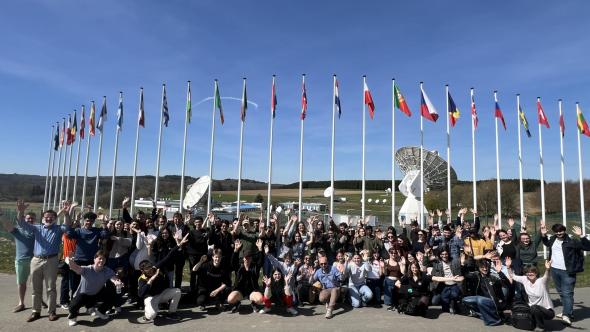
In April 2026, UNamur hosted two events as part of the UNIVERSEH alliance, bringing together more than a hundred students from across Europe.

In April 2026, UNamur hosted two events as part of the UNIVERSEH alliance, bringing together more than a hundred students from across Europe.
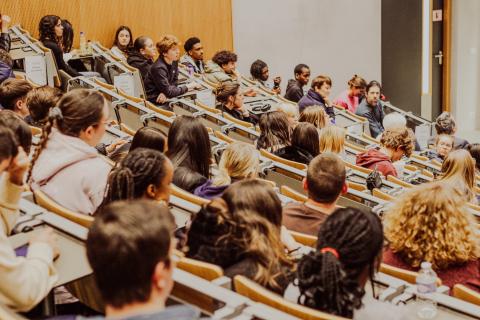
The Spring School, a short-term exchange program (BIP), aims to raise awareness among students from the Alliance’s seven universities about the diverse challenges and societal impacts of the space sector. Through a program combining lectures, visits, and group projects, as well as stargazing and exercises inspired by astronaut training, participants explored space in all its facets: from cybersecurity and nuclear energy in space to satellite services, space environment monitoring, launch vehicles, and astrodynamics.
Inspiration from UNamur experts and partners
Informative and insightful lectures were delivered by a panel of high-level experts from various disciplines. Speakers included André Füzfa (UNamur), Marc Toussaint (ESA/EPFL), Stijn Ilsen (Redwire), Christine Leurquin (Aldoria), Boris Hespeels (UNamur), Magdalena Teissandier (TBS-Toulouse), Fabienne Delhaise (ESA), Bartosz Sawik (AGH), Alain De Neve (Royal Higher Institute of Defense), Brieux Spindler (TRACTEBEL), Liina Vaabel (ESA), Alexandre de Geradon and Matteo Manieri (Telespazio), Jean-Luc Trullemans (ESA-ESEC), Natacha Callens (ESA Academy), and Cindy Léonard (ESA).
The topics covered a wide range of subjects, including the ground segment, astrodynamics, biological experiments, space defense, satellite operations, Space Situational Awareness, New Space, and many others.
Exclusive access to ESA facilities
Throughout the week, the students enjoyed unique and exclusive access to two major ESA sites. The first was the ESA Academy Training and Learning Centre, where they learned how the agency collaborates with universities to pass on its expertise, technical skills, and best practices to the next generation of European space professionals. The second was a visit to ESA’s ESEC-Redu facility, the European Space Safety and Education Center, which provided them with a hands-on look at satellite operations, space safety initiatives, and the management of Smallsat and Cubesat missions. These visits allowed participants to immerse themselves in the infrastructure that supports Europe’s space ambitions.

Among the lessons learned at the Spring School, the most striking is undoubtedly that the space sector is not limited to complex calculations. On the contrary, it brings together people from diverse backgrounds, united by a shared passion.


Designed to bridge the gap between academia and society, this short-term mobility program (BIP) aimed to equip students with the skills needed to communicate their expertise clearly and accessibly beyond specialized circles. The goal was to produce a science communication video that was both engaging and understandable, while encouraging students to adapt their use of English to reach a non-specialist audience.
Throughout the program, students acquired a wide range of key skills. They strengthened their language skills, particularly in the field of science communication in English, while gaining fluency through regular exchanges in an international environment. Critical thinking was also central to the learning process, through structured peer-review sessions that encouraged reflection and constructive feedback. At the same time, participants developed their digital skills, learning to identify reliable online sources and master video recording and editing techniques.
A high degree of autonomy was required throughout the program. Students had an entire day to organize and carry out the filming of their projects on their own, while being able to count on guidance and technical support from instructors as needed.
They were also encouraged to think deeply about their themes in order to identify angles likely to capture the interest of a broad audience. Creativity and originality played a central role, particularly in the visual storytelling that brought their projects to life.

What really struck us was how quickly the groups bonded. From the very first day, a genuine spirit of collaboration, curiosity, and openness took hold.


UNIVERSEH is an alliance of seven universities from seven European countries. It was established in November 2020 as part of the "European Universities" initiative promoted and funded by the European Commission.