
Master in Biology of Organisms and Ecology
You are viewing the program for
Master’s Degree (120 credits) in Organismal Biology and Ecology, Specialization Track |
Overview
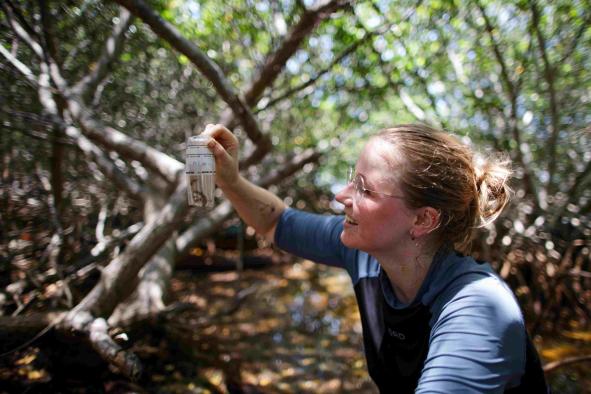
Solving novel problems in modern environmental biology, contributing to a better understanding of how living organisms function within their environment at various levels of integration using cutting-edge techniques, communicating and sharing knowledge… These are just some of the challenges you will face as professionals in organismal biology and ecology.
Your goals
- respond to environmental and biodiversity issues;
- understand the functioning, conservation, and evolution of aquatic and terrestrial ecosystems;
- understand the evolution of ecosystems and organisms;
- conduct field observations and experimental research;
- master modern technologies, from molecular tools to the interpretation of satellite imagery;
- gain practical training that is a key asset in the job market.
The benefits of the training program
- issues at the forefront of current events;
- a personalized academic path and guidance toward a career plan;
- a wide selection of modules, in French or English, offered on two campuses;
- fieldwork and laboratory work;
- modern techniques: molecular biology, GIS, digital ecology…;
- a long-term research project: a thesis spanning 10 months;
- a 4-month professional internship;
- the opportunity to complete your internship or thesis abroad.
The program
The Master’s program in Organismal Biology and Ecology is jointly offered by the University of Namur and UCLouvain. Enrollment in this program is handled exclusively by UCLouvain.
What sets this master’s program apart is its approach to modern issues in organismal biology and ecology, bridging terrestrial and aquatic environments, which have long been studied separately.
The various levels of biological organization (molecular, cellular, biochemical, physiological, behavioral, population, community, and ecosystem) are linked together using cutting-edge techniques (genomics, epigenetics, modeling, GIS, etc.).
The comparative approach allows for the investigation of diverse biological systems across the animal and plant kingdoms as well as among microorganisms, while avoiding a narrow focus on a small number of model species.
The specialized track allows you to orient your future career toward either the environment, experimental research, or scientific communication.
You will also choose three modules from
- Conservation and Restoration of Biodiversity
- Modeling in Ecology and Evolution
- Stress ecology and ecotoxicology
- Spatial and thermal ecology
- Behavioral ecology
- Molecular ecology and biodiversity genomics
You may also select the INEO option, an interdisciplinary program in entrepreneurship. This option spans two years and involves the completion of an interfaculty thesis (in a team) focused on a business creation project. Admission is limited to students selected based on their application. For more information, visit uclouvain.be/etudier/ineo
An experience abroad
The BOE master’s program offers you the opportunity to complete an internship outside of a university or research center (at a company, nonprofit, NGO, etc.), in Belgium or abroad.
You can also complete part of your thesis abroad.
Other master's programs in biology
The University of Namur offers the following master’s programs:
And after the master's degree
You want to empower young people to learn and collaborate, guide them, help them become agents of change?
Discover how to become a teacher in upper secondary (secondary 4-6) after your master's degree.
Contacts
Faculty of Science
2 Grafé Street • B-5000 Namur
Department of Biology
Tel.: +32 (0) 81 72 44 18
secretariat.bio@unamur.be
Vous consultez le programme de
Master 120 en biologie des organismes et écologie, à finalité didactique |
Point of attention |
This training program is suspended. Only current students (enrolled in 2024-2025) will be able to re-enroll and complete their course.
|
Other master's degrees in biology
The University of Namur offers the following master’s programs:
Contacts
Faculty of Science
2 Grafé Street • B-5000 Namur
Department of Biology
Tel.: +32 (0) 81 72 44 18
secretariat.bio@unamur.be
The University of Namur offers the Master 120 in biology of Organisms and Ecology jointly with the UCLouvain.
Full details of the programme are available on the website of the UCLouvain.
To register for the Master's program, please contact UCLouvain.
The University of Namur provides teaching in the following areas:
-
Common core
Code Name Staff Th.+Ex. Credits/Block 1 2 LBOE2191 Ecology and society 30h th. 2 SBOEM111 Advanced and applied evolutionary Dennis Alice 35h th. + 30h ex. 3 SBOEM112 Data analysis and modeling of biological systems De Laender Frédérik 30h th. + 45h ex. 5 LBOE2113 Scientific and Professional Communication in English 15h ex. 3 LBOE2196 Experimental design 15h th. + 22.5h ex. 2 SBOEM197 Introduction to scientific research 8 LGEO1342A Geographic Information Systems (GIS) partim 24h th. + 24h ex. 4 SBOEM297 Master thesis 22 LBOE2114 <unknown> De Laender Frédérik 67.5h th. + 90h ex. 4 -
Humanities
Code Name Staff Th.+Ex. Credits/Block 1 2 Sustainable developmentImage
SSPSM101 Science, ethics and development Tilman Valérie Leyens Stéphane 18h th. + 6h ex. 3 LFILO2003E Ethical issues in science and technology (seminar section) Rezsohazy René 15h th. + 15h ex. 2 LSC2001 Introduction to contemporary philosophy 30h th. 2 LSC2220 Philosophy of science 30h th. 2 MSBMM113 Bioethics Ravez Laurent Pontarotti Gaëlle 18h th. 2 SSPSM203 Philosophy of Life Sciences Pontarotti Gaëlle 12h th. 3 LTHEO2840 Science and the Christian faith 15h th. 2
-
-
In-depth purpose
Code Name Staff Th.+Ex. Credits/Block 1 2 SBOEM241 Professional project Guillaume Murielle 2 SBOEM240 Research internship De Laender Frédérik 28 -
Choice of courses
-
Advanced courses
-
Animal handling
Code Name Staff Th.+Ex. Credits/Block 1 2 WSBIM2290 Introduction to the science of laboratory animals 37h th. 3 3 SFCMM101 Training in animal experimentation at technician level: techniques, alternative methods, legislation and ethics Vermeylen Anne 40h th. 4 4 SFCMM201 Training of master animal handlers Vermeylen Anne 40h th. 4 4 -
Remote sensing and planning
Code Name Staff Th.+Ex. Credits/Block 1 2 LBIRE2102 Applied geomatics 30h th. + 22.5h ex. 4 4 LGEO1343 Earth observation by satellite 30h th. + 30h ex. 5 5 Cyclic course not organized this yearImage
LGEO2140 Global environmental challenges in the Anthropocene 30h th. + 30h ex. 5 5 LBRAT2101 Town and country planning 45h th. + 15h ex. 5 5 LBRTI2101A Data Science in bioscience engineering - Partim A : spatial and temporal data 22.5h th. + 15h ex. 3 3 SGOGB301 Modelling and analysis of geographic information Linard Catherine Brogna Delphine 20h th. + 30h ex. 4 4 -
Opening Courses
Code Name Staff Th.+Ex. Credits/Block 1 2 LDROP2063 Sectoral Environmental Law - Droit sectoriel de l'environnement 30h th. 5 5 LDROP2102 Intellectual rights and new technologies 30h th. 5 5 LDROP2061 General environmental and living environment law 30h th. 5 5 LDROP2101 Management of Intellectual Property Rights 30h th. 5 5 Soft skillsImage
MGESM203 Gestion de l'entreprise 12h th. 2 2
-
-
Module
-
Stress ecology and ecotoxicology
Code Name Staff Th.+Ex. Credits/Block 1 2 SBOEM170 Advances in applied and basic ecotoxicology Thoré Eli Silvestre Frédéric 40h th. + 24h ex. 5 5 LBOE2168 Plant-environment interactions 30h th. + 15h ex. 3 3 -
Modelling in ecology and evolution
Code Name Staff Th.+Ex. Credits/Block 1 2 LBOE2292 Ecological and evolutionary modelling 15h th. + 45h ex. 4 4 Sustainable developmentImage
English Friendly CoursesImage
SBOEM142 Ecosystem stability De Laender Frédérik De Laender Frédérik 16h th. + 12h ex. 2 2 Sustainable developmentImage
SBOEM162 Biodiversity and ecosystem functioning De Laender Frédérik Silvestre Frédéric 16h th. + 12h ex. 2 2 -
Molecular ecology and biodiversity genomics
Code Name Staff Th.+Ex. Credits/Block 1 2 SBOEM114 Molecular ecology and biodiversity genomics Dennis Alice 30h th. + 22.5h ex. 4 4 SBOEM115 Environmental Epigenetics Silvestre Frédéric 15h th. + 15h ex. 2 2 SBOEM116 Applied bioinformatics for molecular ecology Dennis Alice Silvestre Frédéric 30h th. 2 2 -
Spatial and thermal ecology
Code Name Staff Th.+Ex. Credits/Block 1 2 LBOE2140 Landscape Ecology 30h th. + 30h ex. 4 4 LBOE2150 Movement ecology 22.5h th. + 7.5h ex. 2 2 LBOE2151 <unknown> 22.5h th. 2 2 -
Behavioural ecology
Code Name Staff Th.+Ex. Credits/Block 1 2 LBOE2161 Behavioural ecology 30h th. + 15h ex. 4 4 SBOEM113 Behavioural responses to a changing world Thoré Eli 30h th. + 16h ex. 4 4 -
Conservation and restoration ecology
Code Name Staff Th.+Ex. Credits/Block 1 2 LBOE2120 Biodiversity conservation 45h th. + 15h ex. 4 4 LBOE2141 Restoration ecology 15h th. + 15h ex. 2 2 Sustainable developmentImage
English Friendly CoursesImage
SBOEM237 Bioindicators De Laender Frédérik Silvestre Frédéric 16h th. + 12h ex. 2 2
-
-
Common core
Code Name Staff Credits Hours/Quarter 1 2 LBOE2191 Ecology and society 2 30h th. SBOEM111 Advanced and applied evolutionary Dennis Alice 3 35h th. + 30h ex. SBOEM112 Data analysis and modeling of biological systems De Laender Frédérik 5 30h th. + 45h ex. LBOE2113 Scientific and Professional Communication in English 3 15h ex. LBOE2196 Experimental design 2 15h th. + 22.5h ex. SBOEM197 Introduction to scientific research 8 LGEO1342A Geographic Information Systems (GIS) partim 4 24h th. + 24h ex. LBOE2114 <unknown> De Laender Frédérik 4 67.5h th. + 90h ex. -
Humanities
Code Name Staff Credits Hours/Quarter 1 2 Sustainable developmentImage
SSPSM101 Science, ethics and development Tilman Valérie Leyens Stéphane 3 18h th. + 6h ex. LFILO2003E Ethical issues in science and technology (seminar section) Rezsohazy René 2 15h th. + 15h ex. LSC2001 Introduction to contemporary philosophy 2 30h th. LSC2220 Philosophy of science 2 30h th. MSBMM113 Bioethics Ravez Laurent Pontarotti Gaëlle 2 18h th. SSPSM203 Philosophy of Life Sciences Pontarotti Gaëlle 3 12h th. LTHEO2840 Science and the Christian faith 2 15h th.
-
-
Choice of courses
-
Advanced courses
-
Animal handling
Code Name Staff Credits Hours/Quarter 1 2 WSBIM2290 Introduction to the science of laboratory animals 3 37h th. SFCMM101 Training in animal experimentation at technician level: techniques, alternative methods, legislation and ethics Vermeylen Anne 4 40h th. SFCMM201 Training of master animal handlers Vermeylen Anne 4 40h th. -
Remote sensing and planning
Code Name Staff Credits Hours/Quarter 1 2 LBIRE2102 Applied geomatics 4 30h th. + 22.5h ex. LGEO1343 Earth observation by satellite 5 30h th. + 30h ex. Cyclic course not organized this yearImage
LGEO2140 Global environmental challenges in the Anthropocene 5 30h th. + 30h ex. LBRAT2101 Town and country planning 5 45h th. + 15h ex. LBRTI2101A Data Science in bioscience engineering - Partim A : spatial and temporal data 3 22.5h th. + 15h ex. SGOGB301 Modelling and analysis of geographic information Linard Catherine Brogna Delphine 4 20h th. + 30h ex. -
Opening Courses
Code Name Staff Credits Hours/Quarter 1 2 LDROP2063 Sectoral Environmental Law - Droit sectoriel de l'environnement 5 30h th. LDROP2102 Intellectual rights and new technologies 5 30h th. LDROP2061 General environmental and living environment law 5 30h th. LDROP2101 Management of Intellectual Property Rights 5 30h th. Soft skillsImage
MGESM203 Gestion de l'entreprise 2 12h th.
-
-
Module
-
Stress ecology and ecotoxicology
Code Name Staff Credits Hours/Quarter 1 2 SBOEM170 Advances in applied and basic ecotoxicology Thoré Eli Silvestre Frédéric 5 40h th. + 24h ex. LBOE2168 Plant-environment interactions 3 30h th. + 15h ex. -
Modelling in ecology and evolution
Code Name Staff Credits Hours/Quarter 1 2 LBOE2292 Ecological and evolutionary modelling 4 15h th. + 45h ex. Sustainable developmentImage
English Friendly CoursesImage
SBOEM142 Ecosystem stability De Laender Frédérik De Laender Frédérik 2 16h th. + 12h ex. Sustainable developmentImage
SBOEM162 Biodiversity and ecosystem functioning De Laender Frédérik Silvestre Frédéric 2 16h th. + 12h ex. -
Molecular ecology and biodiversity genomics
Code Name Staff Credits Hours/Quarter 1 2 SBOEM114 Molecular ecology and biodiversity genomics Dennis Alice 4 30h th. + 22.5h ex. SBOEM115 Environmental Epigenetics Silvestre Frédéric 2 15h th. + 15h ex. SBOEM116 Applied bioinformatics for molecular ecology Dennis Alice Silvestre Frédéric 2 30h th. -
Spatial and thermal ecology
Code Name Staff Credits Hours/Quarter 1 2 LBOE2140 Landscape Ecology 4 30h th. + 30h ex. LBOE2150 Movement ecology 2 22.5h th. + 7.5h ex. LBOE2151 <unknown> 2 22.5h th. -
Behavioural ecology
Code Name Staff Credits Hours/Quarter 1 2 LBOE2161 Behavioural ecology 4 30h th. + 15h ex. SBOEM113 Behavioural responses to a changing world Thoré Eli 4 30h th. + 16h ex. -
Conservation and restoration ecology
Code Name Staff Credits Hours/Quarter 1 2 LBOE2120 Biodiversity conservation 4 45h th. + 15h ex. LBOE2141 Restoration ecology 2 15h th. + 15h ex. Sustainable developmentImage
English Friendly CoursesImage
SBOEM237 Bioindicators De Laender Frédérik Silvestre Frédéric 2 16h th. + 12h ex.
-
-
Common core
Code Name Staff Credits Hours/Quarter 1 2 SBOEM297 Master thesis 22 -
In-depth purpose
Code Name Staff Credits Hours/Quarter 1 2 SBOEM241 Professional project Guillaume Murielle 2 SBOEM240 Research internship De Laender Frédérik 28 -
Choice of courses
-
Advanced courses
-
Animal handling
Code Name Staff Credits Hours/Quarter 1 2 SFCMM101 Training in animal experimentation at technician level: techniques, alternative methods, legislation and ethics Vermeylen Anne 4 40h th. WSBIM2290 Introduction to the science of laboratory animals 3 37h th. SFCMM201 Training of master animal handlers Vermeylen Anne 4 40h th. -
Remote sensing and planning
Code Name Staff Credits Hours/Quarter 1 2 LBRTI2101A Data Science in bioscience engineering - Partim A : spatial and temporal data 3 22.5h th. + 15h ex. Cyclic course not organized this yearImage
LGEO2140 Global environmental challenges in the Anthropocene 5 30h th. + 30h ex. SGOGB301 Modelling and analysis of geographic information Linard Catherine Brogna Delphine 4 20h th. + 30h ex. LBRAT2101 Town and country planning 5 45h th. + 15h ex. LGEO1343 Earth observation by satellite 5 30h th. + 30h ex. LBIRE2102 Applied geomatics 4 30h th. + 22.5h ex. -
Opening Courses
Code Name Staff Credits Hours/Quarter 1 2 LDROP2102 Intellectual rights and new technologies 5 30h th. LDROP2101 Management of Intellectual Property Rights 5 30h th. LDROP2061 General environmental and living environment law 5 30h th. LDROP2063 Sectoral Environmental Law - Droit sectoriel de l'environnement 5 30h th. Soft skillsImage
MGESM203 Gestion de l'entreprise 2 12h th.
-
-
Module
-
Stress ecology and ecotoxicology
Code Name Staff Credits Hours/Quarter 1 2 SBOEM170 Advances in applied and basic ecotoxicology Thoré Eli Silvestre Frédéric 5 40h th. + 24h ex. LBOE2168 Plant-environment interactions 3 30h th. + 15h ex. -
Modelling in ecology and evolution
Code Name Staff Credits Hours/Quarter 1 2 LBOE2292 Ecological and evolutionary modelling 4 15h th. + 45h ex. Sustainable developmentImage
English Friendly CoursesImage
SBOEM142 Ecosystem stability De Laender Frédérik De Laender Frédérik 2 16h th. + 12h ex. Sustainable developmentImage
SBOEM162 Biodiversity and ecosystem functioning De Laender Frédérik Silvestre Frédéric 2 16h th. + 12h ex. -
Molecular ecology and biodiversity genomics
Code Name Staff Credits Hours/Quarter 1 2 SBOEM114 Molecular ecology and biodiversity genomics Dennis Alice 4 30h th. + 22.5h ex. SBOEM115 Environmental Epigenetics Silvestre Frédéric 2 15h th. + 15h ex. SBOEM116 Applied bioinformatics for molecular ecology Dennis Alice Silvestre Frédéric 2 30h th. -
Spatial and thermal ecology
Code Name Staff Credits Hours/Quarter 1 2 LBOE2140 Landscape Ecology 4 30h th. + 30h ex. LBOE2150 Movement ecology 2 22.5h th. + 7.5h ex. LBOE2151 <unknown> 2 22.5h th. -
Behavioural ecology
Code Name Staff Credits Hours/Quarter 1 2 LBOE2161 Behavioural ecology 4 30h th. + 15h ex. SBOEM113 Behavioural responses to a changing world Thoré Eli 4 30h th. + 16h ex. -
Conservation and restoration ecology
Code Name Staff Credits Hours/Quarter 1 2 LBOE2120 Biodiversity conservation 4 45h th. + 15h ex. LBOE2141 Restoration ecology 2 15h th. + 15h ex. Sustainable developmentImage
English Friendly CoursesImage
SBOEM237 Bioindicators De Laender Frédérik Silvestre Frédéric 2 16h th. + 12h ex.
-
-
Common core
Code Name Staff Th.+Ex. Credits/Block 1 2 LBOE2191 Ecology and society 30h th. 2 SBOEM111 Advanced and applied evolutionary Dennis Alice 35h th. + 30h ex. 3 SBOEM112 Data analysis and modeling of biological systems De Laender Frédérik 30h th. + 45h ex. 5 LBOE2113 Scientific and Professional Communication in English 15h ex. 3 LBOE2196 Experimental design 15h th. + 22.5h ex. 2 SBOEM197 Introduction to scientific research 8 LGEO1342A Geographic Information Systems (GIS) partim 24h th. + 24h ex. 4 SBOEM297 Master thesis 22 LBOE2114 <unknown> De Laender Frédérik 67.5h th. + 90h ex. 4 -
Humanities
Code Name Staff Th.+Ex. Credits/Block 1 2 Sustainable developmentImage
SSPSM101 Science, ethics and development Tilman Valérie Leyens Stéphane 18h th. + 6h ex. 3 LFILO2003E Ethical issues in science and technology (seminar section) Rezsohazy René 15h th. + 15h ex. 2 LSC2001 Introduction to contemporary philosophy 30h th. 2 LSC2220 Philosophy of science 30h th. 2 MSBMM113 Bioethics Ravez Laurent Pontarotti Gaëlle 18h th. 2 SSPSM203 Philosophy of Life Sciences Pontarotti Gaëlle 12h th. 3 LTHEO2840 Science and the Christian faith 15h th. 2
-
-
Didactic purpose
Code Name Staff Th.+Ex. Credits/Block 1 2 FAGRM402 Psychopedagogy I 30h th. + 20h ex. 4 Soft skillsImage
SAGRM211 Secondary school biology teaching internships Vervoort Arnaud 35h ex. 6 English Friendly CoursesImage
FAGRM401 School education and society 30h th. + 10h ex. 4 Sustainable developmentImage
Soft skillsImage
SAGRM203 Didactics and Epistemology of Biology I 30h th. + 10h ex. 3 FAGRM409 Foundations of neutrality 20h th. 2 FAGRM406 Educational psychology II 30h th. + 10h ex. 3 Sustainable developmentImage
Soft skillsImage
SAGRM206 Didactics and Epistemology of Biology II Vervoort Arnaud 30h th. 3 -
Choice of courses
Code Name Staff Th.+Ex. Credits/Block 1 2 SSPSB202_Masters History of science Sartenaer Olivier 15h th. 2 FEDUM203 Digital training Dumortier Laurence 15h th. 2 FEDUM103_P41353 <unknown> Fischer Line Biémar Sandrine 15h th. + 5h ex. 2 -
Teaching another discipline
Code Name Staff Th.+Ex. Credits/Block 1 2 SAGRM204_Partim Didactics and Epistemology of Chemistry I Dehon Jérémy 30h th. 3 Soft skillsImage
SAGRM202_Partim Didactics and Epistemology of Physics I Dias De Carvalho Junior Gabriel 30h th. 3
-
-
Module
-
Stress ecology and ecotoxicology
Code Name Staff Th.+Ex. Credits/Block 1 2 SBOEM170 Advances in applied and basic ecotoxicology Thoré Eli Silvestre Frédéric 40h th. + 24h ex. 5 5 LBOE2168 Plant-environment interactions 30h th. + 15h ex. 3 3 -
Conservation and restoration ecology
Code Name Staff Th.+Ex. Credits/Block 1 2 LBOE2120 Biodiversity conservation 45h th. + 15h ex. 4 4 LBOE2141 Restoration ecology 15h th. + 15h ex. 2 2 Sustainable developmentImage
English Friendly CoursesImage
SBOEM237 Bioindicators De Laender Frédérik Silvestre Frédéric 16h th. + 12h ex. 2 2 -
Modelling in ecology and evolution
Code Name Staff Th.+Ex. Credits/Block 1 2 LBOE2292 Ecological and evolutionary modelling 15h th. + 45h ex. 4 4 Sustainable developmentImage
SBOEM162 Biodiversity and ecosystem functioning De Laender Frédérik Silvestre Frédéric 16h th. + 12h ex. 2 2 Sustainable developmentImage
English Friendly CoursesImage
SBOEM142 Ecosystem stability De Laender Frédérik De Laender Frédérik 16h th. + 12h ex. 2 2 -
Spatial and thermal ecology
Code Name Staff Th.+Ex. Credits/Block 1 2 LBOE2150 Movement ecology 22.5h th. + 7.5h ex. 2 2 LBOE2140 Landscape Ecology 30h th. + 30h ex. 4 4 LBOE2151 <unknown> 22.5h th. 2 2 -
Behavioural ecology
Code Name Staff Th.+Ex. Credits/Block 1 2 LBOE2161 Behavioural ecology 30h th. + 15h ex. 4 4 SBOEM113 Behavioural responses to a changing world Thoré Eli 30h th. + 16h ex. 4 4 -
Molecular ecology and biodiversity genomics
Code Name Staff Th.+Ex. Credits/Block 1 2 SBOEM114 Molecular ecology and biodiversity genomics Dennis Alice 30h th. + 22.5h ex. 4 4 SBOEM115 Environmental Epigenetics Silvestre Frédéric 15h th. + 15h ex. 2 2 SBOEM116 Applied bioinformatics for molecular ecology Dennis Alice Silvestre Frédéric 30h th. 2 2
-
-
Choice of courses
-
Elective courses complementary to UCL's didactic approach
Code Name Staff Th.+Ex. Credits/Block 1 2 LAGRE2221 Learning and teaching with new technologies and exercises 15h th. + 15h ex. 2 LAGRE2310 Micro-teaching exercises 15h th. 2 LGEO2330 Geography didactics seminar 30h ex. 5 LSCI2330 Science didactics research seminar 15h th. + 30h ex. 5 LMAT2330 Seminar on the didactics of mathematics 15h th. + 30h ex. 4 -
Advances courses
-
Remote sensing and planning
Code Name Staff Th.+Ex. Credits/Block 1 2 LBIRE2102 Applied geomatics 30h th. + 22.5h ex. 4 4 LGEO1343 Earth observation by satellite 30h th. + 30h ex. 5 5 Cyclic course not organized this yearImage
LGEO2140 Global environmental challenges in the Anthropocene 30h th. + 30h ex. 5 5 LBRAT2101 Town and country planning 45h th. + 15h ex. 5 5 LBRTI2101A Data Science in bioscience engineering - Partim A : spatial and temporal data 22.5h th. + 15h ex. 3 3 SGOGB301 Modelling and analysis of geographic information Linard Catherine Brogna Delphine 20h th. + 30h ex. 4 4 -
Opening courses
Code Name Staff Th.+Ex. Credits/Block 1 2 LDROP2063 Sectoral Environmental Law - Droit sectoriel de l'environnement 30h th. 5 5 LDROP2102 Intellectual rights and new technologies 30h th. 5 5 LDROP2061 General environmental and living environment law 30h th. 5 5 LDROP2101 Management of Intellectual Property Rights 30h th. 5 5 Soft skillsImage
MGESM203 Gestion de l'entreprise 12h th. 2 2 -
Animal handling
Code Name Staff Th.+Ex. Credits/Block 1 2 WSBIM2290 Introduction to the science of laboratory animals 37h th. 3 3 SFCMM101 Training in animal experimentation at technician level: techniques, alternative methods, legislation and ethics Vermeylen Anne 40h th. 4 4 SFCMM201 Training of master animal handlers Vermeylen Anne 40h th. 4 4
-
-
Common core
Code Name Staff Credits Hours/Quarter 1 2 LBOE2191 Ecology and society 2 30h th. SBOEM111 Advanced and applied evolutionary Dennis Alice 3 35h th. + 30h ex. SBOEM112 Data analysis and modeling of biological systems De Laender Frédérik 5 30h th. + 45h ex. LBOE2113 Scientific and Professional Communication in English 3 15h ex. LBOE2196 Experimental design 2 15h th. + 22.5h ex. SBOEM197 Introduction to scientific research 8 LGEO1342A Geographic Information Systems (GIS) partim 4 24h th. + 24h ex. LBOE2114 <unknown> De Laender Frédérik 4 67.5h th. + 90h ex. -
Humanities
Code Name Staff Credits Hours/Quarter 1 2 Sustainable developmentImage
SSPSM101 Science, ethics and development Tilman Valérie Leyens Stéphane 3 18h th. + 6h ex. LFILO2003E Ethical issues in science and technology (seminar section) Rezsohazy René 2 15h th. + 15h ex. LSC2001 Introduction to contemporary philosophy 2 30h th. LSC2220 Philosophy of science 2 30h th. MSBMM113 Bioethics Ravez Laurent Pontarotti Gaëlle 2 18h th. SSPSM203 Philosophy of Life Sciences Pontarotti Gaëlle 3 12h th. LTHEO2840 Science and the Christian faith 2 15h th.
-
-
Module
-
Stress ecology and ecotoxicology
Code Name Staff Credits Hours/Quarter 1 2 SBOEM170 Advances in applied and basic ecotoxicology Thoré Eli Silvestre Frédéric 5 40h th. + 24h ex. LBOE2168 Plant-environment interactions 3 30h th. + 15h ex. -
Conservation and restoration ecology
Code Name Staff Credits Hours/Quarter 1 2 LBOE2120 Biodiversity conservation 4 45h th. + 15h ex. LBOE2141 Restoration ecology 2 15h th. + 15h ex. Sustainable developmentImage
English Friendly CoursesImage
SBOEM237 Bioindicators De Laender Frédérik Silvestre Frédéric 2 16h th. + 12h ex. -
Modelling in ecology and evolution
Code Name Staff Credits Hours/Quarter 1 2 LBOE2292 Ecological and evolutionary modelling 4 15h th. + 45h ex. Sustainable developmentImage
SBOEM162 Biodiversity and ecosystem functioning De Laender Frédérik Silvestre Frédéric 2 16h th. + 12h ex. Sustainable developmentImage
English Friendly CoursesImage
SBOEM142 Ecosystem stability De Laender Frédérik De Laender Frédérik 2 16h th. + 12h ex. -
Spatial and thermal ecology
Code Name Staff Credits Hours/Quarter 1 2 LBOE2150 Movement ecology 2 22.5h th. + 7.5h ex. LBOE2140 Landscape Ecology 4 30h th. + 30h ex. LBOE2151 <unknown> 2 22.5h th. -
Behavioural ecology
Code Name Staff Credits Hours/Quarter 1 2 LBOE2161 Behavioural ecology 4 30h th. + 15h ex. SBOEM113 Behavioural responses to a changing world Thoré Eli 4 30h th. + 16h ex. -
Molecular ecology and biodiversity genomics
Code Name Staff Credits Hours/Quarter 1 2 SBOEM114 Molecular ecology and biodiversity genomics Dennis Alice 4 30h th. + 22.5h ex. SBOEM115 Environmental Epigenetics Silvestre Frédéric 2 15h th. + 15h ex. SBOEM116 Applied bioinformatics for molecular ecology Dennis Alice Silvestre Frédéric 2 30h th.
-
-
Choice of courses
-
Advances courses
-
Remote sensing and planning
Code Name Staff Credits Hours/Quarter 1 2 LBIRE2102 Applied geomatics 4 30h th. + 22.5h ex. LGEO1343 Earth observation by satellite 5 30h th. + 30h ex. Cyclic course not organized this yearImage
LGEO2140 Global environmental challenges in the Anthropocene 5 30h th. + 30h ex. LBRAT2101 Town and country planning 5 45h th. + 15h ex. LBRTI2101A Data Science in bioscience engineering - Partim A : spatial and temporal data 3 22.5h th. + 15h ex. SGOGB301 Modelling and analysis of geographic information Linard Catherine Brogna Delphine 4 20h th. + 30h ex. -
Opening courses
Code Name Staff Credits Hours/Quarter 1 2 LDROP2063 Sectoral Environmental Law - Droit sectoriel de l'environnement 5 30h th. LDROP2102 Intellectual rights and new technologies 5 30h th. LDROP2061 General environmental and living environment law 5 30h th. LDROP2101 Management of Intellectual Property Rights 5 30h th. Soft skillsImage
MGESM203 Gestion de l'entreprise 2 12h th. -
Animal handling
Code Name Staff Credits Hours/Quarter 1 2 WSBIM2290 Introduction to the science of laboratory animals 3 37h th. SFCMM101 Training in animal experimentation at technician level: techniques, alternative methods, legislation and ethics Vermeylen Anne 4 40h th. SFCMM201 Training of master animal handlers Vermeylen Anne 4 40h th.
-
-
Common core
Code Name Staff Credits Hours/Quarter 1 2 SBOEM297 Master thesis 22 -
Didactic purpose
Code Name Staff Credits Hours/Quarter 1 2 FAGRM402 Psychopedagogy I 4 30h th. + 20h ex. Soft skillsImage
SAGRM211 Secondary school biology teaching internships Vervoort Arnaud 6 35h ex. English Friendly CoursesImage
FAGRM401 School education and society 4 30h th. + 10h ex. Sustainable developmentImage
Soft skillsImage
SAGRM203 Didactics and Epistemology of Biology I 3 30h th. + 10h ex. FAGRM409 Foundations of neutrality 2 20h th. FAGRM406 Educational psychology II 3 30h th. + 10h ex. Sustainable developmentImage
Soft skillsImage
SAGRM206 Didactics and Epistemology of Biology II Vervoort Arnaud 3 30h th. -
Choice of courses
Code Name Staff Credits Hours/Quarter 1 2 SSPSB202_Masters History of science Sartenaer Olivier 2 15h th. FEDUM203 Digital training Dumortier Laurence 2 15h th. FEDUM103_P41353 <unknown> Fischer Line Biémar Sandrine 2 15h th. + 5h ex. -
Teaching another discipline
Code Name Staff Credits Hours/Quarter 1 2 SAGRM204_Partim Didactics and Epistemology of Chemistry I Dehon Jérémy 3 30h th. Soft skillsImage
SAGRM202_Partim Didactics and Epistemology of Physics I Dias De Carvalho Junior Gabriel 3 30h th.
-
-
Module
-
Stress ecology and ecotoxicology
Code Name Staff Credits Hours/Quarter 1 2 LBOE2168 Plant-environment interactions 3 30h th. + 15h ex. SBOEM170 Advances in applied and basic ecotoxicology Thoré Eli Silvestre Frédéric 5 40h th. + 24h ex. -
Conservation and restoration ecology
Code Name Staff Credits Hours/Quarter 1 2 Sustainable developmentImage
English Friendly CoursesImage
SBOEM237 Bioindicators De Laender Frédérik Silvestre Frédéric 2 16h th. + 12h ex. LBOE2141 Restoration ecology 2 15h th. + 15h ex. LBOE2120 Biodiversity conservation 4 45h th. + 15h ex. -
Modelling in ecology and evolution
Code Name Staff Credits Hours/Quarter 1 2 Sustainable developmentImage
SBOEM162 Biodiversity and ecosystem functioning De Laender Frédérik Silvestre Frédéric 2 16h th. + 12h ex. Sustainable developmentImage
English Friendly CoursesImage
SBOEM142 Ecosystem stability De Laender Frédérik De Laender Frédérik 2 16h th. + 12h ex. LBOE2292 Ecological and evolutionary modelling 4 15h th. + 45h ex. -
Spatial and thermal ecology
Code Name Staff Credits Hours/Quarter 1 2 LBOE2140 Landscape Ecology 4 30h th. + 30h ex. LBOE2150 Movement ecology 2 22.5h th. + 7.5h ex. LBOE2151 <unknown> 2 22.5h th. -
Behavioural ecology
Code Name Staff Credits Hours/Quarter 1 2 LBOE2161 Behavioural ecology 4 30h th. + 15h ex. SBOEM113 Behavioural responses to a changing world Thoré Eli 4 30h th. + 16h ex. -
Molecular ecology and biodiversity genomics
Code Name Staff Credits Hours/Quarter 1 2 SBOEM114 Molecular ecology and biodiversity genomics Dennis Alice 4 30h th. + 22.5h ex. SBOEM115 Environmental Epigenetics Silvestre Frédéric 2 15h th. + 15h ex. SBOEM116 Applied bioinformatics for molecular ecology Dennis Alice Silvestre Frédéric 2 30h th.
-
-
Choice of courses
-
Elective courses complementary to UCL's didactic approach
Code Name Staff Credits Hours/Quarter 1 2 LAGRE2221 Learning and teaching with new technologies and exercises 2 15h th. + 15h ex. LAGRE2310 Micro-teaching exercises 2 15h th. LGEO2330 Geography didactics seminar 5 30h ex. LSCI2330 Science didactics research seminar 5 15h th. + 30h ex. LMAT2330 Seminar on the didactics of mathematics 4 15h th. + 30h ex. -
Advances courses
-
Remote sensing and planning
Code Name Staff Credits Hours/Quarter 1 2 LBRTI2101A Data Science in bioscience engineering - Partim A : spatial and temporal data 3 22.5h th. + 15h ex. Cyclic course not organized this yearImage
LGEO2140 Global environmental challenges in the Anthropocene 5 30h th. + 30h ex. LBRAT2101 Town and country planning 5 45h th. + 15h ex. LGEO1343 Earth observation by satellite 5 30h th. + 30h ex. LBIRE2102 Applied geomatics 4 30h th. + 22.5h ex. SGOGB301 Modelling and analysis of geographic information Linard Catherine Brogna Delphine 4 20h th. + 30h ex. -
Opening courses
Code Name Staff Credits Hours/Quarter 1 2 LDROP2101 Management of Intellectual Property Rights 5 30h th. LDROP2102 Intellectual rights and new technologies 5 30h th. LDROP2061 General environmental and living environment law 5 30h th. LDROP2063 Sectoral Environmental Law - Droit sectoriel de l'environnement 5 30h th. Soft skillsImage
MGESM203 Gestion de l'entreprise 2 12h th. -
Animal handling
Code Name Staff Credits Hours/Quarter 1 2 SFCMM101 Training in animal experimentation at technician level: techniques, alternative methods, legislation and ethics Vermeylen Anne 4 40h th. WSBIM2290 Introduction to the science of laboratory animals 3 37h th. SFCMM201 Training of master animal handlers Vermeylen Anne 4 40h th.
-
Aims and objectives
UNamur (Université de Namur) and UCL (Université catholique de Louvain at Louvain-la-Neuve) organize a joint programme, at both sites, for the Master (120 credits) in Biology of Organisms and Ecology, described below.
The aim is to train scientists who can analyse, understand and react when faced with questions or problems relating to the environment and biodiversity, both in terrestrial and aquatic ecosystems, and to the functioning of organisms function in these ecosystems. This involves advanced training, field observation, experimental research both inside and outside the laboratory, and requires the modern methods used by biologists. The Master in Biology of Organisms and Environment (BOE) comprises four option courses : biodiversity, management of ecosystems, interactions between organisms and the environment and biology of plant organisms.
The research focus prepares students to become researchers.Specialized courses deal with issues that are at the edge of human knowledge. There is emphasis on experimentation and academic communication, both written and oral. The programme includes a placement or training in a laboratory outside UCL, preferably abroad.
Teaching methods
Inter-university cooperation between UNamur and UCL, where complementary research in ecology is carried out, means that the range of available courses is much wider than at each individual university. We have built a programme with joint training of 16 credits and four option courses of 22 credits each. These option courses are mainly focused on subjects which cut across the boundaries between the plant and animal and the terrestrial and aquatic worlds. The structure of the programme enables students to diversify and individualize their studies with 18 credits for optional activities. The dissertation begins in the second semester of the first year and is defended at the end of the first semester of the second year: this is convenient for doing field research during the spring and summer. The placement (25 credits) in the second semester of the second year widens experience of scientific research for those doing the research focus and introduces students doing the professional focus to a professional environment. All students must return for the last five credits in advanced training; there is also a debriefing and an opportunity to exchange experiences with the other students.
Assessment
The evaluation methods comply with the regulations concerning studies and exams. More detailed explanation of the modalities specific to each learning unit are available on their description sheets under the heading “Learning outcomes evaluation method”.
Students will mainly be assessed on the basis of individual work (e.g. reading, consultation of databases and bibliographic references, writing monographs and reports, presentation of seminars, dissertation and work placement). Where necessary, students will also be assessed on how much they have learned from lectures. As far as possible, there will be continuous assessment, including regular ‘open book examinations’. Certain activities will not be given a precise mark but will be officially certified. Assessment of the dissertation is in two stages : a ‘progress report’ at the end of the first year of the Master and the final presentation.
International mobility and openness
Students doing the research focus are invited to attend a foreign university, under the Socrates or Mercator exchange schemes, during the second semester of the second year of the Master to do their placement and/or do a part of their dissertation during the dissertation period and possibly also take some optional activities.
For students doing the professional focus, it may be more logical to stay in Belgium, but they may take advantage of the opportunity for an exchange visit during their dissertation. Mobility in the first semester of the first year of the Master may also be possible, providing equivalents for the core subjects and some of the option courses can be found. In the same way, students from foreign universities can come to UCL to take selected activities from our Master programme and/or do a part of their final dissertation.
Careers in organismal biology and ecology
Upon completion of this master’s program, you will be qualified to pursue a scientific career in the national and international job market, particularly in research institutions, nature conservation organizations, government and nongovernmental agencies, as well as private companies.
Your modeling skills, in-depth understanding of phenomena, passion for research, and scientific rigor will be sought after not only in scientific professions (research, development, teaching, etc.), but also across society as a whole.
Examples of career opportunities:
- researchers at universities or public research centers,
- teachers in secondary schools and higher education institutions,
- eco-educators,
- scientific experts,
- environmental consultants,
- ecotoxicology experts — REACH,
- ...
I manage a river contract in southern Belgium, within a nature park funded by European grants. Setting up a river contract involves convincing many partners with often divergent interests. I have to promote the project, particularly by publishing brochures. I organize awareness-raising activities, such as workshops for children. Administrative and financial management, as well as fundraising, take up a significant portion of my time.
Nicolas, graduate
Professions of experts in organismal biology and ecology
On completion of this Master's degree, you will be suitable for scientific employment on the national and international markets, particularly in research institutions, nature conservation organizations, governmental or non-governmental agencies, as well as private companies.
Your ability to model and understand phenomena in depth, your taste for research and your scientific rigor will be in demand not only in the scientific professions (research, development, teaching...), but in society as a whole.
Examples of career opportunities:
- researchers at universities or public research centers,
- teachers in secondary schools and colleges,
- eco-educators,
- scientific experts,
- environmental consultants,
- experts in ecotoxicology - REACH,
- ....
I manage a river contract in southern Belgium, within a nature park financed by European funds. Setting up a river contract involves convincing many partners with often divergent interests. I have to promote the project, notably by publishing brochures. I organize awareness-raising activities, such as courses for children. Administrative and financial management, as well as fund-raising, take up a good part of my time.
Nicolas, graduate