
Bachelor in Veterinary Medicine
-
Schedule
regular course
- ECTS Credits 180
Contest
In 2026–2027, the entrance exam will still be held at the end of the first year of the bachelor’s program. The details of this exam are outlined below in “Organization of Assessments.”
Starting in 2027–2028, admission to the bachelor’s program in veterinary medicine will be subject to an entrance exam, held before the first year. Admission will depend on the candidate’s ranking on the merit list following this exam.
Overview
The veterinary medicine program in Namur is based both on the acquisition and application of knowledge and on regular interaction with animals.
The first block aims to build a solid scientific foundation and to explore animals (understanding their behavior and studying their morphology).
You will then continue your study of the fundamental disciplines (biochemistry, microbiology, genetics, etc.). Many courses focus on animals, such as the anatomy of the musculoskeletal system and organs (splanchnology), as well as their development (embryology). You will also study the physiology of the various systems (respiratory, cardiovascular, reproductive, digestive, nervous, etc.).
Finally, a course in applied ethology covers behavioral disorders in domestic animals, the human-animal relationship, and concepts of well-being and stress.
You're off to a good start
- You are passionate about animals and have a great rapport with them;
- you feel comfortable with science subjects;
- you are open to the life sciences.
Teaching Methods
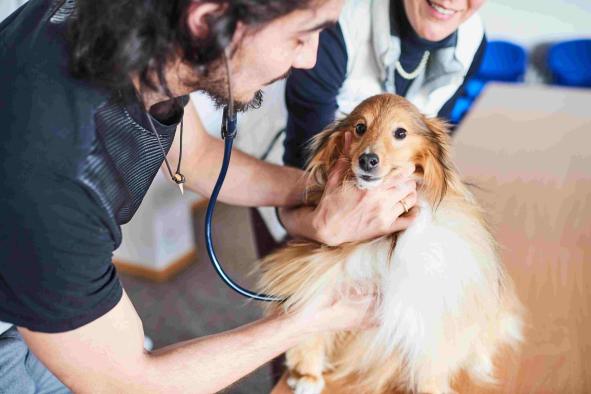
Participation in patient care, lambing, dissection labs, medical imaging, problem-based learning in clinical teams… every effort is made to help you master the concepts and develop your practical skills through hands-on experience with animals.
Hands-on training and animal care at the university’s teaching farm
Starting in your first year, you’ll have the opportunity to bridge the gap between theory and practice through regular, supervised interaction with various animal species. You’ll learn to observe them, handle them, and understand their behavior.
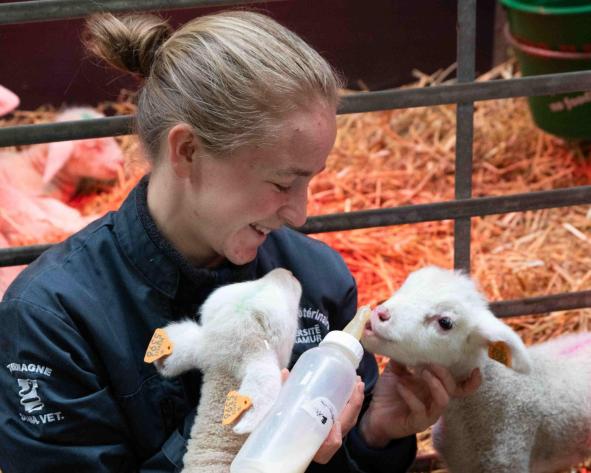
At the teaching farm, you’ll participate in lambing, provide care for newborns, and assist in managing a large herd.
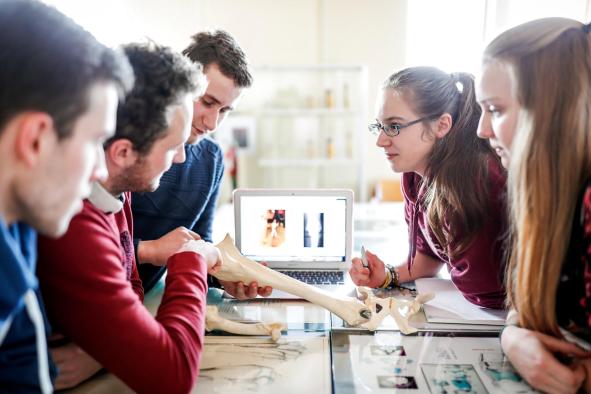
In the laboratory, sessions on dissection, surgical simulation, medical imaging, problem-based learning, and topographic anatomy—among others—complement the courses in anatomy, embryology, and splanchnology. The practical sessions introduce you to various aspects of animal physiology; for example, blood types, blood clotting, electrocardiograms, and sports medicine.
Group Activities and Team-Based Clinics
In groups made up of students from different years, you’ll gain hands-on experience with animals under the supervision of senior students who serve as mentors. Through real-world clinical cases, you’ll not only explore your future profession but also develop teamwork, flexibility, and self-reflection.
Interdisciplinary seminars
Lectures and debates expose you to societal challenges and the roles veterinarians can play in addressing them. Issues such as the welfare of farm animals, animal rights, zoonotic diseases, and natural disasters affect both veterinarians and society as a whole.
Integrated tutorials
Through collaboration with faculty members, integrated activities allow you to make connections between different subjects (physiology and chemistry, neuroanatomy, splanchnology, etc.).
Capstone Project and Student Researcher
By analyzing a scientific question, you develop a scientific and critical mindset, which is essential for medical decision-making.
This project may take the form of a literature review or original research. Upon completion, you will be granted the status of student-researcher. You will participate in drafting research protocols, collecting and analyzing data, publishing results in scientific journals, and presenting findings at conferences.
Animal Science Internships
You also have the opportunity to complete animal husbandry internships on a farm or at a company.
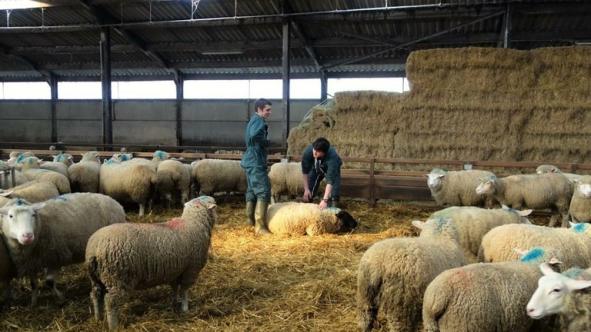
The Faulx-les-Tombes Educational Farm
An exceptional facility dedicated to education!
Organization of Assessments
January, June, and, if necessary, August… three sessions to demonstrate your mastery of the material
In January of your first year, you’ll take the exams for the first-quarter course units. Participation in this exam is mandatory to be eligible for the end-of-year exams.
- If you earn an average of 8/20 or higher, you will continue your first year of the Bachelor of Veterinary Medicine program in the second quadrimester.
- If you earn an average below 8/20, the examination board will invite you to a one-on-one meeting to provide guidance. You may be advised to consider transferring to other programs of study—possibly in the health sector—at a university or college.
However:
- you may request to enroll in a remedial program for the science course units with a view to potentially continuing the veterinary medicine program (or changing your major), with the credits earned for the first quadrimester’s course units being carried over;
- you may also request a reduced course load for the second quadrimester to allow you to take the veterinary medicine entrance exam only in June of the following year.
In June, you will take the exams for the second quadrimester course units to earn the credits.
In June, you will take a second exam: the competitive exam. This exam is held only at the end of the second four-month term and is used to establish a ranking based on the average of the results obtained. To proceed to the next stage of the program, two conditions must be met:
- earn the first 60 credits of the bachelor’s degree;
- be ranked “in order of merit,” that is, within the quota of students to whom the university is authorized to issue the certificate permitting them to continue their studies in veterinary medicine—specifically, the 120 credits that complete the bachelor’s degree in veterinary medicine.
The exams for this competitive entrance exam are multiple-choice.
Depending on the professors’ discretion, exams in the second part of the bachelor’s program in veterinary medicine may be assessed through written or oral examinations. The assessment procedures are explained during the first class and are detailed on the university’s website.
Will you be starting your veterinary medicine studies in September 2027?
Starting in 2027, the veterinary medicine entrance exam will take place before the start of the first year of the bachelor’s program, rather than at the end of the first year, as will still be the case for students enrolling in September 2026.

Support for Success
Succeeding in a year of college involves many challenges.
To help you overcome them, UNamur supports you in developing your academic, methodological, and interpersonal skills—with the help of many professionals.
Preparatory courses, individualized assistance… Discover the resources available to support your education.
After the bachelor's degree: the master's degree
After earning a bachelor’s degree in veterinary medicine, you are eligible to pursue a master’s degree in veterinary medicine. This graduate program can be completed at the University of Liège, the University of Ghent, or any other university in Europe and qualifies you to practice veterinary medicine.
The master’s degree awarded in Belgium is valid throughout Europe. Belgian expertise is widely recognized, and veterinarians easily find employment abroad. There, they can practice their profession in the professional, family, or geographic context of their choice: conventional practice, wildlife in zoos and reserves, development cooperation, and more.
Contacts
Faculty of Science
2 Grafé Street • B-5000 Namur
Office
Ms. A. Brouir, Ms. S. Duvivier, and Ms. C. Haeck
Tel.: +32 (0) 81 72 45 00
secretariat.sciences@unamur.be
Veterinary Medicine Office
Ms. M. Rafaelle
Tel.: +32 (0) 81 72 43 76
secretariat.medvet@unamur.be
-
Code Name Staff Th.+Ex. Credits/Block 1 2 3 Sustainable developmentImage
SVETB101 Ethology of domestic animals 30h th. + 12h ex. 4 SVETB205 Ecology applied to domestic animals Cabaraux Jean-François 30h th. + 12h ex. 4 -
Life sciences
Code Name Staff Th.+Ex. Credits/Block 1 2 3 SBIOB105 General biology Vervoort Arnaud 35h th. + 16h ex. 4 SBIOB104 Animal biology Silvestre Frédéric 35h th. + 12h ex. 5 SVETB116 Biochemistry Hennequart Marc Boonen Marielle 30h th. 4 SVETB218 Physiologie animale I Hontoir Fanny Silvestre Frédéric 25h th. + 16h ex. 4 SVETB228 Animal physiology II Hontoir Fanny 35h th. + 15h ex. 5 SMEDB200 Biochemistry of domestic animals I Hennequart Marc Hamer Isabelle 30h th. + 30h ex. 3 SBIOB206 Genetics applied to veterinary medicine Matroule Jean-Yves 30h th. + 15h ex. 6 SMEDB206 Biochemistry of domestic animals II Hennequart Marc 30h th. 4 SVETB326 Physiologie animale III Hontoir Fanny 15h th. + 8h ex. 3 SVETB306 Immunologie Gillet Nicolas 24h th. + 6h ex. 4 SVETB318 Nutrition Cabaraux Jean-François 30h th. + 4h ex. 4 SVETB327 Integrated physiological responses III Hontoir Fanny 25h th. + 16h ex. 5 -
Basic sciences
Code Name Staff Th.+Ex. Credits/Block 1 2 3 SVETB198 Chemistry and Life Physics Aprile Carmela Hontoir Fanny Baillieul Diane HEUSKIN Anne-Catherine Colaux Julien 25h th. + 25h ex. 3 English Friendly CoursesImage
SPHYB112 Physics I - Mechanics and waves HEUSKIN Anne-Catherine HEUSKIN Anne-Catherine 60h th. + 24h ex. 6 SPHYB113 Syllabus, webcampus, Teams. Colaux Julien Colaux Julien 30h th. + 11h ex. 3 SPHYB114 Physics III - Optics Colaux Julien Colaux Julien 30h th. + 10h ex. 3 SCHIB103 General chemistry Aprile Carmela 60h th. + 18h ex. 7 SCHIB106 Organic chemistry Baillieul Diane 36h th. + 20h ex. 5 -
Morphology
-
Code Name Staff Th.+Ex. Credits/Block 1 2 3 SVETB324 Epidémiologie et EBM Vandeweerd Jean-Michel 20h th. + 10h ex. 4 SVETB310 Microbiology Gillet Nicolas 35h th. + 15h ex. 4 SVETB313 Applied microbiology Gillet Nicolas 20h th. 2 SVETB319 Parasitology Marcotty Tanguy 25h th. + 6h ex. 3 SVETB301 Applied Ethology Diederich Claire 15h th. + 4h ex. 2 SVETB305 Veterinary biosafety Saegerman Claude 30h th. + 10h ex. 2 SVETB390 Professional immersion intership 20h th. + 64h ex. 2 SVETB308 General pharmacology 24h th. + 10h ex. 3 SVETB325 Foodstuffs 30h th. 3 -
Scientific culture and practice
Code Name Staff Th.+Ex. Credits/Block 1 2 3 SSPSB111 Socio-professional surveys Muylkens Benoît Hontoir Fanny Pontarotti Gaëlle Diederich Claire Vandeweerd Jean-Michel Gillet Nicolas 15h th. + 30h ex. 2 MBIOB132 Biostatistics I Bihin Benoît Bihin Benoît 26h th. 2 MBIOB133 Biostatistics II Bihin Benoît Bihin Benoît 26h th. + 16h ex. 2 UNAM0069 Ethics in human-animal relations Pontarotti Gaëlle 30h th. + 20h ex. 3 SVETB334 Interdisciplinary seminar Pontarotti Gaëlle Hontoir Fanny Diederich Claire Gillet Nicolas Muylkens Benoît Vandeweerd Jean-Michel 30h th. 2 SVETB314 Analysis and defence of a scientific question (end of cycle personal work) Vandeweerd Jean-Michel Cambier Carole 20h th. + 20h ex. 4 -
Choice of courses
Code Name Staff Th.+Ex. Credits/Block 1 2 3 SVETB335 Tutoring Vandeweerd Jean-Michel 4h th. + 20h ex. 2 SVETB336 Zootechnics course 2 Hontoir Fanny Cambier Carole 4h th. + 20h ex. 2 SVETB337 Stage au Centre de Recherches Ovines 2 Hontoir Fanny PETIT Astrid 4h th. + 20h ex. 2 -
Complementary activities
-
Code Name Staff Credits Hours/Quarter 1 2 Sustainable developmentImage
SVETB101 Ethology of domestic animals 4 30h th. + 12h ex. -
Life sciences
Code Name Staff Credits Hours/Quarter 1 2 SBIOB105 General biology Vervoort Arnaud 4 35h th. + 16h ex. SBIOB104 Animal biology Silvestre Frédéric 5 35h th. + 12h ex. SVETB116 Biochemistry Hennequart Marc Boonen Marielle 4 30h th. -
Basic sciences
Code Name Staff Credits Hours/Quarter 1 2 SVETB198 Chemistry and Life Physics Aprile Carmela Hontoir Fanny Baillieul Diane HEUSKIN Anne-Catherine Colaux Julien 3 25h th. + 25h ex. English Friendly CoursesImage
SPHYB112 Physics I - Mechanics and waves HEUSKIN Anne-Catherine HEUSKIN Anne-Catherine 6 60h th. + 24h ex. SPHYB113 Syllabus, webcampus, Teams. Colaux Julien Colaux Julien 3 30h th. + 11h ex. SPHYB114 Physics III - Optics Colaux Julien Colaux Julien 3 30h th. + 10h ex. SCHIB103 General chemistry Aprile Carmela 7 60h th. + 18h ex. SCHIB106 Organic chemistry Baillieul Diane 5 36h th. + 20h ex. -
Morphology
Code Name Staff Credits Hours/Quarter 1 2 SVETB199 Team Clinics I Vandeweerd Jean-Michel Muylkens Benoît Vandeweerd Jean-Michel Diederich Claire Hontoir Fanny 2 5h th. + 20h ex. SVETB103 Animal Ethnography (Partial E-Learning) (niveau B1) Muylkens Benoît Bouchat Hélène 5 12h th. + 8h ex. SVETB112 Cytology Boonen Marielle 2 20h th. SVETB111 General Histology Balligand Thomas Canon Caroline 3 30h th. + 20h ex. SVETB102 Anatomy I Vandeweerd Jean-Michel 2 15h th. -
Scientific culture and practice
Code Name Staff Credits Hours/Quarter 1 2 SSPSB111 Socio-professional surveys Muylkens Benoît Hontoir Fanny Pontarotti Gaëlle Diederich Claire Vandeweerd Jean-Michel Gillet Nicolas 2 15h th. + 30h ex.
-
Code Name Staff Credits Hours/Quarter 1 2 SVETB205 Ecology applied to domestic animals Cabaraux Jean-François 4 30h th. + 12h ex. -
Life sciences
Code Name Staff Credits Hours/Quarter 1 2 SVETB218 Physiologie animale I Hontoir Fanny Silvestre Frédéric 4 25h th. + 16h ex. SVETB228 Animal physiology II Hontoir Fanny 5 35h th. + 15h ex. SMEDB200 Biochemistry of domestic animals I Hennequart Marc Hamer Isabelle 3 30h th. + 30h ex. SBIOB206 Genetics applied to veterinary medicine Matroule Jean-Yves 6 30h th. + 15h ex. SMEDB206 Biochemistry of domestic animals II Hennequart Marc 4 30h th. -
Morphology
Code Name Staff Credits Hours/Quarter 1 2 SMEDB203 Functional and comparative histology I A Nicaise Charles Canon Caroline 4 30h th. + 15h ex. SMEDB204 Functional and comparative histology I B Nicaise Charles Canon Caroline 3 25h th. + 15h ex. SVETB202 Anatomy II: Theoretical musculoskeletal anatomy Vandeweerd Jean-Michel 3 30h th. SVETB203 Anatomy: splanchnology Muylkens Benoît Muylkens Benoît 9 35h th. + 6h ex. 25h th. + 10h ex. SVETB215 6 10h th. + 82h ex. SVETB217 2 15h th. + 8h ex. -
Scientific culture and practice
Code Name Staff Credits Hours/Quarter 1 2 MBIOB132 Biostatistics I Bihin Benoît Bihin Benoît 2 26h th. MBIOB133 Biostatistics II Bihin Benoît Bihin Benoît 2 26h th. + 16h ex. UNAM0069 Ethics in human-animal relations Pontarotti Gaëlle 3 30h th. + 20h ex. -
Complementary activities
Code Name Staff Credits Hours/Quarter 1 2 SVETB295 Applied English 1 (level B2) Malcolm Ophélie Bar Vanina Fievez François-Xavier 2 10h th. + 10h ex. SVETB296 Tutorial 1 Vandeweerd Jean-Michel 2 5h th. SVETB297 Zootechnics course 1 Hontoir Fanny Cambier Carole 2 5h th. 5h th. SSPSB203 Psychology Ravez Laurent 2 22.5h th. SVETB343 Internship at the Centre de Recherches Ovines 1 PETIT Astrid Hontoir Fanny 2 20h ex. SVETB393 Pedagogical project Vandeweerd Jean-Michel 3 5h th. SVETB394 Development project Vandeweerd Jean-Michel 3 5h th. SBIOB120 Data management in life sciences, basic principles De Laender Frédérik 2 8h th. + 12h ex. SBIOB220 Data Analysis in Life Sciences Lima Mendez Gipsi 2 12h th. + 15h ex. SBIOB003 Pluridisciplinary scientific field trip Silvestre Frédéric Yans Johan Yans Johan Silvestre Frédéric 3 48h th. + 48h ex. Sustainable developmentImage
MMEDB360 One Health Wieërs Grégoire Lachapelle Amélie Canon Caroline 3 15h th.
-
Life sciences
Code Name Staff Credits Hours/Quarter 1 2 SVETB326 Physiologie animale III Hontoir Fanny 3 15h th. + 8h ex. SVETB306 Immunologie Gillet Nicolas 4 24h th. + 6h ex. SVETB318 Nutrition Cabaraux Jean-François 4 30h th. + 4h ex. SVETB327 Integrated physiological responses III Hontoir Fanny 5 25h th. + 16h ex. -
Morphology
Code Name Staff Credits Hours/Quarter 1 2 SVETB395 Anatomy III: Clinical anatomy Vandeweerd Jean-Michel 5 104h ex. SVETB320 Team Clinics III Hontoir Fanny Muylkens Benoît Vandeweerd Jean-Michel Diederich Claire Vandeweerd Jean-Michel 2 5h th. + 20h ex. SVETB307 Anatomy of domestic animals Hontoir Fanny Vandeweerd Jean-Michel 4 30h th. + 10h ex. -
Code Name Staff Credits Hours/Quarter 1 2 SVETB324 Epidémiologie et EBM Vandeweerd Jean-Michel 4 20h th. + 10h ex. SVETB310 Microbiology Gillet Nicolas 4 35h th. + 15h ex. SVETB313 Applied microbiology Gillet Nicolas 2 20h th. SVETB319 Parasitology Marcotty Tanguy 3 25h th. + 6h ex. SVETB301 Applied Ethology Diederich Claire 2 15h th. + 4h ex. SVETB305 Veterinary biosafety Saegerman Claude 2 30h th. + 10h ex. SVETB390 Professional immersion intership 2 20h th. + 64h ex. SVETB308 General pharmacology 3 24h th. + 10h ex. SVETB325 Foodstuffs 3 30h th. -
Scientific culture and practice
Code Name Staff Credits Hours/Quarter 1 2 SVETB334 Interdisciplinary seminar Pontarotti Gaëlle Hontoir Fanny Diederich Claire Gillet Nicolas Muylkens Benoît Vandeweerd Jean-Michel 2 30h th. SVETB314 Analysis and defence of a scientific question (end of cycle personal work) Vandeweerd Jean-Michel Cambier Carole 4 20h th. + 20h ex. -
Choice of courses
Code Name Staff Credits Hours/Quarter 1 2 SVETB335 Tutoring Vandeweerd Jean-Michel 2 4h th. + 20h ex. SVETB336 Zootechnics course 2 Hontoir Fanny Cambier Carole 2 4h th. + 20h ex. SVETB337 Stage au Centre de Recherches Ovines 2 Hontoir Fanny PETIT Astrid 2 4h th. + 20h ex. -
Complementary activities
Code Name Staff Credits Hours/Quarter 1 2 SBIOB003 Pluridisciplinary scientific field trip Silvestre Frédéric Yans Johan Yans Johan Silvestre Frédéric 3 48h th. + 48h ex. SVETB391 Research student (linked to SVETB314) Vandeweerd Jean-Michel 2 5h th. SVETB392 Research Student + (Linked to SVETB314 and SVETB391) Vandeweerd Jean-Michel 2 5h th. SVETB399 Applied English 2 (Linked to SVET B314 and SVET B392) (level B2+) Malcolm Ophélie Bar Vanina Fievez François-Xavier 2 10h th. + 10h ex. SVETB393 Pedagogical project Vandeweerd Jean-Michel 3 5h th. SVETB394 Development project Vandeweerd Jean-Michel 3 5h th. SVETB345 Participation in the scientific information of practising veterinarians Vandeweerd Jean-Michel 2 5h th. SSPSB203 Psychology Ravez Laurent 2 22.5h th. Sustainable developmentImage
MMEDB360 One Health Wieërs Grégoire Lachapelle Amélie Canon Caroline 3 15h th.
Veterinary Careers
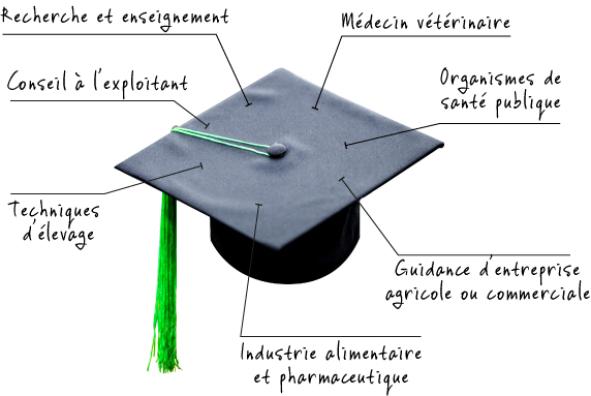
Veterinary professions
The veterinary profession offers exciting and varied career opportunities. Veterinarians may specialize in treating companion animals, horses, or farm animals. They may also provide consulting services to agricultural or commercial businesses. Their training also enables them to contribute to public health. Additionally, they may pursue careers in research or teaching.
Veterinarians
Veterinary practitioners can choose to work with all animal species (general practitioners) or focus on specific ones (canine, equine, or rural practice). They may also choose to work as general practitioners or, as in human medicine, specialize in a particular discipline (medical imaging, surgery, ophthalmology, dermatology, equine internal medicine, companion animal reproduction, etc.). An official specialist designation may be granted upon completion of additional training. Veterinarians, however, are fortunate to be able to practice using state-of-the-art technology without needing to hold a specialist certification.
Experts
Private practice in rural areas can extend beyond the individual care of animals to include advising farmers (breeders, feedlot operators, dairy producers, etc.) on health-related matters (deworming, vaccination, use of medications), ecological factors (facility layout), and zootechnical aspects (nutrition). The food industry (slaughterhouses, stores, etc.) and the pharmaceutical industry employ veterinarians to conduct market research, develop research protocols, handle sales, and ensure product quality control. Veterinarians may also work for official public health agencies (for example, the Federal Agency for the Safety of the Food Chain). Others focus their work on reproductive techniques (artificial insemination, embryo transfer).
The Role of a Faculty Member and Researcher
Training in veterinary medicine opens the door to basic or applied research. Research is conducted in private laboratories at pharmaceutical companies or in those of public organizations (such as the Pasteur Institute, the Center for Veterinary and Agrochemical Studies and Research, etc.) and at universities. Veterinarians may also participate in the basic training of students at veterinary schools and in the continuing education of graduates. Others teach scientific disciplines at the graduate level.