Rather than attempting to define vulnerability in abstract terms, the Center has chosen to focus primarily on vulnerable individuals and the contexts in which they live. Women, children, the elderly, victims, people with disabilities, and members of gender minorities are thus at the heart of the Center’s research. “We always start with the field, with real-life experiences, and then examine the law and its capacity to protect, provide redress, or prevent, explains Stéphanie Wattier, co-director of the Center.

Stéphanie Wattier
Stéphanie Wattier, co-director of the Center for Vulnerabilities and Societies (V&S)

A center rooted in interdisciplinarity and societal transitions

Since joining the Transitions Research Institute in 2024, the V&S; Center has strengthened its interdisciplinary approach. While law remains its foundation, dialogue with other disciplines (philosophy, history, political science, geography, etc.) is essential. “Law is indispensable for structuring society, but it often comes too late. It must be informed by sociological, anthropological, or medical analyses to truly drive change in norms, emphasizes Stéphanie Wattier.

This openness allows the 47 researchers at the V&S; Center to better grasp the complexity of the phenomena they study and avoid a purely normative approach. It also fosters fruitful collaborations with external partners: grassroots organizations, NGOs, public institutions, judges, lawyers, and policymakers. These ongoing exchanges fuel research and strengthen its societal impact.

Conferences and Publications: Bridging the Gap Between Law and Practice

Each year, the Center organizes a conference centered on a unifying theme, chosen based on contemporary societal issues. These gatherings serve as key opportunities for dialogue among researchers and practitioners in the field. They often lead to the publication of collective works, designed as tools for reflection and action.

To mark its tenth anniversary, the Center organized a conference dedicated to a subject that is both sensitive and essential: “Combating Sexual Violence.” This choice came naturally. “Many of us were working, directly or indirectly, on this issue. And despite its prevalence, sexual violence is still under-addressed in legal scholarship, explains the Center’s co-director.

Combating sexual violence: a committed stance

The anniversary symposium brought together legal professionals, specialized organizations (“Breaking the Silence” and “Lawyers Victims Assistance”), researchers from other disciplines, judges, attorneys, and institutional representatives. This diversity reflects the Center’s philosophy: bringing together different perspectives to better understand and take action. Discussions focused on a legal analysis of sexual violence experienced by various groups, including children, the elderly, people with disabilities, and victims of armed conflict; but also on the settings where it occurs, whether in the family, online, or within institutions such as the Catholic Church, higher education, or the medical field.

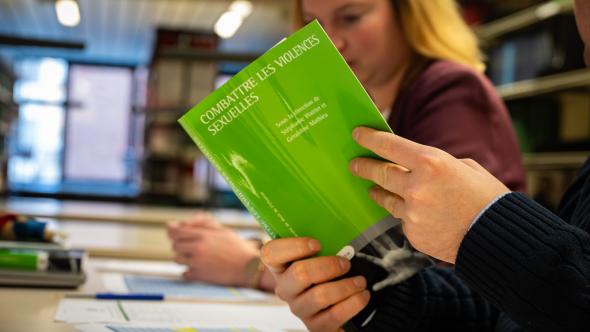
This work resulted in a collective volume published by Larcier, titled “Combattre les violences sexuelles.” The choice of title is no accident. “We wanted to adopt a clearly committed stance. The role of legal doctrine is not only to describe the law, but also to shed light on phenomena that have been silenced or trivialized for too long, explain Stéphanie Wattier and Géraldine Mathieu, coordinators of the book and co-directors of the Center.

The publication highlights two major findings: women and children remain the primary victims of sexual violence, and the law, while indispensable, remains insufficient on its own. The contributions underscore the difficulties related to evidence, compensation for physical and psychological harm, as well as the limitations of an exclusively criminal justice response.

Prevention is the best defense

Through the Center’s conferences and publications—whether addressing gender-based violence from a legal perspective or the rights of intersex people—a common thread emerges: the conviction that prevention is essential. “Punishment isn’t enough. We need to act upstream—raise awareness, educate, and change mindsets. The law can support these changes, but it can’t do everything, insists Stéphanie Wattier.

It is precisely this interplay between the law, on-the-ground realities, and prevention that has been the strength of the Center for Vulnerabilities and Societies for the past ten years. By giving a voice to victims, frontline workers, and researchers, it helps to change norms, practices, and, gradually, society itself. After ten years of existence, the Center continues to pursue its mission: to put the law at the service of people, so that it becomes a true lever for protection, recognition, and social transformation.

Cet article est tiré de la rubrique "Le jour où" du magazine Omalius #40 (Avril 2026).

cover-magazine-omalius-avril-2026