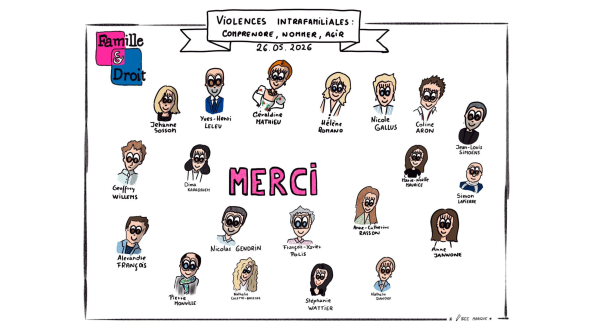
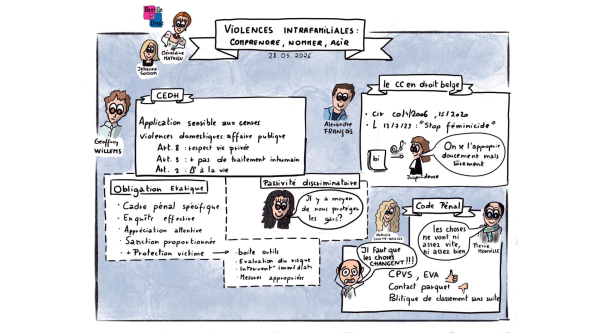
While domestic violence is becoming an increasingly prominent topic in public discourse, this does not mean that it is fully understood. On the contrary. It was this observation that led to the creation of the biennial conference of the Association Famille & Droit, co-chaired by Professor Géraldine Mathieu and Professor Yves-Henri Leleu, which brings together family law professors from French-speaking universities in Belgium. Organized with the support of the “Children’s Rights” Unit at the Vulnerabilities & Societies (V&S) Center at UNamur and the SMAJ (Marche Service for Assistance to Litigants), it brought together 230 researchers, judges, lawyers, psychologists, and practitioners united by a shared conviction: to better understand a complex phenomenon in order to respond to it more effectively. This collective reflection led to the publication of the anthology *Intrafamilial Violence: Understanding, Identifying, and Taking Action: An Interdisciplinary and Systemic Approach*, published by Larcier-Intersentia and edited by Professor Géraldine Mathieu.

Image
Photo  de Géraldine Mathieu, professeure à la Faculté de droit et co-directrice du Centre Vulnérabilités & Sociétés

Having the courage to see the nuances—not to downplay acts of violence, but to better understand situations and develop more appropriate responses.” 

Géraldine Mathieu Co-director of the Center for Vulnerabilities & Societies and professor of family law.

Going Beyond the Obvious

“There are topics that a society can never discuss too much, as long as it continues to learn and question itself,” says Géraldine Mathieu. One of the central themes of the conference and the book is precisely the call to “have the courage to be nuanced—not to downplay violence, but to better understand situations and develop more appropriate responses.”

Understand, name, act: these three verbs structure the book just as they structured the conference. Three verbs that, according to the professor, “emerged naturally,” as they reflect both an ethical and an intellectual imperative in the face of realities that “defy simplistic explanations.”

Coercive Control: Shifting Our Perspective to Understand

One of the book’s major contributions is that it places the concept of coercive control at the heart of its analysis. “It invites us to shift our perspective, explains Géraldine Mathieu. “It reminds us that domestic violence is not limited to a few visible incidents, but can be part of a gradual dynamic of control and domination.”

This concept helps us grasp a reality that has long been underestimated: a person can gradually lose their freedom, self-confidence, or autonomy without there necessarily being any physical violence. Isolation, surveillance, control over finances or movements, systematic belittling… these are all mechanisms that build lasting control, the consequences of which can be just as devastating as physical violence. The book explores how this concept, now recognized within the Belgian legal system, compels the law to listen more closely to victims and to “take seriously realities that sometimes fell outside our usual categories,” explains Géraldine Mathieu.

Colloque violences intrafamiliales - Dessin expliquant le contrôle Coercitif

Invisible Violence: Naming It to Acknowledge It

The book also devotes significant attention to invisible forms of violence (psychological, economic, administrative, or digital), including those that continue after separation and those that affect children. “To name it is already to acknowledge it. And to acknowledge it is to enable better protection,” emphasizes Géraldine Mathieu.

These forms of violence pose a major challenge: they defy existing legal categories, often evade reporting mechanisms, and remain underdocumented. The book’s contributions aim to bring these forms of violence to light through statistical, sociological, and clinical approaches, while also examining the blind spots in public policy. As Géraldine Mathieu puts it: “Words are not just for describing the world. Identifying a form of violence means acknowledging what victims are going through and better understanding the mechanisms at work.”

The law is essential, but it cannot act alone

In the face of this complexity, compartmentalized approaches reveal their limitations. The book brings together 25 contributions from academics, judges, lawyers, clinicians, and practitioners in the field, all sharing a common conviction: “The most relevant solutions emerge when everyone contributes their experience and is willing to learn from others.”

The law (criminal, family, property, and juvenile) is analyzed in depth at the Belgian, European, and international levels, but is constantly placed in dialogue with psychology, sociology, and practices in the field.

The conference embodied this same approach. By bringing together in one room professionals who do not always cross paths, it allowed new perspectives to emerge. “When professionals who don’t always follow the same practices take the time to listen to one another, new ideas emerge and everyone leaves a little changed,” observes Géraldine Mathieu. The outcome exceeded her expectations: for Marie-Amélie Delvaux, an attorney and lecturer at the Faculty of Law, the day was “eye-opening”: “We’re leaving with concrete tools; the speakers drew us into their cause.”

The book builds on this momentum by presenting innovative approaches and inspiring practices to improve the identification, prevention, and support of victims. 

The Vulnerabilities & Societies Center (V&S;)

The Vulnerabilities & Societies Research Center at UNamur takes a resolutely interdisciplinary approach to situations of human vulnerability, at the intersection of law, psychology, and the social sciences. It pays particular attention to vulnerable populations and fundamental rights.

Its unique character is based on a twofold goal: to produce rigorous knowledge and to foster dialogue between academic scholarship and practical fieldwork.

Addressing serious issues with rigor, but also with enough openness to learn from others,” summarizes Géraldine Mathieu, co-director of the center.

Beyond research and teaching, V&S; sees itself as a meeting place between the academic world and the field, convinced that knowledge realizes its full value when it is shared and discussed. This mission is fully illustrated by this conference and the accompanying book.