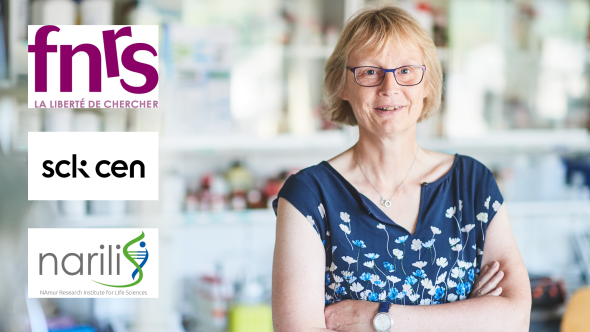
Over the past two decades, Carine Michiels, professor of cell biology at UNamur and member of the radiobiology group at UNamur's life sciences research institute (NARILIS), has significantly advanced our understanding of the molecular mechanisms underlying the interaction between radiation and cancer cells. Within the Institute's cancer center, her research is based on a strong integration of cell biology and radiation physics, supported by a long-standing collaboration with the Institute's physicists, Professor Stéphane Lucas and Professor Anne-Catherine Heuskin. By bridging the gap between biology and physics, his team has conducted cutting-edge interdisciplinary research with the aim of improving the effectiveness of radiation therapy for cancer. 

Preserving healthy cells

One of their main achievements is the development of innovative therapeutic approaches that combine advanced irradiation techniques, such as proton therapy, with unique nanohybrid compounds. These compounds, consisting of gold nanoparticles coupled with targeted antibodies, act as radiosensitizers, increasing the sensitivity of cancer cells to radiation while limiting damage to surrounding healthy tissue.

By paving the way for more precise and personalized cancer treatments, Carine Michiels' research is fully in line with the objectives of the SCK CEN Chair. Her achievements illustrate how fundamental research in radiation sciences can translate into significant advances in medicine and public health.

Long-standing collaborations

The University of Namur and SCK CEN have been collaborating for many years, notably through joint research projects and co-supervision of theses, including most recently that of Naomi Daems, for which Carine Michiels and Stéphane Lucas were co-supervisors alongside Professor Sarah Baatout (SCK CEN).  Thanks to the latter, Carine Michiels joined the group of experts of the Belgian delegation to UNSCEAR (United Nations Scientific Committee on the Effects of Atomic Radiation), an international UN committee set up to assess the effects of ionizing radiation on human health and the environment.

Image
Photo de Carine Michiels

I would particularly like to thank my colleagues Sarah Baatout from SCK CEN, Stéphane Lucas and Anne-Catherine Heuskin from UNamur for their research collaboration. I would also like to thank Télévie from F.R.S.-FNRS and the strategic research project Proton Therapy Research in Wallonia (PROTHER-WAL) from SPW Recherche for their support!

Carine Michiels Professor of Cell Biology, UNamur

A series of conferences in Mol

In addition to receiving a personal award, the SCK CEN Chair holder will give an inaugural lecture and a series of lectures for students, SCK CEN researchers, and the Belgian nuclear community in general during a scientific visit to the Research Center in Mol, Belgium. The series of lectures will be organized in collaboration with the SCK CEN Academy.

Namur Research Institute for Life Sciences (NARILIS)

NARILIS seeks to stimulate two-way interactions between basic researchers and clinicians, and to build bridges between the laboratory and the patient's bedside. NARILIS therefore aims to facilitate the translation of basic research findings into clinical applications. Its mission is to promote multidisciplinary research in order to improve human and animal health and quality of life.

Logo institut de recherche narilis