
Bachelor in Law (Evenings and Weekends Schedule)
-
Schedule
staggered hours
- ECTS Credits 180

Bachelor of Laws with a flexible schedule from UNamur
Are you interested in returning to university to study law while continuing your professional career or fulfilling your personal commitments? The University of Namur’s part-time Bachelor of Law program is specifically designed for adults who wish to pursue a rigorous and academically demanding education in law, while benefiting from a schedule that is compatible with their professional and family lives.
This 180-ECTS-credit program, spread over three annual blocks, leads to the same degree as the full-time Bachelor of Law program and offers the same opportunities for master’s studies and a career in law.
Why choose UNamur’s part-time Bachelor of Laws program?
A solid and recognized legal education
From the very start of the program, you will take the core legal courses that form the foundation of every lawyer’s education: public law, private law, and legal methodology.
These courses are complemented by non-legal courses (history, philosophy, sociology, economics, etc.) that enhance your general knowledge, critical thinking, and analytical skills.
A practical and career-oriented approach
Throughout the bachelor’s program, theoretical knowledge is put to the test in practical situations:
- resolving real-world cases inspired by the practice of lawyers, judges, notaries, or in-house counsel,
- drafting legal documents,
- analyzing legislative texts, case law, and legal doctrine.
You learn to think like a legal professional, to structure a rigorous argument, and to draw on legal sources, just as in professional practice.
Strengthening Language Skills
Proficiency in English and Dutch is essential in the legal profession.
The program includes specific academic support to gradually develop these language skills, which are essential in the Belgian and European legal context.
Are the teaching methods specific to the staggered schedule?
The UNamur School of Law has developed a teaching approach specifically designed for a staggered schedule, based on:
- realistic time management and academic expectations,
- a collaborative work environment,
- close interaction with faculty and teaching assistants,
- an approach to co-constructing knowledge that takes into account the professional and civic experience of an adult student body
- a focus on in-depth understanding of the subject matter.
Practical resources to support your learning journey
- Adapted course materials, including audio and video clips, as well as recordings of most classes made available on the UNamur platform.
- Small-group exercises, promoting discussion and the analysis of practical cases, led by legal professionals.
- Mock trials, drafting of legal opinions and briefs, supervised assignments, and participation in a public speaking competition to bring you closer to the realities of the legal profession.
- Q&A sessions, office hours, and scheduled consultations to support your progress.
- Individual or small-group support for drafting legal papers.
- A dedicated academic coordinator who serves as your primary point of contact for program monitoring, methodological questions, work-time management, and balancing the curriculum with your personal and professional life.
A comprehensive digital environment
You have access to UNamur’s digital tools: Virtual Student Office, WebCampus, Teams, Intranet, legal databases (for completing assignments)…
All materials (syllabi, presentations, answer keys, forums) are centralized to enable hybrid learning, compatible with your professional commitments. At the start of the semester, UNamur’s Reprographics Service organizes late-afternoon drop-in sessions specifically for students on the staggered schedule.
Aware of the daily realities faced by adult students returning to school, and drawing on ten years of experience since the program’s launch in 2016, the UNamur Faculty of Law encourages in-person learning while implementing hybrid teaching methods.
The same services as day students
Students on the staggered schedule have access to all of UNamur’s support services: the Medical-Psychological Unit, integrated services of the Faculty of Education and Training Sciences (FaSEF), notably the Interfaculty Academic Support Unit.

What are the class schedules for the part-time bachelor's program in law?
The program offers a flexible and predictable schedule:
- approximately 12 hours of classes per week,
- spread over three evenings (Monday, Tuesday, and Thursday, 6:00–9:00 p.m.) and Saturday morning (9:00 a.m.–1:00 p.m., sometimes until 5:00 p.m.).
Possible adjustments
- Exemptions may be granted if you already have university credits, allowing you, depending on your background, to enroll directly beyond the first 60-credit block.
- Option to reduce your course load (fewer than 60 credits/year) for professional, social, academic, or medical reasons, with a personalized accommodation plan.
- You may apply for recognition as a student with special needs and receive reasonable accommodations, which vary by category (“student with a disability,” “student who is a young parent,” “pregnant woman,” etc.)
Do you have a short-term degree?
If you already hold a short-track bachelor’s degree in law (from a college or adult education program), a two-year program is available:
• up to 61 credits exempted,
• 59 credits in the first year,
• 60 credits in the second year. This allows
you to benefit from an optimized program without compromising on the quality of your education.
Paid educational leave
The part-time Bachelor of Laws program at UNamur entitles eligible employees to paid educational leave.
What career opportunities are available after completing a part-time bachelor's degree in law?
The degree awarded is strictly equivalent to that of the full-time bachelor’s program.
It grants admission to:
- the Master’s in Law (evening or daytime schedule),
- the Master’s in Criminology,
- to other master’s programs accessible with accommodations.
UNamur offers a joint Master’s in Law (evening schedule) with UCLouvain, paving the way to all legal professions.
FAQ - Frequently Asked Questions About the Part-Time Bachelor of Laws Program at UNamur
What is the part-time Bachelor of Laws program at UNamur?
It is a 180-credit university program, held in the evenings and on Saturdays, designed primarily for adults who wish to resume or continue their law studies while maintaining a professional career or personal responsibilities.
Who is the part-time Bachelor of Law program for?
This program is designed for working professionals, parents, individuals seeking a career change, or those with prior degrees who wish to study law within a rigorous academic framework, while benefiting from a schedule compatible with their professional and personal commitments. Certain arrangements have been specifically designed to accommodate these constraints: for example, two exam dates are offered per course during the first evaluation period of the first semester,
Is the degree earned through the part-time program identical to that of the full-time bachelor’s program?
Yes. The Bachelor of Law degree earned through the part-time program is strictly identical to the one awarded through the full-time program. It offers the same eligibility for master’s programs and the same career prospects.
What are the class schedules for the part-time Bachelor of Law program?
Classes are held primarily in the evenings (Mondays, Tuesdays, and Thursdays from 6:00 PM to 9:00 PM) and on Saturday mornings (9:00 AM to 1:00 PM), sometimes extending into the late afternoon. The course load is approximately 12 hours of class time per week.
Is the program suitable for students returning to school after several years?
Yes. The UNamur School of Law offers specific academic support: guidance on academic work methods, individualized follow-up, supervision of assignments, access to digital resources, and availability of faculty and teaching assistants.
What subjects are taught in the part-time Bachelor of Law program?
The program covers the fundamentals of public and private law, legal methodology, as well as supplementary courses in history, philosophy, sociology, and economics. The goal is to train generalist lawyers capable of critical analysis and rigorous legal reasoning.
Does the part-time Bachelor of Law program provide access to a Master of Law program?
Yes. The part-time Bachelor of Law program provides direct access to the Master of Law program at universities in the Wallonia-Brussels Federation and the Flemish Community. UNamur co-organizes the part-time Master of Law program with UCLouvain.
-
Law
-
Humanities
Code Name Staff Th.+Ex. Credits/Block 1 2 3 Soft skillsImage
DRHDB120 History of Political Institutions 30h th. 5 Soft skillsImage
DRHDB121 Introduction to philosophy Ruffo de Bonneval de la Fare des Comtes de Sinopoli de Calabre Marie-Des-Neiges 30h th. 5 EFASB254_B1 Principles of economics Dejardin Marcus 30h th. 5 DRHDB220 Philosophy of law Montero Redondo Etienne 45h th. 7 EFASB321 Sociology Burnay Nathalie 45h th. 6 -
Languages
Code Name Staff Th.+Ex. Credits/Block 1 2 3 DRHDB141 Dutch (minimum level B1) Bulon Amélie 30h th. 5 DRHDB142 English for Legal Professionals (level B2) Hansel Aude 30h th. 5 DRHDB240 Dutch legal terminology (minimum level B2) 30h th. 5
-
Law
Code Name Staff Credits Hours/Quarter 1 2 DRHDB101 Constitutional law Wattier Stéphanie 9 60h th. Soft skillsImage
DRHDB102 Sources, principles and methods of law II Defreyne Élise 4 30h th. DRHDB103 Civil liability law Colson Pauline 5 30h th. Soft skillsImage
DRHDB104 Historic foundations of the private law Rolain Mathieu 9 60h th. DRHDB105 Practical law exercises 3 20h th. Sustainable developmentImage Soft skillsImage
EFASB210_B1 Sources, principles and methods of law I Degrave Élise 5 30h th. -
Humanities
Code Name Staff Credits Hours/Quarter 1 2 Soft skillsImage
DRHDB120 History of Political Institutions 5 30h th. Soft skillsImage
DRHDB121 Introduction to philosophy Ruffo de Bonneval de la Fare des Comtes de Sinopoli de Calabre Marie-Des-Neiges 5 30h th. EFASB254_B1 Principles of economics Dejardin Marcus 5 30h th. -
Languages
Code Name Staff Credits Hours/Quarter 1 2 DRHDB141 Dutch (minimum level B1) Bulon Amélie 5 30h th. DRHDB142 English for Legal Professionals (level B2) Hansel Aude 5 30h th.
-
Law
Code Name Staff Credits Hours/Quarter 1 2 Sustainable developmentImage
Soft skillsImage
DRHDB201 Criminal law and procedure Basecqz Nathalie Lombaerd Bastien 12 75h th. DRHDB203 Law of obligations and contracts George Florence 12 75h th. Soft skillsImage
DRHDB204 Family law Mathieu Géraldine 7 45h th. DRHDB205 Methodology and law work Wattier Stéphanie 6 15h th. + 15h ex. 30h ex. DRHDB206 Practical legal exercises 5 12h th. 8h th. -
Humanities
Code Name Staff Credits Hours/Quarter 1 2 DRHDB220 Philosophy of law Montero Redondo Etienne 7 45h th. EFASB321 Sociology Burnay Nathalie 6 45h th. -
Languages
Code Name Staff Credits Hours/Quarter 1 2 DRHDB240 Dutch legal terminology (minimum level B2) 5 30h th.
-
Law
Code Name Staff Credits Hours/Quarter 1 2 DRHDB307 European Union law De Streel Alexandre Defreyne Élise 6 30h th. DRHDB301 Social law Flohimont Valérie 5 30h th. DRHDB302 Public liberties Wattier Stéphanie 5 30h th. DRHDB303 Principles of private judicial law LEMAIRE Anne-Sophie 5 30h th. DRHDB304 Practical law exercises Ghislain Sarah Troisfontaines Alice 7 12h th. 8h th. Soft skillsImage
DRHDB305 End of cycle work Rolain Mathieu 10 Soft skillsImage
EFASB311 Economic law Jacquemin Hervé Hubin Jean-Benoît 8 45h th. DRHDB306 Public and administrative law Nihoul Marc 8 45h th. DRHDB313 Property Law 3 30h th. DRHDB316 Intellectual Property Rights Desaunettes Luc 3 30h th.
Jury
Legal careers
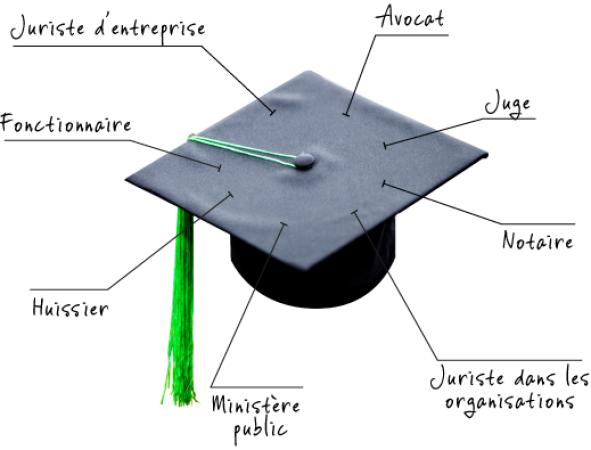
Legal professions
A constantly changing profession
Legal professions are evolving. It's no longer just a matter of intervening in litigation to defend a party or settle a dispute. Lawyers are also the advisors who prevent conflict by scrutinizing the applicable legislation or finalizing a contractual approach. Increasingly, they are called upon to intervene in non-judicial dispute resolution procedures, such as mediation.
Another notable development is internationalization. More and more cases have a foreign element, or are subject to supranational law such as European Union law. Finally, the development of information technologies is changing the day-to-day work of lawyers, while opening up new fields of specialization within the law.
The omnipresence of law in social and economic life explains the diversity of career opportunities open to legal professionals.
The professions of the lawyer
Lawyers are versatile professionals. The functions described here represent the core of the legal profession, but the list of outlets is far from exhaustive.
The judiciary
Magistrates are appointed for life by the King. There are two categories among them, the public prosecutor and the judges.
The Public Prosecutor's Office
Public prosecutors (known as "auditeurs" in first-degree labor courts) and their substitutes, grouped together in the Public Prosecutor's Office (also known as "the standing magistracy" or "the public prosecutor's office"), are in charge of public order. These magistrates prosecute offenders, coordinate police investigations, summon defendants to court and ensure that sentences are carried out. They intervene in economic and financial matters, environmental issues, computer crime, youth protection, social legislation offences... and of course in common law cases (traffic, vice, theft, assault...).
The public prosecutor may also be called upon to advise the court on the appropriate resolution of the dispute, in family matters, labor or social security law or in certain commercial cases.
Judges
Judges (also known as the "magistrature assise" or "the bench") are responsible for adjudicating disputes between individuals (in civil or social law matters) and judging those prosecuted for offenses (in criminal matters). Judges are appointed to various courts and tribunals, including justices of the peace, police courts, courts of first instance, labor courts, commercial courts, courts of appeal, labor courts and the Court of Cassation. Increasingly, judges are also playing a conciliatory role. Outside their hearings, judges study their cases, carry out the appropriate research and draft their judgments. Most judges are specialized. For example, police court judges mainly settle disputes relating to traffic offences and compensation for the consequences of road accidents; labor courts have jurisdiction over disputes between employers and workers, or in matters of safety and social welfare; justices of the peace hear rental disputes, relations between neighbors, and the protection of the mentally ill, among other matters; the family court has jurisdiction to settle family disputes and ensure the protection of children.
To become a magistrate, the main routes are, on the one hand, the competitive examination for admission to the judicial internship (followed by a 24-month internship) for those presenting at least two years' experience in a legal profession, and on the other hand the professional aptitude examination (allowing immediate appointment) for those demonstrating at least five years' experience in a legal profession to become a member of the public prosecutor's office and at least ten years to become a judge.
Notaries
The mission of notaries is to avoid conflicts between people wishing to reach agreements in the fields of real estate (purchase/sale of property, loans...), family (marriage contracts, gifts, inheritance...) and business (incorporation of companies, mergers...). They listen, advise and give opinions. They draw up authentic deeds that record agreements in writing, in a form that is legally unassailable. To embark on a career as a notary, you need, among other things, to pass a master's degree specializing in notarial practice and complete a three-year internship with an appointed notary.
Lawyers
Lawyers are self-employed individuals charged with advising clients facing legal problems in their private or professional lives, in strict compliance with legislation and ethical rules. Lawyers can assist their clients from the conception and launch of a project (drafting opinions and contracts) through to the various stages of dispute resolution (negotiation, mediation, legal proceedings). Their tasks are varied: researching legislation, case law and doctrine, drafting numerous written documents (letters, conclusions), organizing conciliation meetings, taking part in expert appraisals, pleadings... The lawyer's profession sometimes presents faces that are less familiar to the general public. For example, it is often lawyers who act as bankruptcy trustees, liquidators of a vacant estate, debt mediators, or administrators of the assets of vulnerable persons...
Lawyers newly admitted to the Bar must complete a three-year internship with an experienced lawyer before they can join the roll of the Ordre and practice the profession on their own. Many lawyers, however, choose to create or join associations, which in particular enables them to offer more specialized and diversified services.
Bailiffs
Bailiffs are public officers who intervene at various stages of legal proceedings. They communicate procedural documents to litigants (summonses, judgments, etc.). They are also responsible for enforcing court decisions, possibly through seizure. They draw up statements of facts (adultery, certain products on offer, unauthorized use of a brand name on a website, etc.). Their image is unfairly negative. In reality, they can play a conciliatory role, guaranteeing equal treatment for those subject to the law, while respecting everyone's rights. Law graduates can become bailiffs after two years' training and passing a competitive examination. After five years, they can then apply for a
vacant position as a "titular" bailiff.
Lawyers in public and private organizations
Company lawyers
Companies in general (industry, banking, insurance, telecommunications...) employ many lawyers in their various departments (human resources management, litigation, regulations...). Only members of the Institut des juristes d'entreprise can hold the corresponding title. These specialists are consulted on a daily basis by their employers on all legal issues (commercial, tax, environmental, social, etc.). For example, they advise on drafting and negotiating contracts. They also intervene in the event of litigation, although they do not represent the company in court, as they are not lawyers. Finally, they guarantee the legality of the various decision-making procedures within the company (they prepare boards of directors, for example).
Officials
In public services at federal, regional, community, provincial or municipal level (federal public services - SPF, CPAS, ONEM, Forem...), lawyers prepare opinions for managers on matters specific to their administration, focusing on the legal aspects. They play an active role in the preparation of legislative and regulatory texts.
Lawyers in organizations
Depending on their specialties, lawyers are also invaluable advisors in the non-commercial world and in associations (mutual societies, trade unions, consumer associations...), as well as in international organizations (European Commission, UN, International Court of Justice...).
The police
Frequent outlets for lawyers include the police, both in operational (investigations) and administrative settings.
Research and teaching
Some law graduates pursue a research activity in Belgium or abroad. Universities and public funds (e.g. FNRS) finance the completion of a doctorate (usually four years). Alongside other forms of fundamental legal research, "applied" research is generally based on partnerships with companies or public institutions that wish to develop new products or services and have questions about the legal framework. For example, what legal constraints need to be taken into account when setting up an internet sales service, what rules apply to the use of artificial intelligence by the judicial system?
Finally, some lawyers teach in high schools, in higher education or in the world of continuing education.