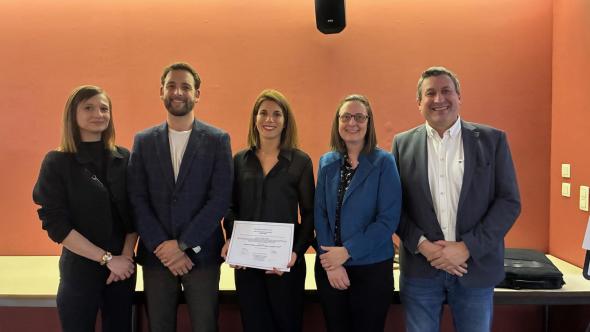
This award recognizes young Belgian scientists whose work makes a significant contribution to the advancement of medicine and the biomedical sciences. 

Above all, this designation represents recognition of our scientific, academic, and societal commitment to the field of health. Through our respective careers, we share a common desire to contribute, through research, teaching, and interdisciplinary dialogue, to a better understanding of public health issues and, more broadly, to improving the health of the population.

- Charlotte Beaudart and Jonathan Douxfils

“This designation is also important because it allows us to engage in a space for reflection that goes beyond the usual institutional frameworks,” adds Jonathan Douxfils.

 The College indeed offers a valuable opportunity to collaborate with researchers from other universities, other disciplines, and other generations of scientists. 

“In a context where medical, scientific, and societal challenges are becoming increasingly complex, this cross-disciplinary and transgenerational approach seems essential to us for fostering collective intelligence, serving the Academy, the scientific community, and society,” he continues. 

Within this College, Charlotte Beaudart and Jonathan Douxfils will contribute their expertise in their respective fields (clinical pharmacology and toxicology, as well as aging), fostering a culture of collegiality, knowledge sharing, and collaboration. 

“Our ambition is to help develop initiatives that bridge the gaps between basic research, clinical research, public health, and innovation, while fostering a scientific culture grounded in rigor, openness, cooperation, and service to the common good,” they conclude. 

Charlotte Beaudart

The recipient of several prestigious awards, Charlotte Beaudart is an associate professor of clinical research at UNamur, a member of the NARILIS Institute, and a senior advisor to the WHO Collaborating Center for the Epidemiology of Musculoskeletal Health and Aging.

She has just received the René de Cooman Prize (March 2026), an award presented every two years by the Belgian Society of Gerontology and Geriatrics (SBGG) that recognizes major scientific contributions by young Belgian researchers in the medical and biomedical fields.

Charlotte Beaudart

The European Society for Clinical and Economic Aspects of Osteoporosis, Osteoarthritis, and Musculoskeletal Diseases (ESCEO) and the International Osteoporosis Foundation (IOF) have also recently awarded him the 2026 ESCEO-IOF Pierre Meunier Prize (https://www.osteoporosis.foundation/news/charlotte-beaudart-receives-prestigious-esceo-iof-pierre-meunier-young-scientist-award) for the young scientist. This prestigious annual award was presented in April 2026 during the WCO-IOF-ESCEO Congress in Prague. 

Charlotte Beaudart’s work focuses on aging and, more specifically, on sarcopenia, a condition characterized by the loss of muscle mass and function in older adults. Through her research, Charlotte Beaudart has made a significant contribution to a better understanding of this condition, notably through the development of the SarcoPhAge cohort (for Sarcopenia and Physical Impairments with advancing Age), a Belgian cohort comprising more than 500 individuals over the age of 65 who were prospectively followed for 10 years, and the creation of the SarQoL questionnaire, now used internationally to assess the quality of life of patients with sarcopenia.

Jonathan Douxfils

Specializing in clinical pharmacology and toxicology, Jonathan Douxfils conducts internationally recognized research in the fields of hemostasis, thrombosis, the development of new diagnostic tools, and pharmacovigilance.  He is Director of the Clinical Pharmacology and Toxicology Research Unit (URPC - https://www.unamur.be/fr/medecine/recherche/urpc) at the UNamur School of Medicine and a member of the NARILIS Research Institute.

Jonathan Douxfils, Faculté de médecine

Since 2023, he has headed a research unit in clinical pharmacology and toxicology, comprising seven faculty members and about ten doctoral students. Professor Douxfils collaborates with numerous researchers in the industrial, hospital, and academic sectors to develop precise and sensitive biomarkers in hemostasis, serology, oncology, and, more recently, neurology. He has secured significant funding for his research in thrombosis, hemostasis, infectious diseases, oncology, and gene therapies. His multidisciplinary approach and expertise in blood biomarkers enable him to work on interconnected projects. He has also served as a pharmacovigilance expert at the European Medicines Agency as an evaluator, co-chairs the SSC Control of Anticoagulation at the International Society on Thrombosis and Haemostasis (ISTH), and is a member of the Haemostasis Diagnostics expert team at ECAT as well as the Belgian Society of Thrombosis and Hemostasis (BSTH). He coordinates the recommendations of the International Council for Standardization in Hematology (ICSH) on the measurement of direct oral anticoagulants and is an associate editor for several scientific journals.

Learn more about the College of Young Researchers

At the initiative of its Permanent Secretary, Georges Casimir, the Academy sought to establish a College of Young Researchers with which it collaborates in a structured and regular manner. It serves as an advisory and forward-looking body for the Academy.
Its mission is:

  1. to attract and engage young researchers in the scientific and academic life of the ARMB;
  2. to foster reflection on current and future challenges in basic, translational, and clinical (bio)medical research;
  3. to serve as a crucible of ideas and proposals for the ARMB’s Executive Board, Sections, and Committees;
  4. to organize, in collaboration with the Academy, at least one annual scientific session dedicated to young researchers.

The College consists of 36 full members, with six members per ARMB Section; the Executive Board may propose up to four additional full members to bring the total to 40. Members must be under 46 years of age as of December 31 of the year of their appointment and must have held a master’s degree for at least 11 years.

The NARILIS Research Institute

NARILIS seeks to foster two-way interactions between basic researchers and clinicians, and to build bridges between the laboratory and the patient’s bedside. NARILIS therefore aims to facilitate the translation of basic research findings into clinical applications. Its mission is to promote multidisciplinary research in order to improve human and animal health and quality of life.

Logo de l'institut de recherche NARILIS