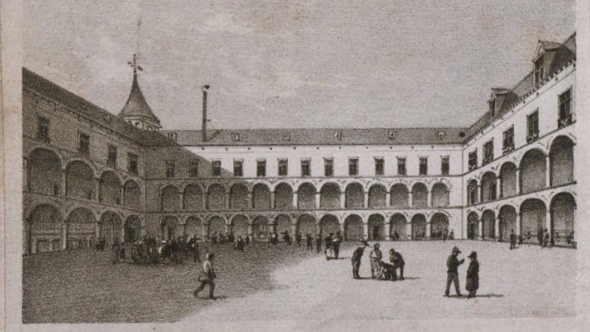
This was a hope cherished by the Jesuit fathers of Namur since 1832: to welcome the Belgian royal couple to their establishment, the Collège Notre-Dame de la Paix, which later became the Facultés and then the University of Namur. The priests were fervent patriots and admirers of King Leopold I, who ascended the throne while they were founding, with the help of a few patrons, a new institution in the educational landscape of the fledgling Belgium.

Léopold Ier (1790-1865), premier roi des Belges.
Leopold I (1790–1865), first king of the Belgians.

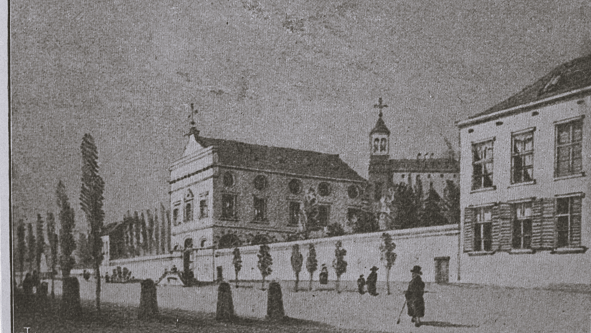
Although Protestant, the sovereign was supportive of the Jesuits' efforts. So, whenever the sovereigns visited Namur, teachers and students pulled out all the stops: "a magnificent throne at court, patriotic inscriptions, flags and banners, heartfelt speeches, odes inspired by German, English, and even Greek muses. Everything was ready," according to the college chronicle. Unfortunately, in 1832 and again in 1836, King Leopold I left Namur without having time to stop at the vast building located between Rue de Bruxelles and Place du Palais de Justice.

Vue du collège depuis la place du Palais de Justice, vers 1840-1845.

View of the college from the Place du Palais de Justice, circa 1840–1845.

In the summer of 1843, the long-awaited moment finally arrived. The town, like the railway, was booming: the sovereigns returned to the Meuse town to inaugurate the new railway line connecting it to Manage in Hainaut. Teachers, students, workers, everyone pitched in to decorate the reception hall of the Notre-Dame de la Paix college: "We are striving to give our already beautiful college a new splendor. Inscriptions, emblems, congratulatory quatrains in all languages; all the art of poetry and painting is being put to use. [...] A platform had been built at the corner of the Place du Palais de Justice, next to our classrooms, where our students were placed more comfortably to enjoy the spectacle and make the sounds of their fanfares resound more loudly in the distance as the King passed by. It was July 29 at three o'clock, and joyful cannon salutes rang out from the citadel. This was the announcement of the King's arrival. No sooner had he appeared before the students than there was a veritable outburst of jubilation: "Long live the King! Long live the Queen!" repeated a thousand times [...]". 

The enthusiasm of the young people caught the attention of Leopold I and his wife, Marie-Louise, who decided to honor the college with their presence the following day at noon. On the big day, Rector Louis Boetman welcomed the monarchs with these words: "It was under the auspices of Your Majesties that the Collège N. D. de la Paix was inaugurated, at this happy time when Belgium obtained both freedom and a King to defend it. Since then, I dare say, Sire, this establishment has had the ambition to serve its Prince and its country well: it was a sacred duty for it."

Louis Boetman (1806-1900), recteur de 1839 à 1845.
Louis Boetman (1806–1900), rector from 1839 to 1845.

The king and queen then listened to speeches by students demonstrating their progress in language studies: Célestin in French, Anatole in German (the sovereign's mother tongue), and Léopold in English. The king congratulated them on their excellent pronunciation and then addressed the assembly with a few warm words. "I am delighted to be here with you. I know that you are pursuing your studies in a good and wise direction. Work hard [...]," he encourages the students, before mentioning their new small country, whose creation and neutrality were intended to guarantee European balance: "[...] a bright future lies ahead for Belgium. Belgium has such a beautiful and fortunate position in Europe! It is up to Belgium alone to preserve it and make it even more advantageous. By sticking to its principles, it will be respectable and respected [...]". Leopold I and Marie-Louise then walked among the rows of students who crowded around them and explored the different parts of the college with interest, before leaving the assembly after a final farewell. The next day, everyone could read the report of this memorable visit in the columns of L'Ami de l'Ordre, the predecessor of the newspaper L'Avenir. The journalist echoed the "wave of interest and curiosity" that it had aroused in the streets of the Meuse city and the "indescribable enthusiasm" felt by the students on this occasion.

Later in its history, UNamur was honored with further royal visits from the descendants of Leopold I and Marie-Louise. The university's photographic archives thus preserve the memory of Albert I's visit in 1931 to inaugurate the university's first scientific library, followed by King Baudouin's visits in 1973 and 1981 for the opening of the Institute of Computer Science and the Arsenal, which had been converted into a university restaurant. King Albert II and Queen Paola will take part in the university's 175th anniversary celebrations in 2007. Finally, Queen Mathilde will visit the Namur campus in March 2021 to visit the Solidarithèque de Namur. This solidarity grocery store helps higher education students facing financial difficulties by providing them with affordable food baskets. 

Namur in 1843

During the visit of the Belgian sovereigns, Namur was undergoing major changes. The city was adapting to the technological innovations of the 19th century and new needs by developing infrastructure that gradually transformed the urban landscape. The 1840s were marked in particular by the appearance of gas installations in many private homes and the creation of a second bridge over the Sambre (1841). The inauguration of a railway station and the first railway line (1843), soon followed by others, made it much easier to travel to the city. Cultural and scholarly life also flourished with the creation of an Academy of Painting (1835) and the Archaeological Society of Namur (1845). It also saw the emergence of regional press outlets such as L'Ami de l'Ordre (1839). The early years of the Notre-Dame de la Paix college were therefore part of the intense development of the city on the Meuse at that time.

This article is taken from the "The Day When" section of Omalius magazine #39 (December 2025).


Cover Omalius décembre 2025